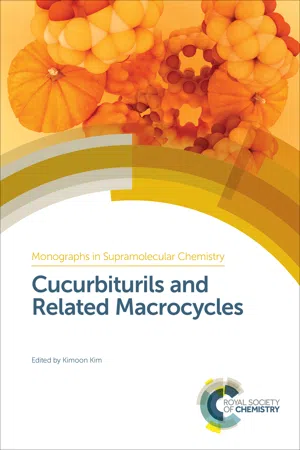
Cucurbiturils (CBs) are a young family of molecular containers, able to form stable complexes with various guests, including drug molecules, amino acids and peptides, saccharides, dyes, hydrocarbons, perfluorinated hydrocarbons, and proteins. Since the discovery of the first CB, the field has seen tremendous growth with respect to the synthesis of new homologues and derivatives, the discovery of record binding affinities of guest molecules in their hydrophobic cavity, and associated applications ranging from sensing to drug delivery. Cucurbiturils and Related Macrocycles provides a complete overview of CB chemistry, covering the fundamental aspects including its history, synthesis, host–guest chemistry and the thermodynamic basis thereof. The book will tackle specialist topics such as redox chemistry of CB complexes and CBs in the gas phase, and will address the recent trends of the application of CBs in other fields including biology and materials. Edited by a pioneer of cucurbituril chemistry, and with contributions from global experts, this title will appeal to students and researchers working in supramolecular chemistry, materials chemistry, nanotechnology, organic chemistry, biochemistry and chemical biology.
- 554 pages
- English
- ePUB (mobile friendly)
- Available on iOS & Android
eBook - ePub
Cucurbiturils and Related Macrocycles
About this book
Information
CHAPTER 1
Introduction: History and Development
a Institute for Basic Science (IBS), Center for Self-assembly and Complexity (CSC), 77 Cheongam-ro, 37673 Pohang Republic of Korea
b Pohang University of Science and Technology (POSTECH), Department of Chemistry, 77 Cheongam-ro, 37673 Pohang Republic of Korea
Email: [email protected]
Email: [email protected]
1.1 Introduction
Supramolecular chemistry, an emerging field of chemistry, focuses on the study of non-covalent interactions such as hydrogen bonding, π–π stacking, and hydrophobic, electrostatic, and van der Waals interactions that modulate molecular recognition and self-assembly. The significance of supramolecular chemistry has been recognized by two Nobel prizes: Cram, Lehn and Pedersen in 1987;1,2 Sauvage, Stoddart and Feringa in 2016.3–5 At the core of supramolecular chemistry is the fine control and understanding of such non-covalent interactions. One sub-category of supramolecular chemistry is the formation of host–guest complexes through molecular recognition between a molecular receptor (the host) and a ligand (guest). Commonly known host molecules include crown ethers, cyclodextrins, and calixarenes; the guest molecules encapsulated by the aforementioned hosts are determined by the structures and physicochemical properties of the corresponding hosts. More recently, cucurbiturils are another family of macrocyclic host molecules that have gained attention as prominent host molecules (Figure 1.1).

Figure 1.1 The chemical structure of cucurbit[6]uril and its resemblance to a pumpkin.
1.2 History of Cucurbiturils
Cucurbiturils are a family of macrocyclic host molecules that have more recently risen to prominence. They are easily accessible macrocycles that display remarakble recognition properties. In 1905, the first synthesis of cucurbituril was reported by the German chemist Behrend. Although no structural determination was demonstrated at the time, we now know it was cucurbit[6]uril.6 The report described the acidic condensation of glycoluril with formaldehyde to afford an insoluble polymeric material, also known as Behrend's polymer. Behrend suggested that this material contained “at least three molecules of glycoluril” condensed with twice as many equivalents of formaldehyde, based on elemental analysis. From this analysis he proposed (we now know incorrectly) the formula C18H18N12O6.6,7 He indicated that this molecule was exceptionally stable, even in the presence of oxidative reagents such as KMnO4. Investigations on its properties revealed that it could form co-crystals with KMnO4, AgNO3, methylene blue and Congo red.
Almost 80 years later, in 1981, Mock and Freeman revisited the original synthesis to further investigate such intriguing properties of cucurbituril with modern structural characterization techniques such as X-ray crystallography and NMR.8 These methods revealed that the structure is a highly symmetric, macrocyclic molecule consisting of a hexameric glycoluril unit with a hydrophilic rim on each side comprised of ureido carbonyls and a hydrophobic interior. Mock named this molecule “cucurbituril” due to its structural resemblance to a pumpkin, a member of the cucurbitaceae family (Figure 1.1). At the time, the hexameric glycoluril-based macrocycle “cucurbituril” was reported as the sole product. However, it turns out that “cucurbituril” was a member of the cucurbit[n]uril family, which consists of macrocycles with varying numbers of n glycoluril units (the “cucurbituril” reported by Mock corresponds to cucurbit[6]uril). Cucurbit[n]uril is often abbreviated as CB[n], CBn, or Q[n], where n is the number of glycoluril units in the macrocycle. For the purpose of consistency, this book will use the CB[n] abbreviation.
Mock also explored the host–guest chemistry of CB[6] to determine what features of guests are important for binding using NMR spectroscopy by systematically examining various substrates.9 In these studies, Mock discovered that numerous alkyl(di)-ammonium species formed strong 1 : 1 inclusion complexes with CB[6] in aqueous formic acid solution, due to the poor solubility of CB[6] in common solvents. Compared to other non-natural synthetic hosts such as cyclodextrins, calixarenes, and crown ethers, CB[6] displayed high binding affinity and specificity. He also measured the kinetics of the binding of host–guest complexes and revealed that CB[6] exhibits slow association rates and even slower dissociation rates. This is attributed to the barrel-like structure and the portals acting as a barrier to guest entry and exit. He was also interested in using CB[6] as an enzyme mimic by utilizing the confined environment of the CB[6] cavity to promote chemical reactions. He demonstrated this using amine-functionalized substrates for the azide–alkyne click reaction,10,11 so that they would bind to the portal of CB[6] and the subsequent triazole formation could occur inside the CB[6] cavity. Despite the accelerated rate of reaction, the resulting triazole could not be dissociated from the CB[6] cavity and thus this process did not display the turnover desirable for truly catalytic reactions.
Another application of CB[6] that Mock first developed was a CB-based switchable pseudorotaxane.12 CB[6] shuttling down an oligoamine chain from the aromatic position to in-between the aliphatic positions was realized by taking advantage of the difference in pKa between aromatic and aliphatic amines. It is noteworthy that this switchable pseudorotaxane was reported before the well-recognized molecular shuttle13 and switch14 by Stoddart. In the 1990s, significant contributions to CB[6] chemistry were achieved by Buschmann and others while exploring its dye complexation behaviour,15,16 its binding to cations,17 and the calorimetric determination of binding constants for amino acids and amino alcohols.18 At this point, the host–guest chemistry of CB[6] was studied only under strongly acidic conditions due to the poor solubility of CB[6] in common solvents. Kim and co-workers reported the first investigation of the CB[6] host–guest chemistry in neutral aqueous media19 which in turn allowed for expanding its host–guest chemistry and also built supramolecular assemblies using CB[6], including mechanically interlocked molecules such as 1-, 2-, and 3-dimensional (1D, 2D, and 3D) polyrotaxanes20 and “molecular necklaces”.21
Although the aforementioned reports demonstrated some of the potential of CBs, they were still not as recognized in the field of host–guest chemistry. Cyclodextrins (CD) and calixarenes were still regarded as the desirable molecular containers in part because they come in a range of sizes (CD: six to eight sugar moieties, calixarenes: four and six phenolic moieties) whereas CB[6] was the only homologue known pre-2000, so CDs and calixarenes had a greater range of host–guest chemistry. The water-soluble nature of CDs also rendered them more desirable to work with and useful for practical applications, in contrast to CB[6], which is practically insoluble in water. These are the challenges that CBs needed to overcome if they were to compete with and substitute the CDs.
1.3 Growth and Development
Breakthroughs in several areas have fuelled the growth and development of CB chemistry. The synthesis, isolation, and characterization of other family members (n=5, 7, and 8) by Kim and coworkers22 addressed the aforementioned downside of CBs not offering a variety of cavity size. CB[6] is the major product of the acid-catalyzed formaldehyde-glycoluril reaction; however, careful control of the reaction temperature allows access to differently sized CBs (CB[n], (n=5, 7, and 8)). Independently, Day and co-workers synthesised and isolated these CB homologues along with CB[5]@CB[10].23 The increased dimensions of the expanded family members enrich and diversify the host–guest chemistry of CBs. CB[7] is appreciably more soluble in water than CB[6], which has helped in applying CB[n] chemistry towards biological applications in aqueous conditions. Other guests of CB[7] include redox sensitive molecules such as ferrocene24 and methyl viologen,25,26 which allows external control of the complexes’ stability;27 and fluorescent dye molecules, which enable the development of sensors and assays.28 The large cavity of CB[8] allows for the formation of homo-22 and hetero-ternary complexes,29 which has been transformative in the field of supramolecular chemistry; the resulting stable ternary complexes can be applied to the formation of supramolecular architectures such as supramolecular polymers,30 block copolymers31 and nanostrucutres.32 CB[8] can also serve as a reaction container for various reactions. Further details on the host–guest chemistry of CBs are introduced in Chapter 3.
When protonated guests become included by macrocyclic hosts, the pKa value of the guests becomes shifted.33 To which direction the pKa shifts is relevant to the characteristics of the host molecule, resulting from the change in preference for the binding of the protonated form compared with its conjugate base. Interestingly, protonated cationic guests that bind to CB[n] have shown an increase in the pKa value owing to the higher binding constant of cationic species over the non-protonated conjugate bases.33 This phenomenon is a trait that differentiates CB[n]s over CDs, whereas CDs prefer binding with neutral and anionic guests resulting in a decrease in the pKa value. Such a pKa shifting nature of CB[n]s has found applications in molecular switches, sensors, assays, and drug delivery systems.34 Further details on such applications of CB[n]s are described in Chapters 6, 10 and 11.
In addition to the CB[n] homologues, several achievements have been accomplished in preparing and studying the respective host–guest interactions of derivatives, analogues, and congeners of the CB[n] family. These include acyclic oligomers of glycoluril, substituted CB[n] molecules (replacement of CH protons with alkyl and aryl groups), inverted cucurbit[n]urils (iCB[6] and iCB[7]), and the chiral bis-nor-seco-CB[6] and bis-nor-seco-CB[10] species.35 The host–guest chemistry of hemicucurbiturils, which are macrocycles composed of ethyleneurea repeating units linked by one row of methylene bridges (thus the nomenclature derived from being “half” of CBs) have been investigated as well. Detailed discussions on the analogues and derivatives are found in Chapters 19 and 20.
The high affinity of CB[n] complexes makes them incredibly robust such that they stand out from other synthetic receptors. As previously mentioned, various guest molecules that bind to CB[6] have been explored. Over the years, increasingly high affinity guests (for CB[7] in particular)36–38 have been introduced resulting in a 1017 M−1 affinity binder for CB[7].39 Studies have demonstrated that the high binding affinity of CBs can be attributed to multiple non-covalent interactions, a non-classical hydrophobic effect arising from the release of high-energy water from the cavity of CBs. In addition, gas phase investigations of CB[n] allowed for better understanding of absolute and relative bond strengths between the host and guest molecules in the absence of solvent. Further...
Table of contents
- Cover
- Title
- Preface
- Contents
- Chapter 1 Introduction: History and Development
- Chapter 2 Synthesis of the Cucurbituril Family
- Chapter 3 Host–Guest Chemistry of the Cucurbituril Family
- Chapter 4 Cucurbituril Properties and the Thermodynamic Basis of Host–Guest Binding
- Chapter 5 Cucurbiturils as Reaction Vessels
- Chapter 6 Cucurbituril-based Sensors and Assays
- Chapter 7 Cucurbituril Complexes of Redox Active Guests
- Chapter 8 Coordination Chemistry of Cucurbiturils
- Chapter 9 Gas Phase Cucurbituril Chemistry
- Chapter 10 Drug Delivery Vehicles Based on Glycoluril Oligomers
- Chapter 11 Machines, Switches and Delivery Devices Based on Cucurbit[6]uril and Bambus[6]uril
- Chapter 12 Cucurbit[n]uril-based (n=7 and 8) (Supra)molecular Switches
- Chapter 13 Functionalisation and Self-assembly of Nanoparticles through Cucurbit[n]uril-based Binding Motifs
- Chapter 14 Cucurbit[8]uril-based Polymeric Materials
- Chapter 15 Cucurbit[6]uril-based Polymer Nanocapsules and Thin Films
- Chapter 16 Cucurbiturils on Surfaces
- Chapter 17 Molecular Recognition of Proteins by Cucurbiturils
- Chapter 18 Supramolecular Latching System—Ultrastable and Controllable Synthetic Binding Pairs and Their Applications
- Chapter 19 Cucurbit[n]uril-type Receptors: Influence of Building Block Exchange, Deletion, and Augmentation
- Chapter 20 Hemicucurbiturils
- Subject Index
Trusted by 375,005 students
Access to over 1.5 million titles for a fair monthly price.
Study more efficiently using our study tools.
Frequently asked questions
Yes, you can cancel anytime from the Subscription tab in your account settings on the Perlego website. Your subscription will stay active until the end of your current billing period. Learn how to cancel your subscription
No, books cannot be downloaded as external files, such as PDFs, for use outside of Perlego. However, you can download books within the Perlego app for offline reading on mobile or tablet. Learn how to download books offline
We are an online textbook subscription service, where you can get access to an entire online library for less than the price of a single book per month. With over 1.5 million books across 990+ topics, we’ve got you covered! Learn about our mission
Look out for the read-aloud symbol on your next book to see if you can listen to it. The read-aloud tool reads text aloud for you, highlighting the text as it is being read. You can pause it, speed it up and slow it down. Learn more about Read Aloud
Yes! You can use the Perlego app on both iOS and Android devices to read anytime, anywhere — even offline. Perfect for commutes or when you’re on the go.
Please note we cannot support devices running on iOS 13 and Android 7 or earlier. Learn more about using the app
Please note we cannot support devices running on iOS 13 and Android 7 or earlier. Learn more about using the app
Yes, you can access Cucurbiturils and Related Macrocycles by Kimoon Kim, Jonathan Steed,Philip Gale in PDF and/or ePUB format, as well as other popular books in Physical Sciences & Organic Chemistry. We have over 1.5 million books available in our catalogue for you to explore.