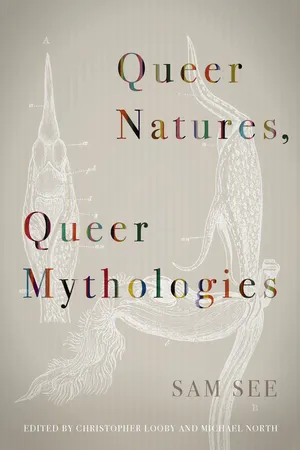
Queer Natures, Queer Mythologies collects in two parts the scholarly work—both published and unpublished—that Sam See had completed as of his death in 2013.
In Part I, in a thorough reading of Darwin, See argues that nature is constantly and aimlessly variable, and that nature itself might be considered queer. In Part II, See proposes that, understood as queer in this way, nature might be made the foundational myth for the building of queer communities.
With essays by Scott Herring, Heather Love, and Wendy Moffat.
eBook - ePub
Queer Natures, Queer Mythologies
- 336 pages
- English
- ePUB (mobile friendly)
- Available on iOS & Android
eBook - ePub
Queer Natures, Queer Mythologies
About this book
Information
Publisher
Fordham University PressYear
2020Print ISBN
9780823286997
9780823286980
eBook ISBN
9780823287000
PART I
Queer Natures
Charles Darwin, Queer Theorist
Doing It Naturally
And when night falls without apology
You can give me a lesson in biology.
For I so want to go when you do,
Back to nature with you.
—COLE PORTER, “Back to Nature with You”1
One of the most popular modernist lyricists, and often regarded as one of the queerest, Cole Porter was a naturalist. Yes, his songs are indisputably clever and urbane, but they are not for those qualities uninterested in the material objects and processes that constitute the natural world. Songs like the simple “Moon, Moon” (1913), the elaborate “The Sponge” (1922), the boisterous “Find Me a Primitive Man” (1929), and the wryly sentimental “Back to Nature with You” (1933), quoted in the epigraph, all demonstrate Porter’s career-long interest in writing about nature, especially in relation to sexuality. Nothing could seem less unusual for a writer in the lyric tradition than to use images of nature, of course, but Porter’s mention of “biology” in “Back to Nature” indicates that nature, for writers composing in the wake of late nineteenth-century evolutionary theory, is inextricably linked with the natural sciences. And what could seem more unlyrical than science?
Perhaps more than any other, Porter’s 1928 song “Let’s Do It” takes this question as its subject and reveals a critically neglected relationship among nature, literature, science, and sexuality in the modernist era. The lyrics’ description of nature’s injunctions to sexual humans also exemplifies why this relationship has been tempting to disregard in studies of modernist sexuality. The piece opens with its speaker claiming that, “when the little bluebird” sings, “when the little bluebell” rings, when even “the little blue clerk” croons to the moon, “It is nature, that’s all / Simply telling us to fall / In love.” After this opening verse, the song proceeds into five stanzas that catalog, in Whitmanic fashion, how nature’s injunction to “do it” explains “why” a host of different species “do it.” Those species include the human—which Porter taxonomizes by nationality—but homo sapiens gets short shrift in the song compared to non-human animals ranging from nightingales to jellyfish to dragonflies to hippopotami. These species span the range of what naturalist scientists at the time deemed higher and lower organisms: Owls do it, even though “they’re supposed to be wise”; “sentimental centipedes” and “the most refined lady bugs do it”; “giraffes, on the sly, do it”; “even pekineses in the Ritz, do it.”2
Juxtaposing creatures of the highest and lowest structural complexity, these five stanzas of thirteen lines each catalogue no less than forty species (a count that includes the referenced Boston beans but not each human nationality) whose example impels the speaker to request his/her addressee, “Let’s do it, let’s fall in love” in each stanza’s refrain. When preceded by “do it,” the phrase “fall in love” must be read at least in part as a euphemism for sex. Porter writes, after all, “Why ask if shad do it? / Waiter, bring me shad roe,” where the eggs serve as a symbol not of love but of sexual reproduction and therefore negate the question of whether shad “do it” genitally.3 Nonetheless, Porter’s linking of the two clauses with the pronoun “it” also suggests that he might be referencing not just sexual contact nor only chaste romantic feeling but some combination of sexual “doing it” and affective “love”: what one might call sexual feeling. Playing coyly with the possibility of seeming either sentimental or outrageously bawdy, “Let’s Do It” takes and engenders pleasure in its refusal to distinguish between genital sex and erotic feeling.4
If he is focused on sexual feeling, however, why does Porter fill his lyrics with so many examples of neither feelings nor sex but various species? Like Whitman often can, Porter sounds less like a lyricist here than a scientific naturalist: He documents evidence of sexual feeling in animals and relates that evidence to human behavior. Biologists have long made such associations to justify or condemn particular human sexual behaviors on scientific grounds: Bruce Bagemihl’s Biological Exuberance (1998) and Joan Roughgarden’s Evolution’s Rainbow (2004), for example, align same-sex behavior in animals with human homosexuality to provide scientific bases upon which to make moral judgments about non-normative sexual behavior.5 But why would sex ever need justification on behalf of nature, especially in the potentially insulting forms of sponges and centipedes? And why would Porter write that justification—if it is one—in a song? What aesthetic value, in other words, did Porter find in using scientific evidence of sexual feeling in both humans and animals?
Considering that special pleading for heterosexuality alone is unnecessary on the basis of “nature” and that recourse to lower life forms would constitute, at best, a tenuous defense of non-normative sexual behaviors, “Let’s Do It” seems to be after something much more ambiguous—something queerer—than a defense of any particular sexual identity or act.6 The ambiguity of the lyrics’ titular “it” refers, after all, to sexual feelings, not the genders of the bodies that possess them or the acts they commit.7 Even more like Charles Darwin than like Whitman, Porter uses scientific discourse here to suggest dispassionately that all sexual feeling has a place in nature, for nature itself creates sexual feeling. Rather than to justify sexual behavior on a moral basis, this song implies, the task of post-Darwinian literary art is actually quite scientific: to express nature’s call as objectively as possible. As a campy expression of that call, “Let’s Do It” certainly earns its place in the canon of queer literature, but it does so for more than its affiliation with Porter’s biography. “Let’s Do It” is a testament to modernist art’s queer natures, for it is an artifact of queer feeling and post-Darwinian nature at once.
Judging by his claims in the first volume of The History of Sexuality (1978), Michel Foucault would likely bristle not only at this interpretation but at the last three lines of the song’s first verse alone: “It is nature, that’s all, / Simply telling us to fall / In love.” These lines would appear to exemplify what Foucault calls the repressive hypothesis, for they enjoin a human addressee through language to embrace sexuality, to do it, including the doing it of simply listening to nature. Speaking of nature, Foucault might say, Porter is only speaking of speaking, not of nature itself, least of all not of the “bodies and pleasures” on which Foucault asks sexual historians to train their attention.8
While I will explore at greater length the difficulties that Foucault’s influential text poses for the literary historian of sexuality—modernist or not—it is worth noting that, throughout “Let’s Do It,” Porter focuses on symbols of the non-discursive and non-linguistic: that is, non-human animals. Exemplifying what Theodore Däubler’s A New Point of View (1919) identified as the widespread “return of man to animal as exemplified through art” during the modernist era, the animals in Porter’s song are so hyperbolically anthropomorphized that phrases like “educated fleas” expose rather than conceal (as many efforts at anthropomorphism do) their ascription of human attributes to animals.9 What nature is “simply telling us” in this song is actually not told at all: Sexual feeling is everywhere implied in the lyrics, but Porter’s coy techniques of indirection require that we interpret what “doing it” means. If Porter were making a discursive argument on behalf of sexological beliefs in the nature of sexuality, he would not need to use animals as symbols of sexual feeling, nor would he need to “do it” in literary art.10
Falling outside the purview of Foucault’s influential history of logical discourses, Porter’s work exemplifies an overlooked strain of modernist aesthetics that views nature itself as an aesthetic object, a source of aesthetic and sexual feeling, and literature not just as a representation of nature but as itself a part of nature. As a reflection and generator of the aesthetic and sexual feelings evident in the natural world, literature becomes for the modernists an artifact of nature itself: It is a repository of feeling as mutable and material as the natural world that Charles Darwin describes in his theory of evolution. That theory develops at the turn of the century into a strain of aesthetic theory called “evolutionary aesthetics” that consistently conflates sexual and aesthetic feeling. It thus entwines concepts that, since Immanuel Kant’s Critique of Judgment (1790), were long separated in Western aesthetic philosophy, and thereby offers modernist artists scientific grounds for creating historically experimental aesthetic forms and sexual themes.
As I will argue in the following pages, Charles Darwin is a queer theorist of the material world who conceptualizes nature as a non-normative, infinitely heterogeneous composite of mutating laws and principles. Contextualizing queer literature within a Darwinian framework presents opportunities to reassess contemporary literary histories of modernism that oppose modernist aesthetics and positivist science and theoretical orthodoxies about the conceptual dangers of nature.11 Such well-intentioned rejections of nature have pervaded poststructuralist critical theory, especially queer theory, which on the models of Foucault and Freud especially has repudiated nature as an ideological construction meant to oppress the unnatural (a constructed concept itself) or viewed sexuality’s location in nature within the immutable system of physical drives.12 While such scholarship—including American Literature’s March 1997 volume Unnatural Formations—has told us much about cultural ideology and the sexual identities propounded therein, it has told us little about the materiality of sexual feeling or the relevance of material forms to one of the most frequently plumbed archives of evidence for scholars of sexuality: literature.
In concert with Timothy Morton’s recent claim that “queer theory has a strange friend in nonessentialist biology” (275) because the latter shows how “queerness, in its variegated forms, is installed in biological substance as such and is not simply a blip in cultural history” (273–4), I examine in this essay how Darwin’s queer theory of nature, specifically his theories of sexual and aesthetic feeling, provide overlooked interpretive tools for scholars of both the sciences and humanities.13 Rather than to Foucault or Freud, I propose that queer theory—and critical theory more broadly—turn to Darwin for a theoretical model with which to interpret the complexity of biological feeling, whether sexual, aesthetic, or otherwise. Darwin’s model offers particularly relevant interpretive tools f...
Table of contents
- Cover
- Half Title
- Title Page
- Copyright
- Contents
- Half Title
- Introduction
- Part I: Queer Natures
- Part II: Queer Mythologies
- Essays
- Acknowledgments
- List of Contributors
- Index
- About the Author and Editors
Trusted by 375,005 students
Access to over 1.5 million titles for a fair monthly price.
Study more efficiently using our study tools.
Frequently asked questions
Yes, you can cancel anytime from the Subscription tab in your account settings on the Perlego website. Your subscription will stay active until the end of your current billing period. Learn how to cancel your subscription
No, books cannot be downloaded as external files, such as PDFs, for use outside of Perlego. However, you can download books within the Perlego app for offline reading on mobile or tablet. Learn how to download books offline
Perlego offers two plans: Essential and Complete
- Essential is ideal for learners and professionals who enjoy exploring a wide range of subjects. Access the Essential Library with 800,000+ trusted titles and best-sellers across business, personal growth, and the humanities. Includes unlimited reading time and Standard Read Aloud voice.
- Complete: Perfect for advanced learners and researchers needing full, unrestricted access. Unlock 1.5M+ books across hundreds of subjects, including academic and specialized titles. The Complete Plan also includes advanced features like Premium Read Aloud and Research Assistant.
We are an online textbook subscription service, where you can get access to an entire online library for less than the price of a single book per month. With over 1.5 million books across 990+ topics, we’ve got you covered! Learn about our mission
Look out for the read-aloud symbol on your next book to see if you can listen to it. The read-aloud tool reads text aloud for you, highlighting the text as it is being read. You can pause it, speed it up and slow it down. Learn more about Read Aloud
Yes! You can use the Perlego app on both iOS and Android devices to read anytime, anywhere — even offline. Perfect for commutes or when you’re on the go.
Please note we cannot support devices running on iOS 13 and Android 7 or earlier. Learn more about using the app
Please note we cannot support devices running on iOS 13 and Android 7 or earlier. Learn more about using the app
Yes, you can access Queer Natures, Queer Mythologies by Sam See, Christopher Looby,Michael North, Christopher Looby, Michael North in PDF and/or ePUB format, as well as other popular books in Letteratura & Teoria della critica letteraria. We have over 1.5 million books available in our catalogue for you to explore.