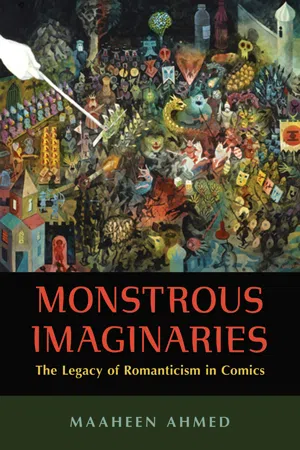
Monsters seem inevitably linked to humans and not always as mere opposites. Maaheen Ahmed examines good monsters in comics to show how Romantic themes from the eighteenth and the nineteenth centuries persist in today's popular culture. Comics monsters, questioning the distinction between human and monster, self and other, are valuable conduits of Romantic inclinations. Engaging with Romanticism and the many monsters created by Romantic writers and artists such as Mary Shelley, Victor Hugo, and Goya, Ahmed maps the heritage, functions, and effects of monsters in contemporary comics and graphic novels. She highlights the persistence of recurrent Romantic features through monstrous protagonists in English- and French-language comics and draws out their implications. Aspects covered include the dark Romantic predilection for ruins and the sordid, the solitary protagonist and his quest, nostalgia, the prominence of the spectacle as well as excessive emotions, and above all, the monster's ambiguity and rebelliousness. Ahmed highlights each Romantic theme through close readings of well-known but often overlooked comics, including Enki Bilal's Monstre tetralogy, Jim O'Barr's The Crow, and Emil Ferris's My Favorite Thing Is Monsters, as well as the iconic comics series Alan Moore's Swamp Thing and Mike Mignola's Hellboy. In blurring the otherness of the monster, these protagonists retain the exaggeration and uncontrollability of all monsters while incorporating Romantic characteristics.
- 264 pages
- English
- ePUB (mobile friendly)
- Available on iOS & Android
eBook - ePub
About this book
Information
CHAPTER 1
ROMANTIC MONSTERS
A Brief History
Aux objets répugnants nous trouvons des appas […]
(By repugnant objects we are lured …)
—CHARLES BAUDELAIRE1
Monsters and Entertainment
Through the centuries, the monster has established itself as an essential entity of popular culture. Exploring the eighteenth-century case of Mary Toft, who allegedly gave birth to rabbits, Dennis Todd points out that monsters were a guaranteed way of making money because of the English public’s fascination with them.2 He also cites Trinculo’s first encounter with Caliban from Shakespeare’s The Tempest to underscore the link between monsters and the money-making spectacle they automatically engendered:
A strange fish! Were I in England now (as once I was) and had but this fish painted, not a holiday fool there but would give a piece of silver. There would this monster make a man; any strange beast there makes a man. (act 2, scene 2)3
The monster eventually became the center of the popular spectacle, epitomized by the freak shows that reached their zenith in the nineteenth century.4 By staging natural oddities, freak shows unsettled the boundaries between real life and fantasy. In addition, evolution theory raised the specter of the missing link, which encouraged the creation of anthropomorphic monsters that visualized the transition from apes to humans.5
Remnants of the characteristics informing the success of freak shows—combining the spectacle with the spectral—remain discernible in the many movies with monsters, which reflect the same aura of fascination that the freak shows sought to foster. This in turn could have played a role in showing monsters in a positive light, since the threat was tamed and contained within a spectacle that “captured the hearts of audiences,” as Stephen Asma puts it when describing the popularity of freak shows.6 The spectrality of monsters stems from their suggestiveness and shying away from absolute truths. By being so different, encapsulating wonder, much like faraway cultures were once a source of wonder and speculation, they also represent alternative ways of living. Tied to the body and yet striving to go beyond the assumptions that accompany its abnormal form, the heroic monster blends horror and fascination. Its spectrality is therefore also an outcome of the many fears regarding the human body’s imperfection, as mocked in the conclusion of Alexander Pope’s “The First Epistle of the First Book of Horace,” in which the reasoning man (Pope himself), “that reas’ning, high, immortal Thing, / Just less than Jove, and much above a King” finds himself “half in Heav’n—except (what’s mighty odd) / A Fit of Vapours clouds this Demi-god.”7 Here Pope, unsurprisingly, suggests that the body, while housing the mind, also anchors it; that both mind and body are linked and uncomfortably fluid. As we will see in chapter 3, ennui captures such fluidity of categories and the anxieties associated with it and modern existence at large.
According to Michel Foucault, “the monster provides an account, as though in caricature, of the genesis of differences.”8 It is, in other words, a necessary corollary of modern thought, of the conceptualization of evolution and progression, the schema of which is mirrored by the sequential form of comics. Foucault’s observation also highlights the role played by the visual aspect of monsters and the wild forms they adopt, which in turn is corroborated by Cartesian logic, according to which imagining is linked to succumbing to corporeal, material desires since “a mind abandoned to the imagination is a mind abandoned to the body.”9 In such cases, ideas are “reduced” to corporeal, visible forms and are often propelled by the baser power of desire (as opposed to the higher powers of intellect and reasoning)—aspects that also play a role in comics, through the predominance of action and slapstick humor, for instance, and have contributed toward its status as a popular, low art. The monster likewise embodies this notion of the imagination allowed to mutate beyond control and consequently inherits the disparagement and distrust attached to the imagination.10
However, as scholars working on the imaginary, especially Gilbert Durand, have suggested, the imagination comprises elementary structures and motifs that mold human thought.11 The recurrence of monsters in romantic art and literature is therefore not an insignificant case of letting the imagination run wild. It exemplifies the ways in which monsters—and by extension the possible subversion of norms—were conceptualized. Notably, some of the most famous romantic monsters—the monstrous humans populating Goya’s prints and Black Paintings or Victor Hugo’s Quasimodo, to name a few—are usually more anthropomorphic than bestial in appearance. This aspect acquires a certain piquancy when one notes that the notion of the abnormal itself was engendered and solidified in the nineteenth century, in the drive toward modernization and its penchant for classifications.12 Concurrently, however, an aesthetics of the “Horrid and the Terrible” was developed, most notably in Edgar Allan Poe’s writings, the darkness of which Baudelaire admired and emulated.13
In his treatise An Historical Sketch on the Art of Caricaturing (1813), the engraver James Peller Malcolm saw caricature as existing naturally in humans and beasts, in the sense that any form that simultaneously alluded to and distorted the norm became a caricature. Malcolm also saw caricature as an outcome of unskilled attempts to imitate nature, for “[he] that draws the human face divine for the first time is a caricaturist per force: he views the lines of the original, and, attempting to imitate them, produces a monster; and it is only by patience and perseverance he conquers his propensity to distortion.”14 Grotesques and caricatures were thus attributed to so-called primitive minds: the savage “seems to lose all recollection that he had ever viewed the human species, and creates monsters from his own disordered imagination.”15 Although for Malcolm the grotesque creatures of the Saxons exemplified lack of good taste,16 Malcolm’s contemporaries Goya (1746–1828), Blake (1757–1827), and Henry Fuseli (1741–1825) gave their imagination free rein, in protest, at least in part, against the repercussions of civilization and the deceptive notion of rationality. Of the three, it was Goya who fully embraced the sociopolitical horrors of his context in order to allow “the overwhelming to overwhelm.”17 As opposed to the smoother, clearer lines of his contemporaries, Goya’s lines “scratch forms into existence and […] splinter them […] to create the distorting visual detritus that shudders around the edges of things seen in agonized haste or in semi-conscious distraction, in fear or self-disgust.”18 Art historian and comics scholar Scott Bukatman emphasizes the close link between Goya’s art and comics cemented through the artist’s imaginative expressionism: “The Romantic sensibility of Francisco Goya bubbles up within the mass medium of the comics, a medium that, as we’ve seen, exceeds the rationalism of linear, phonetic language and allows the imagination access to other worlds, to other modes of reading and of reading the world.”19 Hillary Chute points out that Goya’s monstrous visualizations of history have had a deep impact on famous underground artists such as Robert Crumb and Art Spiegelman.20 The influence of Goya, however, goes far beyond underground comics, not the least perhaps because Goya himself alternated between painting and etching, and his influences ranged from Blake to William Hogarth and also included contemporary caricaturists such as James Gillray and Thomas Rowlandson:21 jagged lines and overflowing outlines are also characteristic of Enki Bilal. Although Bilal does not shy away from the sordid, he does adopt a more aesthetic style for his Monstre comics. The harshness of Goya’s lines and chiaroscuro effects also persist in Jim O’Barr’s drawing style for The Crow. Heavy dramatization and a penchant for the grotesque and the horrific permeate the worlds of both Hellboy and Swamp Thing. The art in Swamp Thing is closer to the art of horror comics, especially those drawn by Bernie Wrightson, who visualized the first Swamp Thing and, years later, in 1983, also published an illustrated version of Mary Shelley’s Frankenstein. The art in Hellboy, on the other hand, wears a distinctive nostalgic veil that pays homage to horror and the grotesque. Mike Mignola’s art for the series stands out through an aesthetic based on flattened, contrast-rich forms.
Referring to the emergence of prints in the fifteenth century, Anne Hollander asserts that “the black-and-white media have had a special power to move the world ever since. By harnessing the elements of light and shade, and by making pictures not only repeatable but movable and adaptable, they have shown what is essential for getting images to do their deepest emotional work.”22 From the comics discussed in this book, the theatricality of black-and-white images is most evident in The Crow. However, chiaroscuro is also regularly employed in the other comics, especially in Swamp Thing and Hellboy through their incorporation of relatively traditional, “flatter” coloring techniques in contrast to the use of direct color in Monstre. For Bukatman, the distinctive flatness and abstraction of Mignola’s art for Hellboy acquires sculptural dimensions and thus enhances layers of both meaning and presence.23
David Kunzle attributes the emergence of caricature to the freer technique of etching—in contrast to the more stringent line of engraving—which was developed around the sixteenth century, popularized through the invention of printing and then fine tuned by artists like Jacques Callot (1592–1635).24 Hollander (in turn resorting to Kunzle) links the further development of caricature to popular picture-stories in the mid-eighteenth century and their increased concentration on psychological aspects through the influence of contemporaneous physiognomic studies.25
In tracing the history of caricature, Malcolm highlights the close, interlinked relationship between monsters and caricature as well as the monstrosity of caricature and uses illuminated manuscripts from the British Museum to illustrate “natural and intended caricature.”26 Natural caricature, as exemplified by religious manuscripts such as the Liber Psalmorum sec. tradit. S. Hieronimi, illustrates “the near relationship between caricatures and the drawings of genius.”27 This is not only because of the monstrous creatures present in the manuscript but also because of the disproportionate renditions and awkward postures attributed to Christ. These plates, like those of many older illuminated manuscripts, create a space that is relatively flat, almost merging with the figures. As elaborated below, a similar style imbues Blake’s work.
Besides medieval manuscripts, Malcolm also examines the post-Renaissance caricatures merging man and beast of Agostino Carracci (1557–1602) and Callot, both of whom used such hybrid forms for portraying outsider figures, including freaks and carnival characters. Carracci became known for perpetuating the comic effect of exaggeration by caricatura, or loading a portrait.28 Later satirical prints, in particular the engravings from 1643 that were attributed to John Vickars, used the biblical iconography of monsters to mock the pope.29 The moral caricature of William Hogarth (1697–1764), in which exaggerated forms are hidden from the cursory glance, remained more successful.30 For Hollander, Hogarth was “moving […] toward demonstrating the excruciating pleasures of strong feeling,” which contributed to his success.31 Such “excruciating pleasures of strong feeling” recur in the romantic monsters discussed below and persist in the comics monsters examined in the coming chapters. The forms that remained discrete in Hogarth’s prints take over many a comics world and before that, the world of nineteenth-century visual arts.
Romantic Visualizations of Monsters
According to the philosopher Gilles Barroux, the eighteenth century was a period of transition for hard sciences such as medicine that were still more in the process of searching for and questioning knowledge than affirming it.32 In this period of change, the monster often symbolized the ill body for scientists. Instead of being a subject that simultaneously evoked fascination and repulsion, the monster attained the status of the unviable or greatly suffering human.33 This notion is reflected in the romantic monsters discussed below: Quasimodo, Gwynplaine, and Frankenstein. It is also present in the artworks of artists such as Blake, Goya, and Fuseli, albeit usually from an inverted perspective: their monsters are products of the artists’ troubled imaginations. They point toward and protest against the prejudices of the contexts in which they are engendered, by giving, in stark opposition to the rationality favored by the Enlightenment, free reign to their imagination and full expression to their emotions.
For a long time, even after the Enlightenment, monstrous imaginings were considered strong enough to materialize as newborns when imagined by a pregnant woman (“Let the pregnant women beware!” is one of the cries heard when Quasimodo is chosen as the Pope of Fools).34 With the secularization established by the Enlightenment, it was the power of the human imagination that was seen as the source of abnormalities and aberrations instead of the increasingly less credible God or devil.35 The imagination was conceived as an image-making faculty, which also acted as a realm of fantasy, representing the liminal region beyond the knowable,36 a mediator between the mind and the body.37 It also led to a turn from seeing monsters as an inevitable part of nature toward relegating them to the realm of fantasy.
Visually, however, monsters have largely been based on the imagination rather than reality, even when their existence was believed to be real, as with the renditions of the inhabitants of faraway regions inspired by writings such as Pliny the Elder’s Natural History (from the first century AD). Supernatural demons, which were subjects of frequent, eagerly vivid portrayals, also contributed greatly to the visual repertoire of monsters. Being imaginative constructions, monsters combine a jumble of organic elements, and this awkward assemblage is their essence.38 The mixed essence of monsters is also described in Genesis, according to which all monsters are the offspring of Cain and are thus both hybrid and evil.39 Although usually composed of disparate components, several parts of the monster are indeed normal, while others may be exaggerations of those normal features. Physical deformities also played an important role in monstrous imaginaries. Comparable to the attraction wielded by freak shows, which showcased real-life deformities, monstrous images—be they visual or literary in essence—induced a fascination mixed with uneasiness. This uneasiness is in part linked to what Dennis Todd describes, in the context of the Mary Toft hoax, as the “levelling tendency of the imagination,” which transposes everything, including aspects such as sense perceptions that are not originally visual, into images.40
Hence, despite their inherent unreality, images of monsters are very real and have a powerful, significant presence. They incorporate certain fears, which can be generalized as the fear of the impossible and the unknown. That the unknown had a certain tantalizing pull that was felt more strongly than before is evident in the changes distinguishing the romantic age, many of which are concretized by Edmund Burke’s philosophy. Burke described a sublime based upon the sensation of pain, “productive of the strongest emotion the mind is capable of feeling,” and opposed it to the pleasure of beauty.41 Yet, like the “positive pain” of solitude,42 the pain of the sublime was life affirming. Such emphasis on the positive aspects of conditions usually perceived as negative persists in the ambiguous monsters as well as the good ones discussed in the coming chapters, including Warhole (an example of the former), the Swamp Thing, and Hellboy (examples of the latter). In Goya’s works, however, there is little that is redeeming in the ambiguity between people and monsters.
Goya’s Narratives of the Body
Both Goya and Blake adopted print making as their preferred means of expression in lieu of traditional painting. Being easily transportable and reproducible, and...
Table of contents
- Cover
- Title Page
- Copyright
- Contents
- Acknowledgments
- Introduction: Charting Monstrous Territory
- Chapter One: Romantic Monsters: A Brief History
- Chapter Two: Swamp Thing: Patchworks and Panoramas in Monster Comics
- Chapter Three: Monstre: Monstrous Fluidity
- Chapter Four: Hellboy: Nostalgia and the Doomed Quest
- Chapter Five: The Crow: Spectacularity and Emotionality
- Conclusion: Comics Monsters: Per Monstra ad Astra
- Notes
- Bibliography
- About the Author
Trusted by 375,005 students
Access to over 1.5 million titles for a fair monthly price.
Study more efficiently using our study tools.
Frequently asked questions
Yes, you can cancel anytime from the Subscription tab in your account settings on the Perlego website. Your subscription will stay active until the end of your current billing period. Learn how to cancel your subscription
No, books cannot be downloaded as external files, such as PDFs, for use outside of Perlego. However, you can download books within the Perlego app for offline reading on mobile or tablet. Learn how to download books offline
Perlego offers two plans: Essential and Complete
- Essential is ideal for learners and professionals who enjoy exploring a wide range of subjects. Access the Essential Library with 800,000+ trusted titles and best-sellers across business, personal growth, and the humanities. Includes unlimited reading time and Standard Read Aloud voice.
- Complete: Perfect for advanced learners and researchers needing full, unrestricted access. Unlock 1.5M+ books across hundreds of subjects, including academic and specialized titles. The Complete Plan also includes advanced features like Premium Read Aloud and Research Assistant.
We are an online textbook subscription service, where you can get access to an entire online library for less than the price of a single book per month. With over 1.5 million books across 990+ topics, we’ve got you covered! Learn about our mission
Look out for the read-aloud symbol on your next book to see if you can listen to it. The read-aloud tool reads text aloud for you, highlighting the text as it is being read. You can pause it, speed it up and slow it down. Learn more about Read Aloud
Yes! You can use the Perlego app on both iOS and Android devices to read anytime, anywhere — even offline. Perfect for commutes or when you’re on the go.
Please note we cannot support devices running on iOS 13 and Android 7 or earlier. Learn more about using the app
Please note we cannot support devices running on iOS 13 and Android 7 or earlier. Learn more about using the app
Yes, you can access Monstrous Imaginaries by Maaheen Ahmed in PDF and/or ePUB format, as well as other popular books in Literature & Comics & Graphic Novels Literary Criticism. We have over 1.5 million books available in our catalogue for you to explore.