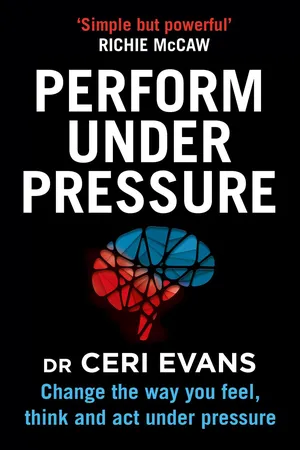
The transformative mind-model for performing under stress and making pressure your advantage
Used by the planet's top performers
In Performance Under Pressure, forensic psychiatrist Dr Ceri Evans gives you the tools to take control of the moment.
Beat doubt, worry, regret and burnout with simple mind techniques and discover the secret of how to be 'comfortable being uncomfortable'.
No one is immune to pressure. We all fall victim to its effects in the same ways. But pressure is misunderstood. Pressure can be your greatest ally in leading a fulfilling and successful life. The more discomfort there is in a situation, the better it is for those who have prepared.
In this, his very first book, Dr Ceri Evans shares the life-changing methods he uses with some of the planet's top performers. This book will give you a better understanding of how the brain behaves under pressure using the Red-Blue mind model, a simple, contagious and universally applicable recipe for dealing with whatever pressure you have in your life, whatever form it takes.
Trusted by 375,005 students
Access to over 1 million titles for a fair monthly price.
An abnormal reaction to an abnormal situation is normal behaviour.
Viktor Frankl, psychiatrist (1905–1997)
CHAPTER 1
Chapter 1, The Nature of Pressure
Pressure is confronting. It can smack us in the face. The sharp edge of reality has a way of cutting our fantasies to shreds.
Pressure is universal. No matter what our level of performance, we all fall victim to it in the same ways.
Pressure is real. What happens inside our heads and bodies – anxiety, tension, frustration, exasperation, foggy thinking, tunnel vision – is not imagined. And when it comes to the effects of pressure, there is no immunity.
Pressure is a mystery. The simple rules of the external world of cause and effect don’t hold. The mental world is a non-linear, invisible, cryptic one, where our unconscious often lurks in the background with sinister intent. With success within their grasp – and therefore also the prospect of failure – some people suddenly collapse under pressure, and we don’t really understand why. Because the mental world seems hard to comprehend, many people don’t make an effort to do so. The very thing that is the most variable, and has the greatest impact, is the least pursued.
Pressure is captivating. Tight sporting contests, precarious business decisions and tense armed stand-offs seem very different situations, but they draw us in for the same reasons. We don’t know how they will turn out, and the outcome matters. Predictability is boring and, especially when the stakes are high, unpredictability is thrilling.
Pressure is perilous. The knife-edge, risk–reward seesaw explains why many people do everything they can to avoid or escape from stressful situations.
But a minority of people do the opposite. They walk towards these moments of truth, seeking the things they also fear.
Pressure can be an incredibly sobering, painful or even crushing experience, from which we may struggle to recover, or a stirring, heartening one, which resets our life trajectory upwards.
Welcome to the world of pressure.
Two Kinds of Threat
At the heart of pressure is fear. But not all fear is equal.
Imagine someone is walking in the country, in a relatively reflective state, when a wild dog bursts into their path, locks eyes with them, snarls and runs directly at them.
How do they react? Their eyes fixate on the dog, their body becomes tense and their thinking shuts down, all in a split second. They are in a state of fear.
Now imagine a golfer leading his first big championship by one shot. (Please note that all examples in this book, unless otherwise stated, are fictional and any resemblance to real situations is purely coincidental.) At the final hole he is confronted with a difficult water hazard that has claimed his tee shot in the last two rounds.
How does he react? His eyes fixate on the water, his body becomes tense and his thinking shuts down, all in a split second. He is in a state of fear.
These two reactions look identical at face value. They are both internal fear reactions to external situations. But they’re different in one key respect: the wild dog is a genuine external threat, while the golf hole is not. The golf shot holds the potential for judgment, but no direct physical threat (unless the golfer falls in the water).
The wild dog triggers a split-second reaction, directly provoked by an external stimulus: sharp teeth. But we can’t say the same thing about the golf shot. The golfer’s state of fear is triggered by what the external situation stirs up inside him. The threat is not an animal with teeth, but feelings that bite.
The tournament or crowd don’t directly cause the fear. It’s the change in situation that creates the threat: getting close to the end, on the cusp of winning. Which also means possibly losing, with instant audible and visible judgment from the crowd. This possible judgment stirs up deep-seated feelings from long-forgotten past performances, leading to anxiety and tension.
So, there are two kinds of threat: one that is triggered by real external danger, and one that is prompted by an internal emotional conflict.
Faced with the first kind of threat – the wild dog – just about everyone would have a similar reaction. But in the case of internal emotional threats, there’s a lot of variation in how people react. Some people become fearful and some don’t, with all grades in between.
What determines who becomes fearful and who doesn’t? And when does this become a problem for performance?
To answer these questions, we’ll need to learn more about the human brain …
CHAPTER 2
Chapter 2, Two Minds – Introducing Red and Blue
Our brain is the part of our body that has the greatest influence on our performance under pressure.
Even when a challenge is mainly physical – such as training for a marathon – pressure places demands on us mentally as we solve problems, make decisions, adjust timing, fight through the discomfort, and much more. Our mental response is what makes the difference.
Our brain is easily the most complex organ in our body – in fact, it’s the most complex thing in the universe. The numbers people use in talking about the brain are so big, and at the same time so small, that they’re hard to fathom.
The human brain contains roughly 100 billion neurons (nerve cells), which generate trillions of synapses (connections) with other neurons. At the other end of the scale, the average neuron is just one-tenth of a millimetre in size. A piece of brain tissue the size of a full-stop on this page could hold 10,000 synapses, allowing cells to pass information to each other as they branch out from the brain through the spinal cord and nerves to reach, and control, every corner of our body.
Whichever way we look at it, our nervous system is impressive, even though in terms of our knowledge of its complexity it remains a vast, unknown frontier.
This complexity is necessary for neuroscience, but not for us. Fortunately, we can easily simplify how the brain functions into just two interactive systems.
But first, to appreciate why the RED–BLUE mind model makes sense in performance situations, it will help if we understand some basic facts about how the brain is structured.
We can view the structure of the brain in terms of three parts, or levels.
The first level, located at the base of the brain – at the top of the spine – is the brainstem, which is responsible for our major physiological drives and functions and our basic survival responses. It is fully developed at birth. We share this part of the brain with reptiles and other mammals.
The second level, sitting at the heart of the brain, is the limbic system, which is responsible for processing information about our emotional and physical state, and emotional information about those around us. It develops after the brainstem, going through significant change in the first year of life. A set of nuclei (nerve centres) located around the limbic system, called the basal ganglia, are closely associated with our unconscious physical habits.
The third level is the cerebral cortex – the outer layers of the brain – made up of two halves: the left and right hemispheres, joined by a thick bundle of fibres called the corpus callosum. The cerebral cortex, which controls advanced mental processes such as language and reflection, is the last part of the brain to develop, and is still maturing in our mid-20s.
THE HUMAN BRAIN
External structure
From the outside, the brain is dominated by two large cerebral hemispheres.
Although nearly all mental tasks are based on a combination of left- and right-hemisphere activity, one will dominate, because they function very differently in terms of the types of information they process.
Right-hemisphere processes are automatic, fast, and largely unconscious. The right hemisphere works in the here and now, using non-verbal information such as images, and has the capacity to see the big picture, taking an instant snapshot of the situation.
Left-hemisphere processes are deliberate, slower, and conscious. The left hemisphere works by matching current reality with past experiences, using language and calculation to construct stories, explanations and timelines.
The three parts of the brain – and the two hemispheres – function within a hierarchy, with the brainstem at the bottom, the limbic system in the middle, and the cerebral cortex at the top. The later-developing cortex has the power to hold back or refine the more primitive reactions from the sub-cortical structures (the limbic system and the brainstem), giving top-down control.
The right hemisphere, which matures before the left hemisphere, is more concerned with our immediate safety and sense of where we are in the world, while the left hemisphere is more concerned with analysis and setting goals. Likewise, the back of the brain processes raw sensory data (like visual images), while the front of the brain is more concerned with refining these images through meaning and interpretation. Altogether, our brain develops in a bottom-to-top, back-to-front and right-to-left direction.
To keep things simple, we can see both our right hemisphere and our limbic system and brainstem as dealing primarily with feeling, and our left hemisphere as dealing mainly with thinking.
The feeling system is primed for survival – including our essential physical processes and the fight–flight reaction. It runs on raw, unprocessed data: when a large dog suddenly appears in front of us, all we need to see and sense is that it’s angry and growling, not its name, species or favourite park. The defining feature of this survival system is speed. Because it’s linked to emotions such as fear, it has been described as ‘the hot system’. I call this system RED.
THE HUMAN BRAIN
Internal structure – Side view
On the inside, the human brain is organised into three main functional areas: the brainstem at the base; the limbic system in the middle; and the cerebral hemispheres at the top.
The thinking system is primed for potential. Once we’re safe from the dog, we can think about how to avoid crossing its path in future – maybe we need to buy an even bigger dog ourselves! This system allows us to solve problems, set goals, learn and adapt. Because it’s linked more to thinking and rational analysis, it has been described as ‘the cool system’. I call this system BLUE.
Red
The RED system is strongly connected to our body through powerful nerves, to maintain the overall functioning of our body and main organs within certain, comfortable limits, and to allow us either to run away or to de...
Table of contents
Cover
Title Page
Copyright
Dedication
Contents
List of Illustrations
Foreword
Introduction
Part 1: Red and Blue – Understanding Pressure
Part 2: Preparing to Perform – Laying the Groundwork
Part 3: Performing Under Pressure
Conclusion
Glossary
Further reading
Acknowledgements
About the Author
About the Publisher
Frequently asked questions
Yes, you can cancel anytime from the Subscription tab in your account settings on the Perlego website. Your subscription will stay active until the end of your current billing period. Learn how to cancel your subscription
No, books cannot be downloaded as external files, such as PDFs, for use outside of Perlego. However, you can download books within the Perlego app for offline reading on mobile or tablet. Learn how to download books offline
Perlego offers two plans: Essential and Complete
Essential is ideal for learners and professionals who enjoy exploring a wide range of subjects. Access the Essential Library with 800,000+ trusted titles and best-sellers across business, personal growth, and the humanities. Includes unlimited reading time and Standard Read Aloud voice.
Complete: Perfect for advanced learners and researchers needing full, unrestricted access. Unlock 1.4M+ books across hundreds of subjects, including academic and specialized titles. The Complete Plan also includes advanced features like Premium Read Aloud and Research Assistant.
Both plans are available with monthly, semester, or annual billing cycles.
We are an online textbook subscription service, where you can get access to an entire online library for less than the price of a single book per month. With over 1 million books across 990+ topics, we’ve got you covered! Learn about our mission
Look out for the read-aloud symbol on your next book to see if you can listen to it. The read-aloud tool reads text aloud for you, highlighting the text as it is being read. You can pause it, speed it up and slow it down. Learn more about Read Aloud
Yes! You can use the Perlego app on both iOS and Android devices to read anytime, anywhere — even offline. Perfect for commutes or when you’re on the go. Please note we cannot support devices running on iOS 13 and Android 7 or earlier. Learn more about using the app
Yes, you can access PERFORM UNDER PRESSURE EB by Ceri Evans in PDF and/or ePUB format, as well as other popular books in Psychology & Leadership. We have over one million books available in our catalogue for you to explore.