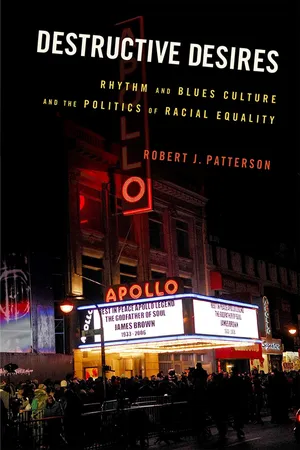
Despite rhythm and blues culture's undeniable role in molding, reflecting, and reshaping black cultural production, consciousness, and politics, it has yet to receive the serious scholarly examination it deserves. Destructive Desires corrects this omission by analyzing how post-Civil Rights era rhythm and blues culture articulates competing and conflicting political, social, familial, and economic desires within and for African American communities. As an important form of black cultural production, rhythm and blues music helps us to understand black political and cultural desires and longings in light of neo-liberalism's increased codification in America's racial politics and policies since the 1970s. Robert J. Patterson provides a thorough analysis of four artists—Kenneth "Babyface" Edmonds, Adina Howard, Whitney Houston, and Toni Braxton—to examine black cultural longings by demonstrating how our reading of specific moments in their lives, careers, and performances serve as metacommentaries for broader issues in black culture and politics.
eBook - ePub
Destructive Desires: Rhythm and Blues Culture and the Politics of Racial Equality
Rhythm and Blues Culture and the Politics of Racial Equality
- English
- ePUB (mobile friendly)
- Available on iOS & Android
eBook - ePub
Destructive Desires: Rhythm and Blues Culture and the Politics of Racial Equality
Rhythm and Blues Culture and the Politics of Racial Equality
About this book
Information
Publisher
Rutgers University PressYear
2019Print ISBN
9781978803589
9781978803596
eBook ISBN
9781978803602
Subtopic
Music1
Reading Race, Gender, and Sex
Black Intimate Relations, Black Inequality, and the Rhythm and Blues Imagination
Came into my life a stranger / You captured my heart / Now I’ve got to face the danger, I’m ready to start / Thought that I could make it on my own / All alone I tried too hard to fake it / Now the truth must be known / Two hearts are always better / Together, forever.
—Teddy Pendergrass and Stephanie Mills, Stephanie, “Two Hearts”
What’s the sense in sharing this one and only life / Ending up just another lost and lonely wife / You count up the years / And they will be filled with tears.
—Candi Staton, Young Hearts Run Free, “Young Hearts Run Free”
TRACK 1
BLACK FEMINIST THINKING AND STRUCTURAL INEQUALITY
BLACK FEMINIST THINKING AND STRUCTURAL INEQUALITY
Released one year after Natalie Cole’s “I’m Catching Hell” (1977) and two years after Candi Staton’s “Young Hearts Run Free” (1976), Jean Carne’s “There’s a Shortage of Good Men” (1978) (re)focuses conversations about black intimate relationships toward the multilayered, interconnected, and persistent institutional factors that thwart black individuals, relationships, and communities from thriving. Unnerving the increasingly persistent post–civil rights era explanations for black inequality that locate black people’s putative inability and unwillingness to enter long-term, monogamous marriages as the cause of and explanation for black inequality, Carne’s persona attributes the shortage of good (black) men to economic, personal, and political deprivations that war, subemployment, unemployment, and imprisonment cause for black men in particular. If black intimate relations must shore up black inequality, and, as the persona laments, “brothers in jail” because “the system makes them fail,” Carne’s song leaves us to question: How might black intimate relationships thrive in this context where antiblack racism systemically colludes to erode black progress by removing black men from black households? If black men “can’t find no job nowhere,” how then are they to fulfill the patriarchal breadwinner model that organized American nuclear families? If even the good men become “strung out with drugs” and thus contribute to the “broken home” phenomenon, what options do heterosexual black women have available to improve their social location if the primary means for improvement is marriage?
Carne’s lyrics thus demonstrate the pervasive and persistent cultural longing in public policy and the wider public’s imaginary that views heterosexual marriage as the solution to black people’s economic and political inequalities. Yet this destructive desire fails to consider the institutional and structural factors—historical and contemporary—that limit access to this model for black people, and instead situates any nonfulfillment of this model as a consequence of black people’s lack of motivation or desire for monogamy. This (destructive) desire for black marriages, which I later refer to as the marriage panacea thesis, calls forth black behaviors, or, as is the case here, the failure to engage in norm-accruing behaviors, as the primary cause for black inequality. This cultural longing, which both nonblack and black people accept, seductively obfuscates how the persistence of racism undercuts the possibility for racial equality, how the institution of marriage itself masks and maintains inequality, and how the institution of marriage becomes a mechanism through which the welfare state can shirk its responsibility to ensure the welfare of its citizens.
Carne’s lyrics, however, resist this cultural logic by revising the centrality of the mutually constitutive relationship between black intimate relationships and black behaviors: black behaviors do not necessarily produce or ameliorate black inequality (figure 1.1). And, the lyrics do so, as the aforementioned discussion of the song illuminates, by pointing to a myriad of institutional factors that impede black people and black relationships from thriving. With regard to black music culture more generally, and rhythm and blues and soul music more specifically, this revision to the cultural longings for black intimate relations diverges from the familial narratives emerging early in the 1970s that cherish the nuclear family model. As my forthcoming analysis of The O’Jays’ 1975 album Family Reunion and Sly and the Family Stone’s hit single “Family Affair” (1971) accentuates, by calling forth black familial organization as the key to black political enfranchisement, albums and songs like these reinforce the importance of black intimate relationships in forging and building black communities, as well as of the relationships themselves as becoming institutions to reshape black political and economic aspirations. Coming on the heels of the now (in)famous Moynihan Report, Carne’s song discursively takes up the claims the report makes, usefully accentuating the structural impediments to black equality that, while present in the report, get subsumed by the behavioral explanations. To examine Carne’s song then is to arrive at a more nuanced understanding of the complexities of black intimate relationships, how black intimate relationships explain black inequality, and how those explanations fall short in grasping the complexities of black inequality in the post–civil rights era. This knowledge then requires us to think about and propose solutions for black inequality that do not center intimate relations in traditional ways.

FIGURE 1.1. Jean Carne performs during the 17th Annual Long Beach Jazz Festival on August 14, 2004, at The Lagoon at the Long Beach Convention Center in Long Beach, California.
Rejecting the persona of Cole’s song, who laments “that female liberation stuff” may in fact not be “worth it,” “Shortage” instead also admonishes that a “strong woman needs a strong man,” that “there’s no time to be weak and insecure.” “Shortage” thus counters the related notion that out of place black women also contribute to the dissolution of black intimate relationships, the failure of black men to achieve an empowered masculinity, and the overall problems attributed to black communities’ inability to succeed without assistance from the government. Recall that it was in 1979 that Michele Wallace published The Black Macho and the Myth of the Superwoman, a groundbreaking black feminist manifesto that upended the matriarchy thesis, challenged a black machismo that lacked the capaciousness to appreciate black feminist politics, and foregrounded the elevation of black womanhood’s status to that of black manhood.1 This discursive context informs the cultural revision in which Carne’s song engages as it rejects the notion that black men’s liberation comes at the expense of black women by refusing to elevate and normalize black heteropatriarchy. The context also calls attention to the corrective analytical lens that black feminist theory and praxis brought to black empowerment conversations in that black feminism opened up the possibilities for revising cultural expectations about black intimate relationships and their political efficacy that would become more pronounced in the following eras; black feminism demanded what might now be called a nontoxic (black) masculinity.
Less demure than Cole’s persona, Carne’s rejects the notion that empowered black womanhood (the infamous variations of the matriarchy thesis) undermines empowered black manhood, while calling on (black) men to rise to the occasion. Whereas Cole’s persona performs an ambivalent reading of (black) feminist thinking’s effect on black intimate relationships, Staton’s, by contrast, articulates the ways that the institution of marriage adversely affects black women’s happiness and life chances. By asking, for example, “What’s the use of sharing this one and only life” and further admonishing women that “you’ll count up the years and they will be filled with tears,” “Young Hearts” neither pictures marriage as a solution to the black community’s problems nor as a prerequisite for women’s personal fulfilment. At the nexus of these discourses, “Shortage” similarly extends this logic to examine how institutional racism impedes black men’s abilities to fulfill the roles that society (and black women) would expect of them in heterosexual marriage, especially when structural racism curtails their abilities to fulfill those roles. The issues these songs raise provide the opportunity for us to think about how black cultural production becomes a discursive site to (re)imagine the causes of and solutions to black inequality by displacing black intimate relations from the center of those conversations.
Rhythm and blues music and culture since the 1960s have provided fertile cultural space to examine how African American cultural production and producers have imagined the possibilities for black love, relationships, marriage, and couplings, but black music studies have been conspicuously absent in these conversations. Indeed, cultural criticism has privileged African American literary production as a primary, if not preferred, site to investigate this issue, and two trends explain this phenomenon. First, the rise and institutionalization of black feminism increased the sustained examinations of black intimate relations’ relationships to black political desire and empowerment. Second, a significant portion of black academic feminism emerged from and grew within black literary culture. Candace Jenkins’s Proper Lives, Proper Relations: Regulating Black Intimacy, which Destructive Desires views as a crucial interlocutor, evidences this point as she examines black intimacy in twentieth-century black women’s writing, thinking, and culture. Yet, given music’s widespread reach, mass appeal, and cultural significance, as well as rhythm and blues culture’s status as a voice for intimate relations in black cultural production, this turn to rhythm and blues music offers an opportunity to investigate the myriad of ways that black music intervenes in debates about black intimate relations and revises cultural expectations about how black intimate relations can shore up black political interests.
Through an analysis of rhythm and blues music produced during the 1970s and 1980s, this chapter examines what I theorize as the marriage panacea thesis to consider how aesthetic, political, and social conditions of the post–civil rights era contribute to the rejection of this thesis. The marriage panacea thesis refers to an interrelated set of cultural logics which insist that the institution of marriage will ameliorate black inequality, and fits more broadly within the rubric of behavioral explanations for black inequality, such as the culture of poverty.2 The persistence of the marriage panacea thesis in social discourse, public policy, and everyday conversation positions the cause of and solution for black inequality on black people’s behaviors, reinforces the supremacy of monogamy, and displaces and diminishes the state’s role in providing for its citizens. Insofar as American culture widely believes marriage increases educational attainment, economic prosperity, and overall stability, it simultaneously insists that marriage reduces criminality and disrupts cycles of poverty for black communities. Yet, as “Shortage” intimates, it is important to shift attention from black people’s behaviors to illuminate how behavioral explanations often ignore, or at least diminish, the structural and historical forces that entrench inequality for black people (even within their intimate relationships). This chapter thus sets the stage for a set of cultural longings that cohere in the 1970s, become more pronouncedly disrupted during the 1980s, and even more fragmented during the 1990s and beyond.
The trifecta of the rise of neoliberalism, the institutionalization of Reaganomics, and the decline of the welfare state collude to sediment black inequality and posit black people’s behaviors as the cause of and solution to their political, economic, and social disparities. This discursive context crucially situates the cultural longings that frame black political desire and desire for black politics, and also becomes an entangled network through which rhythm and blues culture provides alternative epistemologies to reshape black politics. Whereas the beginning of this chapter analyzes Carne’s “Shortage of Black Men” to demonstrate how it engages extant discourses about black intimate relationships and black inequality, the argument here (and throughout) emphasizes how the music and culture potentially reframe how we think, imagine, and act. Put another way, cultural revision and cultural rebellion focus on the discursive and epistemological, and while they acknowledge their important relationships to the material, they consider the implicit, unspecific, un(measurable), and unquantifiable. The argument therefore does not predict that the music culture always, intentionally, explicitly, engaged a policy, idea, or discourse to produce a specific, measurable, quantifiable transformation.
To be clear, my work here and elsewhere rejects the problematic premise that the nuclear family is the best familial configuration and the related notion that monogamous heteronormative marriage will solve black people’s political problems.3 In fact, the two-faced meaning of destructive desires calls attention to this claim. Yet, given the persistence of the marriage panacea thesis, it is worth debunking the (il)logics and mythologies that undergird these cultural longings to demonstrate where they fall short in explaining black inequality and why they are in fact destructive desires. Moreover, and this point remains crucial, this argument demonstrates how the thesis fails to explain why—even when black people do marry, and conform to the expectations of marriage—their economic outcomes lag behind those of other groups (and white people in particular). The turn to black music affords us the opportunity to understand how it provides alternative epistemologies that can help us reimagine black intimate relationships, and, in this innovative reimagining, articulate newer and more robust ways to address black inequality.
In Soul Covers: Rhythm and Blues Remakes and the Struggle for Artistic Identity, Michael Awkward posits that black popular music’s “mass distribution enabled it to saturate and, indeed, reshape mainstream popular musical and sociocultural sensibilities” to account for black music’s role in imagining and reimagining some of the very ideas that influence its cultural production.4 Moving beyond the critique of ideas, this chapter also sketches some of the ways that black music responded to “sociocultural sensibilities” about black intimate relationships in order to articulate new possibilities for both intimate relations and political empowerment, while rejecting the marriage panacea thesis. In other words, even if the songs are a bunch of love songs, their engagement with and construction of notions of love connect to broader political and politicized discourses about love, relationships, and family that remain sutured to conversations and discourses about (in)equality. By examining the political import of the cultural production, the chapter complements Brian Ward’s Just My Soul Responding: Rhythm and Blues, Black Consciousness, and Race Relations (1996), which argues that rhythm and blues music intentionally and unintentionally engaged anti–civil rights movements that aimed to suppress black political advancement during the late 1960s.5
TRACK 2
BLACK FAMILIAL DISCOURSES AND AFRICAN AMERICAN MARRIAGES
BLACK FAMILIAL DISCOURSES AND AFRICAN AMERICAN MARRIAGES
Although the Moynihan Report’s claims did little to support the amelioration of black inequality in terms of how the government responded to its propositions, the sting of the report lies in the fact that its publication—at the height of the civil rights movement—also coincided with the onset of the decline of the welfare state’s scope, the emerging anti–civil rights backlash, and the social and political transformation of “personal responsibility” philosophies in political discourses. That the black family was in a “crisis” was not an argument new to the 1960s, nor were the arguments that Senator Daniel Patrick Moynihan proffered in his now (in)famous report, The Negro Family: A Case for National Action, particularly novel.6 Notwithstanding the argument’s problematic assumptions—including a limited data sample that Moynihan himself acknowledges—the report seems at least to suggest, however cursorily, that institutional structures impede black people’s ability to experience upward mobility (or even to conform to the nuclear family model). Although often dismissed or otherwise subordinated to more behavioral explanations for black inequality, the institutional barriers become significant—in terms of his acknowledgment and in terms of their impact. Rather than disrupt the cultural longing for the marriage panacea thesis by clarifying how discrimination in the workforce inhibits black famil...
Table of contents
- Cover
- Title Page
- Copyright
- Dedication
- Contents
- Preface: RJP and the Rhythm and Blues Imagination
- Introduction: (Re)Reading Destructive Desires and Cultural Longings in Post–Civil Rights Era Rhythm and Blues Culture, Life, and Politics
- 1. Reading Race, Gender, and Sex: Black Intimate Relations, Black Inequality, and the Rhythm and Blues Imagination
- 2. Whip Appeal”: Reading Kenneth “Babyface” Edmonds
- 3. “Freak Like Me”: Reading Adina Howard
- 4. “Didn’t We Almost Have It All?”: Reading Whitney Houston
- Epilogue: “It’s Just Another Sad Love Song”: Reading Toni Braxton
- Appendix A: Select List of Kenneth “Babyface” Edmonds’s Songs
- Appendix B: Select Awards and Honors
- Appendix C: Robert J. Patterson Interviews Adina Howard
- Acknowledgments
- Notes
- Bibliography
- Index
- About the Author
Trusted by 375,005 students
Access to over 1.5 million titles for a fair monthly price.
Study more efficiently using our study tools.
Frequently asked questions
Yes, you can cancel anytime from the Subscription tab in your account settings on the Perlego website. Your subscription will stay active until the end of your current billing period. Learn how to cancel your subscription
No, books cannot be downloaded as external files, such as PDFs, for use outside of Perlego. However, you can download books within the Perlego app for offline reading on mobile or tablet. Learn how to download books offline
Perlego offers two plans: Essential and Complete
- Essential is ideal for learners and professionals who enjoy exploring a wide range of subjects. Access the Essential Library with 800,000+ trusted titles and best-sellers across business, personal growth, and the humanities. Includes unlimited reading time and Standard Read Aloud voice.
- Complete: Perfect for advanced learners and researchers needing full, unrestricted access. Unlock 1.5M+ books across hundreds of subjects, including academic and specialized titles. The Complete Plan also includes advanced features like Premium Read Aloud and Research Assistant.
We are an online textbook subscription service, where you can get access to an entire online library for less than the price of a single book per month. With over 1.5 million books across 990+ topics, we’ve got you covered! Learn about our mission
Look out for the read-aloud symbol on your next book to see if you can listen to it. The read-aloud tool reads text aloud for you, highlighting the text as it is being read. You can pause it, speed it up and slow it down. Learn more about Read Aloud
Yes! You can use the Perlego app on both iOS and Android devices to read anytime, anywhere — even offline. Perfect for commutes or when you’re on the go.
Please note we cannot support devices running on iOS 13 and Android 7 or earlier. Learn more about using the app
Please note we cannot support devices running on iOS 13 and Android 7 or earlier. Learn more about using the app
Yes, you can access Destructive Desires: Rhythm and Blues Culture and the Politics of Racial Equality by Robert J. Patterson in PDF and/or ePUB format, as well as other popular books in Media & Performing Arts & Music. We have over 1.5 million books available in our catalogue for you to explore.