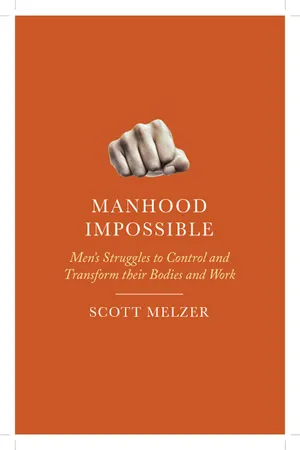
In Manhood Impossible, Scott Melzer argues that boys' and men's bodies and breadwinner status are the two primary sites for their expression of control. Controlling selves and others, and resisting being dominated and controlled is most connected to men's bodies and work. However, no man can live up to these culturally ascendant ideals of manhood. The strategies men use to manage unmet expectations often prove toxic, not only for men themselves, but also for other men, women, and society. Melzer strategically explores the lives of four groups of adult men struggling with contemporary body and breadwinner ideals. These case studies uncover men's struggles to achieve and maintain manhood, and redefine what it means to be a man.
eBook - ePub
Manhood Impossible: Men's Struggles to Control and Transform their Bodies and Work
Men's Struggles to Control and Transform their Bodies and Work
- English
- ePUB (mobile friendly)
- Available on iOS & Android
eBook - ePub
Manhood Impossible: Men's Struggles to Control and Transform their Bodies and Work
Men's Struggles to Control and Transform their Bodies and Work
About this book
Information
Part I
The Body Dilemma
1
Ritual Violence in a Two-Car Garage
The Gentlemen’s Fighting Club
Fight the Professor
“Fighters ready?” I tighten my fingers around the handle of the training knife and square off with my opponent. We gently tap weapons to acknowledge we are ready, and I hope, to communicate to each other and the other fighters that we will fight without malice; no one will be brought to tears or crippled today. “Fight!”
My opponent, Mike, is in good shape, athletic and wiry-strong. Our fight begins cautiously. All the other fighters know each other’s styles and tendencies. My only advantage is that I’m a wild card. No one knows what I’m going to do, including me. Mike and I exchange attacks and counterattacks, trying to strike each other with our training knives while maintaining our footing on the wet turf. Twice he sticks me in my mask, attacks that would be disabling and possibly fatal if we were street combatants using real knives. I land a couple of uninspiring kicks to Mike’s torso as well as one or two stabs with my knife. Time expires. I survive unscathed, thanks to my headgear.
The 60 seconds is an eternity, yet it ends before I have time to process anything that happens. Fighting is an “in the moment” activity; my mind does not wander to writing deadlines or to-do lists. The event organizer and Gentlemen’s Fighting Club cofounder, Rick, peppers me with questions immediately after the fight while his brother continues filming; all GFC fights are recorded and watched afterward. Rick asks me what went through my mind during my first knife fight. Camera shy and mostly unfazed by the experience, my response is brief and perhaps unsatisfactory. “Longest 60 seconds of your life, huh?” he says before moving to Mike. “How was it fighting the professor?” Rick asks. “It was nice. I’ve got a little ring rust,” Mike says, referencing not having fought in a while. He notes an ankle injury slowed him down and limited his aggression but generously observes, “He actually got some good shots. Got me on my fingertips, I think an open shot on my elbow, so that let me know he was serious.”
My bad back holds up well, I have no visible bruises, my energy isn’t sapped, and I don’t vomit. I feel good!
Another pair of fighters readies themselves. Six of us will continue to rotate through in paired fights. I have about 10 minutes to recover before my next one. As I watch the other fights, I’m struck by the ferocity and degree of violence between the experienced fighters. Their level of aggression is something I feel unprepared to match. My feelings are not atypical. Many GFC fighters struggle with being the aggressor. They share self-criticisms during interviews, revealing to me that inflicting violence is less enjoyable than dodging or even withstanding it. They derive satisfaction from avoiding or weathering big blows, not from clobbering their opponents. However, not all GFC fighters share this apprehension. A couple report that they relish landing big shots.
I recall the advice and pep talk emailed to me several days before the event. A GFC member unable to attend wrote,
KICK ASS AND TAKE NAMES!
You were **BORN** for violence my fellow MAN.
Take up that stick knowing in your heart of hearts that every fiber of your being
has either evolved through fighting and death
or was simply created
. . . to do . . .
THIS.
He and several other GFC fighters think men have a killer instinct—literally, not metaphorically. Fighting, they explain to me, is a primal act, one that men’s bodies have evolved to do. They believe it needs to be freed from the suppressing forces of civilized society. If true, if interpersonal violence is in males’ DNA, fighters shouldn’t struggle so much with using violence. And there should be a line of men down the street hoping to join GFC. Neither are true. Violence isn’t an essential feature of maleness. One reason “caveman masculinity” and pop-Darwinism evolutionary psychology resonate so strongly today is men’s feelings of powerlessness in the face of their declining breadwinner status and diminishing cultural hegemony.1 In other words, the rise in popularity of caveman masculinity as a lay explanation for men’s more brutish behaviors is a collective compensatory manhood act, an attempt to justify and restore men’s dominant position, because they believe it to be threatened or lost.
I feel personally powerless as I watch the other fighters and take mental notes on attack tactics, hoping to summon a greater level of aggression for my next fight.
Was I was born to do this?
Feeling well rested, I volunteer to lead off the second round of matches. Another fighter, Kay, does, too. Kay is not an intimidating presence: undersized and gregarious, he has a sharp mind, a good sense of humor, and slightly disheveled hair and is prone to screaming when he receives a hard blow. I know better than to underestimate him, though. His physical appearance belies his superior skills and technique, which match or exceed most of his opponents. Kay is among the many participants who view their fighting club experiences as self-defense training. They see GFC as a way to prepare themselves for unexpected confrontations that could happen walking down the street or socializing at a bar.
In this vein he suggests a “knife versus jacket” fight, where one of us has a knife and the other is armed only with the windbreaker he would be wearing walking around chilly San Francisco. “I’ll take the knife!” I shout. Only my brother laughs. When the fight is delayed due to Rick fiddling with the camera settings, my brother and I huddle up and jokingly exchange a series of hypothetical, escalating asymmetric fight scenarios inspired by “knife versus jacket”: “Uzi versus pen!” “Flamethrower versus thimble!” “Tank versus paper clip!” With the intensity level of the previous two fights fresh in our minds and my escape from harm seeming less likely, we find temporary refuge in humor. I suspect this fear and anxiety, ironically coupled with the somewhat controlled nature of GFC fights, is what sets its audience experience apart from watching cage fighting, wrestling, or even dog- or cockfighting. The GFC audience and participants are one and the same; anyone may later end up on the receiving end of a strike they now cheer. The costuming and occasional playfulness, along with padding and an array of skill levels, also alters the experience. It seems as if the strongest source of bonding is self-deprecation rather than celebrating fighters’ skills. Sure, an impressive move receives an audience response, but collectively and individually, fighters seem most connected laughing at their own and others’ klutzy moves and failed attacks, whether in the moment or later on video.
I wear pad-free mesh gloves to grip the short knife I’m given to fight Kay. We both wear fencing masks. Kay begins our fight by unexpectedly going on the offensive and whipping me with his thin jacket. I had anticipated he would try to use it to wrap my wrist and disarm me. Instead he’s using it to maintain distance from my hypothetically deadly weapon. After three stinging whips to my upper body, I am both impressed and annoyed. I grab the jacket the next time he tries to hit me and rip it out of his hands. The small crowd cheers my surprisingly effective countermove. The underdog has captured the crowd’s heart. My lack of training exposes me, though, as I meekly hit Kay with his jacket using my off hand. Eventually I figure out that the jacket is a hindrance so I toss it into a bush. Now it’s knife versus nothing.
A knife in my hands proves just as nonlethal as the jacket. Kay lunges forward and delivers a mighty punch to my head. I rock back a step and a half from the force of the blow, then quickly process two key pieces of information. First, despite being several inches shorter and many pounds lighter than me, Kay could easily knock me out if I wasn’t wearing a helmet. Second, I am wearing a helmet. It absorbs virtually all of the force, and although temporarily surprised and knocked back by the punch, I am fine. I am better than fine. Feeling energized by the protection of my safety equipment, I go on the offensive. I return a punch to his headgear with my now jacketless left hand. The punch leaves my knuckles sore and stinging after the fight, but delivering a successful strike feels good in the moment. It feels like an accomplishment.
Even better, Kay is treating my training knife like it is real, testing his skills to see if he can avoid any contact from my blade. He could simply bull-rush me, get in close, and pummel me, ignoring whatever fake knife slashes I might deliver. Instead he chooses to engage in the academic exercise of avoiding a potentially lethal knife wound. Or rather, the real exercise of fighting a knife-wielding academic.
Near the end of our fight, he moves in to attack me but slips on a muddy patch of grass. A vision flashes in my mind: Kay on the ground, unarmed, pinned under me as I repeatedly stab and hit him. Before that violent thought is complete, I find myself on the wrong end of it. Kay pulls me down with him and suddenly I am on my back, disarmed, and ineffectually trying to use my hands, arms, knees, and legs to block the haymakers Kay is raining down on my mask. “Time!” my brother screams, mercifully and more emphatically than any of his other fight-ending yells. Damn. I don’t feel so good.
The other fighters rotate through, and I get more rest. One fighter has his toe knifed or stepped on (it’s unclear) and is likely going to lose a toenail. Another, Patrick, probably broke a finger. He did not wear gloves during his stick fight with Rick, or “the War Chief,” as one member half-jokingly, half-affectionately calls him. Rick is intent on doing a stick fight with me as well. He checks with me to see how many more fights I can handle. I still have a lot of energy, and the only bad blows I’ve taken have been to my headgear, so I tell him I can do two more. I am saving the worst for last—my ceremonial beating at the hands of my host.
Lived and Bled with Us
Thinking about it now, agreeing to fight Rick is akin to my punching back against some of those high school boys who symbolically and physically dominated me. Rather than avoiding them in the hallway, this is me slugging them on the arm first and inviting a return blow. It is conquering fear and bonding through violence, thereby gaining full entry into the privileged dominant group. And unlike high school boys, GFC participants want nothing more than to bring me into the fold.
Hearing I am willing to participate in two more fights, Andrew extends an invitation. I accept, and we discuss our weapons options. We agree on the foot-long, hollow rubber hoses. Terrible choice. I pick one up and discover it isn’t the flexible, jiggly rubber I was expecting. It bends a little, but not much. It’s a hard, dangerous weapon. I instinctively held my hands up to deflect knife attacks and punches during the first two fights. Remembering this, I put on a heavily padded glove and smack myself on the back of the hand for a preview of what’s to come. It hurts. A lot. I strap on a much sturdier kendo mask, which is heavily padded all around the head and neck, save for a series of bars protecting the face. “Fighters ready?”
I feel as disconnected as ever from my ancient human ancestors. I was not born to do this.
Andrew has a distinct size advantage over me and has a decade of martial arts training and fighting experience. Some of that experience includes rubber hose fights. I am quicker, though, so I plan to use my speed to get in and out, negating his greater size while avoiding getting into a grappling match. If I stay too far away, I expose myself to his reach advantage, but if I get too close he can grab me and eliminate my speed advantage. Who am I kidding? I’m armed with a rubber hose I just picked up for the first time in my life, and I have no training, experience, or technique. I’m in trouble no matter what I do.
Andrew confirms as much soon into our match. He lands a huge blow to my inner thigh, which will result in a multicolored bruise that will last the next couple of weeks. I use my padded glove to deflect a couple of Andrew’s strikes, but it offers only so much protection against the sturdy hose. Caught up in the moment, though, the pain doesn’t fully register. I fake an attack to Andrew’s upper body and then swing my weapon at his legs, nailing him with a shot on his quadriceps that matches the one he gave me. I feel good. Another exchange nearly ends with my grabbing and taking away his weapon, but I fail to do so. Then with about 15 seconds left, I lose my weapon (again) in a scuffle. I retreat and hear my brother announce, “Ten seconds!” The rational part of my brain formulates a plan: run away and do not let Andrew come anywhere near me. The yard is plenty big enough to take evasive maneuvers for 10 seconds. However, that would violate the spirit of the fight club and probably leave me with a deeper bruise than anything Andrew can deliver with the hose.
I fake retreat and then try to get close enough to him that he can’t effectively swing his weapon but far enough away that I won’t get caught in a wrestling match. In other words, I try to exist in a space-time dimension I just invented. The first attempt fails and he smacks me on the top of my grilled mask. It jolts me and makes an echoing dinging noise when the rubber hits the metal. I know the ringing is in my headgear, not my head, so I make another attempt to move in closer. This time we lock arms. We methodically spin in a clockwise rotation, him looking for opportunities to strike me in my torso with his knee and me trying to keep him off balance so he can’t do so. Fatigue sets in after a couple spins. I know I just need to hold on for a second or two more. Mercifully, again, the timer buzzes, signaling the fight’s end.
“Keep going,” Rick says from the sideline. It seems demonic in the moment, but at GFC, it is not unusual to extend the time if neither fighter is hurt and they have enough energy to continue. I already mentally checked out, though, and am physically exhausted as well. Dutifully following Rick’s forceful suggestion, Andrew and I continue our orbital dance. His significant size and mass advantage allows him to expend less energy. He tries to knee me in my stomach several times. Each time I raise my knee to block his and keep us spinning to deflect the blows. I’m spent, running on fumes. Finally, unable to protect myself any longer, I let my guard down and Andrew knees me in my solar plexus. I audibly groan and bend over in pain as the air rushes out of me. The strike disables and disorients me. Thankfully, even though I fail to officially tap out of the fight, Andrew stops attacking me because he sees I’m incapacitated. A gentlemen’s fighting club indeed.
Rick tells me to take a 15-second rest and then keep fighting. If I could breathe or speak I would curse at him. I stay bent over for a few seconds. A small part of me actually briefly considers his horrific idea before I realize I’m unable to continue. I mumble through my mouthpiece, “I’m done,” hoping to convey every possible meaning of that phrase. I nearly vomited when Andrew’s knee struck me, and the feeling isn’t subsiding. Still, Rick subjects me to the postfight interview, which also includes a close-up examination of my welts and bruises. In what feels like a depraved sports physical, he gleefully and exhaustively probes my wounds, commenting on each. I feel awful.
I sit down, force myself to take a few sips of an energy drink, and try to recuperate. The next fight happens, but I barely notice. It ends, and the camera is unwelcomingly in my face again: “How are you recovering from the fight?” I answer truthfully: “I don’t feel like I am.” Everybody laughs. It looks like my stick fighting career will end before it starts. Meanwhile, Patrick and Andrew agree to a weapons-free fight. No weapons means no headgear is worn, so they follow what GFC calls “yuppie rules”—no shots to the head. The social class implications are clear: middle-class men insulate themselves from the dangers and consequences of street violence. They can’t show up to their jobs or return to their families and communities with bruised and battered faces.
Earlier, Patrick broke a finger and briefly blacked out during a double-stick fight with Rick, who accidentally hit Patrick on a tiny unprotected area on the crown of his head where the helmet straps meet. Patrick and Andrew’s helmetless fistfight is a marathon, a full five minutes. Both fighters are dog-tired at the end. This buys me enough time to recover, the pain and nausea finally subsiding. Rick checks to see how I’m doing but really to see if I will be able to fight one more time. I know I have to do so. Given how indebted I am to him for providing such extensive access to GFC, I mostly willingly accept his invitation to stick fight.
We follow our plan to do a single stick fight, using sticks about two and a half feet in length and an inch in diameter. “Just 30 seconds,” he says, so I can get a taste of stick fighting. Rick is built like a linebacker. He is a skilled fighter with a reputation that extends beyond GFC to a broader fighting community. Once again, he promises to “bring me up” rather than “beat me down.” Mike helps me strap on my kendo helmet and offers some advice on how to swing my weapon with greater force and how to most effectively attack Rick. I thank him but promptly forget his suggestions as soon as the sticks start flying.
Rick has me do one last prefight interview: “So you’re going into your first stick fight here. What’s running through your mind?” he asks. “What’s running through my mind is that you’ve been incredibly helpful,” I tell him, “and that I owe you a lot and I’m about to pay it back right now, because I’m dead tired. I just took a big shot, and I’m feeling like my tank is empty.” I look into the camera, resigned to my fate: “But I’ve got to square off with this guy at least once, so . . .” Rick, buoyant now, shares his own preliminary thoughts with the camera: “All right. So I’m preparing myself to go up against the professor. You never know. You always learn the most f...
Table of contents
- Cover
- Title Page
- Copyright Page
- Contents
- Introduction: The Manhood Dilemma
- Part I. The Body Dilemma
- Part II. The Breadwinner Dilemma
- Part III. The Future of the Manhood Dilemma
- Appendix: Studying Men and Manhood
- Acknowledgments
- Notes
- Index
- About the Author
Trusted by 375,005 students
Access to over 1.5 million titles for a fair monthly price.
Study more efficiently using our study tools.
Frequently asked questions
Yes, you can cancel anytime from the Subscription tab in your account settings on the Perlego website. Your subscription will stay active until the end of your current billing period. Learn how to cancel your subscription
No, books cannot be downloaded as external files, such as PDFs, for use outside of Perlego. However, you can download books within the Perlego app for offline reading on mobile or tablet. Learn how to download books offline
Perlego offers two plans: Essential and Complete
- Essential is ideal for learners and professionals who enjoy exploring a wide range of subjects. Access the Essential Library with 800,000+ trusted titles and best-sellers across business, personal growth, and the humanities. Includes unlimited reading time and Standard Read Aloud voice.
- Complete: Perfect for advanced learners and researchers needing full, unrestricted access. Unlock 1.5M+ books across hundreds of subjects, including academic and specialized titles. The Complete Plan also includes advanced features like Premium Read Aloud and Research Assistant.
We are an online textbook subscription service, where you can get access to an entire online library for less than the price of a single book per month. With over 1.5 million books across 990+ topics, we’ve got you covered! Learn about our mission
Look out for the read-aloud symbol on your next book to see if you can listen to it. The read-aloud tool reads text aloud for you, highlighting the text as it is being read. You can pause it, speed it up and slow it down. Learn more about Read Aloud
Yes! You can use the Perlego app on both iOS and Android devices to read anytime, anywhere — even offline. Perfect for commutes or when you’re on the go.
Please note we cannot support devices running on iOS 13 and Android 7 or earlier. Learn more about using the app
Please note we cannot support devices running on iOS 13 and Android 7 or earlier. Learn more about using the app
Yes, you can access Manhood Impossible: Men's Struggles to Control and Transform their Bodies and Work by Scott Melzer in PDF and/or ePUB format, as well as other popular books in Social Sciences & Sociology. We have over 1.5 million books available in our catalogue for you to explore.