Few scholars have explored the collective experiences of women living in the inner city and the innovative strategies they develop to navigate daily life in this setting. The Grind illustrates the lived experiences of poor African American women and the creative strategies they develop to manage these events and survive in a community commonly exposed to violence.Alexis S. McCurn draws on nearly two years of naturalistic field research among adolescents and adults in Oakland, California to provide an ethnographic account of how black women accomplish the routine tasks necessary for basic survival in poor inner-city neighborhoods and how the intersections of race, gender, and class shape how black women interact with others in public. This book makes the case that the daily consequences of racialized poverty in the lives of African Americans cannot be fully understood without accounting for the personal and collective experiences of poor black women.
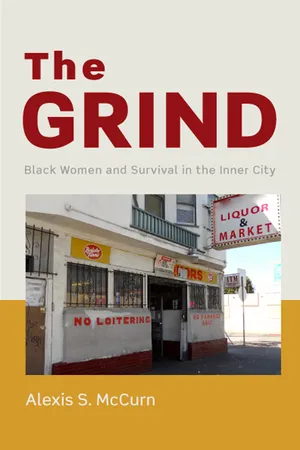
eBook - ePub
The Grind: Black Women and Survival in the Inner City
Black Women and Survival in the Inner City
- English
- ePUB (mobile friendly)
- Available on iOS & Android
eBook - ePub
The Grind: Black Women and Survival in the Inner City
Black Women and Survival in the Inner City
About this book
Information
Publisher
Rutgers University PressYear
2018Print ISBN
9780813585055
9780813585062
eBook ISBN
9780813585079
CHAPTER 1
“Grinding”
LIVING AND WORKING IN EAST OAKLAND
I SIT ON the front steps of my apartment building around 7:15 on a Thursday morning. I have used this time regularly over the past six months to observe the morning routines of local residents. I wave to Ruth, the nineteen-year-old mother of a two-year-old boy. I look on as she pushes her son’s stroller down the street in the direction of where I sit. On many mornings I watch Ruth walk this same path.
“Where you going, Ruth?” I ask with a smile.
She shakes her head and smiles back. “You know where I’m going, taking him to the babysitter, then to King’s” (the local fast-food restaurant where she works). She points to the long-sleeved yellow shirt she wears with the restaurant’s emblem printed on the front. “I gotta stay on my grind ’cause the bills don’t stop.”
“Hang in there, and have a good day,” I say.
“I’ll try,” she says over her shoulder, then waves and continues walking.
The grind, or grinding, is a term used by black women like Ruth to describe the different types of work they do in distressed urban communities. Ruth walks each day through her troubled inner-city neighborhood as she takes her toddler to a babysitter and then works long hours at King’s. Her reference to “my grind” reveals both the physical and emotional work required to negotiate the demands of daily life in distressed inner-city space. For women in this neighborhood, grinding is a term that can refer to work in both the formal and the underground economies. There are four dimensions to grinding for women in this setting:
The half-time hustle: Participation in both low-wage jobs within the formal economy and entrepreneurial ventures in the underground marketplace.
Underground entrepreneurship: Paid work in the underground marketplace that commonly includes selling stolen goods from retail stores out of cars, homes, or on the street for a discounted price.
Managing violence: Negotiating daily work in the formal and informal economy as both become routinely complicated by the presence of neighborhood violence.
Surviving the grind: Coping with the stress and emotional labor that accompany both low-wage and underground labor while working to stay safe in a neighborhood regularly exposed to violence.
As a term, grinding reflects the intensity and drudgery of managing these dimensions of daily life. Not all women experience all dimensions at the same time, but among those women I interviewed it was common to experience underground entrepreneurship, managing violence, and sometimes more at a given time. The intersection of physical and emotional labor make up the grind for women in this setting. The pressure of the grind is exacerbated by the intense demands of daily life, both physical and emotional, that these women encounter each day.
How do women overcome the challenges of paying the bills and caring for their family in settings like East Oakland? Ruth works at the fast-food restaurant by day and as a seamstress at night and on weekends. Ruth and her retired mother are unlawfully employed by a dry-cleaning business that pays them weekly in cash, off the books, and well below minimum wage to complete store orders requiring sewing or alterations. Ms. Jenny is a middle-aged woman who works full-time in the underground marketplace, using space in her home to resell stolen goods to those who cannot afford to buy those same goods in retail stores. It is not likely that successfully negotiating the grind will lead to stable careers for Ruth or Ms. Jenny. Still, the women do this work because they have few other options to provide for themselves and their families.
I draw on cases discovered during my field research and interviews to illustrate what the grind looks like from the perspective of women like Ruth and Ms. Jenny. Respondent accounts shed light on how structural and cultural circumstances further shape women’s work at low-wage jobs and entrepreneurial ventures in the underground marketplace as a way to make money. The grind is complicated by the presence of neighborhood violence and the stress and emotional labor required to stay safe in its presence. This analysis of the grind also reveals how women manage constraining and contradictory gendered expectations in this setting.
GRINDING IN EAST OAKLAND: HUSTLING TO SUPPLEMENT LOW-WAGE WORK
Douglas S. Massey and Nancy A. Denton argue that “segregation plays a key role in depriving poor black families of access to goods and services because it interacts with poverty to create neighborhood conditions that make it nearly impossible to sustain a viable retail sector” (1993, 135). In distressed communities without a workable retail segment, residents find it nearly impossible to obtain necessary goods and services and become further excluded from mainstream job opportunities. With such limited possibilities before them, the lives and work of hustlers, drug dealers, and pimps become more attractive and appear to be a route toward success (Anderson 1990).
These changes are obvious in East Oakland; the presence of work within the underground marketplace is largely a result of such depressed employment opportunities and a lack of accessible goods and services. Here residents must go in search of daily necessities because institutionalized racism has prevented such retail establishments from setting up businesses in this community. Not only is racial isolation taking place as a result, but the conditions also produce “profound alienation from American society and its institutions” as a disturbing consequence (Massey and Denton 1993, 160).
In East Oakland, women sometimes turn to work in the underground and illegal economies as a means of economic survival. They engage in a range of what they refer to as “hustles” to make money. Prostitution, drug sales, theft, and credit card, identity, and insurance scams (such as burning down one’s own property or arranging for one’s property to be “stolen” in order to file a report of arson or theft and claim the insurance money) are common ways people sustain themselves from day to day. This includes hustling to provide food, clothing, shelter, and other basic needs for themselves and their families. Grinding represents the different types of intense work that black women do, including hustling to manage life in troubled inner-city neighborhoods. The grind includes two common ways that women make money: through low-wage work in the formal economy and through paid work in the underground marketplace. Some women adopt a half-time hustle while others become urban entrepreneurs. Women in East Oakland often hold low-wage jobs that require long hours of labor-intensive work, but for many such jobs fail to provide a decent wage. In order to approximate a livable wage some women supplement their income from low-wage paid work with income from hustles worked within the underground marketplace. Such half-time hustles can provide economically vulnerable women with a place to live and food to eat.
The following account from Rachel, a twenty-one-year-old Oakland native, illustrates how she simultaneously works as a nursing assistant and orchestrates insurance fraud to provide basic needs for herself and her developmentally disabled ten-year-old brother, for whom she is the primary caretaker. Rachel’s work as a nursing assistant takes place at a resident care facility a short bus ride away from her home. As she explains, “I work a lot and still don’t have enough money for everything we need. He [her brother] needs extra stuff that other kids don’t, and Social Security only covers some of it. The rest I have to come up with.… I have had a few cars stolen and one catch on fire over the last couple of years just so I can get the insurance money. It’s not something I’m proud of, but at the time I didn’t really see another way.”
Although Rachel is lawfully employed full-time, she resorts to insurance fraud just to get by financially. This type of fraud is not uncommon here, as Rachel goes on to tell me that it is from people she knows in the neighborhood that she learned of this scam and how to carry it out. She says that she grinds “all day, everyday,” but it is apparent that grinding for her is much more than going to her nursing assistant job. The work that Rachel does both professionally and illegally is an example of one way the hustle is used in conjunction with low-wage paid work.
Ruth, the 19-year old mother of a two-year-old, has lived in East Oakland over half of her young life. She, like Rachel, must also depend on a half-time hustle in order to provide basic needs for herself and her son. Ruth describes the “under-the-table” work she and her retired mother do to provide for their household:
My mom is really good at sewing. She always has been, but never did it full-time because she couldn’t ever make enough money at it to quit her other job as a janitor for the school district. But one day she got this chance to sew for this dry-cleaning place. They said they would pay her in cash once a week and drop off and pick up the stuff that needed to be mended. I do the work with her whenever I’m not at my day job. Even though it’s a lot of work for not much money it pays in cash, on time, every week. So it’s something we can pretty much count on.
Ruth and her mother work together to maintain their part-time hustle. This work is illegal, but it adds significantly to how they provide for their household. Although Ruth works full-time at King’s and her mother collects minimal retirement benefits from her janitorial job, the underground seamstress work they do each week is something they have come to rely on just as they do with the legal forms of income they earn. This type of work or “general labor” in both legal and illegal sectors is not uncommon for individuals and families struggling to survive in the inner city (Venkatesh 206, 34). Some legitimate businesses hire individuals on an occasional basis to complete small jobs; these jobs usually pay in cash, do not require employees to have proper certification or training, have no job security, and do not offer health or retirement benefits, workers compensation, and the like. Ruth’s mother’s weekly tailoring and mending work offers no stability and can be discontinued at any time without notice. For Ruth, grinding consists of both the work she does at her restaurant job and the routine underground seamstress work she and her mother do. Together this part-time hustle and low-wage work make it possible to provide some basic needs for their family.
Vanessa, a twenty-four-year-old mother of eight-month-old twin boys, has worked as an administrative assistant at a local city government agency for the last three years since earning her associate degree in business. Vanessa proudly tells me how she put herself through school to earn her degree, which made getting her job possible. Though currently working in this position full-time, Vanessa also earns money as an unlicensed hairdresser, an underground job she has held since her teens. This part-time hustle is what paid for her education and now supplements the limited income she earns at her day job.
The underground work that women like Vanessa, Ruth, and others take on challenges the stereotypes of poor black women as lazy welfare queens. As Vanessa explains, “I have always liked doing hair and became pretty good at it. My sister went to cosmetology school and taught me a lot of what I know. When I was a kid I was always asking my friends to let me do their hair so I could practice just for fun. Then I got good, and people wanted me to do their hair for real. That is when I realized I could make money doing this. I have been ever since.”
Vanessa’s part-time hustle as a hairdresser helped her finance her education at the local community college. Without this part-time work she explains that earning her associate degree would not have been possible. Now as an administrative assistant and new mother of twins, her part-time hustle is still a vital financial resource for herself and her family. She explains that her day job provided “just okay” financially for her individually, but now with two children she regularly depends on the money she earns from her half-time hustle to help provide for her family’s basic needs. Vanessa’s illegal work as an unlicensed hairdresser and professional work as a city government employee operate in conjunction to help her provide for the daily needs of herself and her young children.
For Rachel, Ruth, and Vanessa, part-time hustles are central to the ways in which they manage their daily lives in the inner city. Many working-poor individuals and families in the inner city have come to depend upon underground work, though many do not generally condone illegal behavior and some even fear the dangers associated with illegal hustles (Venkatesh 2006, chap.7). Women like Rachel, Ruth, and Vanessa use low-wage work and illegal hustles as a means of economic survival. Some may participate in illegal work with goals of attaining power, prestige, and social mobility according to local standards, but for the women in this study, low-wage work and half-time hustles are about day-to-day economic survival with the hope of creating some level of economic stability even within this highly unstable underground arena. It is important to note that without significant changes in resources and opportunities for those living in poor urban communities like East Oakland, economic stability and upward mobility remain unlikely but the availability of underground work will persist. The half-time hustle operates in what Sudhir Alladi Venkatesh describes as the “shady world.” In this environment, inner-city households depend upon work as well as “off the books transactions” in the underground marketplace (2006, chap. 7).
The unlawful work performed by women in this study reflects the necessity of low-wage work and the half-time hustle working in conjunction as a means of financial survival. For women to maintain their full-time socially legitimate work and support their families it is important to some that their part-time hustles involve less violence and carry lesser legal penalties than hustles involving, for example, the drug trade. In this way the half-time hustle is different from the often gang-affiliated full-time criminal activity illustrated in what Venkatesh describes as “shady dealings” (2006, chap. 7). The types of half-time hustles performed by these women differ somewhat in nature even as the reasons why they participate in such illegal work are similar. Each woman is lawfully employed full-time but still does not earn enough money to consistently provide basic needs for herself and her family. In turn, they all rely on this underground work to supplement the income earned from low-wage work. This dimension of the grind is central to how women and girls negotiate distressed daily life in the inner city.
While some women avoid hustles that increase the threat of violence, some women take part in underground work that heightens their risk of physical violence. In addition to individual strategies like those described above, women and girls are also involved in underground marketplaces like the drug trade. Gender patterns their involvement in these systems in key ways. In general, the underground marketplace in this setting is male dominated; men in their late teens through middle age generally control this underground system while employing women to do work within it as subordinates but not typically as partners. By a large margin men run the “drug game,” but they are increasingly recruiting young girls as “runners” for the delivery and pickup of their products and payments. These drug dealers also use young girls as lookouts for police and threatening outsiders. For men, markers such as the number of employees, women, property, cars, jewelry, and clothes they have determine their status. Some exceptions to these rules include traditional and nontraditional family legacies or carrying out crimes “successfully” that have gone unsolved by the police or higher-level public authorities. These exceptions grant limited flexibility upon gaini...
Table of contents
- Cover
- Title Page
- Copyright
- Dedication
- Contents
- Introduction
- 1. “Grinding”: Living and Working in East Oakland
- 2. “It Happens All the Time”: Day-to-Day Experiences with Microinteractional Assaults
- 3. “I Am Not a Prostitute”: How Young Black Women Challenge Sexual Harassment on the Street
- 4. “Keeping It Fresh”: Self-Representation and Challenging Controlling Images in the Inner City
- Conclusion
- Appendix: Field Research Methods in Urban Public Space
- Acknowledgments
- Notes
- References
- Index
- About the Author
Trusted by 375,005 students
Access to over 1.5 million titles for a fair monthly price.
Study more efficiently using our study tools.
Frequently asked questions
Yes, you can cancel anytime from the Subscription tab in your account settings on the Perlego website. Your subscription will stay active until the end of your current billing period. Learn how to cancel your subscription
No, books cannot be downloaded as external files, such as PDFs, for use outside of Perlego. However, you can download books within the Perlego app for offline reading on mobile or tablet. Learn how to download books offline
Perlego offers two plans: Essential and Complete
- Essential is ideal for learners and professionals who enjoy exploring a wide range of subjects. Access the Essential Library with 800,000+ trusted titles and best-sellers across business, personal growth, and the humanities. Includes unlimited reading time and Standard Read Aloud voice.
- Complete: Perfect for advanced learners and researchers needing full, unrestricted access. Unlock 1.5M+ books across hundreds of subjects, including academic and specialized titles. The Complete Plan also includes advanced features like Premium Read Aloud and Research Assistant.
We are an online textbook subscription service, where you can get access to an entire online library for less than the price of a single book per month. With over 1.5 million books across 990+ topics, we’ve got you covered! Learn about our mission
Look out for the read-aloud symbol on your next book to see if you can listen to it. The read-aloud tool reads text aloud for you, highlighting the text as it is being read. You can pause it, speed it up and slow it down. Learn more about Read Aloud
Yes! You can use the Perlego app on both iOS and Android devices to read anytime, anywhere — even offline. Perfect for commutes or when you’re on the go.
Please note we cannot support devices running on iOS 13 and Android 7 or earlier. Learn more about using the app
Please note we cannot support devices running on iOS 13 and Android 7 or earlier. Learn more about using the app
Yes, you can access The Grind: Black Women and Survival in the Inner City by Alexis S. McCurn in PDF and/or ePUB format, as well as other popular books in Social Sciences & Sociology. We have over 1.5 million books available in our catalogue for you to explore.