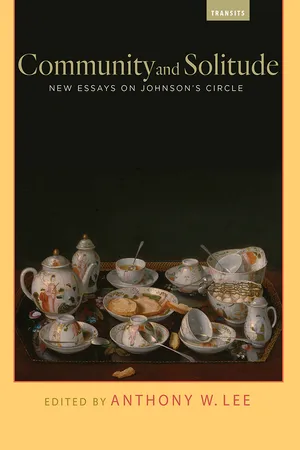
Samuel Johnson's life was situated within a rich social and intellectual community of friendships—and antagonisms. Community and Solitude is a collection of ten essays that
explores relationships between Johnson and several of his main contemporaries—including James Boswell, Edmund Burke, Frances Burney, Robert Chambers, Oliver Goldsmith, Bennet Langton, Arthur Murphy, Richard Savage, Anna Seward, and Thomas Warton—and analyzes some of the literary productions emanating from the pressures within those relationships. In their detailed and careful examination of particular works situated within complex social and personal contexts, the essays in this volume offer a "thick" and illuminating description of Johnson's world that also engages with larger cultural and aesthetic issues, such as intertextuality, literary celebrity, narrative, the nature of criticism, race, slavery, and sensibility. Contributors: Christopher Catanese, James Caudle, Marilyn Francus, Christine Jackson-Holzberg, Claudia Thomas Kairoff, Elizabeth Lambert, Anthony W. Lee, James E. May, John Radner, and Lance Wilcox.Published by Bucknell University Press. Distributed worldwide byRutgers University Press.
- English
- ePUB (mobile friendly)
- Available on iOS & Android
eBook - ePub
About this book
Information
Publisher
Bucknell University PressYear
2019Print ISBN
9781684480227
9781684480234
eBook ISBN
9781684480241
Part One
PERSONAL RELATIONSHIPS
Letters and Conversation
1
CONNECTING WITH THREE “YOUNG DOGS”
Johnson’s Early Letters to Robert Chambers, Bennet Langton, and James Boswell
JOHN RADNER
It is now long since we saw one another, and whatever has been the reason neither You have written to me, nor I to you. To let friendship dye away by negligence and silence is certainly not wise. It is to throw away one of the greatest comforts of this weary pilgrimage.… Do not forget me, You see that I do not forget You. It is pleasing in the silence of solitude to think, that there is One at least however distant of whose benevolence there is little doubt, and whom there is yet hope of seeing again.
—Samuel Johnson, Letter to Bennet Langton1
ON AUGUST 18, 1763, twelve days after he and Johnson parted on the beach at Harwich, a distraught James Boswell cried out for help from the man who had praised and encouraged him during his last six weeks in London. Seven weeks later, no longer despairing, Boswell wrote again, describing what he had achieved by reading Johnson’s Rambler essays. But he had to wait more than two additional months before receiving a response that delighted him with its length and upbeat support, but that puzzlingly redefined their friendship.2
When Boswell, at twenty-two years old, had come to London the previous November, he knew Johnson as the author of the Dictionary, the Rambler, and Rasselas. He had heard David Hume repeat stories others had told him about Johnson, and he had also heard Thomas Sheridan describe Johnson’s marvelous conversation and how he frequently visited till two or three in the morning, before leaving for other engagements. Then, starting on June 25, 1763, when he and Johnson spent the first of many tavern evenings together, they had become friends. Johnson reassuringly reported having once been “a talker against religion,” that he “never believed what [his] father said,” and that he had been “greatly distressed” with melancholy. Boswell’s journal and letters also report Johnson repeatedly declaring his “love” for Boswell, and his eagerness to reconnect once Boswell returned from abroad. Johnson also offered to accompany Boswell to Harwich, where he would board the ship to Holland, and where—according to the Life—Johnson declared, “Sir, it is more likely that you should forget me than that I should forget you.”3
Four months later, responding to Boswell’s two letters, especially his October anxiety at Johnson’s silence, Johnson wrote, “You are not to think yourself forgotten or criminally neglected that you have had yet no letter from me.” But after declaring his hope “not to gratify [his] indolence by the omission of any important duty or any office of real kindness,” and before addressing Boswell’s “dissipation of thought,” Johnson seemed eager to modify their friendship. Despite having spent many hours talking about his own experiences as well as Boswell’s hopes and fears, Johnson would write only to instruct or advise. “To tell you that I am or am not well, that I have or have not been in the country … I seldom shall think worth communication[;] but if I can have it in my power to calm any harassing disquiet to excite any virtuous desire to rectify any important opinion or fortify any generous resolution you need not doubt but I shall at least wish to prefer the pleasure of gratifying a friend much less esteemed than yourself before the gloomy calm of idle Vacancy” (Letters, 1:237–38).
Pleased that Johnson had finally written, even if much less companionably than anticipated, Boswell quickly sent a “noble” response, and wrote again in March 1764. But when he left Utrecht in June, Boswell still had not heard again from Johnson. Nor did Johnson respond to the “joint Letter from two of your distant friends” that Boswell got Giuseppe Baretti to write in July 1765.4 In fact Johnson next wrote only in January 1766, when Boswell would soon pass through London on his way home from the Continent. Then over the next six years, despite repeated attempts to coax responses, Boswell received only six additional letters from Johnson. Also, only in June 1771 did Johnson’s letter to Boswell begin to share news and to confess some of his failings, and only the next year did a letter talk about his health.
In Johnson and Boswell: A Biography of Friendship, I tried to explain Johnson’s initial delay in writing Boswell, his long silences, the relative guardedness of his early letters, and the major changes starting in 1773, when Johnson fully embraced Boswell’s plan to write his biography, by carefully examining all the information available concerning this friendship, much of it from Boswell’s journals. Here I would like to highlight some of the distinctive features of this developing friendship by comparing Johnson’s early letters to Boswell with those he wrote during the same years—as well as earlier—to Robert Chambers and Bennet Langton, both of whom, like Boswell, saved all the letters they received from Johnson.
Johnson met Chambers, who, like Langton, was three years older than Boswell, in 1754; soon after this young Newcastle man enrolled in the Middle Temple, and Johnson helped persuade Chambers also to enroll in Oxford. About the same time, or perhaps a bit later, Johnson became acquainted with Langton, heir to an ancient Lincolnshire estate, who was preparing for his own matriculation at Oxford. By the time Johnson first encountered Boswell in Tom Davies’s Bookshop, both Chambers and Langton had long been members of his inner circle, and Johnson surely had them in mind in when he praised Boswell as “very forward in knowledge, for [his] age,” and then added that he “had not six above [him]. Perhaps not one. He did not know one.”5 Johnson saw Chambers regularly in London or Oxford every year through 1773. He saw Langton, too, during most of the years, but not so regularly, especially toward the end, so his letters to Langton occasionally worked harder than those to Chambers at developing and nurturing this friendship. In contrast, Johnson saw Boswell in only six of the eleven years from 1763 through 1773. His letters to Boswell had even more work to accomplish; and his long silences are both puzzling and suggestive.
Johnson’s letters to Chambers, Langton and Boswell—all men who had great potential, but in different ways needed guidance and encouragement—suggest key differences in how he befriended each, as well as in the satisfactions each friendship offered, the different worries or frustrations each produced. I am not interested in determining which of the three Johnson loved most, but in noticing what these letters, by themselves, show about how differently Johnson applauded each young friend’s abilities, resolved his doubts and confusions, responded to what he saw as his deficiencies. How did Johnson connect with each in those moments when he wrote, and how did writing to each engage him? How did he live vicariously through each of these young friends, and how did he hope to live in their minds? Also, do these early letters indicate changes in each of these friendships?
1754–1763: NOTES AND LETTERS TO CHAMBERS
The eleven letters and notes Johnson wrote to Chambers through 1763, and the five he wrote to Langton during this same period, provide a useful framework for an assessment of his first letter to Boswell. Based on these letters and notes, Johnson’s friendship with Chambers was the easiest to maintain, because Johnson regularly saw Chambers in London or Oxford. He requested information, asked other favors, occasionally offered advice, and frequently called for replies, sustaining contact when he and Chambers were not together. But his notes and letters—especially the early ones—reveal less of how Johnson and Chambers interacted when together than those to Langton and Boswell do.
Johnson’s first letter, written soon after Chambers had begun studying at Oxford, asked him to pass on to Thomas Warton a detailed request concerning several manuscripts, hoped Chambers did not regret the move from London to Oxford, reported that Baretti and Anna Williams—both daily participants in Johnson’s London life—were well, and concluded, “we shall all be glad to hear from you, whenever you shall be so kind as to write” (Letters, 1:86–87). The next year, after a visit to Oxford, Johnson left a note thanking Chambers for his “company and kindness,” and three days later wrote asking Chambers to pay the barber for a week’s shaving, and to “call at Mrs. Simpson’s for a box of pills which [he] left behind … and [was] “loath to lose” (Letters, 1:112–14). A more substantial letter in July 1756 thanked Chambers for a contribution to the Literary Magazine, which Johnson “sent … to the press, unread,” requested other “performances from Oxford,” and cautioned Chambers not to tell anyone that Johnson was editing this publication, “For though it is known conjecturally I would not have it made certain.” After reporting that Robert Levett and Anna Williams were well, instead of simply asking for news Johnson concluded with this playful allusion to the new war with France: “I think much on my friends, and shall take pleasure to hear of your operations at Lincoln College, when I am unconcerned about the marches and countermarches in America, therefore pray write sometimes to, Dear sir, your affectionate servant, SAM. JOHNSON” (Letters, 1:138–39).
In April 1758, when Chambers applied for one of the first Vinerian scholarships to study law at Oxford, Johnson quickly sent several letters of recommendation, for Chambers to read and distribute as he pleased. He wrote again six days later, “long[ing] to hear how you go on in your solicitation, and what hopes you have of success.” But Johnson also began reflecting, as he would have done at length had he and Chambers had a chance to talk, whether “these new benefactions,” with restrictions on Chambers’s time, would be “worth the acceptance of any practical Lawyer” (Letters, 1:160–62). Seven weeks later, after expressing his delight that Chambers’s application was unopposed, Johnson urged his young friend to “consider how much will be expected from one that begins so well,” and to “take care not to break the promise you have made”; he added that Rev. Francis Wise, to whom he had addressed one of his recommendations, had responded “with high commendations” of Chambers (Letters, 1:164–65).
At the very end of 1760, Johnson asked Chambers for a detailed report on the condition of Sir John Philips, the “chief friend of Miss Williams,” who was “ill of a mortified leg at Oxford,” and concluded this request by wishing Chambers “many happy years, for I am, Dearest Sir,...
Table of contents
- Cover
- Series Page
- Title Page
- Copyright
- Dedication
- Contents
- Abbreviations
- Introduction
- Part One: Personal Relationships: Letters and Conversation
- Part Two: Literary Relationships: Major Texts and Topics
- Acknowledgments
- Bibliography
- About the Contributors
- Index
Trusted by 375,005 students
Access to over 1.5 million titles for a fair monthly price.
Study more efficiently using our study tools.
Frequently asked questions
Yes, you can cancel anytime from the Subscription tab in your account settings on the Perlego website. Your subscription will stay active until the end of your current billing period. Learn how to cancel your subscription
No, books cannot be downloaded as external files, such as PDFs, for use outside of Perlego. However, you can download books within the Perlego app for offline reading on mobile or tablet. Learn how to download books offline
Perlego offers two plans: Essential and Complete
- Essential is ideal for learners and professionals who enjoy exploring a wide range of subjects. Access the Essential Library with 800,000+ trusted titles and best-sellers across business, personal growth, and the humanities. Includes unlimited reading time and Standard Read Aloud voice.
- Complete: Perfect for advanced learners and researchers needing full, unrestricted access. Unlock 1.5M+ books across hundreds of subjects, including academic and specialized titles. The Complete Plan also includes advanced features like Premium Read Aloud and Research Assistant.
We are an online textbook subscription service, where you can get access to an entire online library for less than the price of a single book per month. With over 1.5 million books across 990+ topics, we’ve got you covered! Learn about our mission
Look out for the read-aloud symbol on your next book to see if you can listen to it. The read-aloud tool reads text aloud for you, highlighting the text as it is being read. You can pause it, speed it up and slow it down. Learn more about Read Aloud
Yes! You can use the Perlego app on both iOS and Android devices to read anytime, anywhere — even offline. Perfect for commutes or when you’re on the go.
Please note we cannot support devices running on iOS 13 and Android 7 or earlier. Learn more about using the app
Please note we cannot support devices running on iOS 13 and Android 7 or earlier. Learn more about using the app
Yes, you can access Community and Solitude by Anthony W Lee,Anthony W. Lee in PDF and/or ePUB format, as well as other popular books in Literature & English Literary Criticism. We have over 1.5 million books available in our catalogue for you to explore.