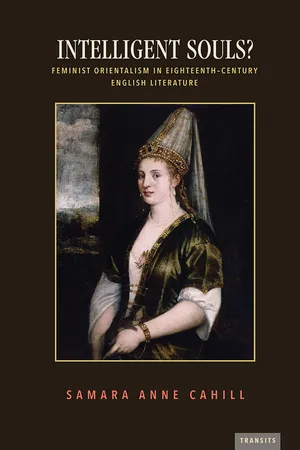
Intelligent Souls? offers a new understanding of Islam in eighteenth-century Britain. Samara A. Cahill explores two overlapping strands of thinking about women and Islam, which produce the phenomenon of "feminist orientalism." One strand describes seventeenth-century ideas about the nature of the soul used to denigrate religio-political opponents. A second strand tracks the transference of these ideas to Islam during the Glorious Revolution and the Trinitarian controversy of the 1690s. The confluence of these discourses compounded if not wholly produced the stereotype that Islam denied women intelligent souls. Surprisingly, women writers of the period accepted the stereotype, but used it for their own purposes. Rowe, Carter, Lennox, More, and Wollstonecraft, Cahill argues, established common ground with men by leveraging the "otherness" identified with Islam to dispute British culture's assumption that British women were lacking in intelligence, selfhood, or professional abilities. When Wollstonecraft wrote A Vindication of the Rights of Woman she accepted that view as true—and "feminist orientalism" was born, introducing a fallacy about Islam to the West that persists to this day. Published by Bucknell University Press. Distributed worldwide byRutgers University Press.
eBook - ePub
Intelligent Souls?
Feminist Orientalism in Eighteenth-Century English Literature
- English
- ePUB (mobile friendly)
- Available on iOS & Android
eBook - ePub
About this book
Information
Publisher
Bucknell University PressYear
2019Print ISBN
9781684480975
9781684480982
eBook ISBN
9781684480999
Topic
Literatur1
THE NEGATIVE IDEAL
THE ISLAMOPHOBIC USE OF MISOGYNISTIC mortalism—the accusation that Islam denies that women have immortal souls and, therefore, intelligence—became useful in the English (and later British) context as a way of rhetorically fabricating a Protestant unity that could never exist. This assertion of unity was important in the face of a series of exegetical, doctrinal, and political controversies. Among them was the Trinitarian Controversy of the 1690s in which the language of Trinitarianism (“substance,” “person”) came under such intense pressure that it threatened to collapse. The concept of the Trinity mattered because it was foundational to Anglican identity and was enshrined in English law. The Trinitarian Controversy has been extensively discussed, most thoroughly by Philip Dixon, and my concern in this chapter is not so much to rehearse the controversy itself as to lay out the circuitous route by which the exclusion of Islam became central to defenses of Anglican orthodoxy in the 1690s. In the next chapter I discuss how women writers drew on this rhetorical framework in their arguments for women’s intelligence after the 1690s. But to understand this rhetorical context requires some background on the antagonism felt by several groups—including Roman Catholics, High Church Anglicans, Socinians, and Dissenters—toward the set of ecumenically minded Anglican ministers known as the “Latitudinarians.” A very brief overview of the religiopolitical background of this antagonism will help to clarify why Anglicans, and particularly those known as “Latitudinarian” Anglicans, would have had an investment in excluding Islam from English identity.
THE PURITY OF CHRISTIAN FAITH
King Charles II ascended the English throne in 1660. After the upheaval of the Civil Wars, it seemed that religious uniformity, or at least a Church of England that could encompass all English Protestants, would reinforce social stability. But including all Protestants within the Church of England proved difficult. The result was the Clarendon Code, a series of acts that penalized those Protestants who could not accept the Book of Common Prayer or what it contained—the Thirty-Nine Articles of Religion, the Church of England’s statement of doctrine. Those Protestants who could not approve of the Thirty-Nine Articles came to be known as Dissenters (or nonconformists).
Part of the Clarendon Code, the Act of Uniformity of 1662 required the Church of England’s Book of Common Prayer to be used in religious services. “Institutionalised Dissent” commenced with the ejection of “ministers, university dons and schoolteachers who refused to accept the Book of Common Prayer.”1 The Act of Uniformity thus informed the “literary culture aligned with Protestant dissent” that included writers like John Milton, John Bunyan, and Daniel Defoe.2 The marginalization of Dissent was enforced until the repeal of the Corporation and Test Acts in 1828. In short, between 1662 and 1828, “Anglican exclusiveness and resentment triumphed over Protestant ecumenicism.”3 The Church of England was bulwarked by state power, but it did not represent all English Protestants. Nor did it represent English Catholics, who hastened to point out any inconsistencies between Trinitarian orthodoxy (which Roman Catholics and Anglicans shared) and the departures of Anglicanism from Roman Catholic doctrine. For instance, in the “rule of faith” controversy of the 1680s, English Catholics charged the Latitudinarians with Socinianism because they had defended the use of reason in scriptural interpretation.4 I discuss Socinianism at length below, but, very broadly speaking, it was identified with an exegetical tradition that denied Christian mysteries, particularly Christ’s identity with God the Father. Socinianism therefore, and most significantly for this argument, rejected the Trinity. It had this in common with Islam, which considers Jesus Christ a prophet, but denies that he is consubstantial with the Father or that he died to atone for human sin. In the 1680s, then, Catholics were using Trinitarian orthodoxy to challenge defenses of Protestant exegesis.
A further complication of English Protestantism occurred in 1688–89 when the Roman Catholic king James II, who had come to the throne after the death of his brother, fled (or abdicated) from England. His Protestant daughter and her husband, Mary and William of Orange, ascended the throne. They soon issued what is now commonly referred to as the Act of Toleration (1689); it granted limited concessions to Protestants outside of the Church of England. But the Act of Toleration left in place two of the most discriminatory pieces of legislation, the Corporation Act (1661) and the Test Act (1673), which regulated access to “ ‘offices of trust,’ whether civil or military, under the Crown.” To hold such offices required “receiving the sacrament of holy communion according to the rites of the Church of England.”5 Though some Church of England ministers mobilized a “comprehension” scheme—by which they intended “modifying liturgy and discipline … to allow reincorporation of some moderate Dissenters or leaving most Dissenters free to worship as they would”—this project ultimately failed.6 Circumscribed “toleration” and legal marginalization of Dissenters were the norm for the entirety of the eighteenth century. The “Occasional Conformity” debate, which resulted in the passing of the Occasional Conformity Act in 1711, derived from the practice of those who were not members of the Church of England occasionally (at least once a year) taking communion according to its rites so that they could qualify for these employments. The Occasional Conformity controversy effectively ended in 1717 when George I, the first of the Hanoverian kings, prorogued Convocation. This was a crucial decision, for Convocation was the official assembly of bishops and clergy and the main instrument by which certain Anglicans tried to assert an ecclesiastical authority independent of the Crown. Meetings of Convocation were merely formal from 1717 until the nineteenth century. Parliament repealed the Occasional Conformity Act in 1719.
This is a very broad portrait of the legal status and frustrations of Protestants who did not accept the Book of Common Prayer. But there were profound divisions even among those Protestants who did accept it. After William and Mary came to the throne in the “Glorious Revolution” of 1688, the Church of England clergy were required to take an oath of loyalty that recognized William and Mary as England’s monarchs. Those bishops and clergy who refused to swear the oath (nonjurors) were deprived of their sees in February 1690 and new ministers were ultimately consecrated in their stead. The ejection of the nonjurors left ecclesiastical power in the hands of the so-called Latitudinarian ministers. It also “transformed the whole tenor of counter-revolutionary Anglicanism,” resulting, ultimately, in a “church in danger” polemic in the late seventeenth and early eighteenth centuries.7 High Church Anglicans (who favored liturgical ritualism and a more conservative model of ecclesiastical authority) tried to wrest power away from the “Latitudinarian” Anglicans by accusing them of being inadequate shepherds of their Christian flock—of giving too much latitude on questions of Anglican orthodoxy and, therefore, of imperiling the Protestant identity of England. After England and Wales merged with Scotland to become the United Kingdom (1707) the “Church of England” was increasingly referred to as the Anglican Church. In short, among Roman Catholics, Dissenters, High Church Anglicans, and—ultimately—deist freethinkers, the Latitudinarian Anglicans were the beleaguered but nevertheless dominant religious group in England. But who were these men?
“Latitudinarian” is a useful but notoriously imprecise term that belies the complexity and diversity of thought among the men generally identified as such. But, very broadly speaking, “Latitudinarian” usually suggested an inclination to see the relationship of reason and religion as one of cooperation rather than antagonism and to approve of religious toleration (of non-Anglican Protestants). Influential ministers would include Archbishop John Tillotson; his successor Archbishop Thomas Tenison; Edward Stillingfleet, bishop of Worcester; Simon Patrick, bishop of Ely; and Gilbert Burnet, bishop of Salisbury. Burnet was the author of An Exposition of the Thirty-nine Articles of the Church of England (1699), often called the “manifesto of the latitudinarian party.”8 There were also political and geographic associations: Latitudinarians were “prominent London divines who opposed James II and received advancement under his successors.”9 The Latitudinarians were at the center of the Trinitarian Controversy.10
The reasons for this were multiple. First, Trinitarian orthodoxy was enshrined in the Thirty-Nine Articles, which codified the doctrine of the Church of England and to which all clergy of the Church of England had to subscribe. Along with the Athanasian Creed, the Thirty-Nine Articles were enforced “on clergymen when taking orders, and on undergraduates either on taking their degree (at Cambridge) or in order to matriculate (at Oxford).”11 This meant that Trinitarian orthodoxy was enforced by the state on clergy, officeholders, and those who wished to attend university.
Second, the Latitudinarians were particularly close to William of Orange and were in a position to ask for his intervention when defending themselves against those (like the nonjurors and High Church Anglicans) who felt excluded by the Revolution Settlement. Indeed, Archbishop Tenison asked King William to intervene in the Trinitarian Controversy, which resulted in the issuance of Directions to our Arch-Bishops and Bishops for the Preserving of Unity in the Church, and the Purity of Christian Faith, Concerning the Holy Trinity (February 3, 1696). This was followed in 1697 by the Blasphemy Act, which “prescribed three years imprisonment for those convicted of anti-trinitarian belief.”12 The Blasphemy Act, though rarely used, was not amended until the Doctrine of the Trinity Act (1813). In Scotland, which had passed an earlier Blasphemy Act, Thomas Aikenhead, who had allegedly scorned the Trinity, became “the last person to be executed for heresy in the British Isles” in 1697.13
Third, the Latitudinarians came under attack specifically for their supposed heterodoxy and had to defend themselves—against charges of Socinianism—by distancing themselves not only from the Church of Rome but also from the charge of free thinking. Scholars have widely acknowledged the fast-and-loose deployment of religious pejoratives in this period, pejoratives that were often highly inaccurate. The Latitudinarians were a prime target of such pejoratives and often returned the rhetoric in kind.14 The historically situated development of this rhetorical quagmire is how Islam came to be excluded from the British political establishment (which was officially Trinitarian) and extolled by certain political theorists as an alternate legislative model.15
Islam and Socinianism were linked because of their shared rejection of the Christian Trinity, which associated them with the Christological disputes and the Trinitarian Controversy of the early church.16 But the association was more complicated than that. Anglican thinkers, in their refutations of Roman Catholic dogma, often turned to the doctrines of the early church. Roughly speaking, the “early church” refers to Christianity before it received the official sanction of tempora...
Table of contents
- Cover
- Series Page
- Title Page
- Copyright
- Dedication
- Contents
- Introduction: Foreign Intelligence
- 1. The Negative Ideal
- 2. Minding the Gap
- 3. The Canal of Pleasure
- 4. A “Foreign and Uninteresting” Subject
- 5. The “Mahometan Strain”
- Epilogue: Save Our Souls?
- Bibliography
- Index
- About the Author
- Series List
Trusted by 375,005 students
Access to over 1.5 million titles for a fair monthly price.
Study more efficiently using our study tools.
Frequently asked questions
Yes, you can cancel anytime from the Subscription tab in your account settings on the Perlego website. Your subscription will stay active until the end of your current billing period. Learn how to cancel your subscription
No, books cannot be downloaded as external files, such as PDFs, for use outside of Perlego. However, you can download books within the Perlego app for offline reading on mobile or tablet. Learn how to download books offline
We are an online textbook subscription service, where you can get access to an entire online library for less than the price of a single book per month. With over 1.5 million books across 990+ topics, we’ve got you covered! Learn about our mission
Look out for the read-aloud symbol on your next book to see if you can listen to it. The read-aloud tool reads text aloud for you, highlighting the text as it is being read. You can pause it, speed it up and slow it down. Learn more about Read Aloud
Yes! You can use the Perlego app on both iOS and Android devices to read anytime, anywhere — even offline. Perfect for commutes or when you’re on the go.
Please note we cannot support devices running on iOS 13 and Android 7 or earlier. Learn more about using the app
Please note we cannot support devices running on iOS 13 and Android 7 or earlier. Learn more about using the app
Yes, you can access Intelligent Souls? by Samara Anne Cahill in PDF and/or ePUB format, as well as other popular books in Literatur & Frauenrechtlerische Literaturkritik. We have over 1.5 million books available in our catalogue for you to explore.