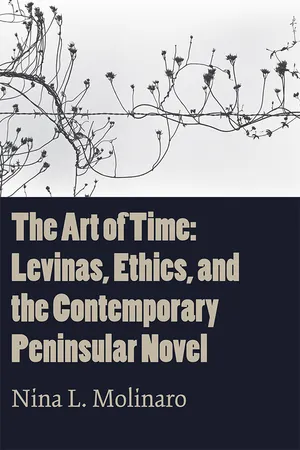
Ethics, or the systematized set of inquiries and responses to the question "what should I do?" has infused the history of human narrative for more than two centuries. One of the foremost theorists of ethics during the twentieth century, Emmanuel Levinas (1906-1995) radicalized the discipline of philosophy by arguing that "the ethical" is the foundational moment for human subjectivity, and that human subjectivity underlies all of Western philosophy. Levinas's voice is crucial to the resurging global attention to ethics because he grapples with the quintessential problem of alterity or "otherness, " which he conceptualizes as the articulation of, and prior responsibility to, difference in relation to the competing movement toward sameness.Academicians and journalists in Spain and abroad have recently fastened on an emerging cluster of peninsular writers who, they argue, pertain to a discernible literary generation, provisionally referred to as Generación X. These writers are distinct from their predecessors; they and their literary texts are closely related to the specific socio-political and historical circumstances in Spain; and their novels relate stories of more and less proximity, more and less responsibility, and more and less temporality. In short, they trace the temporal movement of alterity through narrative.Published by Bucknell University Press. Distributed worldwide byRutgers University Press.
- English
- ePUB (mobile friendly)
- Available on iOS & Android
eBook - ePub
About this book
Information
Publisher
Bucknell University PressYear
2019Print ISBN
9781684481279
9781684481286
eBook ISBN
9781684481354
Table of contents
- Cover
- Title Page
- Copyright Page
- Dedication
- Contents
- Chapter 1. Ethics, Alterity, and Levinas
- Chapter 2. Spain’s Generación X
- Chapter 3. Repeating the Same Violence, or The Failure of Synchrony: Veo veo, El frío, and Mensaka
- Chapter 4. The Betrayal of Diachrony: El secreto de Sara, Anatol y dos más, and Tocarnos la cara
- Chapter 5. Diachrony and Saying: Arde lo que será, Sentimental, and La fiebre amarilla
- Afterword
- Acknowledgments
- Notes
- Bibliography
- Index
- About the Author
Trusted by 375,005 students
Access to over 1.5 million titles for a fair monthly price.
Study more efficiently using our study tools.
Frequently asked questions
Yes, you can cancel anytime from the Subscription tab in your account settings on the Perlego website. Your subscription will stay active until the end of your current billing period. Learn how to cancel your subscription
No, books cannot be downloaded as external files, such as PDFs, for use outside of Perlego. However, you can download books within the Perlego app for offline reading on mobile or tablet. Learn how to download books offline
We are an online textbook subscription service, where you can get access to an entire online library for less than the price of a single book per month. With over 1.5 million books across 990+ topics, we’ve got you covered! Learn about our mission
Look out for the read-aloud symbol on your next book to see if you can listen to it. The read-aloud tool reads text aloud for you, highlighting the text as it is being read. You can pause it, speed it up and slow it down. Learn more about Read Aloud
Yes! You can use the Perlego app on both iOS and Android devices to read anytime, anywhere — even offline. Perfect for commutes or when you’re on the go.
Please note we cannot support devices running on iOS 13 and Android 7 or earlier. Learn more about using the app
Please note we cannot support devices running on iOS 13 and Android 7 or earlier. Learn more about using the app
Yes, you can access The Art of Time by Nina L Molinaro in PDF and/or ePUB format, as well as other popular books in Literature & European Literary Criticism. We have over 1.5 million books available in our catalogue for you to explore.