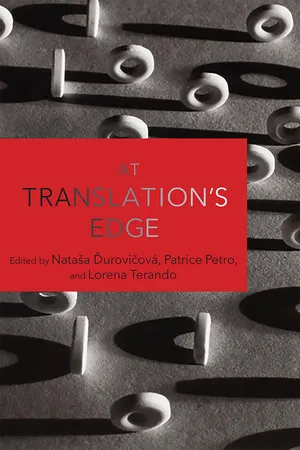
Since the 1970s, the field of Translation Studies has entered into dialogue with an array of other disciplines, sustaining a close but contentious relationship with literary translation. At Translation's Edge expands this interdisciplinary dialogue by taking up questions of translation across sub-fields and within disciplines, including film and media studies, comparative literature, history, and education among others. For the contributors to this volume, translation is understood in its most expansive, transdisciplinary sense: translation as exchange, migration, and mobility, including cross-cultural communication and media circulation. Whether exploring the Universal Declaration of Human Rights or silent film intertitles, this volume brings together the work of scholars aiming to address the edges of Translation Studies while engaging with major and minor languages, colonial and post-colonial studies, feminism and disability studies, and theories of globalization and empire.
eBook - ePub
At Translation's Edge
- English
- ePUB (mobile friendly)
- Available on iOS & Android
eBook - ePub
At Translation's Edge
About this book
Information
Publisher
Rutgers University PressYear
2019Print ISBN
9781978803336
9781978803381
eBook ISBN
9781978803350
PART 1 NEW PERSPECTIVES ON TRANSLATION
1
THE EVENTFULNESS OF TRANSLATION
Temporality, Difference, and Competing Universals
LYDIA H. LIU
Imagine a poem fluttering down in the sky and somehow falling into your hands. You might think that this imaginary scenario would come from a surrealist movie, but I am referring to neither surrealist fantasy nor a writer’s delirium. It is related to one of the scandals of translation in modern history. The scandal gripped my attention when I first learned that the U.S. Central Intelligence Agency prepared a Russian translation of T. S. Eliot’s poem Four Quartets and airdropped it onto the territory of the Soviet Union during the Cold War.1 This minor escapade quickly passed into oblivion, but the worldwide promotion of postwar modernist art and literature by the CIA and the IRD (the Information Research Department of the British Foreign Office) appears singularly effective in hindsight, so effective that Frances Stonor Saunders, who conducted research in the CIA’s archives, came to the conclusion that the West won the Cold War mainly by conquering the world of arts and letters with weapons of the mind, rather than through the arms race or the economic sanctions that are generally considered responsible for the downfall of the socialist bloc.
Although critics may agree or disagree with Saunders’s analysis, they need not accept her conclusion to notice a few striking consequences. One of them is that the majority of CIA- backed artists and writers—and there is a long list of them—have made their way into the modernist literary and artistic canon of the West and have systematically been translated as “world literature” around the world, where, for instance, George Orwell’s works are read in more languages than Mikhail Sholokhov’s novels, even though Sholokhov, in the candid opinion of a literary scholar such as myself, is by far a better writer. And as we turn to twentieth-century poets, T. S. Eliot is perhaps taught in more languages of the world than are Pablo Neruda, Nâzım Hikmet, and Bei Dao combined. It seems that the bets that the CIA placed on Eliot, Orwell, Abstract Expressionists, and other writers or artists whom they favored—airborne or subterranean—have handsomely paid off. Critics sometimes attribute this success to the sophisticated taste and foresight of CIA and IRD covert operators and their collaborators. There may be some truth in this analysis, but taste or aesthetic judgment is often mystifying. Taste cannot explain, for example, the remarkable coincidence whereby many of the writers blacklisted by Senator McCarthy and disfavored by the CIA on nonartistic grounds during the Cold War have subsequently been marginalized in contemporary literary studies or dropped out of the canon altogether after World War II.2 Why does aesthetic judgment take a backseat when it comes to excluding certain writers from the literary canon, but plays a decisive role when it comes to including certain other writers? Is the making of the literary canon fundamentally political? Or is this merely a case of politics interfering with literature? What role, if any, does global politics play in the struggle over literary productions and their chances of survival in the modern world?3 Can such political questions throw fresh light on some of the blind spots in the field of translation studies?
These questions have prompted my study of translation as a political problem. The more I learn about the cultural politics of the Cold War, the less I feel inclined to treat global politics as outside interference. Rather than close off the boundaries of literature and politics and render them external to each other, I propose that we, first, examine the dynamic interplay of forces and circumstances that precipitate the act of translation as an act of inclusion and exclusion. Such forces and circumstances are not so much external to translation as prior to any translator’s determination of texts to be translated, a determination excluding other works. The study of these processes can help illuminate the meaning of the political more clearly than an examination of the intentions of writers and translators, or their idiosyncratic tastes.
Second, there is a formidable obstacle we must confront if we decide to undertake this line of investigation in translation studies. The obstacle, which often stands in the way of our understanding of the political, is the familiar mental image of translation as a process of verbal communication, linguistic reciprocity, or equivalences, or an issue of commensurability or incommensurability. It is almost as if the promise of meaning or its withdrawal among languages were the only possible thing—blessing or catastrophe—that could happen to the act of translation.4 I have critiqued these logocentric assumptions in translation studies elsewhere and will not reiterate my position here. To do so would draw us through another round of critiques of linguistics, philology, the philosophy of language, and cultural anthropology, which would draw us too far afield. I should mention briefly, though, that when I proposed the idea of translingual practices many years ago, I was trying to grapple with epistemological issues about how we study translation and address conceptual pitfalls in philological approaches.5 One question I came very close to asking but did not ask in the mid-1990s was this: Can the eventfulness of translation itself be thought? This question, as it now seems to me, may lead to a more promising approach to the study of translation than either the communication model or the biblical model.6 And in the context of my chapter in this volume, the question allows me to develop a new critical method for discerning and analyzing the political in regard to translation.
The reason I urge us to develop new methods for analyzing translation is because the problem of translation not only troubles the study of language, literature, philosophy, and cultural anthropology but also cuts across other disciplines and fields. In molecular biology, for example, the idea of translation is ubiquitous and appears in the guise of a metaphor—unquestioned and undertheorized—used to conceptualize the biochemical processes of DNA and RNA. The mobility of this metaphor in the hands of scientists and social scientists has greatly outpaced our ability to think clearly about translation, much less come up with a method to analyze its discursive behavior across the disciplines. In short, translation is no more just a linguistic matter than linguistic differences can be reduced to cultural differences. I believe we have reached the point when the eventfulness of translation itself must be interrogated.7
In the first section below, I introduce my methodological reflections and develop some ideas about the multiple temporalities of translation in what I call differentially distributed discursive practices across languages. This analysis leads to a discussion of universalism and cultural difference in the second section, which is focused on the multilingual making of one of the best-known documents of the postwar period: the Universal Declaration of Human Rights (hereafter UDHR) of the United Nations. Here I examine P. C. Chang’s contribution as vice-chair on the Drafting Committee of the UDHR document—which also included chair Eleanor Roosevelt and other members—and analyze his philosophical contestation of parochial universalism at the UN in 1947–1948. I turn next to a remarkable vision of competing universalisms with a focus on Afro-Asian Writers Conferences and their translation projects in the 1950s. The third section shows how some of these projects were organized and pursued in response to the postwar geopolitics of that time. I conclude with some final reflections on translation and literary diplomacy and internationalism in the Cold War.
DISCURSIVE MOBILITY
In light of my initial question—Can the eventfulness of translation be thought?—I would say yes, but not until we begin by rethinking the relationship among text, interpretation, and event. If all acts of translation—and, by extension, all textual work—are mediated by temporality and spatiality, do all translated texts qualify as events? The answer hinges on how the idea of “event” is defined or philosophically worked out, but that is not the task of this chapter.8 Instead of indulging in exercises of definition that belong elsewhere, I choose to focus on the multiplicity of differentially distributed discursive fields as the site—in terms of both spatiality and mobility—of any translated text and explore their temporalities as instances of events. For no event worthy of the name—as naming is always part of the process—could possibly exist outside of the discursive practices that organize it and make it emerge as such, much less the event of translation, which always presupposes the multiplicity of discursive fields across different languages. The first step toward a fruitful understanding of the eventfulness of translation, therefore, is to develop a conceptual framework for analyzing the interplay of temporality and discursive practices across languages.
Before we contemplate the possibility of such a framework, we must address yet another potential objection: What is to be achieved through the proposed study of eventfulness of translation? Why not be content with our old philological methods? Is it not sufficient to analyze, say, a word-for-word rendering of a poem from English to Russian or the case of a mismatched verb in translated text? I would not rule out the value of this kind of philological work so long as it does not limit our understanding of how a work of translation is brought into being in the first place, and why one writer is deemed more worthy of translation into foreign languages than other writers. As a matter of fact, T. S. Eliot found himself compelled to address these issues when he accepted the Nobel Prize in Literature. In his acceptance speech at the Nobel Banquet in Stockholm in 1948, Eliot stated,
If this were simply the recognition of merit, or of the fact that an author’s reputation has passed the boundaries of his own country and his own language, we could say that hardly any one of us at any time is, more than others, worthy of being so distinguished. But I find in the Nobel Award something more and something different from such recognition. It seems to me more the election of an individual, chosen from time to time from one nation or another, and selected by something like an act of grace, to fill a peculiar role and to become a peculiar symbol. A ceremony takes place, by which a man is suddenly endowed with some function which he did not fill before. So the question is not whether he was worthy to be so singled out, but whether he can perform the function which you have assigned to him: the function of serving as a representative, so far as any man can be, of something of far greater importance than the value of what he himself has written.9
Eliot’s disavowal of his unique accomplishment as a poet may have been motivated by real modesty, but it simultaneously touches on the truth of what it means to “fill a peculiar role and to become a peculiar symbol” or to “perform a function” and serve “as a representative.” And of what is he a representative? When Eliot’s Four Quartets leapt over the spatial, linguistic, and ideological divide of the Cold War to fall from the sky—let’s hope not directly into a river—the Russian translation was probably taken by covert operators to represent good poetry from the Free World as opposed to the dogma of socialist realism. In that case, the poet could do very little about the idiosyncratic decisions of those operators who instrumentalized his work.
It is interesting that Eliot was keenly aware of his own passivity when it comes to being selected, being endowed, being singled out, and being assigned by others and so on. To emphasize his passive role is not to extricate him from the complicity with the CIA but to point out that, in spite of himself, Eliot’s name and his poetry do indeed float around like a symbol. Perhaps more mobile and airborne than other symbols, but nevertheless a symbol, often outside of his control but which he must live up to. And live up to it he did. Furthermore, the symbol called T. S. Eliot is assigned to function in a multiplicity of languages and discursive fields that inevitably mark a literary work for translation and international distribution. This discursive marking, I emphasize, holds out the potential of turning a symbol into an event, or an event into a symbol, back and forth.
In that sense, the question as ...
Table of contents
- Cover
- Series Page
- Title Page
- Copyright
- Contents
- Introduction: At Translation’s Edge
- Part 1: New Perspectives on Translation
- Part 2: Translation at the Limits of the Nation-State
- Part 3: Translation’s Practices and Politics
- Acknowledgments
- Notes on Contributors
- Index
Trusted by 375,005 students
Access to over 1.5 million titles for a fair monthly price.
Study more efficiently using our study tools.
Frequently asked questions
Yes, you can cancel anytime from the Subscription tab in your account settings on the Perlego website. Your subscription will stay active until the end of your current billing period. Learn how to cancel your subscription
No, books cannot be downloaded as external files, such as PDFs, for use outside of Perlego. However, you can download books within the Perlego app for offline reading on mobile or tablet. Learn how to download books offline
Perlego offers two plans: Essential and Complete
- Essential is ideal for learners and professionals who enjoy exploring a wide range of subjects. Access the Essential Library with 800,000+ trusted titles and best-sellers across business, personal growth, and the humanities. Includes unlimited reading time and Standard Read Aloud voice.
- Complete: Perfect for advanced learners and researchers needing full, unrestricted access. Unlock 1.5M+ books across hundreds of subjects, including academic and specialized titles. The Complete Plan also includes advanced features like Premium Read Aloud and Research Assistant.
We are an online textbook subscription service, where you can get access to an entire online library for less than the price of a single book per month. With over 1.5 million books across 990+ topics, we’ve got you covered! Learn about our mission
Look out for the read-aloud symbol on your next book to see if you can listen to it. The read-aloud tool reads text aloud for you, highlighting the text as it is being read. You can pause it, speed it up and slow it down. Learn more about Read Aloud
Yes! You can use the Perlego app on both iOS and Android devices to read anytime, anywhere — even offline. Perfect for commutes or when you’re on the go.
Please note we cannot support devices running on iOS 13 and Android 7 or earlier. Learn more about using the app
Please note we cannot support devices running on iOS 13 and Android 7 or earlier. Learn more about using the app
Yes, you can access At Translation's Edge by Nataša Durovicova,Patrice Petro,Lorena Terando, Lorena Terando,Lorena Terando in PDF and/or ePUB format, as well as other popular books in Languages & Linguistics & Linguistics. We have over 1.5 million books available in our catalogue for you to explore.