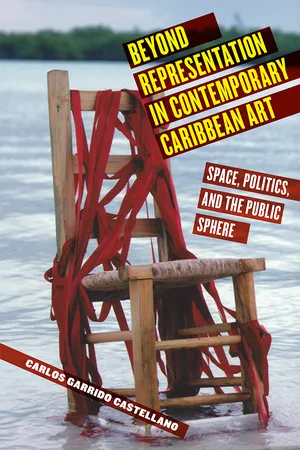
The Caribbean has been traditionally associated with externally devised mappings and categories, thus appearing as a passive entity to be consumed and categorized. Challenging these forces and representations, Carlos Garrido Castellano argues that something more must be added to the discussion in order to address contemporary Caribbean visual creativity. Beyond Representation in Contemporary Caribbean Art arises from several years of field research and curatorial activity in museums, universities, and cultural institutions of Jamaica, Trinidad, Martinique, Guadeloupe, Cuba, Dominican Republic, Puerto Rico, and the United States. This book explores the ways in which Caribbean individuals and communities have recurred to art and visual creativity to create and sustain public spaces of discussion and social interaction. The book analyzes contemporary Caribbean art in relation to broader discussions of citizenship, cultural agency, critical geography, migration, and social justice. Covering a broad range of artistic projects, including curatorial practice, socially engaged art, institutional politics, public art, and performance, this book is about the imaginative ways in which Caribbean subjects and communities rearrange the sociocultural framework(s) they inhabit and share.
eBook - ePub
Beyond Representation in Contemporary Caribbean Art
Space, Politics, and the Public Sphere
- English
- ePUB (mobile friendly)
- Available on iOS & Android
eBook - ePub
Beyond Representation in Contemporary Caribbean Art
Space, Politics, and the Public Sphere
About this book
Information
Publisher
Rutgers University PressYear
2019Print ISBN
9780813594804
9780813594811
eBook ISBN
9780813594828
Topic
ArtSubtopic
Art General1
Being Here and There
Curatorial-Specific Approaches to Caribbean Reality
Curatorial function is, thus, inherently restricted by the interests of larger or more powerful groups and constituencies. To pretend that any type of alternative field of action exists outside of the web of market or institutionally dominated interests is a fallacy.
—Belkis Ramírez (1996, 15)
“Why do we need curators anyway?”
This last question shocked me. In 2010, while I was doing fieldwork in Santiago de los Caballeros (Dominican Republic), I attended a round table led by the Cuban curator Iván de la Nuez, whose book Un mapa de sal (A salt-made map, 2010) related to the seminar topics. He was visiting the Dominican Republic and decided to transform a conventional round table into an open-to-all debate with the local art crew of Santiago. After a short presentation, de la Nuez urged members of the audience to express their concerns on creativity, institutional dynamics, and any other pressing issue they were facing. The statements were predictable, ranging from shy introductions to passionate defenses of the importance of Santiaguero artists in the definition of the Dominican national imaginary. As in any improvised artistic gathering, the mood started heating up after the speakers grew more confident. Then an artist asked a question that took the atmosphere of the meeting back to its initial state: “Why do we need curators anyway?”
The figure of the curator has always been a problematic one. Not long ago, the image of the curator was easily identifiable: when it came to mind, one could not help thinking of powerful administrators, dictatorial figures scrutinizing and ruling over exhibition space. The history of curatorship, Terry Smith argues (2012a), is a history of curatorial practices (exhibition-making at the beginning), both the practices themselves and the role played by curators. In that regard, he argues, “the purpose of curating today is something like this: To exhibit (in the broad sense of show, offer, enable the experience of) contemporary presence and the currency that is contemporaneity as these are manifest in art present, past, and multitemporal, even atemporal” (2012a, 29). Curating would then be a matter of doing and simultaneously reflecting reflexively on that doing (Fowler 2007). The question launched at the round table in Santiago de los Caballeros arose out of the artist’s perception of the uselessness and unproductivity of curators (“they produce nothing, we can do well without their help”), as much as from suspicion about their interference (“they control how our production is displayed and understood”).
Those questions are even more pressing when translated to the Caribbean, where the development of curatorial practices has been marked since an early moment by external interference. Curatorial parachuting is just the last stage in a long tradition of transforming Caribbean reality into visual commodities, a tradition dating from colonial times. Caribbean curatorial agents (not exclusively trained curators but also artists, cultural managers, or social animators, if this distinction between roles holds any value in our days) have striven to counter an international interest in the region that produced art exhibitions delimiting what the Caribbean is, where it begins and ends, and how it should be displayed, understood, and dealt with. International curators, on the other hand, have always provided “local” artists an opportunity of international recognition, networking, and career development. The words of the artist who attended de la Nuez’s lecture in Santiago were shaped by ambivalent expectations of curatorial practice. Curators were imported goods and modern-day colonizers in equal parts, empowering agents or culprits of “shows of force” (Luke 1992).
Four years later, in 2014, I was back in the Dominican Republic. On this occasion, my fourth visit to the country, I was the curator. I organized a retrospective bringing together work produced by the artist Belkis Ramírez over the previous twenty years. Ramírez is a well-known figure in the Dominican Republic landscape since the late 1980s. By then, we had a relatively long history of collaboration and friendship: In 2010 I interviewed Ramírez as part of a set of conversations with Dominican artists (Garrido Castellano 2011, 163–189); in the three months I spent in the country that year, she and the other artists who belonged to the Quintapata collective shared many conversations, challenged my ideas, and were eager to join me in studio visits, exhibition meetings, and talks.1 Three years later, the “Quintapatas” asked me to be their spokesperson in designing the intervention they brought to the Latin American Pavilion of the Venice Biennial, a collaborative piece called DNA curated by Paz Guevara.2 Organizing the retrospective, however, placed us in a different situation, in many respects. Firstly, I was a young, foreign curator coming from the Dominican Republic’s former metropolis, and therefore by definition an outsider. Secondly, Ramírez’s career path of more than two decades was well known by the Dominican cultural audience. Thirdly, the space chosen for the show, a colonial house in Santo Domingo’s Ciudad Colonial hosting the Centro Cultural de España (CCE), had a long history of innovative and daring exhibition-making in the local art milieu. And finally, our show just followed the Quintapata’s participation in Venice. Expectations were high, and they were matched by our enthusiasm.
To be sure, Ramírez had her own ghosts. Doing a retrospective exhibition after twenty years is a difficult task in many ways, one of these being the need to (re)view the fruits of a long career from the perspective of the present. Self-valorization and hesitation are the bread and butter of every artist; multiply their effect by twenty years, and a complicated situation to handle, to say the least, will arise. Twenty years of sustained artistic output is a long achievement but also a burden in which failures, success, influences, and histories intermingle. On top of that, there were practical issues we needed to resolve: some of the pieces we wanted to include were lost, others had deteriorated, and yet some others had been integrated in new installational devices and could not be removed from them. To deal with the situation, we decided to make our doubts visible. Many of the artworks that Ramírez created for the retrospective were shaped by an essayistic tone that was not as visible in previous pieces. Hasta que me guste (Until I like it) was an unusual retrospective from the moment we decided to focus on new material instead of creating a “Belkis Ramírez museum” with material with which the Dominican audience would already be familiar. In the place of actual artworks, we planted several artistic clues that the local public would easily recognize. Moreover, some installations updated old collaborations with colleagues and fellow creators who have accompanied Ramírez through those two decades, among them Pascal Meccariello, Raquel Paiewonsky, Citlaly Miranda, Frank Bueno, Alex Otero, and María Castillo.
The exhibition’s main issue was hesitation. For instance, Hasta que me guste, the piece that gave the whole display its title, presented four hours of conversations accessible to spectators once they entered a semi-sphere hanging from the art center entrance. At first, the dialogue is undistinguishable, but after a while spectators would recognize Ramírez’s voice commenting on the same exhibition they are visiting. I was the other interlocutor, and the conversation, in fact, consisted of selections from all the discussions we held until the project was fully configured. The exhibition was curated mostly through the continuous Skype conversations I held with Ramírez throughout 2013. Being separated by an ocean does not aid coordination, and although I had the advantage of knowing the space of the CCE from my stay in 2010 and subsequent visits, nothing could equal being there in person. In the absence of that, we at least had the advantage of knowing each other well. Hasta que me guste attempted to make use of this advantage while transmitting to the spectator the sense of disorientation lying behind any curatorial process.
An anecdote related to Hasta que me guste resulted in a situation that was revealing for both of us. At the exhibition opening, a relatively large audience gathered, among them a large woman who entered the sound installation and stayed there for a while, listening to our voices. I captured this moment in a photograph that seemed to perfectly stand for what we wanted to achieve through this exhibition: the vernacular image of the woman contrasted with the white design-like semi-sphere of the installation, fulfilling the intentions we had when we decided to situate hesitation and trial and error at the center of the CCE space. Without looking deliberately, we found “our perfect spectator,” one capable of fruitfully engaging with the ideas and stimuli we were presenting but also of challenging them and revealing their limitations. The installation Hasta que me guste was special for many reasons, and soon it became the central point of the exhibition, the piece people interacted with most. Aware of this, the CCE used the piece to advertise the whole show, only, instead of portraying “our perfect spectator,” they chose the image of a young urban man dressed casually while hanging out inside the sphere.
In my view, there was a big distance between the two images. The former was about hesitation but also about the capacity of audiences to subvert the messages sent out by artists and curators. There was something in that photograph that resisted categorization and confronted the solemn tone of the institutional space. The latter, however, clearly resembled a flyer for any contemporary art exhibition and therefore revealed how objectives can quickly be transformed into hype. We attempted to create an exhibition that would transmit to the audience a sense of density and instability. Although the exhibition was successful in terms of visitor numbers and we received positive feedback, its advertising image somehow contradicted our intentions, revealing how each exhibition hides many exhibitions inside it, portrays many agencies, regardless of the will of artists, curators, and institutions. In the end, exhibitions, like pictures, live their own life (see Mitchell 1996). So why do we need curators anyway?
The Caribbean Curatorial
Curating is, or can be, many things. It can imply reinforcing institutions or casting doubt on them; advertising artworks or withdrawing from the art market; enshrining artists or creating horizontal bonds. The curatorial goes far beyond exhibition-making, involving issues of education, organization, research, and participation.3 These are frequently overshadowed by art exhibitions and biennials, which in many cases are designed in a simplistic way, as “the locus where contemporary art is produced.” The preeminence of exhibition-making in our understanding of the potential of curatorial agency is not without consequences. Privileging temporary displays over deeper, investigative artistic forms, installing newness and originality as preconditions of artistic innovation, relying on a transnational “cultural class” jumping from one event to the next, are some of the values we tend to associate with curating. Yet curatorial agency is not limited to the here and now of temporary exhibitions, nor do all those exhibitions respond to the model I described above. More than that, curating has stopped being a privilege in the hands of a minority, and now involves, as Alex Farquharson states, “a shift in the conception of what curators do, from a person who works at some remove from the processes of artistic production, to one actively in the thick of it” (2003, 8).
However, these issues stand outside the debates on institutional politics and exhibition-making. The way art is produced and discussed nowadays has been shaped by what I will call a “postcolonial exhibitionary complex.” By this I understand, with Tony Bennett (1996), the ways in which institutions exercise control and impose authority not by concealing but by exhibiting.4 For Bennett, the institutions of confinement and the institutions of display constitute coexisting and intertwined forces determining, through self-regulation, the gap between individuals and institutions. The history of cultural institutions would then be the history of a specific relationship between audiences and display as well as one involving the creation of vantage points from which to see the world and to see oneself seeing; they would be “vantage points from which everyone could be seen, thus combining the functions of spectacle and surveillance” (62). Through this passing from conservational and restrictive to the making of exhibition, institutions will be ready to represent and exhibit “society itself—in its constituent parts and as a whole” as spectacle (62). Through the development of the technologies of seeing, Bennett establishes the division between seeing and being seen as full of colonial connotations: “And this power marked out the distinction between the subjects and the objects of power not within the national body but, as organized by the rhetoric of imperialism, between that body and other, ‘non-civilized’ peoples upon whose bodies the effects of power were unleashed with as much force and theatricality as had been manifest on the scaffold” (64).
According to Bennett, “power” operates in two different ways: first, as a matter of difference, a classical “us/them” rhetoric; and second, and more importantly, through the display of that difference by exhibiting in spaces designated for that specific purpose. It involves images as much as audiences and platforms. Power does not depend on the external will of an institution that commoditizes and swallows otherness but with the self-regulatory processes of an artistic community. As we will see in chapter 2, a struggle for visibility and representation within transnational scenarios has somehow blurred the weight that less visible, infrastructural practices emerging from different scenarios have in configuring effective and long-lasting public spheres. The commoditization of difference in discursive terms would be symptomatic not only on the continuities of central epistemic and cultural inequalities within our supposedly postcolonial reality; it will also lie behind epistemic and cultural divisions between subjects with institutional agency and subjects still confined to representation. This division, importantly enough, still holds a geographical appeal. The ways in which the public sphere associated with certain contexts is defined within and beyond the traditional frontiers of artistic practice in uneven ways, limiting curatorial agency to the role of representational exhibition-making (which is carried out in many cases by foreign “experts” who exert authority and legislate taste), is what I understand to be the postcolonial exhibitionary complex.
The history of Caribbean curatorial practices is deeply embedded in a similar situation. On the one hand, we cannot disregard the impact of large-scale mega-exhibitions, often produced outside the region, in determining understanding and images of the Caribbean and in deconstructing exhibitional Eurocentrism (Mosquera 1992). On the other hand, Caribbean curators and art institutions have attempted to counter the discourses produced about the region following external anxieties and imaginaries. Controlling what is shown, in which context, and by whom, has been as important as finding alternative ways of engaging visual regimes beyond display. Inventing new ways of telling is just as urgent as escaping the over-determination stemming from the insertion of Caribbean art into predefined geo-cultural mappings.5 The history of Caribbean curatorial agency is one of perseverance and imagination, of tenacity and originality. In the conversations I have had w...
Table of contents
- Cover
- Series Page
- Title Page
- Copyright
- Dedication
- Epigraphs
- Contents
- Introduction: Art, Space, and Agency in the Contemporary Caribbean
- 1. Being Here and There: Curatorial-Specific Approaches to Caribbean Reality
- 2. Caribbean Art Institutions, Critique, and the Public Sphere
- 3. Art Melting in Site-Specificity: Performance Art and Public Space in the Dominican Republic
- Color Plates
- 4. Toward a Diasporic Counterstreaming Caribbean Imagination
- 5. Subversive Alliances: Collaborative Agency beyond Representation
- Coda: Artistic Agency, Space, and the Praxis of Caribbean Studies
- Acknowledgments
- Notes
- References
- Index
- About the Author
Trusted by 375,005 students
Access to over 1.5 million titles for a fair monthly price.
Study more efficiently using our study tools.
Frequently asked questions
Yes, you can cancel anytime from the Subscription tab in your account settings on the Perlego website. Your subscription will stay active until the end of your current billing period. Learn how to cancel your subscription
No, books cannot be downloaded as external files, such as PDFs, for use outside of Perlego. However, you can download books within the Perlego app for offline reading on mobile or tablet. Learn how to download books offline
We are an online textbook subscription service, where you can get access to an entire online library for less than the price of a single book per month. With over 1.5 million books across 990+ topics, we’ve got you covered! Learn about our mission
Look out for the read-aloud symbol on your next book to see if you can listen to it. The read-aloud tool reads text aloud for you, highlighting the text as it is being read. You can pause it, speed it up and slow it down. Learn more about Read Aloud
Yes! You can use the Perlego app on both iOS and Android devices to read anytime, anywhere — even offline. Perfect for commutes or when you’re on the go.
Please note we cannot support devices running on iOS 13 and Android 7 or earlier. Learn more about using the app
Please note we cannot support devices running on iOS 13 and Android 7 or earlier. Learn more about using the app
Yes, you can access Beyond Representation in Contemporary Caribbean Art by Carlos Garrido Castellano in PDF and/or ePUB format, as well as other popular books in Art & Art General. We have over 1.5 million books available in our catalogue for you to explore.