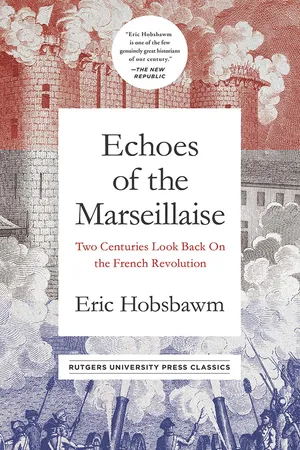
What was the French Revolution? Was it the triumph of Enlightenment humanist principles, or a violent reign of terror? Did it empower the common man, or just the bourgeoisie? And was it a turning point in world history, or a mere anomaly?E.J. Hobsbawm's classic historiographic study—written at the very moment when a new set of revolutions swept through the Eastern Bloc and brought down the Iron Curtain—explores how the French Revolution was perceived over the following two centuries. He traces how the French Revolution became integral to nineteenth-century political discourse, when everyone from bourgeois liberals to radical socialists cited these historical events, even as they disagreed on what their meaning. And he considers why references to the French Revolution continued to inflame passions into the twentieth century, as a rhetorical touchstone for communist revolutionaries and as a boogeyman for social conservatives. Echoes of the Marseillaise is a stimulating examination of how the same events have been reimagined by different generations and factions to serve various political agendas. It will give readers a new appreciation for how the French Revolution not only made history, but also shaped our fundamental notions about history itself.
eBook - ePub
Echoes of the Marseillaise
Two Centuries Look Back on the French Revolution
- English
- ePUB (mobile friendly)
- Available on iOS & Android
eBook - ePub
About this book
Information
Publisher
Rutgers University Press ClassicsYear
2018Print ISBN
9781978802377
9781978802384
eBook ISBN
9781978802391
CHAPTER 1
A Revolution of the Middle Class
The subtitle of this book is “Two Centuries Look Back on the French Revolution.” Looking backward, forward, or in any direction, always implies a point of view—in time, space, mental attitude, or other subjective perspective. What I see from my window overlooking Santa Monica as I write this, is real enough. I am not inventing the buildings, the palm trees, the parking lot six floors below me, or the hills beyond, barely visible through the smog. To this extent the theorists who see all reality purely as a mental construction beyond which analysis cannot penetrate, are mistaken, and in saying so at the outset, I am nailing my conceptual colours to some kind of mast. If the history we write about were indistinguishable from fiction, there would be no room for the profession of historian, and people like me would have been wasting their lives. Nevertheless, it is undeniable that what I see out of my window, or in looking back at the past, is not only the reality out there or back there, but a highly specific selection. It is both what I can see physically from the point where I find myself and under the given circumstances—for instance I cannot, without going to the other side of the building, see in the direction of Los Angeles, and I cannot see much of the hills until the weather improves—and what I am interested in seeing. Out of the infinity of what is objectively observable out there, I am in fact observing only a very limited selection. And, of course, if I were to look out at exactly the same scene from the same window some other time, I might find myself focusing on different aspects of it; that is, making a different selection. Nevertheless, it is almost inconceivable that I, or anyone else, looking out of this window at any time while the view remains as it is, would not see, or more precisely notice, certain inescapable features of the landscape: for instance the slim church spire just to one side of the large flat slab of an eighteen-storey building, and the cubic tower on top of its flat roof.
I do not want to labour this analogy between looking at a landscape and looking at a part of the past. In any case, I shall be returning to the point I have tried to make in the course of these pages. As we shall see, what people have read into the French Revolution as they have looked back on it in the two hundred years since 1789 has varied enormously, largely for political and ideological reasons. Yet two things about it have been generally accepted. The first is the general shape of the landscape at which they looked. Whatever the theories about the origins of the Revolution, all agree that there was a crisis in the old monarchy which, in 1788, led to the calling of the States General—the assembly representing the three estates of the realm, clergy, nobility, and the rest, the “Third Estate”—for the first time since 1614. Since they were first established the main political landmarks remain unchanged: the transformation of the States General, or rather the Third Estate, into the National Assembly, the acts visibly ending the old regime—the taking of the Bastille, the royal prison, on 14 July; the giving up of their feudal rights by the nobility on 4 August 1789; the Declaration of Rights; the transformation of the National Assembly into a Constituent Assembly that, between 1789 and 1791, revolutionised the administrative structure and organisation of the country, incidentally introducing the metric system to the world, and that drafted the first of the nearly twenty constitutions of modern France, a liberal constitutional monarchy. There is equally no disagreement about the facts of the double radicalisation of the Revolution after 1791, which led, in 1792, to the outbreak of war between revolutionary France and a varying coalition of counterrevolutionary foreign powers and domestic counterrevolutionary insurrections. This lasted, almost without a break, until 1815. It also led to the second Revolution of August 1792, which abolished the monarchy and instituted the Republic—a new, utterly revolutionary era in human history—symbolised, with a slight delay, by a new calendar. Starting at year I, the calendar abolished the ancient weekly division, giving the months new names in order to provide history students with headaches but also with useful mnemonics. (The new era and its calendar lasted just twelve years.)
The period of the radical revolution from 1792 to 1794, and especially the period of the Jacobin Republic, also known as “The Terror” of 1793–1794, form an even more universally recognised landmark; as does the end of the Terror, the famous Ninth Thermidor, which saw the arrest and execution of its leader Robespierre—although, about no period of the Revolution have opinions differed more dramatically. The regime of moderate liberalism and graft that took over for the next five years lacked an adequate basis of political support or the ability to restore conditions of stability and, as once again everyone agrees, it was replaced on the famous Eighteenth Brumaire in 1799 by a barely disguised military dictatorship, the first of many in modern history, and as a result of the coup of a successful young ex-radical general, Napoleon Bonaparte. Most modern historians end the French Revolution at this point, although, as we shall see, during the first half of the nineteenth century, the regime of Napoleon, at all events until he declared himself Emperor in 1804, was very commonly seen as the institutionalisation of the new revolutionary society. You may recall that Beethoven did not withdraw the dedication of the Eroica symphony to Napoleon until after he had ceased to be the head of a Republic. The basic succession of events, the Revolution’s nature and periodisation, are not in dispute. Whatever our disagreements about the Revolution, and about its landmarks, insofar as we see the same landmarks in its historical landscape, we are talking about the same thing. (This is not always the case in history.) Mention the Ninth Thermidor and everyone who takes the slightest interest in the French Revolution knows what we mean: the fall and execution of Robespierre, the end of the most radical phase of the Revolution.
The second notion about the Revolution that was universally accepted, at all events until very recently, is in some ways more important: that the Revolution was an episode of profound, unparalleled significance in the history of the entire modern world, whatever exactly we believe that significance to have been. It was, to return to the quotation from Holland Rose “the most terrible and momentous series of events in all history.… the real starting-point for the history of the nineteenth century; for that great upheaval has profoundly affected the political and, still more, the social life of the Continent of Europe.”1 There was, thought a German liberal historian of 1848—Karl von Rotteck—“no greater event in world history than the French Revolution, indeed hardly any event of equal greatness.”2 Other historians were less extreme, they merely thought it was the most important historical event since the fall of the Roman Empire in the fifth century A.D. Some of the more Christian or, among the Germans, more patriotic, were prepared to think of the Crusades and the (German) Reformation, as comparable, but Rotteck, who considered such alternative candidates as the foundation of Islam, the reforms of the medieval Papacy and the Crusades, dismissed them. To him, the only developments that had changed the world to the same extent were Christianity and the invention of writing and of print—and all of these changed the world only gradually. But the French Revolution “abruptly and with irresistible force, convulsed the continent that gave it birth. It also hurled its thunderbolts on the other continents. Since it emerged it has been virtually the only object to be considered on the scene of world history.”3
Let us, therefore, take it for granted that people in the nineteenth century, or at least the literate section of them, regarded the French Revolution as supremely important; as an event or a series of events of unprecedented size, scale, and impact. This was due not only to the enormous historical consequences that seemed obvious to observers, but also to the peculiarly dramatic and spectacular nature of what had taken place in France and, through France in Europe and even beyond, in the years after 1789. The Revolution, thought Thomas Carlyle, who wrote an early, impassioned, and highly coloured history of it in the 1830s, was in some sense not only a European revolution—he saw it as the predecessor of Chartism—but the great poem of the nineteenth century; a real-life equivalent to the myths and epics of ancient Greece, yet written not by a Sophocles or a Homer, but by life itself.4 It was a history of terror—and indeed the period of the Jacobin Republic of 1793–1794 is still commonly known as The Terror, even though, by our standards of massacre, it killed only modest numbers: perhaps a few tens of thousands. In Britain, for instance, this was the image of the Revolution that came closest to entering public consciousness, thanks to Carlyle and Dickens’s (Carlyle-inspired) A Tale of Two Cities, Followed by pop-literary epigones like Baroness Orczy’s The Scarlet Pimpernel: the knock of the guillotine’s blades, the sansculotte women knitting impassively as they watched the counterrevolutionary heads fall. Simon Schama’s Citizens, the 1989 bestseller written for the English-language market by an expatriate British historian, suggests that this popular image is still very much alive. It was a history of heroism and of great deeds, of ragged soldiers led by generals in their twenties conquering ail Europe, and plunging the continent and the seas into almost a quarter-century of virtually continuous war. It produced larger-than-life heroes and villains: Robespierre, Saint-Just, Danton, Napoleon. For intellectuals it produced prose of marvellous laconic lucidity and force. In short, whatever else the Revolution was, it was a superspectacle.
Yet the major impact of the Revolution on those who looked back on it in the nineteenth, and indeed in the twentieth century was not literary but political, or more generally, ideological. In this book I shall consider three aspects of this retrospective analysis. First, I shall look at the French Revolution as a bourgeois revolution, and indeed as, in some sense, the prototype of bourgeois revolutions. Next, I shall look at it as a model for subsequent revolutions, especially social revolutions or those who wanted to make them. And finally, I shall consider the shifting political attitudes reflected in the commemorations of the French Revolution between its first and its second centenaries and their impact on those who wrote and continue to write its history.
It is today not merely unfashionable to see the French Revolution as a “bourgeois revolution,” but many excellent historians would regard this interpretation of the Revolution as exploded and untenable. So, although I shall have no difficulty in showing that the earliest serious students of the history of the Revolution—incidentally men who had actually lived through the years from 1789 to 1815—saw it in precisely this manner, I shall have to say a preliminary word about the current phase of historical revisionism about the Revolution, which was initiated by the late Alfred Cobban of London University in the middle 1950s. This became a massive onslaught in 1970 when François Furet and Denis Richet criticised the established view of revolutionary history, as taught from the Sorbonne chair (established for this purpose almost a century earlier).5 In the final chapter, I shall return to the canonical succession of professors who defended the Revolution and the Republic. Here it is relevant to observe only that the revisionist attack was directed primarily against what was seen as a—or rather the—Marxist interpretation of the Revolution as formulated in the twenty years or so before and after World War II. Whether this was or was not Marx’s own interpretation is a relatively trivial question, especially because the fullest scholarly survey of Marx and Engels’s views on the subject shows that their opinions on it, never systematically expounded, were sometimes inconsistent or incoherent. It is, however, worth mentioning in passing that, according to the same scholars, the concept of a bourgeois revolution (bürgerliche revolution) occurs no more than about a dozen times in the thirty-eight massive volumes of the two authors’ Werke.6
The view that has been controverted is the one that sees the French eighteenth century as a class struggle between a rising capitalist bourgeoisie and an established ruling class of feudal aristocrats, which the rising bourgeoisie, conscious of itself as a class, fought to replace as the dominant force in society. This view saw the Revolution as the triumph of that class and, consequently, as the historical mechanism for ending feudal‒aristocratic society and inaugurating nineteenth-century bourgeois capitalist society, which, it was implied, could not otherwise have broken through what Marx, speaking of the proletarian revolution he saw as destined to overthrow capitalism, called “the integument of the old society.” In short, revisionism criticised (and criticises) the concept of the French Revolution as essentially a necessary social revolution, an essential and inevitable step in the historical development of modern society, and, of course, as the transfer of power from one class to another.
There is no doubt that something like this view was widely held, and not only among Marxists. However, it must also be said that the great historical specialists who operated in this tradition are far from being reducible to such a simple model. Moreover, again this model was not a specifically Marxist one, although—for reasons I shall discuss in the last chapter—between 1900 and the Second World War, the orthodox tradition of revolutionary historiography found itself converging with the Marxist tradition. It is also clear why such a model would suit Marxists. It provided, as it were, a bourgeois precede...
Table of contents
- Cover
- Series Page
- Title Page
- Copyright
- Contents
- Preface
- 1. A Revolution of the Middle Class
- 2. Beyond the Bourgeoisie
- 3. From One Centenary to Another
- 4. Surviving Revision
- Appendix
- Acknowledgments
- Notes
- Index
- About the Author
Trusted by 375,005 students
Access to over 1.5 million titles for a fair monthly price.
Study more efficiently using our study tools.
Frequently asked questions
Yes, you can cancel anytime from the Subscription tab in your account settings on the Perlego website. Your subscription will stay active until the end of your current billing period. Learn how to cancel your subscription
No, books cannot be downloaded as external files, such as PDFs, for use outside of Perlego. However, you can download books within the Perlego app for offline reading on mobile or tablet. Learn how to download books offline
Perlego offers two plans: Essential and Complete
- Essential is ideal for learners and professionals who enjoy exploring a wide range of subjects. Access the Essential Library with 800,000+ trusted titles and best-sellers across business, personal growth, and the humanities. Includes unlimited reading time and Standard Read Aloud voice.
- Complete: Perfect for advanced learners and researchers needing full, unrestricted access. Unlock 1.5M+ books across hundreds of subjects, including academic and specialized titles. The Complete Plan also includes advanced features like Premium Read Aloud and Research Assistant.
We are an online textbook subscription service, where you can get access to an entire online library for less than the price of a single book per month. With over 1.5 million books across 990+ topics, we’ve got you covered! Learn about our mission
Look out for the read-aloud symbol on your next book to see if you can listen to it. The read-aloud tool reads text aloud for you, highlighting the text as it is being read. You can pause it, speed it up and slow it down. Learn more about Read Aloud
Yes! You can use the Perlego app on both iOS and Android devices to read anytime, anywhere — even offline. Perfect for commutes or when you’re on the go.
Please note we cannot support devices running on iOS 13 and Android 7 or earlier. Learn more about using the app
Please note we cannot support devices running on iOS 13 and Android 7 or earlier. Learn more about using the app
Yes, you can access Echoes of the Marseillaise by Eric Hobsbawm in PDF and/or ePUB format, as well as other popular books in History & French History. We have over 1.5 million books available in our catalogue for you to explore.