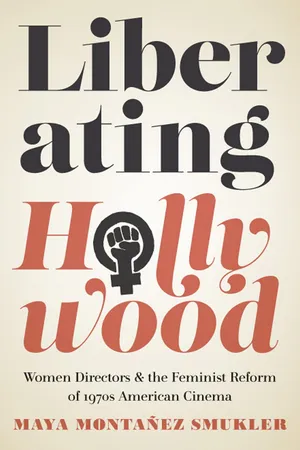
Liberating Hollywood examines the professional experiences and creative output of women filmmakers during a unique moment in history when the social justice movements that defined the 1960s and 1970s challenged the enduring culture of sexism and racism in the U.S. film industry. Throughout the 1970s feminist reform efforts resulted in a noticeable rise in the number of women directors, yet at the same time the institutionalized sexism of Hollywood continued to create obstacles to closing the gender gap. Maya Montañez Smukler reveals that during this era there were an estimated sixteen women making independent and studio films: Penny Allen, Karen Arthur, Anne Bancroft, Joan Darling, Lee Grant, Barbara Loden, Elaine May, Barbara Peeters, Joan Rivers, Stephanie Rothman, Beverly Sebastian, Joan Micklin Silver, Joan Tewkesbury, Jane Wagner, Nancy Walker, and Claudia Weill. Drawing on interviews conducted by the author, Liberating Hollywood is the first study of women directors within the intersection of second wave feminism, civil rights legislation, and Hollywood to investigate the remarkable careers of these filmmakers during one of the most mythologized periods in American film history.
eBook - ePub
Liberating Hollywood
Women Directors and the Feminist Reform of 1970s American Cinema
- English
- ePUB (mobile friendly)
- Available on iOS & Android
eBook - ePub
Liberating Hollywood
Women Directors and the Feminist Reform of 1970s American Cinema
About this book
Information
Subtopic
Film History & Criticism1
Feminist Reform Comes to Hollywood
New Hollywood, Old Sexism
Writing for Ms. in 1977, film critic and historian Marjorie Rosen reflected on the status of women directors at the time: “A couple of years ago women filmmakers were closet movie directors. Their energy and numbers were in the East, their focus was on documentaries and personal revelations. For them, ‘film’ meant an alternative vision to the drivel about earthquakes, sharks, and homoerotic gangbusters passing for what we commonly call ‘movies’ … but [the film industry] seems to be the ironic center for women who want to be, yes—directors.”1 By identifying this new crop of directors as bound for Hollywood, Rosen recognized their interest and potential to be part of the creative and economic power that defined Hollywood. To acknowledge these women was to confront their absence in male-centric Hollywood and to challenge the popular notion held by many in the film industry that women were not cut out for the job of director. Rosen drew an important distinction between the “personal-revelation” filmmakers from the “East” [Coast]—code for the feminist, counter-cinema filmmaking that flourished during the era—and the commercial aspirations of women coming out of the Hollywood director “closet.” By differentiating between the two kinds of filmmakers, the author made a significant point that not all women directors are the same, nor should it be assumed that they are. Also significant was Rosen’s assertion that not only were there women skilled and ambitious enough to thrive in Hollywood but also that they wanted a part in profit-making cinema.
The years 1977 and 1978 were pivotal for women directors in Hollywood. For the first time since the 1910s, they appeared as a critical mass—if but a small one. The number of women directors did not rival that of their male peers by any means, but collectively the handful of women filmmakers indicated a measure of progress while simultaneously drawing attention to the continued and significant gender gap within the industry. By 1976, Karen Arthur, Barbara Loden, and Joan Micklin Silver had each made one film; Elaine May and Barbara Peeters, three; Stephanie Rothman, seven (two completed in 1966 and in 1967); and Beverly Sebastian, five (one completed in 1967). In 1977, Micklin Silver completed her second feature and Joan Darling her first. In 1978, Penny Allen, Joan Rivers, Jane Wagner, and Claudia Weill released their first films, and Peeters completed her fourth. Between 1970 and 1978, twenty-five films were made by a total of twelve female directors. These twenty-five films made up 0.6 percent of the 4,149 films released between 1970 and 1978 in the United States that were rated by the Motion Picture Association of America (MPAA).2
As the number of women directors increased for the first time in four decades, debates regarding power, authority, and gender, both behind the camera and on-screen, circulated in the entertainment industry. In 1978, Verna Fields, an Academy Award-winning film editor who was then the vice president of production at Universal, predicted, “The worst thing that could happen to a woman director, even at this point, is that she should have trouble on the set, go over budget, over schedule, that kind of nonsense. I think it would be very easy for a lot of people to blame it on the fact that she had no control—that she didn’t shoot well that day because she had her period.”3 Field was quick to identify a myth that many resisting the inevitable change taking place in Hollywood often raised: the belief that women’s physiology made them ill-suited for the job of film director. Estrogen made women too docile to command a movie and too irrational to handle the responsibility. Such detractors believed that women were innately conditioned to nurture, based on their biological ability to have children. This “female” quality was considered contrary to the “masculine” competitive drive essential to making it in Hollywood. According to this idea, if women were controlled by their biology, ultimately it would take over and derail their ambition, taking down along with it a movie’s budget and production schedule. Male directors, critically but affectionately described as “movie brats,” would make famous the 1970s film era with their excessive behavior that on numerous occasions resulted in productions that notoriously went over budget—in many ways, that conduct was condoned by the studio executives who oversaw those budgets.4 For the rising number of women directors attempting to enter the motion picture workforce during this time, a double standard was firmly in place.
Speaking candidly in the Los Angeles Times in 1978, director Nell Cox attested to the reality of gender-focused hostility: “I’ve had studio executives look me right in the eye and say there are no women directors because there are no women qualified—and I’ve been directing films for 18 years and done a feature.”5 In the 1960s, Cox began her career as a prolific documentarian as part of the New York City cinema verité movement before making the transition to narrative filmmaking as writer-director of the feature film Liza’s Pioneer Diary (1976) for the PBS broadcast series Visions. In the mid-1970s, she relocated to Hollywood and started writing and directing episodic television, working on network shows such as The Waltons and M*A*S*H. The studio executives’ deliberate disregard of Cox and the ease with which they made statements similar to the one cited by her typified the industry’s belief system that kept women—in spite of and, more often, because of their experience and qualifications—from positions with creative and economic power.
Long-standing cultural perceptions of how women and men act when in positions of power—women are nurturing and subservient, and therefore unqualified, men are domineering and confident—shaped attitudes in the film industry, providing another layer of resistance that women directors would need to trudge through. “The director is a papa figure,” observed Fay Kanin, the award-winning screenwriter-producer for film and television, who was president of the Academy of Motion Picture Arts and Sciences from 1979–1983. “We were always told women couldn’t exercise authority over a bunch of men. It’s nonsense, of course. Some women are lousy at authority. But then, so are some men.”6
In a 1979 interview conducted before an audience at the American Film Institute, filmmaker Joan Micklin Silver refuted the assumption that women lacked the necessary gumption to succeed in Hollywood. By this point in her career Micklin Silver had made two films in collaboration with her husband-producer, Ray Silver: Hester Street (1975) and Between the Lines (1977); both were independently financed and distributed by the couple. At the time of the interview, her third feature and first studio project, Chilly Scenes of Winter (United Artists, 1979), had just been released. “I’m sure lots of people quit because it is just too damn hard,” she offered, describing her personal experience in making films as something common to both women and men. “It is. It’s terrible,” confessed Micklin Silver. “You have to lean into it all the time.… You have to push at it and push at it. It’s incredibly hard. But it’s such a thrill to do it. I mean, to make a movie is so worth it. It’s so worth every bit of it.”7 As the mother of three daughters and collaborator with her husband on her professional endeavors, Micklin Silver devoted herself to both family and filmmaking: meeting the “terrible” challenge of making movies was the motivation that helped her stay the course.
Joanna Lee (1931–2003) echoed Micklin Silver’s work ethic with equal gusto. Interviews with Lee, a successful television writer-producer-director, almost always described her striking looks. In 1978, she joked how, early in her career, she used assumptions about her appearance to gain access for her work. “I used to write simple, mindless sitcom [sic]. I was very ‘cute.’ So they said, ‘Let’s hire her, I hear she’s got a great pair of legs.’ What did I care? I would’ve worn a G-string as long as I had four good ideas in my briefcase and I’d sell one before I left the office.”8 Quick to make light of the industry’s notorious reputation for demanding sex from women as collateral for employment, Lee did not sacrifice her professionalism or her personal integrity. “I was always very prepared. I always dressed terrific, looking fancy but acting very straight. And I worked six days a week for ten years. I see people waiting for things to be given to them; well, I broke my ass.”9 Perseverance and hard work were required for anyone—female or male—determined to succeed in the industry.
Lee won an Emmy in 1974 for Best Writing in Drama for the Waltons episode “The Thanksgiving Story.” In addition to her success with episodic series, in the 1970s and 1980s she excelled in the television movie format, where she frequently created programming focused on social issues such as divorce and teen pregnancy. In her 1999 autobiography, A Difficult Woman in Hollywood, she offers the reader her mantra for achieving success in the entertainment business: “So, how do you become a producer in Hollywood? Simple. Have a vision. Have guts. And be willing to risk everything.”10 Lee was cognizant of what was required to compete in the exclusive, cutthroat media industry. Her success and preparedness to “risk everything” belied sexist attitudes about women not having the innate tenacity to thrive in Hollywood. She was also aware that her gender could function as both an asset, in the most superficial way (“femaleness” as employment currency), and as a detriment (a limited and mostly false currency), suggesting a complexity to being a woman in Hollywood.
Lee wrote, directed and starred, with her young son, Christopher Ciampa, in A Pocket Filled with Dreams (1976), the only feature film she directed; it was independently financed and filmed in Greece. There is little material on Lee’s film, other than a short chapter in her memoir.11 A Pocket Filled with Dreams was invited to be screened at the Cannes Film Festival in 1975, but does not appear to have received any kind of theatrical release in the United States.
Monique James, vice president of new talent at MCA-Universal, shared Lee’s assessment that women during these years were constantly forced to negotiate Hollywood’s double standard: to maintain “feminine,” nonthreatening qualities in an industry that was predicated on assertive and aggressive behavior. “Women who are in responsible positions are often called tough and mean and loud and castrating,” explained James. “Unless you take a position and really feel strongly about something and are willing to stand on your two feet, nobody is going to do it for you.”12
In 1975, Maya Angelou (1928–2014) became the first African American woman to join the Directors Guild in the director’s category.13 Angelou had participated in the American Film Institute’s first Directing Workshop for Women in 1974; in 1977 she directed The Tapestry, an hour-long episode for PBS’s Visions series. Angelou would direct her only feature film, Down on the Delta, featuring Alfre Woodard, Wesley Snipes, Esther Rolle, and Loretta Devine, for Showtime Networks, with a limited theatrical release, in 1998. Yet she first tried to break into directing feature films in 1971 when she started writing a screenplay adaptation of her award-winning autobiography, I Know Why the Caged Bird Sings, which Angelou was slated to direct for Kelly-Jordon Enterprises Inc., an independent black-owned and operated production company where she was primed to be the first African American woman to helm a feature.14 That was not to come to pass: the script eventually was produced as a television movie that aired on CBS in 1979, starring Diahann Carroll and helmed by veteran television director Fielder Cook. “Hollywood never before trusted a budget of $1.5 million to a black woman,” Angelou told the Los Angeles Times in 1978, alluding to her struggle in bringing her book and herself to the big screen. “Suddenly, I’m in the business where everybody and his dog can say something about your work. In television, they treat me well, according to their likes.”15
During these years, Angelou, a multifaceted artist-intellectual, accomplished not only as a writer of prose and poetry but also a singer-songwriter, dancer, theater director, and activist whose work resonated with the era’s social justice movements, had all the promise of a Hollywood talent. In addition to her work on I Know Why the Caged Bird Sings, in 1972 Angelou wrote the screenplay for the feature film Georgia, Georgia, also produced by Kelly-Jordon Enterprises Inc., distributed by Cinerama Releasing Corp., and starring Diana Sands as an American Jazz singer in Sweden. The film received mixed reviews, but critics recognized the significance of a film centered around a black female protagonist, with a screenplay by a leading ...
Table of contents
- Cover
- Title Page
- Copyright
- Dedication
- Contents
- Introduction
- Prologue: Before There Was 1970s Hollywood, There Was New York City in the 1960s
- 1. Feminist Reform Comes to Hollywood: New Hollywood, Old Sexism
- 2. 1970s Cultures of Production: Studio, Art House, and Exploitation
- 3. New Women: Women Directors and the 1970s New Woman Film
- 4. Radicalizing the Directors Guild of America
- Epilogue: Desperately Seeking the Eighties
- Appendix
- Acknowledgments
- Notes
- Index
- About the Author
Trusted by 375,005 students
Access to over 1.5 million titles for a fair monthly price.
Study more efficiently using our study tools.
Frequently asked questions
Yes, you can cancel anytime from the Subscription tab in your account settings on the Perlego website. Your subscription will stay active until the end of your current billing period. Learn how to cancel your subscription
No, books cannot be downloaded as external files, such as PDFs, for use outside of Perlego. However, you can download books within the Perlego app for offline reading on mobile or tablet. Learn how to download books offline
Perlego offers two plans: Essential and Complete
- Essential is ideal for learners and professionals who enjoy exploring a wide range of subjects. Access the Essential Library with 800,000+ trusted titles and best-sellers across business, personal growth, and the humanities. Includes unlimited reading time and Standard Read Aloud voice.
- Complete: Perfect for advanced learners and researchers needing full, unrestricted access. Unlock 1.5M+ books across hundreds of subjects, including academic and specialized titles. The Complete Plan also includes advanced features like Premium Read Aloud and Research Assistant.
We are an online textbook subscription service, where you can get access to an entire online library for less than the price of a single book per month. With over 1.5 million books across 990+ topics, we’ve got you covered! Learn about our mission
Look out for the read-aloud symbol on your next book to see if you can listen to it. The read-aloud tool reads text aloud for you, highlighting the text as it is being read. You can pause it, speed it up and slow it down. Learn more about Read Aloud
Yes! You can use the Perlego app on both iOS and Android devices to read anytime, anywhere — even offline. Perfect for commutes or when you’re on the go.
Please note we cannot support devices running on iOS 13 and Android 7 or earlier. Learn more about using the app
Please note we cannot support devices running on iOS 13 and Android 7 or earlier. Learn more about using the app
Yes, you can access Liberating Hollywood by Maya Montañez Smukler in PDF and/or ePUB format, as well as other popular books in Media & Performing Arts & Film History & Criticism. We have over 1.5 million books available in our catalogue for you to explore.