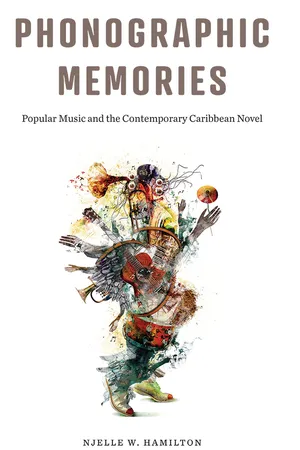
Phonographic Memories is the first book to perform a sustained analysis of the narrative and thematic influence of Caribbean popular music on the Caribbean novel. Tracing a region-wide attention to the deep connections between music and memory in the work of Lawrence Scott, Oscar Hijuelos, Colin Channer, Daniel Maximin, and Ramabai Espinet, Njelle Hamilton tunes in to each novel's soundtrack while considering the broader listening cultures that sustain collective memory and situate Caribbean subjects in specific localities. These "musical fictions" depict Caribbean people turning to calypso, bolero, reggae, gwoka, and dub to record, retrieve, and replay personal and cultural memories. Offering a fresh perspective on musical nationalism and nostalgic memory in the era of globalization, Phonographic Memories affirms the continued importance of Caribbean music in providing contemporary novelists ethical narrative models for sounding marginalized memories and voices. NjelleW. Hamilton's Spotify playlist to accompany Phonographic Memories: https://spoti.fi/2tCQRm8
eBook - ePub
Phonographic Memories
Popular Music and the Contemporary Caribbean Novel
- English
- ePUB (mobile friendly)
- Available on iOS & Android
eBook - ePub
About this book
Information
Publisher
Rutgers University PressYear
2019Print ISBN
9780813596594
9780813596600
eBook ISBN
9780813596617
CHAPTER 1
Phonographic Memory
Tracing the Calypsonian’s Work in Lawrence Scott’s Night Calypso
Calypso does remember.
—M. NourbeSe Philip, “Fugues, Fragments and Fissures”
Do you remember the days of slavery?
History can recall, history can recall [ . . . ]
While I remember, please remember.
—Burning Spear, “Slavery Days”
One could hear Burning Spear’s “Slavery Days” as a stirring attempt to trigger the memory of key aspects of the Afro-Caribbean experience. Indeed, it is the second track on the Jamaican reggae act’s 1975 Marcus Garvey album that is filled with historical events and figures. One such figure is the titular Garvey for whom knowledge of black history was a core component of rehumanizing African diaspora peoples in the first three decades of the twentieth century. But the lyrics of “Slavery Days” are curious: its refrain asks reggae listeners in and since 1975 if they “remember the days of slavery.” If “remembering” is figured as the retrieval of an experience personally experienced and stored in the annals of memory, then Winston Rodney’s question seems nonsensical on the surface. Since slavery was abolished in the anglophone Caribbean in 1834, his listeners did not personally experience and therefore neither have forgotten nor can remember the whipping, beating, and enchainment that the song recounts. As the song goes on, Rodney makes two claims that illuminate both his conception of remembering and his understanding of the role of the Caribbean musician: “history can recall” and “I [the musician] remember.” Here, the “history” that “can recall” is not official history but the song itself; in other words, the song narrates historical events neither recorded in canonical archives nor transmitted in remembered stories. The creation and curation of a historical record in song aims to plant “memories” in the mind of listeners far beyond the temporal and spatial locations of the initial horrific events narrated and beyond the personal experiences of those for whom the song’s events constitute first-person testimony.
I begin this chapter on Trinidad calypso with this anachronistic story from 1970s Jamaica to draw attention to the region-wide mnemonic function of Caribbean popular music and musicians that undergirds this book. If Phonographic Memories examines how Caribbean music enables remembering, this opening chapter establishes the role of the Caribbean musician as creator and curator of collective memory. Since the Middle Passage and plantation slavery ruptured memory and subjectivity, dealing what Derek Walcott calls a “deep, amnesiac blow” to the region’s inhabitants (Collected Poems 88), where are the records of the Caribbean past and what techniques and technologies might allow for their retrieval and replay? As I argue in this chapter, that is the work of musicians like the calypsonian. In “Fugues, Fragments and Fissures,” M. NourbeSe Philip proposes that “calypso does remember” (80). As direct descendants of the West African griot tradition of recording and transmitting collective memory, calypsonians “serve to wake us from our dissociative states” by “improvis[ing and] filling the gaps in our memory” (84, 80). She describes the calypsonian’s primary function as “the performance of memory. . . . But that memory is a two-edged sword on the one side of which is amnesia and on the other forgetting” (80). Starting from this premise, I trace the techniques that calypsonians use to remember and record traumatic memories unavailable to consciousness or in other archives, even as such recuperation remains partial and provisional.
To this end, this chapter performs a critical listening of the calypso phonotopes in Night Calypso (2004) by Trinidadian novelist Lawrence Scott. If his earlier fiction locates calypso and Carnival as performative modes for recuperating and narrating Caribbean memory, in his third novel, Scott depicts a Caribbean rife with alternate memory archives, including bodily wounds and sound recordings of popular music. Whereas lay citizens can afford to forget, the novel shows how individuals gifted with phonographic memory remember on behalf of the community, carry collective memory in their minds and bodies, and transmit it down through time through performance. In Witchbroom (1992), Scott’s white Creole protagonist listens to the stories of others in order to assemble them in a narrative Scott calls “Carnival tales,” but in Night Calypso, Dr. Vincent Metevier, the white Creole narrator, must listen to the “night calypso” crafted by Theo, a twelve-year-old orphan who bears mysterious bodily scars and whose composite racial heritage marks him as the product of a creolization rooted in sexual violence. In both novels, Scott interrogates the place of white Trinidadians in postcolonial nation-building while privileging Afro-Trinidadian memory practices.
Framed by two brief sections set in 1983, Night Calypso spans World War II and the immediate postwar period (1938–1948) when Trinidad’s location at the southernmost tip of the Caribbean archipelago placed it at the frontline of the war. German U-boats often found their way into Trinidadian waters, and the United States set up naval bases on the island to monitor and launch attacks against German incursions into the region. The novel reimagines this watershed period in Western history and the turning point for trauma and memory studies from an alternative perspective. It chronicles the psychological and political struggles of a group of lepers and other outcasts exiled to a leprosarium run by French nuns on El Caracol, a fictional island off the coast of mainland Trinidad. Populating the novel with historical doubles and characters who begin as stock types of the key players in Trinidad and Tobago’s wartime history, Scott depicts the war as part of the Caribbean’s historical memory: that of white Creole Trinidadians like Vincent, who belongs to a class of landed elites grappling with challenges to their economic power; of Jews like Vincent’s assistant Madeleine Weil, who flees the pogroms for the Caribbean and refashions herself as the nun, Sister Thérèse; of the fishermen who discover dead German sailors in their nets; of the mothers and daughters who discover the power of the Yankee dollar and the “social invasion” that the naval bases cause in their sexual and economic lives; of Indian and African laborers and labor leaders struggling for bread and justice; of the lepers cast off the mainland to live or die in leper colonies; and of the calypsonians who had constant fodder for their sung commentary even as their practice was censored during this period.
Believed mute when he is first sent to the island to seek psychological help from the doctor, it takes many overtures by Vincent and others before Theo responds, selectively and unevenly, not only to touch but also to conversation. With the emotional and physical safety afforded by Vincent’s care for and informal adoption of the boy, it soon becomes clear that Theo’s aphasia is a psychological rather than physical disability due to his having repressed a story of sexual trauma. Despite “choking on [his] own words” (NC 37), Theo must find a mode of telling that will allow him to narrate the story of his visible and invisible injuries. As this chapter will show, despite the efficacy of Vincent’s training in psychoanalysis and mediate auscultation, and even with the coterminous emergence of early-twentieth-century modern technologies like the phonograph record and the gramophone, Night Calypso privileges corporeal memory rather than recording technology and calypso rather than the talking cure to negotiate the amnesia and aphasia that attend Caribbean trauma.
Although it refers to a song form, calypso (alternately kaiso) is best understood as a discursive practice and narrative form set to music. Rich with rhetorical masking features that allow the calypsonian to effect social and political commentary, it is readily transducible to other narrative forms and has long inspired the region’s writers. Kamau Brathwaite regards the calypsonian as the “musical counterpart of the novelist” (“Caribbean Literature” 46), while Funso Aiyejina coined the term novelypso to describe novels that mimic the form, content, and techniques of calypso music and the masking and memory work of the calypsonian or chantwell (“Novelypso”).1 Two Trinidadian authors in particular have established the novelypso tradition: Samuel Selvon transposes the style of the chantwell into novelistic narrative voice (The Lonely Londoners, 1956), while Earl Lovelace (The Dragon Can’t Dance, 1979) explicitly incorporates calypso lyrics, calypsonian figures, Carnival tropes, and the broader rhetorical strategies of the chantwell. Scott combines both in Night Calypso: lyrics of actual calypsos of the World War II period appear as chapter titles, are sung by characters, and serve to comment on the story in a similar way to Lovelace, Scott’s unofficial literary mentor.2 These real calypsos complement the titular “night calypso,” Theo’s term for the remembered tale he narrates in “sleeptalking” mode. Even though Theo’s tale includes moments of calypso singing, his neologism frames his tale as the narrative equivalent to sung calypsos. Like Selvon’s chantwell narrator, Theo employs the narrative and rhetorical masking strategies that the music form derives from its association with Carnival, the annual pre-Lenten masquerades of Trinidad and Tobago. However, Scott’s chantwell is not the novel’s overarching narrator but a character who crafts an extended “calypso” within the novel.
Through this metafictional mode, Scott illustrates how the calypsonian performatively salvages and surfaces repressed memory fragments, then composes them into a public record of collective memory that enables amnesiac listeners to remember in their own turn. In this way, Scott reframes calypso’s “I” narrator—a marker of personal witnessing—into collective memory and depicts memory work as a shared project constructed through the call-and-response between musician and audience. The emphasis on performative retrieval and replay establishes two key aspects of Caribbean memory that will recur throughout this book. First, without intact memories, postcolonial Caribbean recollection is only partial and fraught with fragmentation and degradation. As a result, Caribbean memory work is not a process of reencountering the past as it was but reconstructing and curating it through performance and storytelling. Second, as the music played in Carnival tents and during road marches, calypso is closely related to forms of dramatization associated with “playing mas”—Carnival masquerade—and thus highlights the corporeality of Caribbean memory.
As I will show, calypso offers the traumatized storyteller innovative narrative techniques to salvage recessed memories from both the collective unconscious and the wounded body. Focusing on Theo’s deployment of chantwell techniques of linguistic, narrative, theatrical, and sartorial masquerade, I investigate how he bypasses the unnarratability of trauma and circumvents some of the limits of modern calypso to make women’s voices and memories audible. Significantly, whereas calypsonians, like other musicians, are skilled at memorizing their compositions, in transducing the musician’s memory work into novel form, Scott constellates in Theo three exceptional modes of high-fidelity recording and remembering: the musician’s memory, the vinyl record, and trauma. Theo’s phonographic memory surrogates for recording technologies as high-fidelity media and enables an inclusive genealogy of musicking that does not sideline people without access to modern or Western technologies. By localizing phonographic memory in Theo’s chantwell skills, Scott displaces the listening and recording technologies extant during the time of the novel, even those that prove efficacious in Vincent’s treatment of his other patients.
Sound(ing) History: Calypso as Record
Night Calypso depicts several early-twentieth-century listening technologies and modes of listening even as it often sidelines modern technologies to center calypso itself as an audible record of Trinidadian history.3 Four major circumstances of the “turbulent thirties” contributed to calypso’s emergence in its present form. The presence of American marines in calypso tents helped to professionalize the song form, and the money they freely spent in the towns created a bustling economy in the demimonde centered on calypso and prostitution. But as a result of the Theatre and Dancehalls Ordinance (1937–1951), calypsonians had to present their songs for censorship before recording or performing them as white and brown elites tried to snuff out the rising working-class political voice and black merriment. Ironically, while censorship meant the dumping of many records into the sea, it also led to a variety of alternate recordings in newspapers, pamphlets, and booklets, as well as to innovative censorship-evading linguistic techniques. But the emergent recording industry in the thirties also enabled calypsonians to ink lucrative recording contracts with American companies such as RCA Victor, Okeh, and Columbia Records, and several calypsonians including Rafael “Roaring Lion” de Leon and Raymond “Atilla” Quevedo embarked on recording sessions in New York City. During the thirties, Decca Records even sent delegates to Port of Spain to record the annual calypso competitions, and they often left with enough recordings to last until the next year’s competition. The censorship, the recording missions, and the vigorous debates around calypso in the newspapers of the day gift present-day auditors with a rich archive of sonic and written records of the song form.
As the people’s spokesman, calypsonians recorded, critiqued, and broadcasted news of the events that would become key plot points in Night Calypso: the 1937 labor riots, the arrival of Jews in the southern Caribbean, a German U-boat attack in Trinidadian waters on Ash Wednesday 1942, the resentment against American marines and the socially disruptive influence of the Yankee dollar in the towns and tents, the birth of steel pan on VE and V-J Day, and even the censorship of calypso and the ban on Carnival. Much of the plot not only has a soundtrack indexed by chapter titles and calypso couplets but also dramatizes historical events recorded in calypso songs of the day. As Theo himself demonstrates, these songs were often hot off the press, composed and circulated in the mouths of tent audiences within hours or days of the events described therein.4 An alternative archive for calypso and subaltern histories, the novel incorporates fragments of calypso lyrics of and about the period, which are in turn sonic records of key moments in history.5 Scott in fact imaginatively reconstructed a narrative of those times from Gordon Rohlehr’s documentation of wartime calypso records in Calypso and Society (1990). In other words, the novel documents calypso’s (trans)formative period, particularly given that calypso remains one of the few indigenous records of life on the island during the war.
In a novel about listening techniques and technologies as much as narrative practices, the chantwell combines both in order to discern and compose untold stories into audible history to be recorded for posterity. Considered the historical antecedent to the Caribbean chantwell, West African griots chronicled collective history by composing and memorizing sung genealogies. In the griot tradition, history is a collective story that is sung and heard, and “once composed, [the griot’s] song is not forgotten” (Hale 38). As history in song, calypso likewise enables historians to reconstitute a chronicle of the island’s history and attitudes to world history beyond those recorded in the elite newspapers of the day. Notwithstanding, the extant calypso archive is an incomplete historical record of that time, with untold stories lost to the unfathomable archive of the sea. Even further, although the presence of recording technologies often assuages our sense that we can record experience for posterity, no technology can as yet capture with perfect fidelity the entirety of lived experience. Sound technology’s capabilities of the day were often mono, low-fidelity, static-ridden, and selectively recorded with the inbuilt censorship of having to make decisions about what to record based on economic, political, or technical exigencies.
By focusing on a period in which history was made acutely audible via sound reproduction technologies, even as European states strove to violently erase the living memories of subaltern constituents, Scott emphasizes the tension between recording and forgetting and the simultaneous absence and presence of historical records. Although this was a time of increased recording, historians would need to turn to alternate archives and historiographic techniques—not just musical records but also remembered records. Despite censorship, irrepressible calypsonians found other modes of transmission. Vincent notices that “the calypsonians kept their commentary going on the time. . . . The Doctor’s House was a buzz of humming and singing, replacing the ban on Carnival by the governor. . . . The fishermen were the calypsonians” (NC 171). The novel shows the fishermen, and later Theo, listening to and memorizing censored calypsos and then broadcasting them to others by singing and, even further, by reliving and reenacting the historical events that the calypso narrates. Recording makes historical events replayable and repeatable, but even before the advent of recording technology, the repeated performance of calypso songs in the tents and road marches enabled their transmission with a kind of fidelity that anticipates recorded music but was entirely ingrained in oral transmission. Scott establishes calypso’s credentials as both audible and embodied history; here, history is condensed into a three-minute song that is replayable in conscious or subconscious retrievals. In so doing, he suggests that under the right circumstances, memory might substitute for sound recording technology.
Phonographic Memory
Trauma functions in the novel much like the phonograph recording process. Leon Scott’s 1856 phonautograph, for instance, “used a cone-shaped horn to capture sound and ‘focus’ it on a flexible membrane stretched across the small end. Sounds captured by the horn made the membrane vibrate rapidly. Linked to the membrane through a delicate mechanism was a pointed stylus to which the vibrations were transmitted. . . . If the cylinder was turned rapidly during this, the stylus would scribe a thin line in the soot, rendering a visible record of the sound” (Morton 2). This silent but “visible record” is nevertheless pregnant with sounds that must be coaxed out by a playback mechanism. Scott likewise depicts Theo’s body as a visible record of colonial violence, but this recording requires the appropriate playback mechanism to make its data audible.
Trauma is, of course, Greek for “wound,” originating in bodily injury then expanded into psychoanalysis to denote psychic injury. The wounds of Vincent’s patients are both physical and psychological, the physical often serving as a legible yet silent testimony to profound psychological trauma. Trauma marks and imprints the body with what Roberta Culbertson calls “the memory of the event” (174), making the wounded body a silent archive and a site of memory. Narratives that foreground bodily inscription therefore suggest that we might have to look to the wounded body to recover memory records lost to other historical archives.6 The physical wound is distinct from the scar—the one fresh and present, the other signaling that the injury has hea...
Table of contents
- Cover
- Title Page
- Copyright Page
- Dedication
- Contents
- Preface
- Introduction
- Chapter 1. Phonographic Memory: Tracing the Calypsonian’s Work in Lawrence Scott’s Night Calypso
- Chapter 2. “Record Your Memories”: The Bolero Aesthetic in Oscar Hijuelos’s The Mambo Kings Play Songs of Love
- Chapter 3. Re-membering “Body and Soul”: Gender, Jazz, and Gwoka in Daniel Maximin’s Lone Sun
- Chapter 4. Roots, Romance, Reggae: (Dis)Placing Memory in Colin Channer’s Waiting in Vain
- Chapter 5. Memory as Mixtape: The Dub Aesthetic in Ramabai Espinet’s The Swinging Bridge
- Coda
- Acknowledgments
- Notes
- Works Cited
- Index
Trusted by 375,005 students
Access to over 1.5 million titles for a fair monthly price.
Study more efficiently using our study tools.
Frequently asked questions
Yes, you can cancel anytime from the Subscription tab in your account settings on the Perlego website. Your subscription will stay active until the end of your current billing period. Learn how to cancel your subscription
No, books cannot be downloaded as external files, such as PDFs, for use outside of Perlego. However, you can download books within the Perlego app for offline reading on mobile or tablet. Learn how to download books offline
Perlego offers two plans: Essential and Complete
- Essential is ideal for learners and professionals who enjoy exploring a wide range of subjects. Access the Essential Library with 800,000+ trusted titles and best-sellers across business, personal growth, and the humanities. Includes unlimited reading time and Standard Read Aloud voice.
- Complete: Perfect for advanced learners and researchers needing full, unrestricted access. Unlock 1.5M+ books across hundreds of subjects, including academic and specialized titles. The Complete Plan also includes advanced features like Premium Read Aloud and Research Assistant.
We are an online textbook subscription service, where you can get access to an entire online library for less than the price of a single book per month. With over 1.5 million books across 990+ topics, we’ve got you covered! Learn about our mission
Look out for the read-aloud symbol on your next book to see if you can listen to it. The read-aloud tool reads text aloud for you, highlighting the text as it is being read. You can pause it, speed it up and slow it down. Learn more about Read Aloud
Yes! You can use the Perlego app on both iOS and Android devices to read anytime, anywhere — even offline. Perfect for commutes or when you’re on the go.
Please note we cannot support devices running on iOS 13 and Android 7 or earlier. Learn more about using the app
Please note we cannot support devices running on iOS 13 and Android 7 or earlier. Learn more about using the app
Yes, you can access Phonographic Memories by Njelle W. Hamilton in PDF and/or ePUB format, as well as other popular books in Literature & Latin American & Caribbean Literary Criticism. We have over 1.5 million books available in our catalogue for you to explore.