San Francisco is a city of contradictions. It is one of the most socially liberal cities in America, but it also has some of the nation's worst income inequality. It is a playground for tech millionaires, with an outrageously high cost of living, yet it also supports vibrant alternative and avant-garde scenes. So how did the city get this way?In San Francisco Year Zero, San Francisco native Lincoln Mitchell traces the roots of the current situation back to 1978, when three key events occurred: the assassination of George Moscone and Harvey Milk occurring fewer than two weeks after the massacre of Peoples Temple members in Jonestown, Guyana, the explosion of the city's punk rock scene, and a breakthrough season for the San Francisco Giants. Through these three strands, Mitchell explores the rifts between the city's pro-business and progressive-left politicians, the emergence of Dianne Feinstein as a political powerhouse, the increasing prominence of the city's LGBT community, punk's reinvigoration of the Bay Area's radical cultural politics, and the ways that the Giants helped unify one of the most ethnically and culturally diverse cities in the nation.Written from a unique insider's perspective, San Francisco Year Zero deftly weaves together the personal and the political, putting a human face on the social upheavals that transformed a city.
eBook - ePub
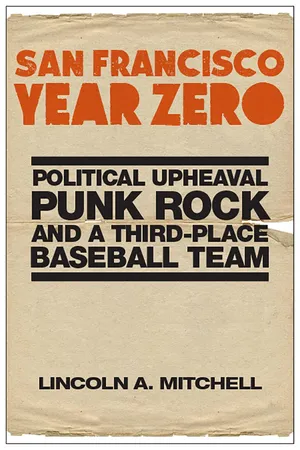
San Francisco Year Zero
Political Upheaval, Punk Rock and a Third-Place Baseball Team
- English
- ePUB (mobile friendly)
- Available on iOS & Android
eBook - ePub
San Francisco Year Zero
Political Upheaval, Punk Rock and a Third-Place Baseball Team
About this book
Information
1
New Year’s 1978
On the corner of Sutter and Steiner Streets in what was then the Western Addition, or perhaps the Fillmore District, of San Francisco, a local Bay Area band interrupted their New Year’s Eve show a few minutes after 1978 began while a man who as a young boy had fled the Nazis descended across the ballroom and onto the stage on a giant jerry-rigged model of a motorcycle. As Bill Graham landed on the stage at Winterland, the Grateful Dead hit the opening notes of “Sugar Magnolia,” and 1978 in San Francisco was underway. It was a year that would be unlike any other the city had known.
By the end of 1977, the Grateful Dead were already an old band. They were mostly linked with the San Francisco of the 1960s and the acid tests, be-ins, Summer of Love, and hippies that were associated with that time. However, the Grateful Dead still had a loyal following in the late 1970s for whom New Year’s shows in San Francisco were an annual ritual. That ritual lasted until Jerry Garcia, the band’s paunchy lead guitarist, died in 1995. The Dead continue to play in various forms and under somewhat different names, so it turns out that New Year’s Eve 1977 was, in Grateful Dead terms, the early years.
The Grateful Dead concert on New Year’s Eve 1977 was a good one. The band played some of their most beloved and best-known songs, including “Sugar Magnolia,” “Scarlet Begonias,” “Friend of the Devil,” and “Truckin’,” encored with “One More Saturday Night” (December 31, 1977, was a Saturday) and “Casey Jones.” For fans of the more obscure, they even played a cover of Luigi Denza’s 1880 composition “Funiculi, Funicula.”
The Grateful Dead’s New Year’s show was just one of many ways San Franciscans welcomed in 1978. Fans of what was known as arena rock spent the evening at the Cow Palace at another Bill Graham event, this one with Santana, Journey, and Eddie Money performing. Disco was still very popular in San Francisco in 1978. The City on Montgomery Street and the Jack Tar Hotel on Van Ness Avenue held New Year’s disco parties, which drew a much more diverse crowd than the mostly straight white audiences at Graham’s events. Adherents of San Francisco’s nascent punk rock culture went to the Mabuhay Gardens, known even then simply as the Mab, or occasionally the Fab Mab, to ring in the New Year with a roster of punk rock bands.
San Franciscans with something else on their minds on New Year’s Eve were invited to “Meet Kyoto” at the O’Farrell Theatre, with the promise that she and “each one of our ultra women are specially trained to make your ‘ultra visit’ as erotic and pleasurable as possible.”1 The proprietors of the O’Farrell Theatre were the Mitchell Brothers. By 1978, Jim and Artie Mitchell were among the most prominent pornographers in the country and very much part of the cultural milieu of San Francisco. The two brothers operated a number of strip clubs, produced X-rated movies from the late 1960s through the 1980s, and were very well connected in San Francisco’s political and social circles. In 1991, after years of feuding, Jim shot and killed Artie.
In the jungles of Guyana, about 4,500 miles southeast of San Francisco, a group of former San Franciscans met the New Year a little differently. The thousand or so members of the Peoples Temple enjoyed no major New Year’s celebration and spent the last days of 1977 continuing to try to construct the utopia that their increasingly erratic and unstable leader, Jim Jones, had promised. The stifling humidity, inadequate food supplies, poor sanitary conditions, and extremely simple living quarters in Jonestown—the name Jim Jones had immodestly given to his jungle fantasy—did not lend themselves to a festive feeling, even on New Year’s Day.
Jones had been an important figure in San Francisco’s religious, political, and civic life in the early and mid-1970s. His Peoples Temple had begun to relocate to Guyana in 1974, but it wasn’t until 1977 that a significant numbers of Peoples Temple members made the journey to Guyana. Jones himself had left San Francisco and moved there during the summer of 1977. By the end of that year, there were some concerns in San Francisco about what was happening in Guyana and what the true nature of Jim Jones’s organization was. Some thought it had become a dangerous cult, while others continued to see it as an experiment in radical equality and progressive living.
Marshall Kilduff and Phil Tracy captured this dichotomy in a 1977 article in New West, writing that California’s “Lieutenant Governor Mervyn Dymally went so far as to visit Jones’s 27,000 acre agricultural station in Guyana, South America and he pronounced himself impressed.” However, Kilduff and Tracy also concluded that “life inside Peoples Temple was a mixture of Spartan regimentation, fear and self-imposed humiliation,” and described physical and psychological methods used to abuse members of the organization.2
A few hours after Bill Graham’s motorcycle ride, another set of Mitchell brothers, these ones in fifth and seventh grade, boarded a plane in New York to return to their home in San Francisco for the rest of the school year. My brother and I were not related to Jim and Artie, but if you grew up in San Francisco in the 1970s and 1980s with my last name and had a brother, you heard a lot of jokes, as well as the occasional request for tickets. My brother and I were still a few years removed from punk rock or Grateful Dead shows. The only politics we knew were mostly from our radical left-wing grandparents in New York. As we got older, those views usually served us well in our hometown, but on more than a few occasions they made us stand out at our Catholic school, where we found ourselves in a sea of kids who came from very different backgrounds from ours. Most of their families did not share our grandparents’ political views. This would be very apparent by the end of the year.
Although our beloved grandparents made sure that my brother and I shared their political positions, our passion was not yet politics or even music. Instead, it was that most all-American of activities—baseball. Our grandfather, a first-generation American born on the Lower East Side of Manhattan to Belarusian Jewish immigrants in 1907, had moved to the Bronx as a boy. A few years later, the Yankees followed him across the river from Manhattan and became his team. We rooted for the Yankees too because of our New York roots and because of him, but by 1976 or so had also become fans of our local team. The Giants were pretty bad back then, but you could get tickets in the upper deck for three bucks, and the Ballpark Express, run by Muni, the city’s transit authority, was cheap and sometimes even convenient.
Inauguration Day
On the second Monday of 1978, after school had resumed and San Franciscans had recovered from the holiday season, the eleven-member board of supervisors, including five new members, was inaugurated. The swearing in of new members of the city’s legislature was not the kind of thing that typically drew much attention in the San Francisco of that time, but this year was different. Among the five people being sworn in for the first time that day was Harvey Milk, one of the very first openly gay elected officials anywhere in the world, and a man who eventually became a major part of the history of his adopted hometown, and indeed the whole country.
In our house, this event went largely unremarked upon, save for my mother’s happiness at seeing a left-of-center Jew from New York on the board of supervisors. Before Milk, the most well-known Jewish member of that body had been the daughter of a prominent Jewish doctor who, despite her Eastern European roots, had long been part of the more elite German Jewish community in San Francisco. Milk, however, was one of us. He came from Long Island—we were from Manhattan—and, like my mother, spoke English with a New York accent. Milk even spoke a little Yiddish.
Milk may have been a good progressive New York Jew, but he became an international icon and historical figure because of his outspoken and eloquent work for equality for gays and lesbians. As a single working mother in San Francisco in the 1970s, my mother had many gay friends and business acquaintances with whom she worked well and built relationships. In those days, most straight women, even progressive ones, didn’t speak much about gay rights, but my mother was not a bigot and was not opposed to Milk.
The Catholic school where my brother and I went every day was a little different. These were the days when “f *g” was still a playground taunt hurled at a target of enmity countless times a day, even in San Francisco. School was not an environment where anybody spent a lot of time recognizing the historic significance of Milk’s being on the board of supervisors. For many of our classmates, he was simply “that f *g.”3
The official inauguration photo of that day shows Milk standing in the back row in, appropriately, the far left. He has the big smile of a man who has finally achieved something he has been working toward for years. The previous November he had been elected in his third bid for office. Next to him is another progressive Jew from the East Coast. Carol Ruth Silver had come to San Francisco from Massachusetts and been a Freedom Rider in the South before moving to California. A little to the right, physically, if not politically, was Ella Hill Hutch, only the second African American, and the first African American woman, ever elected to the San Francisco Board of Supervisors. Milk and Silver shared more than just progressive politics and their Judaism. They were friends and political allies. When I met with Silver in her home in 2018 to discuss this book, she pointed out that the kitchen table at which we were sitting was the same one where she and Milk had strategized about his 1976 race for the state assembly, which he ultimately lost.
Hutch, Silver, and Milk had all been elected the previous fall when the city had implemented district-based, rather than at-large, elections for its board of supervisors. This was a demand made by progressives and communities of color, who believed, accurately, that if supervisors were elected from individual districts, the board would better reflect the diversity of San Francisco. At-large elections, in which the entire city voted for the entire board, created a big advantage for those who could raise enough money to campaign citywide, and thus for those candidates who had the support of powerful real estate or other well-heeled interests. Changing the electoral system so that members of the board of supervisors were elected by smaller districts made fund-raising less important while rewarding candidates who were either well known in a specific part of the city or who were willing to work very hard to become well known in their district. Moreover, district elections gave opportunities for minorities and gays, who had limited citywide appeal, to get elected in districts where they were the majority. The switch to district elections had been a major victory for progressives seeking to remake San Francisco. It was, therefore, no accident that the board of supervisors that was sworn into office in 1978 was the most diverse in San Francisco history.
In the inauguration photo—sandwiched not entirely comfortably, but still smiling, between Silver and Hutch—is another new supervisor whom the voters elected that fall in a district that had been drawn in one of the city’s most conservative neighborhoods. We should probably be grateful that we will never know what was going through the mind of Dan White, who by the end of the year the world would know to be deeply disturbed, as he posed with a gay Jew, a radical Jewish woman, and a progressive African American woman. These three new members intended to create a very different San Francisco than the one envisioned by White, a working-class conservative Catholic from the Excelsior district whom Charles A. Fracchia Sr., a San Francisco historian who founded the San Francisco Historical Society in 1988 and currently serves as its president emeritus, described to me as a “a real representative of the old San Francisco.”4
San Francisco city legislators are known as supervisors because the city and county lines are the same. Although they function as a city council, members are also county supervisors. In general, county supervisors and city council members are not well known outside of their city or county. Some politicians start out at this most local of elected offices and become famous for things they achieve later in higher offices, but very few are remembered simply for being city legislators. In all of American history, the two most famous city-level legislators who never went on to higher office are Dan White and Harvey Milk. They were both elected in the same year in the same city, and their stories remain linked to this day. Both of them got elected in competitive multicandidate races that they won through hard work and good retail politicking, and were briefly considered rising political stars in San Francisco. The San Francisco Bay Guardian, a left-leaning community newspaper, attributed Milk’s having won to the fact that he “simply out-politicked his opposition,” while using similar language to explain White’s victory: “Dan White simply out-campaigned his 12 opponents in what was a vigorous person-to person effort.”5 Fitzgerald’s analysis of Milk’s political style and themes provides a sense of the kind of politician that Milk was:
As an outsider running against liberals, he became at once a fiscal conservative and a populist: he was for “the little people” in the neighborhoods against the downtown interests and the landlords; he was for mass transit, better schools, better city services for the elderly; to pay for that he would end waste in government and tax the corporations and the commuters from Marin County. Along the way, his support came from the Teamsters, the Firefighters’ Union, the Building and Construction Trades Council, and small businessmen; but in the end his main supporters were the thousands upon thousands of young gay men settling in the Castro.6
In January 1978, nobody knew how the relationship between White and Milk would develop over the next eleven months. However, it was apparent that the two new members of the board represented very different directions for the future of San Francisco and that both were emerging as visible representatives of those different directions.
On the day Milk, White, and the other supervisors were sworn in, the board of supervisors also had to determine who would be their leader. In a close race, the moderate supervisor Dianne Feinstein, who represented some of San Francisco’s most affluent neighborhoods in the northern part of the city, defeated Gordon Lau by a 6–5 vote. Milk supported Lau, the more progressive candidate. Dan White sided with the more centrist Feinstein. That narrow vote would become very important by the end of the year. Feinstein’s victory in that election showed that while the board of supervisors may have been the most progressive in the history of San Francisco, progressives still did not have the majority they needed. Getting that sixth vote would be a challenge throughout Milk’s tenure on the board and would ultimately play an enormous role in the events of 1978.
The video of Milk being sworn in shows the new supervisor jubilantly repeating the oath of office. When he is finished, Milk and the man who swore him in, Mayor George Moscone, warmly shake hands and smile broadly for the cameras. It was the smile of political allies. One, by dint of the office he held, was more powerful, but both were looking forward to working together to remake their city in a more progressive direction. Milk was a gay Jew who had moved to San Francisco when he was already in middle age and began running for office only a few short years after arriving in town. Moscone was a straight Italian American Catholic whose San Francisco bona fides were second to nobody’s. They made...
Table of contents
- Cover
- Title Page
- Copyright
- Dedication
- Contents
- Preface
- 1. New Year’s 1978
- 2. San Francisco in 1978
- 3. Spring Training
- 4. Heading to the ’Stick
- 5. Harvey Milk
- 6. The Band Is Called What?
- 7. The Pennant Race
- 8. A Month Like No Other
- 9. The Long Shadow of 1978
- 10. Neighborhoods, Natives, and Those Hills
- Plates
- Acknowledgments
- Notes
- Index
- About the Author
Trusted by 375,005 students
Access to over 1.5 million titles for a fair monthly price.
Study more efficiently using our study tools.
Frequently asked questions
Yes, you can cancel anytime from the Subscription tab in your account settings on the Perlego website. Your subscription will stay active until the end of your current billing period. Learn how to cancel your subscription
No, books cannot be downloaded as external files, such as PDFs, for use outside of Perlego. However, you can download books within the Perlego app for offline reading on mobile or tablet. Learn how to download books offline
Perlego offers two plans: Essential and Complete
- Essential is ideal for learners and professionals who enjoy exploring a wide range of subjects. Access the Essential Library with 800,000+ trusted titles and best-sellers across business, personal growth, and the humanities. Includes unlimited reading time and Standard Read Aloud voice.
- Complete: Perfect for advanced learners and researchers needing full, unrestricted access. Unlock 1.5M+ books across hundreds of subjects, including academic and specialized titles. The Complete Plan also includes advanced features like Premium Read Aloud and Research Assistant.
We are an online textbook subscription service, where you can get access to an entire online library for less than the price of a single book per month. With over 1.5 million books across 990+ topics, we’ve got you covered! Learn about our mission
Look out for the read-aloud symbol on your next book to see if you can listen to it. The read-aloud tool reads text aloud for you, highlighting the text as it is being read. You can pause it, speed it up and slow it down. Learn more about Read Aloud
Yes! You can use the Perlego app on both iOS and Android devices to read anytime, anywhere — even offline. Perfect for commutes or when you’re on the go.
Please note we cannot support devices running on iOS 13 and Android 7 or earlier. Learn more about using the app
Please note we cannot support devices running on iOS 13 and Android 7 or earlier. Learn more about using the app
Yes, you can access San Francisco Year Zero by Lincoln A. Mitchell in PDF and/or ePUB format, as well as other popular books in History & North American History. We have over 1.5 million books available in our catalogue for you to explore.