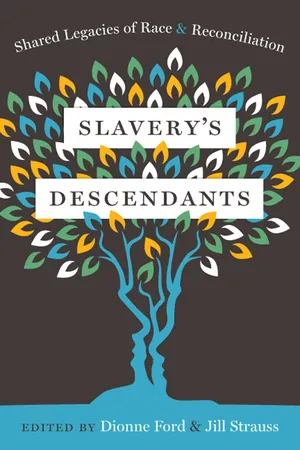
Race remains a potent and divisive force in our society. Whether it is the shooting of minority people by the police, the mass incarceration of people of color, or the recent KKK rallies that have been in the news, it is clear that the scars from the United States' histories of slavery and racial discrimination run too deep to simply be ignored. But what are the most productive ways to deal with the toxic and torturous legacies of American racism? Slavery's Descendants brings together contributors from a variety of racial backgrounds, all members or associates of a national racial reconciliation organization called Coming to the Table, to tell their stories of dealing with America's racial past through their experiences and their family histories. Some are descendants of slaveholders, some are descendants of the enslaved, and many are descendants of both slaveholders and slaves. What they all have in common is a commitment toward collective introspection, and a willingness to think critically about how the nation's histories of oppression continue to ripple into the present, affecting us all.The stories in Slavery's Descendants deal with harrowing topics—rape, lynching, cruelty, shame—but they also describe acts of generosity, gratitude, and love. Together, they help us confront the legacy of slavery to reclaim a more complete picture of U.S. history, one cousin at a time. Funding for the production of this book was provided by Furthermore, a program of the J. M. Kaplan Fund ( https://www.furthermore.org ).
eBook - ePub
Slavery's Descendants
Shared Legacies of Race and Reconciliation
- English
- ePUB (mobile friendly)
- Available on iOS & Android
eBook - ePub
Slavery's Descendants
Shared Legacies of Race and Reconciliation
About this book
Information
PART I UNCOVERING HISTORY
1
PRESIDENT IN THE FAMILY
SHANNON LaNIER
“SIT DOWN AND stop telling lies!”
Those were the words asserted by my first-grade teacher when I told the class that “President Thomas Jefferson is my great-great-great-great-great-great-grandfather.” We were studying U.S. presidents, so I was excited to share the information that I had been hearing in my family my whole life. At seven years old, I didn’t understand the complexity of what I was saying or why someone wouldn’t believe it. This was not “fake news.” It was my family’s legacy—the oral history that had been passed down to my brother Shawn and me as a matter of fact. Luckily, my mother, Priscilla, whose family line (on her father’s side) makes the Jefferson link, went to my school the next day and told the teacher who had berated me, “My son is a ninth generation descendant of Thomas Jefferson and his slave Sally Hemings, and don’t tell him differently!”
From that day on, I think I realized that not everyone would believe the story of my heritage. Not even some of my close friends would believe me at first. Their responses were usually, “Yeah, right, and I’m related to Abraham Lincoln.” After so much criticism and disbelief about my connection to Jefferson, I stopped telling people about it. I knew who I was and didn’t need to prove it to anyone. As my mom always said, “Be strong in the belief of who you are and don’t let other people define you.” I still practice that lesson to this day.
Fast forward thirty-one years, and I’m now coauthor (with photojournalist Jane Feldman) of the book Jefferson’s Children: The Story of One American Family. The Jefferson-Hemings relationship has been validated by researchers like Annette Gordon Reid, with the help of DNA samples, and it has been accepted as fact by countless sources, including the Thomas Jefferson Foundation, which runs Jefferson’s home and museum, Monticello. The family was even featured on the Oprah Winfrey Show, the Today Show, CBS Sunday Morning, and the list goes on. There is still a faction, however, that claims that a relative of Jefferson was the one to father some of Sally Hemings’s children. I’m pretty sure, that today, my first-grade teacher would not challenge me.
Although my family story is more widely accepted now than ever before, wrapping our minds around all of the complexities in this family, as well as in other families touched by slavery, can be challenging. This is one reason that Jefferson/Hemings family members came together to help start the organization Coming to the Table (CTTT). When my cousin Shay Banks-Young, who we call Mama Shay, told me that the descendants of slaves and the descendants of slaveowners were coming together at the “table of brotherhood” to break bread and to discuss in depth our country’s complicated past and its connections to our personal families, I knew I had to be involved. However, I had no idea what to expect. I’m not even sure if the organization had a mission statement at that point or if they just knew they had a novel idea. Either way, the concept was enough to catch my attention. It sounded like Dr. Martin Luther King, Jr.’s dream was being realized, and I wanted a seat at the table.
Not only was I not going to miss the opportunity to participate, but I also didn’t want to miss the opportunity to document the experience. So, my wife Chandra and I asked for permission to film the conference for historical documentation and for CTTT to use to inspire others and to uncover future opportunities.
At that first CTTT gathering at Eastern Mennonite University in Virginia, a small and diverse group talked about the pain, anger, and guilt, along with the barrage of other feelings that were surfacing upon our discovery that we were descendants of slaves or slave masters. In some cases, like mine and that of a few of my cousins, we had to deal with the thought of being a descendant of both slave and slave master.
For some, it was the first time they had heard others talk about how they were dealing with the news and what it meant for them. While this may not have been the first time the black people in the room had talked about their views on slavery and its effects on our families, it may have been the first time they shared these thoughts and feelings with white people. It also seemed to be the first time many of the white people faced confronting and sharing their feelings about the issue. I remember thinking that the whole exchange was very brave. It was a vulnerable situation, and it was refreshing to see people willing to have in-depth conversations about a topic that most would never touch but that we all knew needed to be talked about. It was a truly enlightening experience. I often say that in order to let go of the anger, pain, and resentment we feel about slavery, we have to talk about it and go through the healing process, and CTTT allowed that outlet.
One experience especially sticks out in my mind. In one of our sessions with the entire group, my cousin Mama Shay said she wanted to tell everyone a story. She wanted everyone to have a better picture of what African people went through when they took that two- to three-month journey to a new land to be broken into slaves.
“Close your eyes and clear your mind,” she said. Then she proceeded to narrate the highlights of that slave voyage to the new land. She led us through the kidnapping, the deplorable living conditions, the murder, rape, physical abuse, and dehumanization. When she finished, there was not a dry eye left in the house. It was an experience many had never even thought about, let alone been “transported” to.
Not only was Mama Shay’s slave journey powerful and impactful, but it was also a learning experience. While some appreciated that glimpse into the reality of slavery, some were upset that she had caught them off guard and had subjected them to such a horrible and graphic experience without a warning or disclaimer. Mama Shay used these insights to open up a discussion about how slaves also never got a warning or disclaimer before being ripped from their families and having their lives disrupted and violated.
That discussion is a perfect example of what’s great about the CTTT organization. It forces us out of our comfort zones but doesn’t leave us faltering in unknown territory. For it is outside our comfort zones where the real work begins—work that can lead to deeper understanding, healing, and, in many cases, reconciliation.
I felt that those who participated in that first year of CTTT opened up and saw the world differently; or, at least, I saw them differently. I saw white people apologize for the injustices of their ancestors, and I saw black people accept those apologies, embracing and reassuring the slaveowners’ descendants that what happened more than two hundred years ago wasn’t their fault. In fact, we acknowledged that while the people in the room were not to blame for the past, they could be thanked for being part of the solution—by being involved in those important and difficult conversations. It seemed as if we were embarking on a new movement that had the capability of spreading to communities throughout the country.
That first year especially, the ideas behind CTTT really called for people who were open to understanding and accepting others and to extending forgiveness. Today, it still calls for such people. CTTT acts as a catalyst for those hard discussions over race relations, history, and healing, and those willing to go through such uncomfortable conversations and feelings, both personally and communally, grow into better people for a greater cause. After all, the only way we are going to grow and someday be a unified nation, is to start talking about our painful past.
The CTTT organization and conference is one of those deep and life-changing experiences that you may have to go through to truly understand, but once you do, you will not be sorry. And you certainly won’t be the same.
2
SO MANY NAMES
A. B. WESTRICK
IN THE FALL of 2015 while researching Richmond, Virginia, as the setting for a novel, I came across a book by Benjamin Campbell titled Richmond’s Unhealed History.1 I was devouring the text, underlining and highlighting passages, totally absorbed in Campbell’s presentation, when I hit a section about Virginia’s House of Burgesses and stopped cold. I say that “I hit a section,” but the effect was more like the section hit me. Here before me was colonial history I hadn’t learned. How could I have missed it? How could American textbooks have left it out?
I’m descended from a number of men who served in Virginia’s House of Burgesses. Aunt Margaret had played the role of family historian and instilled in all of us—cousins, aunts, uncles, anyone who’d listen—a tremendous sense of pride in our family tree. Textbooks describe our ancestors with words like courageous, for having fought off “Indians,” and bold for having established a government “of the people, by the people, and for the people.” Our ancestors forged a nation that would become great by virtue of its principles, such as “all are created equal.” They were strong leaders and articulate speakers, greatly respected and admired.
But in Richmond’s Unhealed History, the author doesn’t gush with admiration over these men. Instead, he sheds light on some of the legislative accomplishments of the House of Burgesses—specifically, on laws having to do with slavery. These were laws I hadn’t heard about, or if I had, I’d forgotten. They certainly hadn’t been emphasized when I was in school.
I blog regularly, and a few years before reading Richmond’s Unhealed History, I happened to mention in a post that my ancestors had enslaved Africans. Aunt Margaret hadn’t ever said as much, but I’d figured it out through deductive reasoning: If textbooks presented Thomas Jefferson as a reluctant participant in the institution of slavery, and if Jefferson was the first cousin of my direct ancestor, then mine had to have been an enslaver too. The blog post in reference was on a different topic (slaveholding was an aside), but the line about slavery clearly hit a nerve.
Three thousand miles away, a close relative read my post and shot me an email with the subject line, “2Much Information!” He wrote that it was inexcusable for me to blog about the family, adding, “I do not think that our family history of owning slaves, if indeed true, as which is very new-news to me, needs to be in the public domain.” He thought I should “become more appreciative” of our relatives, and he asked me to take down the post.
While he didn’t use the word shame, I imagine he felt it. Or he felt embarrassed or wronged or something—I’m not sure what. But I realized that if I was going to put information like this out into the world, I would need proof; deductive reasoning wasn’t good enough. But proof would require ...
Table of contents
- Cover
- Title Page
- Copyright
- Dedication
- Contents
- Foreword: Coming to the Table
- Introduction
- Part I: Uncovering History
- Part II: Making Connections
- Part III: Working toward Healing
- Part IV: Taking Action
- Afterword: What a Legacy of Slavery and Racism Has to Do with Me
- Postscript: From Branches to Roots
- Acknowledgments
- Bibliography
- Notes on Contributors
- Index
Trusted by 375,005 students
Access to over 1.5 million titles for a fair monthly price.
Study more efficiently using our study tools.
Frequently asked questions
Yes, you can cancel anytime from the Subscription tab in your account settings on the Perlego website. Your subscription will stay active until the end of your current billing period. Learn how to cancel your subscription
No, books cannot be downloaded as external files, such as PDFs, for use outside of Perlego. However, you can download books within the Perlego app for offline reading on mobile or tablet. Learn how to download books offline
Perlego offers two plans: Essential and Complete
- Essential is ideal for learners and professionals who enjoy exploring a wide range of subjects. Access the Essential Library with 800,000+ trusted titles and best-sellers across business, personal growth, and the humanities. Includes unlimited reading time and Standard Read Aloud voice.
- Complete: Perfect for advanced learners and researchers needing full, unrestricted access. Unlock 1.5M+ books across hundreds of subjects, including academic and specialized titles. The Complete Plan also includes advanced features like Premium Read Aloud and Research Assistant.
We are an online textbook subscription service, where you can get access to an entire online library for less than the price of a single book per month. With over 1.5 million books across 990+ topics, we’ve got you covered! Learn about our mission
Look out for the read-aloud symbol on your next book to see if you can listen to it. The read-aloud tool reads text aloud for you, highlighting the text as it is being read. You can pause it, speed it up and slow it down. Learn more about Read Aloud
Yes! You can use the Perlego app on both iOS and Android devices to read anytime, anywhere — even offline. Perfect for commutes or when you’re on the go.
Please note we cannot support devices running on iOS 13 and Android 7 or earlier. Learn more about using the app
Please note we cannot support devices running on iOS 13 and Android 7 or earlier. Learn more about using the app
Yes, you can access Slavery's Descendants by Jill Strauss, Jill Strauss,Dionne Ford in PDF and/or ePUB format, as well as other popular books in Social Sciences & Slavery. We have over 1.5 million books available in our catalogue for you to explore.