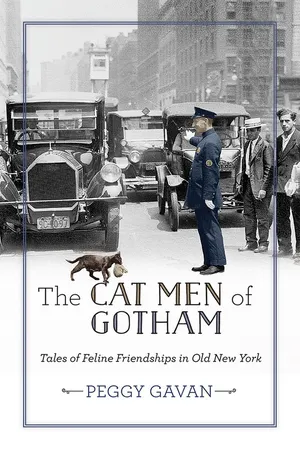
The nineteenth century was a rough time to be a stray cat in New York City. The city's human residents dealt with feline overpopulation by gassing unwanted cats or tossing them in rivers. But a few lucky strays were found by a diverse array of men—including firemen, cops, athletes, and politicians—who rescued them from the streets and welcomed them into their homes and hearts.This book tells the stories of these heroic cat men of Gotham and their beloved feline companions. Not only does it introduce us to some remarkable men, but we get to meet many extraordinary cats as well, from Chinese stowaways prowling the Chelsea Piers to the sole feline survivor of the USS Maine explosion. Among the forty-two profiles, we find many feline Cinderella stories, as humble alley cats achieved renown as sports team mascots, artists' muses, and even presidential pets.Sure to appeal to cat fanciers and history fans alike, The Cat Men of Gotham will give you a new appreciation for Old New York and the people and animals who made it their home. As it takes you on a journey through the streets of Manhattan and Brooklyn, it will amuse and astound you with tales of powerful men and their pussycats.
- English
- ePUB (mobile friendly)
- Available on iOS & Android
eBook - ePub
About this book
Information
1
Seafaring Cats
The special relationship between sailors and cats dates back thousands of years. According to the United States Naval Institute, although ship cats were primarily responsible for killing the rats that gnawed at the ship’s ropes and provisions, it was also common for crews to adopt or “liberate” cats from foreign lands. These cats served as souvenirs as well as surrogates for the pets the sailors had left back home. They also provided companionship and a sense of security for men who were often away from loved ones for long periods of time.
Many sailors believed that a cat’s behavior could also help predict the weather. For example, if the ship’s cat licked its fur against the grain, a hailstorm was looming. When a cat sneezed, rain was coming. If the feline was frisky, the sailors could expect high winds. Some superstitious sailors even believed cats could effect stormy weather with magic powers stored in their tails.
Feline mascots were also in high demand because sailors believed cats brought good luck to a ship. A ship that set sail without a cat would be plagued by bad luck. And heaven forbid a cat mascot fall overboard. Sailors thought this was a bad omen that would cause the ship to sink in a terrible storm. Even if the ship were to survive, a ship that lost its feline mascot to the sea would be cursed with years of bad luck.

Crewmen of the USS Olympia on deck with their two ship cats in 1898. Note the one sailor playing with a cat using a mirror and sunlight. (Photograph by George Grantham [NH 43211], courtesy of the Naval History & Heritage Command)
In the 1800s and 1900s, cats of all nations gathered on the piers in Manhattan and Brooklyn. Feline colonies were especially prolific during wartime, when almost every ship had at least one cat. Although some of the cats were born on the piers, many were refugees that had traveled to New York on the various steamships taking part in the war efforts. Most of these cats, like Tom of the USS Maine, were old salts that spent their entire life at sea. Others, like Minnie of the Brooklyn Navy Yard, were landlubbers that preferred to stay behind on the docks to do their mouse-catching duties.
Today, most modern commercial and naval vessels no longer permit cats (the Russian navy sea kittens are one exception). However, recent news articles about sailors jumping into the seas to rescue drowning kittens and online videos of brawny recreational boaters bonding with their feline companions prove that the special bond between cat and sailor still thrives.
1893
The Brave and Brawny Cats of the Brooklyn Navy Yard
In the late nineteenth century, the Brooklyn Navy Yard was overrun with rats. The voracious rodents gnawed at every dock, causing extensive damage. The losses in rigging, spare sails, and other wares were also great. Officials tried traps and poisons, but the rats simply made a sport of it and got fat on the poisoned food. The United States Navy recruited some dogs to help with the cause, but the canines were no match for the clever rats (the dogs would bolt out of the yard in terror whenever they encountered the bold rodents). Unfortunately, there were very few mousers available during this time. To be sure, plenty of kittens had been born at the yard over the years, but most cats and kittens were quickly scooped up by sailors who wanted a good-luck mascot. The few cats left behind helped as best they could, but the rodent population was too much for only a few felines to handle.
The situation changed in 1893, when a few neighboring landlubber cats entered the Brooklyn Navy Yard to do some exploring. Upon discovering the large rodent population, these cats decided to hide from the sailors and stay in place rather than go out to sea. The new terra-firma cats went into high gear, and within a few years, the rodent population was under control.
In November 1900, President William McKinley appointed forty-two-year-old Francis Tiffany Bowles to the position of Rear Admiral, Chief Constructor of the Navy. By this time, there were more cats than rodents at the Brooklyn Navy Yard. However, the young officer told his men that they were not to hurt or interfere with any of the cats that prowled in the yard. Rear Admiral Bowles understood how valuable the felines were to the shipyard. They did not cost the government a penny, and in fact they saved the United States thousands of dollars a year by keeping the rats and mice away from the storage sheds and shops. Not only did the men abide by the officer’s orders, but many were more than willing to share scraps of food with the mousers at lunch time. When the bells tolled at noon, the cats would come running to their respective dining stations.
* * *
Two of the veteran cats who arrived at the yard in 1893 were Tom and Minnie. These two black cats did their policing in the electrical building, where large quantities of oiled silk and other insulating materials were stored. The rats were quite attracted to these materials and had often gnawed on them before the dynamic feline duo came to town. Tom was a large cat, while Minnie, the smallest working cat in the yard, was not much bigger than a kitten. Despite her size, Minnie was the best ratter in yard. One workman told a New York Times reporter that she was probably the best ratter in the world. Minnie had full run of the machine rooms, and she knew how to protect every wheel and strap. She’d dodge among the whirling belts and wheels in hot pursuit and tackle rats as big as herself. She could jump up to eight feet; once she jumped down a flight of stairs to land on a rat’s back. As one workman noted, “She deserves a gold medal for preserving the property of the United States government.”
Jerry, the oldest cat in the yard, arrived soon after Tom and Minnie in 1893. His feline partner was George Dewey, who came to the yards in 1897. The two were responsible for patrolling the rigging loft in Building 8 on Chauncey Avenue. This loft had at one time been infested with rats and mice that did tremendous damage to the rigging. George and Jerry worked alongside the master sailmaker William L. Cowan, a veteran of the navy who had served with the Paraguay Expedition of 1858 and the Potomac Squadron during the Civil War. Cowan took charge of the sailmaking department at the Brooklyn Navy Yard in 1889, just after Commodore George Dewey ordered that every ship repaired at Brooklyn also have its sails made at the yard. According to Cowan, once George and Jerry went on the job, the loft was free of rodents, and he no longer had to worry about them running over his feet or trying to run up his pants. “You have no idea of the change that has taken place there,” Cowan told the reporter. “The mice used to be awful. They were so bold and fearless that they would come scampering over our hands while we were working at the rigging here.”
Jerry was the most unusual of the landlubber cats in the yard, as he was the only one to have gone to sea and come back. According to Cowan, Jerry took two trips on American ships and one voyage on the Monongahela with the Asiatic Squadron. Jerry also had a habit of taking long trips away from the shipyard about once a month, leaving George alone to handle the rodents in the rigging loft. No matter how long Jerry stayed away though, he would always return and work overtime when the mice started to show up again. One time, Jerry was taken against his will by one of the workmen who wanted to domesticate him. Jerry was not about to be a house cat, so he escaped and returned to the yard the next day. Some of the workers believed that he must have followed the sound of the lunch bell tolling at noon.
J. A. Cook, a workman in the ship carpenters’ department, also had a cat, whom he named Joan of Arc. According to Cook, Joan of Arc was a Republican feline from Omaha; however, he noted, she could “smell a rat just as quick as if she were a Democrat.” The workmen in this shop said they could set their watches by Joan, because she showed up every day at 11:55 a.m. to get some scraps of food and milk before any other cats arrived when the lunch bell rang.
Another Brooklyn Navy Yard cat was Jennie, a tortoiseshell feline employed in Building 20, the iron-plating shop. Here, she worked with her owner, Bob Duke, in the construction and repairs department. She was the expert ratter in residence, and it was her job to teach all her kittens the skills they needed to get their mouse. According to Duke, Jennie had kittens about every three months, and most of them were taken all over the world by the sailors who adopted them as ship mascots. Before the kittens headed to sea, though, Jennie would give each one lessons in rodent catching. She would do this by depositing a dead mouse on the floor and then carrying one of the kittens to the dead rodent. She’d then get into a crouching position at some distance from the mouse, pounce on it with a sudden spring, and growl fiercely. After repeating these steps several times, she would step aside and let the kitten mimic her actions.
During the war years, many of the shipyard cats headed out to sea as mascots of the warships, which helped keep the land-based population in check. But ten years after World War II ended, the cat colonies started getting out of hand, forcing the navy to set traps and override the old rules established by Rear Admiral Bowles in 1900. The cats had a hero in Bill Wade, a grizzled, tattooed old sailor and journeyman who thought cats were the greatest sailors in the world. Wade would go around springing the traps to help save all the cats that he cared for and loved. Twice he was suspended for disabling the cat traps. He must have done a good job saving them though: by the time he retired in 1965, there were about fifteen hundred cats on the property.
In June 1966, one week after the government officially closed the Brooklyn Navy Yard, Wade reached out to Judith Scofield, who had founded the Save a Cat League in 1957. The two met with Rear Admiral William Francis Petrovic, several enlisted men, representatives from the city health department, and representatives from the Brooklyn branch of the ASPCA to discuss the fate of the abandoned cats. The Save a Cat League was given three months to find homes for any cats the navy could safely trap. Just a few hours before the meeting, however, three men reportedly came to the yard and stole many of the cats. Scofield and Wade were furious. “What happened to those cats who were taken away just hours before we came and who were those men?” Scofield asked. “Are those cats covered by the agreement the navy made with us?” According to Scofield, many people had expressed a desire to have a shipyard cat, and her organization would have found good homes for all of them had they not been stolen.
Today, many descendants of the twentieth-century Brooklyn Navy Yard mousers that dodged capture are still roaming the property and living in feral cat colonies. As more neighborhoods throughout Brooklyn and the other boroughs are gentrified, cat activists must continuously address the city’s serious feral cat problem by setting up food stations, building shelters, and implementing Trap-Neuter-Return to humanely control and reduce the cat population.
* * *
The New York Naval Shipyard, more popularly known as the Brooklyn Navy Yard, is located on the Wallabout Bay, a knee-shaped bend in the East River. The bay takes its name from a group of French-speaking Walloons from Belgium who settled on the Brooklyn waterfront in the mid-seventeenth century. One of the first settlers to the area was Joris Jansen Rapalje, a tavern keeper who purchased about 335 acres of land in June 1637 and established a farm near what was then called Waal-Bogt Bay (bay of the foreigners). Over the years, Wallabout Village grew into a small farming and milling community of about a dozen interrelated families living along the shore of the bay, just north of present-day Flushing Avenue.
In 1791, the shipbuilder John Jackson and his brothers Samuel and Treadwell acquired from the Commissioners of Forfeiture a one-hundred-acre crescent-shaped tract adjacent to the bay. The Jackson brothers built a small shipyard on an existing dock and about ten houses for their workers. Ten years later, in 1801, they sold their shipyard to the United States government for $40,000. President John Adams’s administration authorized the establishment of a naval shipyard in Brooklyn in 1801, and in 1806 the property became an active United States Navy shipyard.
In 1966, Secretary of Defense Robert McNamara closed the Brooklyn Navy Yard and ninety other military bases and installations. At the time of its closing, the yard comprised more than two hundred acres and employed more than nine thousand workers. New York City reopened the yard as an industrial park in 1969, and today the yard is managed by the Brooklyn Navy Yard Development Corporation.
DID YOU KNOW?
Following the Battle of Long Island in 1776, thousands of Continental Army soldiers were taken prisoner and transferred to British ships anchored in Wallabout Bay. Overcome by disease, fires, flogging, and squalid conditions, about 11,500 soldiers died on the overcrowded prison ships. Many of the dead were thrown overboard or buried in mass graves in the mud flats along the bay. Others were hastily buried in a sandy hill adjacent to today’s Flushing Avenue. During the years that the Jackson brothers owned the Wallabout Bay property, many bones of the dead Continental soldiers were exposed as the tide eroded the beach. Other graves were uncovered during grading for the navy yard. In 1808, the remains were placed in thirteen coffins, representing the thirteen original colonies. The coffins were reportedly placed in a vault on John Jackson’s farm outside the navy shipyard wall, at the corner of Jackson Street (now Hudson Avenue) and York Street. In 1873, the remains were moved to a large brick vault in Brooklyn’s Fort Greene Park. The renowned New York City architectural firm of McKim, Mead & White designed a monument for the vault in 1905, which was dedicated as the Prison Ship Martyrs Monument on November 14, 1908.
1898
Tom, the Old Na...
Table of contents
- Cover
- Title Page
- Copyright
- Dedication
- Contents
- Introduction
- 1. Seafaring Cats
- 2. Police Cats
- 3. Fire Cats
- 4. Artist and Editorial Cats
- 5. Hospitality Cats
- 6. Theatrical and Show Cats
- 7. Civil Servant Cats
- 8. Good-Luck Cats
- 9. Lucky Cats
- Suggestions for Further Reading
- Notes
- Index
- About the Author
Trusted by 375,005 students
Access to over 1.5 million titles for a fair monthly price.
Study more efficiently using our study tools.
Frequently asked questions
Yes, you can cancel anytime from the Subscription tab in your account settings on the Perlego website. Your subscription will stay active until the end of your current billing period. Learn how to cancel your subscription
No, books cannot be downloaded as external files, such as PDFs, for use outside of Perlego. However, you can download books within the Perlego app for offline reading on mobile or tablet. Learn how to download books offline
Perlego offers two plans: Essential and Complete
- Essential is ideal for learners and professionals who enjoy exploring a wide range of subjects. Access the Essential Library with 800,000+ trusted titles and best-sellers across business, personal growth, and the humanities. Includes unlimited reading time and Standard Read Aloud voice.
- Complete: Perfect for advanced learners and researchers needing full, unrestricted access. Unlock 1.5M+ books across hundreds of subjects, including academic and specialized titles. The Complete Plan also includes advanced features like Premium Read Aloud and Research Assistant.
We are an online textbook subscription service, where you can get access to an entire online library for less than the price of a single book per month. With over 1.5 million books across 990+ topics, we’ve got you covered! Learn about our mission
Look out for the read-aloud symbol on your next book to see if you can listen to it. The read-aloud tool reads text aloud for you, highlighting the text as it is being read. You can pause it, speed it up and slow it down. Learn more about Read Aloud
Yes! You can use the Perlego app on both iOS and Android devices to read anytime, anywhere — even offline. Perfect for commutes or when you’re on the go.
Please note we cannot support devices running on iOS 13 and Android 7 or earlier. Learn more about using the app
Please note we cannot support devices running on iOS 13 and Android 7 or earlier. Learn more about using the app
Yes, you can access The Cat Men of Gotham by Peggy Gavan in PDF and/or ePUB format, as well as other popular books in History & North American History. We have over 1.5 million books available in our catalogue for you to explore.