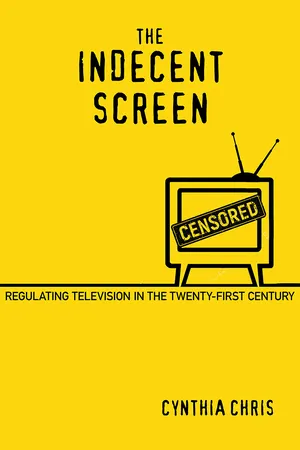
The Indecent Screen explores clashes over indecency in broadcast television among U.S.-based media advocates, television professionals, the Federal Communications Commission, and TV audiences. Cynthia Chris focuses on the decency debates during an approximately twenty-year period since the Telecommunications Act of 1996, which in many ways restructured the media environment. Simultaneously, ever increasing channel capacity, new forms of distribution, and time-shifting (in the form of streaming and on-demand viewing options) radically changed how, when, and what we watch. But instead of these innovations quelling concerns that TV networks were too often transmitting indecent material that was accessible to children, complaints about indecency skyrocketed soon after the turn of the century. Chris demonstrates that these clashes are significant battles over the role of family, the role of government, and the value of free speech in our lives, arguing that an uncensored media is so imperative to the public good that we can, and must, endure the occasional indecent screen.
- English
- ePUB (mobile friendly)
- Available on iOS & Android
eBook - ePub
About this book
Information
Publisher
Rutgers University PressYear
2019Print ISBN
9780813594064
9780813594071
eBook ISBN
9780813594088
Subtopic
Performing Arts1
A Brief History of Indecency in Media in the Twentieth Century
We cannot allow any single person or group to place themselves in a position where they can censor the material which shall be broadcast to the public, nor do I believe that the government should ever be placed in a position of censoring this material.
—Herbert Hoover, 1924
On Tuesday, May 26, 1987, KZKC-TV showed a movie called Private Lessons (1981) in the prime 8:00 to 10:00 P.M. time slot. The film, a comedy directed by Alan Myerson, is about a blackmail plot that involves a housekeeper’s seduction of her employer’s fifteen-year-old son. When the movie was released theatrically, the Classification and Rating Administration (CARA) of the Motion Picture Association of America (MPAA) had rated Private Lessons “R—Restricted—Under 17 Requires Accompanying Parent or Adult Guardian.” It wasn’t the first time that KZKC, an independent station in Kansas City, Missouri, had shown an unedited or lightly edited R-rated film, and it was not uncommon for the station to receive ten or twelve letters of complaint when one of these films contained sexual themes or a bit of partial nudity.1 But this time, one complainant didn’t simply notify the station that she found the film inappropriate for primetime. A member of the local chapter of the National Federation for Decency, she videotaped the film and submitted a complaint to the Federal Communications Commission (FCC).2
In January 1988, the FCC announced that it would investigate the broadcast. Kansas City Star television critic Barry Garron responded in a barbed column:
Hallelujah and pass the hypocrisy!
It should be a particularly interesting investigation, because other TV stations throughout the country have shown uncut R-rated films for years without any FCC interference, and because the FCC apparently has expressed no interest in the many other R-rated films Channel 62 has shown in the past.
The FCC has a quaint idea of what is indecent. When a Dodge City, Kan., station broadcast racist and anti-Semitic diatribes, the commission found no indecency. When a Utah station last year devoted hours a day to a white supremacist, that, too, was not indecent, according to the FCC.
Now the FCC is saying it is perfectly all right to expose children to the rantings of racists and bigots but downright harmful for them to catch a brief glimpse of a naked body.… Maybe it has come to believe that censorship of what a few may believe to be naughty is how best to serve the nation.
Now isn’t that indecent?3
Garron showed no mercy for a system that would take punitive action against a somewhat risqué movie while protecting niches in which hate speech could flourish unfettered. Apparently, officials at the federal agency charged with regulating indecency in broadcasting didn’t see the irony. Even if they did, they were only empowered to take action against broadcasts that included, as per revised indecency enforcement standards issued by the FCC in 1987, “language or material that depicts or describes, in terms patently offensive as measured by contemporary community standards for the broadcast medium, sexual or excretory activities or organs.”4 On June 23, 1988, the FCC issued a notice indicating that it had found KZKC responsible for broadcasting indecent material and would fine the station $2,000.
This case should raise questions for anyone interested in the extent to which the federal government can or should regulate speech. Among them: (1) Since the material in question was not actually obscene, how can the courts and Congress justify policies permitting the FCC to take punitive action against the station that aired it, given the broad protections of the First Amendment?5 (2) Does one complaining viewer constitute an indication that the broadcasted film was “patently offensive”? Regarding the first question, the FCC’s authority to restrict and take punitive actions against indecent broadcasts is derived from the legacy status of broadcasting as a public trustee of the airwaves with unusual obligations. Indecency law does not pertain to other media—not print, recorded music, cable TV, or internet-based content. As for the second question, the “community standards” component of the indecency policy is regularly criticized as vague, subjective, and abstract. After all, who is to say what “community standards” are? KZKC’s program manager told the Kansas City Star that while it received a dozen phone calls complaining about its broadcast of My Tutor (1983), a film with themes similar to those of Private Lessons and aired the previous evening, two callers told the station they had over-edited the film: “They knew we had cut quite a bit out.”6 In a nation as diverse—and, in many regards, as divided—as the United States—it would be more accurate to say they we constitute communities, plural and comingled, and that, therefore, a single standard is elusive.
Further answers to these questions can be found by exploring the history of attempts to regulate television content. In this chapter, I examine a handful of key concepts, focusing on pre-1996 phases of decency regulation: the television industry’s own codes of ethics and their key precedents in film and radio; self-regulation and the Family Viewing Hour; the impact of the FCC v. Pacifica ruling and the “safe harbor.” These concepts are entangled, and their histories are overlapping. The history of television regulation is not entirely separable from the history of attempts to regulate radio programming, because the same FCC policy pertains to both forms of broadcasting. Accordingly, I will discuss some pertinent radio cases but keep my emphasis on TV.
While readers may hope for a tidy, linear history, making sense of these cases defies strict chronological impulses. Each case moves along a trajectory marked occasionally by the fits and starts of flaring campaigns, at other times by recession into the background, and often by the slow grind of bureaucratic and corporate pas de deux that take place in courtrooms and offices largely off of the public radar.
The Television Code and Its Precedents
People have fretted about seeing human flesh and hearing unsavory dialogue on television as long as there has been television. And by no means was television the first medium to arouse such fears. By 1907, the then-new medium of cinema prompted enough concern from both non-secular (mainly Protestant) groups and secular organizations devoted to social reform to support the founding of censor boards in cities and states throughout the United States, beginning in Chicago.7 The Supreme Court legitimated film censorship in 1915 in the landmark case Mutual Film Corporation v. Industrial Commission of Ohio, which essentially deprived the movies of full First Amendment protections. Writing for the majority of the court, Justice Joseph McKenna asserted that “moving pictures … [are] capable of evil, having power for it, the greater because of their attractiveness and manner of exhibition,” and that audiences for the movies, which were “not of adults alone, but of children, make them the more insidious.”8 Without hesitation, the Supreme Court affirmed that states and municipalities could operate censor boards empowered to exercise prior restraint (that is, to suppress entire films or demand excision of particular scenes within films before they were screened), a kind of a priori censorship that would have been unconstitutional if the medium in question were newspapers or magazines.
Censors were interested in preventing a range of behaviors from appearing in cinema and used a variety of means to do so. For example, boxing films became controversial, especially in the American South, when the outcomes of the fights offended white supremacists. The states of Arkansas and Tennessee banned films of the African American boxer Jack Johnson defeating white opponents, including Johnson-Jeffries Fight (1910). In 1912 Congress passed the Sims Act, named after its primary sponsor, Representative Thetus Willrette Sims (D-TN), which made it illegal to transport boxing films across state lines. The law was repealed only in 1940.9 While the Sims Act impeded distribution of films that defied Jim Crow-era ideologies of white superiority and racial segregation, in many ways, the most widespread and persistent concern about the movies was how they treated sexual subjects.
Time and time again, early films displaying the (usually female) body or addressing sexual subjects were vulnerable to censorship, morality campaigns, bans, even occasional arrests of theater operators. This was the case for films as different as The Unwritten Law: A Thrilling Drama Based on the Thaw White Case (1907), a true-crime drama based on a much-publicized sex scandal; Lois Weber’s Where Are My Children (1916), a melodrama with themes including access to contraception, abortion, and the eugenics movement; and Purity (1916), in which Audrey Munson played an artists’ model and posed in the gauzy nude.10 As film scholar Lee Grieveson observes, the reason for this is not simple prudishness, but rather,
Sexuality exists at the interface between the individual body and the social body; thus, individual sexual and reproductive conduct interconnects with issues of national policy and power. Legislation directed against prostitution, venereal disease, and “white slavery,” the forced abduction of white women into prostitution, made this connection particularly clear.11
Then as now, controversies over glimpses of human flesh and treatments of sexual behaviors, whether salacious or sensitive, erupted as part and parcel of larger social debates over women’s control over their own bodies—just as the ban on boxing films was part of the powerful and racist discourse on the control of black men’s bodies.
The Supreme Court bolstered the authority of the censor boards to cut or ban such films in the 1915 Mutual decision. Seeking to ameliorate the power of the censor boards, the movie industry developed self-regulating strategies. Under Will H. Hays’s leadership, the Motion Picture Producers and Distributors of America (MPPDA) launched a voluntary script-reviewing system called “The Formula” in 1924, followed in 1927 by Hays’s “Don’ts and Be Carefuls” and by the Production Code in 1930, authored by film magazine publisher Martin Quigley and Jesuit priest Daniel A. Lord.12 The Hollywood studios did not embrace these guidelines until 1934, when they agreed to strict enforcement of the Production Code in order to avert threatened boycotts by the Catholic Legion of Decency and other groups. The MPPDA established the Production Code Administration (PCA) and named Joseph I. Breen to enforce the code, which assigned (or denied) a seal of approval to each film before it went into distribution. Eventually, the authority of the PCA and the local censor boards to approve, disapprove, or alter films began to wane in light of the 1952 Supreme Court case Joseph Burstyn, Inc. v. Wilson.13 In what is often known as the “Miracle decision” after the 1948 film directed by Roberto Rossellini at the heart of the case, the court reversed the 1915 Mutual decision that had essentially denied motion pictures First Amendment protections.14 The Supreme Court’s decision in Freedman v. Maryland (1965), a case in which a film exhibitor challenged his state censor board’s power to ban films, assured that any remaining censor boards would soon be dismantled.15 Likewise, the movie industry’s trade association, by now renamed the Motion Picture Association of America, eventually abandoned the Production Code. In place of the censors and the code, the MPAA launched an age-based classification system in 1968.16
Despite the censor boards, motion pictures remained a wildly popular form of entertainment even when radio broadcasting emerged in the 1920s. Secretary of Commerce (and later U.S. President) Herbert Hoover, who was instrumental in developing a regulatory apparatus for radio, opposed imposing potentially censorious forms of regulation on radio.17 However, the then-new medium was not immun...
Table of contents
- Cover
- Title Page
- Copyright
- Contents
- Chronology
- List of Abbreviations
- Introduction: What We Talk About When We Talk About Television and Indecency
- 1. A Brief History of Indecency in Media in the Twentieth Century
- 2. Targeting Television in the Twenty-First Century
- 3. Television: More or Less?
- 4. Bleeps and Other Obscenities
- 5. Who’s Afraid of Dick Smart? The Body Politic, Public Access, and the Punitive State
- Conclusion: The Future of Indecency and Why It Matters
- Acknowledgments
- Notes
- Index
- About the Author
Trusted by 375,005 students
Access to over 1.5 million titles for a fair monthly price.
Study more efficiently using our study tools.
Frequently asked questions
Yes, you can cancel anytime from the Subscription tab in your account settings on the Perlego website. Your subscription will stay active until the end of your current billing period. Learn how to cancel your subscription
No, books cannot be downloaded as external files, such as PDFs, for use outside of Perlego. However, you can download books within the Perlego app for offline reading on mobile or tablet. Learn how to download books offline
Perlego offers two plans: Essential and Complete
- Essential is ideal for learners and professionals who enjoy exploring a wide range of subjects. Access the Essential Library with 800,000+ trusted titles and best-sellers across business, personal growth, and the humanities. Includes unlimited reading time and Standard Read Aloud voice.
- Complete: Perfect for advanced learners and researchers needing full, unrestricted access. Unlock 1.5M+ books across hundreds of subjects, including academic and specialized titles. The Complete Plan also includes advanced features like Premium Read Aloud and Research Assistant.
We are an online textbook subscription service, where you can get access to an entire online library for less than the price of a single book per month. With over 1.5 million books across 990+ topics, we’ve got you covered! Learn about our mission
Look out for the read-aloud symbol on your next book to see if you can listen to it. The read-aloud tool reads text aloud for you, highlighting the text as it is being read. You can pause it, speed it up and slow it down. Learn more about Read Aloud
Yes! You can use the Perlego app on both iOS and Android devices to read anytime, anywhere — even offline. Perfect for commutes or when you’re on the go.
Please note we cannot support devices running on iOS 13 and Android 7 or earlier. Learn more about using the app
Please note we cannot support devices running on iOS 13 and Android 7 or earlier. Learn more about using the app
Yes, you can access The Indecent Screen by Cynthia Chris in PDF and/or ePUB format, as well as other popular books in Media & Performing Arts & Performing Arts. We have over 1.5 million books available in our catalogue for you to explore.