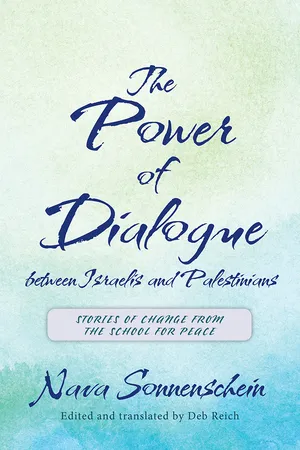
In The Power of Dialogue between Israelis and Palestinians, scholar and activist Nava Sonnenschein shares a collection of twenty-five powerful interviews she conducted with Palestinian and Jewish Israeli alumni of peacebuilding courses, a decade after their graduation. Participants with diverse personal and professional backgrounds completed a series of conflict transformation workshops using the model developed by the School for Peace at the world's only intentional Jewish-Palestinian community, Neve Shalom-Wahat al-Salam ("Oasis of Peace" in Hebrew and Arabic). Critically, the interviews vividly demonstrate that peacebuilding does not end with the courses. Most of the graduates choose to work professionally in roles that contribute to peace-building. Sonnenschein shows the transformational potential of encounter between members of groups in conflict, sharing how ordinary Israelis and Palestinians coming together in an open and honest environment undergo life-changing experiences that provide concrete hope for a sustainable path to a peaceful shared existence as equals in Israel and Palestine.
eBook - ePub
The Power of Dialogue between Israelis and Palestinians
Stories of Change from the School for Peace
- English
- ePUB (mobile friendly)
- Available on iOS & Android
eBook - ePub
The Power of Dialogue between Israelis and Palestinians
Stories of Change from the School for Peace
About this book
Information
PART 1 HUMAN RIGHTS AND POLITICAL ACTIVISM
1 • MICHAEL SFARD
Human Rights Advocate
Born in 1972, Michael Sfard is an attorney specializing in international human rights law and the laws of war. Sfard grew up in Jerusalem and served in the Israeli Defense Forces (IDF) as a military paramedic. Sfard was a conscientious objector and spent three weeks in military prison because of his refusal to serve in Hebron in the occupied West Bank. He obtained his law degree from the Hebrew University in Jerusalem, after which he apprenticed with Attorney Avigdor Feldman and worked in Feldman’s office for five years. Meanwhile, during a year in London, he completed a master’s degree in International Human Rights Law at UCL. In early 2004, Sfard opened his own legal practice in Tel Aviv. Today Sfard is the legal adviser to several Israeli human rights organizations and peace groups (including Yesh Din, Peace Now, and Breaking the Silence) and represents Palestinian communities (like the Village of Bil’in) and Israeli and Palestinian activists. Sfard led, and continues to lead, legal campaigns for the evacuation of illegal settlements and outposts built in the occupied West Bank (most notably, his successful litigation for removal of the Migron outpost), and he has handled numerous petitions concerning the Separation Barrier. He has represented many conscientious objectors, led the case against the Israeli policy of “targeted assassinations,” and represents Palestinian detainees before parole boards. Michael Sfard attended the School for Peace Course for Facilitators of Groups in Conflict in 1994 at Wahat al-Salam–Neve Shalom. He was interviewed for this project in spring 2007.
At Neve Shalom, I finally understood my connection to all the conquests and expulsions: not a legal connection, but one of silence, of acquiescence, of resigning myself to let it happen. It’s about responsibility.
Michael, tell me about how you were affected by the course you took at Neve Shalom.
The bottom line, completely without exaggeration, is that it unequivocally changed my life. It is the point of reference for all my development as a human being and certainly as an Israeli. I was just out of the army; I was twenty-two. I was actually still on unpaid termination leave from the Nahal Brigade and, since I was a group leader, I was sent to take the School for Peace Course for Facilitators of Groups in Conflict, and they even paid my fee. This came at just the right time for me because the army years are exceedingly problematical from a personal development standpoint; at the end, I was starved for both emotional and intellectual challenges. The course provides both, in one concentrated and generous serving.
The work you do as you struggle with the things you encounter in the course stays with you for a long time afterward. It’s like that toothpaste commercial about how it keeps on working.… It keeps on working because what I felt I got from that course was not only about Jews and Arabs. I got a complete set of equipment, tools, lenses, I don’t know what to call it, which allowed me to examine the behavior of groups of people in all sorts of cross-sections. I think that my understanding concerning men and women changed: it improved amazingly, even though the Neve Shalom course did not deal directly with gender issues. Even now when I look at social situations, sociological situations of one sort or another, the tools I use to analyze them, my most basic tools, are from Neve Shalom.
Meanwhile, the course is not just a pleasant memory: I shed a lot of my innocence during that period, thanks to the course, because of the course. Two kinds of innocence: One was my Zionist innocence. I’m saying this as clearly as possible; it’s not simple at all. And the other kind was the sort of innocence that permits us to say, hey, we are all human beings, this too shall pass and then everything will be fine. So in a certain sense, confronting this actually reinforced my identity as someone who was coming from the perspective of wanting to ignore differences, to say let’s all dance together in one circle and we are all human beings and the differences between us are not important, and there is absolute equality. It was this kind of simplistic liberalism, this very superficial leftist stance.
I came to understand that the fact that we are all human beings is only part of the story, that my being a Jew is significant; it’s not a question of good or bad, but it is significant. The fact that someone else is an Arab is significant and it has significance for how we relate to each other, whether I want that to be the case or not. This understanding, this insight is very powerful and has stayed with me, maybe even having an inverse effect … on my sense of belonging to this place. It’s very strange.
MULTIPLE PERSPECTIVES
This brings me to the next important point, which is the ability to accept that there can be several aspects to a single story. This is something you don’t understand until you notice it, until a day comes when you see the light.… One fine day you understand that different people can see the same reality differently and that we don’t necessarily have to decide that one person is wrong and another is right. People can live together in that reality and see it differently, and what’s important is that they see it differently. It’s less important to try to find out what really happened because the very fact that they see reality differently has implications for their living together. And this thing is simply part of me in everything, everything I do, in work relationships, everything. In other words, it doesn’t just involve conflicts between peoples, between the sexes or between races; it addresses the relations between people in general. In the specific Neve Shalom course that I took, there was a practice of trying to understand that while I am looking at something and seeing it as square, the person sitting next to me in the room is looking at the same thing and seeing it as round, and my job is not to blame him for having terrible eyesight, but to try to understand that he sees it differently. It took me a very long time in the course to accept this; but after you accept it, it really does change the way you look at all relationships between people, and I take this with me wherever I go.
Talk a little more about the impact of this in your personal and professional life.
Consider the example of the relationship between two people who are a couple.… Today I am more interested in the fact that someone feels something, feels, let’s say … hurt by me. Today it’s more important to me to understand what he feels than to try to persuade him that he’s wrong because he wasn’t supposed to feel that way. It’s less important who is right, because there really is no such thing. When I am having an argument with someone and they see something differently than I see it, the fact is that we have a disagreement about how things look. That’s what interests me: that this is our situation. I’m less interested in the fact that I can or cannot persuade that other person to see things the way I do. Our human story is the fact that we see things differently and we have to let this manifest itself and not negate the other person.
I am a lawyer now. My profession deals all the time with different narratives. I am always representing one side and the other side is representing the other party. We deal all the time, nonstop, with stories. I think this greatly helps me to understand the situation, because sometimes the sense that you are right can blind you. You feel so strongly that you are right that you cannot really step into the shoes of your opponent, which is a loss, because you are unable to fully understand. In my profession, in the end, if you cannot fully understand the other side, you won’t be able to see things the way the other side sees them, and you also won’t be able to properly appreciate the strength of the other side’s case.
Another thing is that today, a large part of what I do is representing the Palestinian narrative, and I feel like someone who can speak two languages.… That is, I am certainly an Israeli Jew and as such I know very well that I’m coming from the Israeli Zionist discourse. I know exactly what pushes people’s buttons in that narrative, I know the weaknesses of that narrative, I know its strengths, I know all of that. I know that in a lot of cases now I represent “Palestinian interests,” in quotation marks, but I don’t really think that these are Palestinian interests: I think that they are Israeli interests to the same degree.… But I represent interests that are perceived as Palestinian interests, and I am able today to see things from that angle. I feel like someone who previously spoke only French and now has also learned English, so he transitions into the possibility of communicating with more people, and his capacity for creative thought has grown. A language is not just a tool for communication, it’s actually also a tool for your own communication with yourself. So the more languages you know, the more you can express yourself, the more creative your thinking becomes, and that’s how I feel in this context. But I feel uncomfortable in that I seem to be giving myself compliments now.
IDEOLOGICAL METAMORPHOSIS
Both in practice and ideologically, the course influenced me enormously. When I got to Neve Shalom, I already knew that I was going to study law, but thanks to the course, the realms in which I wanted to change the world also shifted. Originally I aspired to petition the Supreme Court on cases of freedom of expression that would change the world. Later I realized that the things that are most important to me involve the Israeli-Palestinian conflict. I already saw myself as a leftist in every respect—one of what I call in hindsight the “soldiers with blankets”: when right-wingers are beating a Palestinian prisoner, these guys bring him a blanket against the cold. But the fiction that you can be an enlightened occupier really blew up in my face at Neve Shalom. That revelation marked a very significant new stage for me: it led me to choose to refuse a military call-up, long before the second Intifada began in the fall of 2000 and before the influential Courage to Refuse group was established in 2001.
For someone who goes through the course at Neve Shalom wholeheartedly, there is a stage when you know that you are continuing to play a role and you know that you’re lying; you continue to say the same things but, deep inside, you know that there is a gap between what you are presenting outwardly and what is happening inside of you. For me, this feeling was very, very difficult, because I don’t like to lie. I remember one specific session when I got angry at some image about a donkey and its rider, with the donkey being the Palestinian people and the rider being the Zionist entity. I have forgotten the details but I remember having been very angry at this image. Afterward, at home, I was even angrier when I realized that I had not said anything about it; I went back determined to crack that open, at least that one phrase, so that they wouldn’t say it anymore. And even as I was speaking, I already knew that I didn’t believe what I was saying.
JAIL TIME
In 1998 when I was called up for reserve duty in Hebron, I refused to report for duty and went to jail instead. From that point to defending conscientious objectors was not much of a leap, and it already seemed very natural. The formative moment is not when you represent someone else who is a conscientious objector, but rather your own refusal. That’s the formative moment. That moment was undoubtedly a product of the process I had gone through, and the main catalyst for it was the course at Neve Shalom. I found that things suddenly fall into place. Everything; suddenly. You realize things that maybe already were there, but suddenly you understand them differently. Suddenly I was trying to really think about how it feels to be an Arab citizen in Israel. This isn’t something you really ask yourself about, because you are captive to these concepts of we have a state, everything is democratic, there is equality here and there’s no law preventing an Arab from becoming the prime minister or defense minister or chief of staff. Not only are you inside of this thing; you’re also in total segregation in Israel. I was born and grew up in Jerusalem, a mixed city where I did not see a single Arab in my entire life. What does this “I did not see” mean? They passed in front of my retina but I did not really see and I did not connect, of course. Well, here and there, the [left-wing political party] Ratz youth movement, left-wing activism of one sort or another, so there were encounters but they were fleeting and superficial, not serious.
Then suddenly you are thrust into this consciousness at Neve Shalom with all the tension that goes along with it, and you really have to be authentic at some point because by now you are sick of the perpetual pretense. Little by little you start to understand what it is actually like, to be a citizen who belongs to a minority that is in conflict with the majority. The moment I understood, there was a natural progression to where I could no longer be a part of this. I am talking on purpose about the Arab citizens of Israel. Of course when we are dealing with the territories, then the story is much simpler from that standpoint. So it was a tremendous catalyst, there’s no doubt of that. Until I got to Neve Shalom, I was a combat soldier. I don’t want to say that I regret it: I was a combat soldier who was in the territories and did not refuse and did not think about refusing, on the contrary, I argued against what were relatively marginal phenomena of refusal and I never imagined for a moment that someday I would refuse.
You said: “I was always asking myself, if I did not refuse, then how could I look at myself in the mirror afterward?” That was the real question.
Yes … I was telling myself things that related to other things … things like: I am talking really well and I’ve never had a problem with expressing myself, so I am talking really well, but now is the time when I have to stand behind the words I speak, and standing behind the words means not to be part of the machine.
I had this moment in front of the officer … the moment when the officer said, “Look, I can’t promise you that I won’t put you up for a disciplinary hearing but I want to ask you, just so I know.… If we give you a role that has no contact with the population there in Hebron, without touching the population at all, then would you retract your refusal?” Never mind that an affirmative answer to that proposition is immoral in my view, and also kind of cowardly. Like, it’s OK for others to do the “dirty work”! That made me say no, immediately. But later I tried to think about it and to really try to imagine doing things there that would not involve direct contact with the population … and then came this matter of being a cog in the machine … and in the context of Neve Shalom, it’s fairly clear. It’s awfully clear. I am the good leftist who comes from a good home and wants peace and wants brotherhood. I come to Neve Shalom and suddenly I am fielding all these accusations as if.… What? Excuse me, but am I the one who started the Six-Day War? Did I do the conquering there? Did I expel people from Jaffa? What does all that (pardon the expression) shit have to do with me? And at Neve Shalom, I understood what my connection is: It does not have to be a legal one, involving criminal thinking that can be proven in a court of law beyond a reasonable doubt; it can be a connection of silence, of acquiescence, of coming to terms with letting it happen. All of these things definitely arose at Neve Shalom. It’s the feeling of responsibility.
Incidentally, there’s something else that’s connected, an intuitive connection, via the “school of identities” that I encountered at Neve Shalom. There were things that I was learning on my own back then about the banality of evil and the dangers of modernity and things relating to bureaucracy and being a cog in the system that does evil and whether this cog is responsible or not responsible. All these things brought me, in the end, to some kind of understanding about a human being who wants not to feel that he is a cog in the machine. Given a kind of determinism dictating that he will be part of some kind of big machine, he has to know, he has to constantly look around and say: Do I agree or do I not agree to do what I’m being commanded to do? It’s not especially problematical to say no when they are telling you to shoot an unarmed child waiving a white flag. The trick is to say no when you are ordered into a guard tower, and the guard tower is part of a huge system that ends with the child being killed. The connection between these two things is problematical. Yet the moment arrived when all these things came together for me. It could have happened to me on an earlier round of reserve duty when I was in Gaza; it could have happened to me on the next round of reserve duty. It happened at a point when things had reached some kind of … when the circle had closed.
CRITICAL VISION
The ideological change is very connected with the issue of thinking critically. You develop the ability to be critical about the obvious, about the self-evident things broadcast by the society around you. There’s a lot of danger in that [critical stance] ...
Table of contents
- Cover
- Title Page
- Copyright
- Contents
- Preface
- Introduction: When Groups Meet—Understanding How Power Dynamics Shape Intergroup Encounters
- Part I: Human Rights and Political Activism
- Part II: Community Organizing, Education, and Planning
- Part III: Family and Community Mental Health
- Part IV: University Teaching and Research
- Part V: Pioneering New Organizations
- Afterword: A Critical Analysis of the Interviews
- Acknowledgments
- Bibliography
- About the Author
Trusted by 375,005 students
Access to over 1.5 million titles for a fair monthly price.
Study more efficiently using our study tools.
Frequently asked questions
Yes, you can cancel anytime from the Subscription tab in your account settings on the Perlego website. Your subscription will stay active until the end of your current billing period. Learn how to cancel your subscription
No, books cannot be downloaded as external files, such as PDFs, for use outside of Perlego. However, you can download books within the Perlego app for offline reading on mobile or tablet. Learn how to download books offline
We are an online textbook subscription service, where you can get access to an entire online library for less than the price of a single book per month. With over 1.5 million books across 990+ topics, we’ve got you covered! Learn about our mission
Look out for the read-aloud symbol on your next book to see if you can listen to it. The read-aloud tool reads text aloud for you, highlighting the text as it is being read. You can pause it, speed it up and slow it down. Learn more about Read Aloud
Yes! You can use the Perlego app on both iOS and Android devices to read anytime, anywhere — even offline. Perfect for commutes or when you’re on the go.
Please note we cannot support devices running on iOS 13 and Android 7 or earlier. Learn more about using the app
Please note we cannot support devices running on iOS 13 and Android 7 or earlier. Learn more about using the app
Yes, you can access The Power of Dialogue between Israelis and Palestinians by Nava Sonnenschein, Deb Reich in PDF and/or ePUB format, as well as other popular books in Politics & International Relations & Middle Eastern Politics. We have over 1.5 million books available in our catalogue for you to explore.