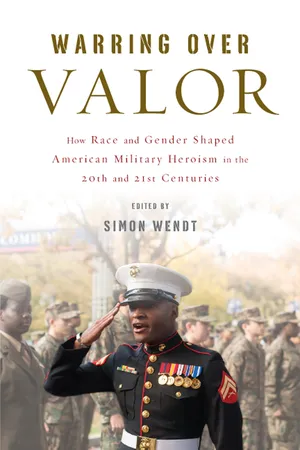
By focusing on how the idea of heroism on the battlefield helped construct, perpetuate, and challenge racial and gender hierarchies in the United States between World War I and the present, Warring over Valor provides fresh perspectives on the history of American military heroism. The book offers two major insights into the history of military heroism. First, it reveals a precarious ambiguity in the efforts of minorities such as African Americans, Asian Americans, Native Americans, women, and gay men to be recognized as heroic soldiers. Paradoxically, America's heroism discourse allowed them to press their case for full membership in the nation, but doing so simultaneously validated the dichotomous interpretations of race and gender they repudiated. The ambiguous role of marginalized groups in war-related hero-making processes also testifies to this volume's second general insight: the durability and tenacity of the masculine warrior hero in U.S. society and culture. Warring over Valor bridges a gap in the historiography of heroism and military affairs.
eBook - ePub
Warring over Valor
How Race and Gender Shaped American Military Heroism in the Twentieth and Twenty-First Centuries
- English
- ePUB (mobile friendly)
- Available on iOS & Android
eBook - ePub
Warring over Valor
How Race and Gender Shaped American Military Heroism in the Twentieth and Twenty-First Centuries
About this book
Trusted by 375,005 students
Access to over 1.5 million titles for a fair monthly price.
Study more efficiently using our study tools.
Information
1 • THE END OF MILITARY HEROISM?
The American Legion and “Service” between the Wars
GEORGE LEWIS
World War I wrought chaos on the Western heroic ideal. Not only were long-standing tropes of masculine, military heroism questioned in its aftermath, but so, too, was the very notion of heroism itself. On one side of the Atlantic, for example, Winston Churchill returned from the western front ready to question whether communities could dispense with “great men” and “hero worship.” If the questions reflected gendered assumptions that had long been made about heroes in general, and by Churchill in particular, the need to ask them was rooted in shifts in both modern warfare and modern society. “Modern conditions do not lend themselves to the production of the heroic,” Churchill surmised. “The heroes of modern war lie out in the cratered fields, mangled, stifled, scarred; and there are too many of them for exceptional honours.” On the other side of the Atlantic, heroism’s viability and trajectory were under equal scrutiny. In Sidney Hook’s analysis, the key differentiation to be made in understanding heroism was between the “eventful man” and the “event-making man,” the latter of whom was more likely to fulfil the requirements of heroism. For Hook, however, it was not modernity’s mechanization of the battlefield that threatened the hero, but the expansion of participatory democracy. His “event-making man” was defined by an ability to redetermine the course of history. By the time in which he was writing, that power was increasingly deemed to lie not with a small coterie of individual men, but with the enfranchised citizenry of a democratic community, now regardless of gender. For Hook’s putative hero, the “processes of democracy” were likely “a fetter upon his calling.”1
While Churchill continued to cast around for a solution to military heroism’s place in the modern world, by the end of the interwar period Hook believed that he had scented one. Modern society should not confine its definition of the heroic life to the “grandeur and nobility” most commonly associated with careers and actions that reeked with “blood and suffering.” For heroism to reemerge and survive as a valuable concept, Hook argued, it should be reimagined, although, notably, not in a way that would alter its gender dynamic: “a hero,” he concluded, should be “any individual who does his work well and makes a unique contribution to the public good.” Developing his theme, Hook declared that “a democracy should contrive its affairs, not to give one or a few the chance to reach heroic stature, but rather to take as a regulative ideal the slogan, ‘every man a hero.’ We call this a ‘regulative ideal,’ ” he summarized, “because it would be Utopian to imagine that it could ever be literally embodied.”2
That “regulative ideal,” however, did not have to remain “Utopian.” For the entire interwar period, it was adopted, developed, and resourced by the American Legion. The Legion occupied a privileged position in the discourse of military heroism, not least because its members had each had personal experience of modern warfare as a prerequisite of membership, but also because of the intricate local, national, and, indeed, international network of posts of which it was comprised, and the significant lobbying operation that it developed. As will be argued here, the Legion’s stance on heroism is surprising and counterintuitive, and had a major impact on the shape and tenor of discourses of American heroism—and masculinity—in the interwar period. In its view of heroism, the Legion negotiated a pathway between the complex concerns of both Churchill and Hook. It concurred with Churchill on military heroism, for example, but for subtly different reasons: where, for Churchill, the mechanical horrors of modern warfare meant that military heroism could not be celebrated, the Legion argued that it should not be. More significantly, however, and in line with Hook’s “regulative ideal,” the Legion strove to disassemble conventional theories of military heroism, relegating them below a sublimated ideal of heroism as “service,” by which it meant the collective endeavor of citizens to build and protect both democracy and what it defined as “Americanism” in civic society. Such activity should take place, the Legion believed, with a sense of sacrifice and fervor equal to that with which veterans had fought on the battlefield for the same ideals.3
The Legion, in other words, sought a seismic shift in the collective American understanding of the heroic: acts of military heroism were purposefully omitted from Legion discourse. In addition, they were consciously replaced with the privileging of service to civic democracy as the new, modern heroic ideal. Reimagining heroism not as something that was achieved via hypermasculinized military bravery, but as citizenship-oriented civic service, thus effectively severed what earlier commentators have referred to as the “inherent” and “underlying theme” of the “continuing universal appeal of the myth of the warrior hero.”4 Moreover, it also brought with it an important by-product, for—at least in theory—it also effectively served to democratize heroism: under such a schema, all citizens, and not just physically strong and martially skilled white men, gained access to the potentially heroic. In that sense, the Legion’s activity in the interwar era forces a further reconceptualization of American military heroism, for it suggests flaws in the mooted model of “transcendent national citizenship” that, it has been claimed, was fostered by the U.S. military along heterosexual, masculine lines.5 Despite the importance and, above all, the scale of its work, however, the Legion’s attempts to reshape American notions of heroism in the interwar period have been subjected to what might be termed symbiotic neglect—the few organization histories that do exist of the Legion fail to acknowledge its impact on the heroic ideal, and the historiography of American heroism simply fails to recognize the Legion.6 As a result, the rationales that lay behind the Legion’s position, the way in which it put that theoretical position into practice, and the effect that practice had on American notions of military heroism, gender, and identity are in need of explanation and explication.
As would be expected from such a large organization with such a multifaceted membership, those motivating factors were often complex, but can nonetheless be understood as practical, pragmatic, political, experiential, and ideological. The decision to reimagine heroism was born largely of the experiential, but also had pragmatic and ideological elements. Most decisively, the Legion shared Churchill’s reading of the nonheroic nature of modern warfare: war was hell rather than heroic, and to pretend otherwise was an affront to the battlefield experience of Legionnaires, and also increased the likelihood of a return to conflict in the future.7 Thus, for example, one Legionnaire wrote in a regular Legion publication that a mooted international agreement aimed at “more humane warfare” was, of course, “a contradiction in terms.” Another, asked to identify his first “thrill” in the war, mentioned not the excitement of basic training, or embarkation, or transatlantic travel and arrival on the exotic shores of Europe, or the first close shell explosion he witnessed at the front. Rather, he realized that “I was scared, not thrilled,” and said the first thrill he could recall was his eventual return—safe—to the peacetime tranquility of the New Jersey shoreline.8
As ideological and pragmatic corollaries, the Legion’s focus on battle as a collective endeavor and its need to represent each of its members equally also led it to eschew military heroism as traditionally conceived. Thus, for example, the postwar vogue for ruminating on and ranking the “greatest” battles and “most heroic” acts of war was summarily dismissed. As an American Legion Weekly editorial surmised, such comparisons were odious. Soldiers fought equally as hard in side skirmishes as they did in battles that decided “the fates of a nation and of ideas,” and reducing these activities to a cleanly ordered list of battles was highly inappropriate. Such a formula was “so much cold mathematics,” the editorial noted, before concluding somewhat ruefully that, in the modern age, “much of war” in general was “cold mathematics and no more.”9 In terms of pragmatism, the Legion recognized that it needed to represent a diverse cross-section of members, given that the prerequisite for joining was personal experience of battles waged for the preservation of American ideals of democracy, albeit in carefully selected wars. It would, therefore, have been counterproductive to alienate vast swathes of that membership by elevating only a small number of military “heroes” in its ranks, thereby implying that the military service of all other Legionnaires had not been recognized as heroic, or, indeed, had been identified as nonheroic. That situation was all the more delicate given that a majority of the soldiers who joined the U.S. Army in 1917 to 1918 did not have the opportunity to leave the nation’s shores for the European theater before an end to hostilities was declared. For those who were involved in fighting, the modern battlefield was a mechanically democratized arena, and it was a reflection of the collective nature of the Legion’s response that—jarringly, as it soon turned out—Legionnaires referred to one another as “comrade.” So, too, was the sense of collective military responsibility: frequent were the Legion’s assertions, for example, that single regiments should not receive plaudits for particular battles, for all who served contributed an equal share.10
That collectivism should also be understood more broadly, however, for it also explicitly included women, and implicitly included nonwhite citizens. Indeed, a women’s section was established at the very first Legion convention in 1919, although it is notable that it was labelled the “Auxiliary” and was tasked with traditionally gendered assignments such as fund-raising and children’s welfare. Nonetheless, its continual growth was such that by the end of the interwar period it boasted more than 520,000 members, and the Legion’s forward-thinking postwar ethos of the value in civic service, rather than a backward-looking gaze toward past battlefield heroism, allowed—at least in theory—the new version of heroism to appreciate the input of female members as much as male. In practice, Auxiliary members were often hidebound by traditionally gendered roles within that service, although the equally gendered historiography on the subject often obscures even those limited roles.11
Indeed, the evidence from here and elsewhere suggests that the Legion’s extending to women access to possible heroism as part of a drive to reimagine heroism as civic rather than martial was a reflection of internal schisms within the organization, or—at the very least—of the extent to which the many different parts of the Legion worked at such different speeds that they were often in tension with one another. Thus, it was an unintended consequence of the “collective” aspect of heroic civic service that it repeatedly turned out to be selective. For example, although it proclaimed all citizens to be “united in a common purpose,” a schools educational award initiated by the Legion outlined the judging criteria for boys as honor, courage, scholarship, leadership, and service; girls could also be judged on courage, scholarship, and service, but honor and leadership were replaced by companionship and character.12 That should not be taken as evidence of an organization that was simply failing to reflect modernizing attitudes toward gender roles, but rather of one in which the aspiration for a more modern approach had yet to manifest itself in real change across its membership. The tension between the two positions exemplified the difficulties of enforcing a unified position on such an amorphous and sprawling organization as the Legion, and especially one so reliant upon the work of volunteers. Where, for example, the entrenched conservatism of the “kingmakers” of the Legion’s central command clung to the idea of heroism as the preserve of a very masculine construction of warfare, other branches of the Legion structure, notably the National Americanism Commission (NAC), took a more forward-looking view of service that at least offered a bridge to a more egalitarian future. It was one that reflected the more participative role played by women in World War I, but was useful only if Legion posts and members were willing to take it up.
Nowhere were those tensions more graphically illustrated, and the positives that could be wrought from the adoption of service over heroism more obviously demonstrated, than in the internal confusion at the end of the 1920s that surrounded a war novel prize which was cosponsored by the Legion and the Houghton Mifflin publishing company. After rancorous internal debates between the judges, the decision was made to award the prize jointly to two authors, one of whom was Mary Lee, for her novel It’s a Great War! The idea for running the prize grew from the obvious success of one of the Legion’s main tactics to ensure the successful dissemination of its service strategy—a series of annual school essay writing competitions on self-consciously “patriotic” topics. Those competitions saw 50,000 school children...
Table of contents
- Cover
- Series Page
- Title Page
- Copyright
- Contents
- Introduction: Reconsidering Military Heroism in American History
- 1. The End of Military Heroism? The American Legion and “Service” between the Wars
- 2. GI Joe Nisei: The Invention of World War II’s Iconic Japanese American Soldier
- 3. Instrument of Subjugation or Avenue for Liberation? Black Military Heroism from World War II to the Vietnam War
- 4. “Warriors in Uniform”: Race, Masculinity, and Martial Valor among Native American Veterans from the Great War to Vietnam and Beyond
- 5. My Lai: The Crisis of American Military Heroism in the Vietnam War
- 6. Leonard Matlovich: From Military Hero to Gay Rights Poster Boy
- 7. Displaying Heroism: Media Images of the Weary Soldier in World War II, the Korean War, and the Vietnam War
- 8. “From Louboutins to Combat Boots”? The Negotiation of a Twenty-First-Century Female Warrior Image in American Popular Culture and Literature
- 9. From Warrior to Soldier? Lakota Veterans on Military Valor
- 10. Virtual Warfare: Video Games, Drones, and the Reimagination of Heroic Masculinity
- Acknowledgments
- Notes on Contributors
- Index
Frequently asked questions
Yes, you can cancel anytime from the Subscription tab in your account settings on the Perlego website. Your subscription will stay active until the end of your current billing period. Learn how to cancel your subscription
No, books cannot be downloaded as external files, such as PDFs, for use outside of Perlego. However, you can download books within the Perlego app for offline reading on mobile or tablet. Learn how to download books offline
Perlego offers two plans: Essential and Complete
- Essential is ideal for learners and professionals who enjoy exploring a wide range of subjects. Access the Essential Library with 800,000+ trusted titles and best-sellers across business, personal growth, and the humanities. Includes unlimited reading time and Standard Read Aloud voice.
- Complete: Perfect for advanced learners and researchers needing full, unrestricted access. Unlock 1.5M+ books across hundreds of subjects, including academic and specialized titles. The Complete Plan also includes advanced features like Premium Read Aloud and Research Assistant.
We are an online textbook subscription service, where you can get access to an entire online library for less than the price of a single book per month. With over 1.5 million books across 990+ topics, we’ve got you covered! Learn about our mission
Look out for the read-aloud symbol on your next book to see if you can listen to it. The read-aloud tool reads text aloud for you, highlighting the text as it is being read. You can pause it, speed it up and slow it down. Learn more about Read Aloud
Yes! You can use the Perlego app on both iOS and Android devices to read anytime, anywhere — even offline. Perfect for commutes or when you’re on the go.
Please note we cannot support devices running on iOS 13 and Android 7 or earlier. Learn more about using the app
Please note we cannot support devices running on iOS 13 and Android 7 or earlier. Learn more about using the app
Yes, you can access Warring over Valor by Simon Wendt in PDF and/or ePUB format, as well as other popular books in History & Historiography. We have over 1.5 million books available in our catalogue for you to explore.