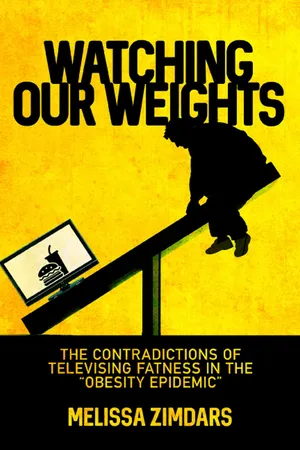
Watching Our Weights explores the competing and contradictory fat representations on television that are related to weight-loss and health, medicalization and disease, and body positivity and fat acceptance. While television—especially reality television—is typically understood to promote individual self-discipline and expert interventions as necessary for transforming fat bodies into thin bodies, fat representations and narratives on television also create space for alternative as well as resistant discourses of the body. Melissa Zimdars thus examines the resistance inherent within TV representations and narratives of fatness as a global health issue, the inherent and overt resistance found across stories of medicalized fatness, and programs that actively avoid dieting narratives in favor of less oppressive ways of thinking about the fat body. Watching Our Weights weaves together analyses of media industry lore and decisions, communication and health policies, medical research, activist projects, popular culture, and media texts to establish both how television shapes our knowledge of fatness and how fatness helps us better understand contemporary television.
eBook - ePub
Watching Our Weights
The Contradictions of Televising Fatness in the "Obesity Epidemic"
- English
- ePUB (mobile friendly)
- Available on iOS & Android
eBook - ePub
Watching Our Weights
The Contradictions of Televising Fatness in the "Obesity Epidemic"
About this book
Information
Topic
Sciences socialesSubtopic
Étude des média1
Televising Fatness
“On behalf of our chubby trio, I welcome you into our flabby foursome,” Ethel says to Lucy, who dramatically responds, “I’m going to go out and kill myself.” Lucy, who had gained weight since marrying Ricky, realizes her weight increase only when Ricky, Ethel, and Fred make her step on a scale after she calls Ricky “porky” and “fatso” for eating sixteen oysters. While Ricky, Ethel, and Fred all admit with minimal lament to getting a little “puffy” over the years, Lucy takes the news hard, referring to herself as just a “bunch of blubber.” The remainder of “The Diet” (1951) episode of I Love Lucy (1951–1957) depicts Lucy running circles around her apartment to lose twelve pounds in four days in order to fit into a dance costume for Ricky’s show. In classic I Love Lucy form, she also goes on a strict diet of celery that starves her to the point of stealing table scraps from the hopeful dog waiting under the dinner table. Desperate to meet her weight-loss goal, Lucy even sits in a “human pressure cooker” to sweat out the pounds. By episode’s end, she achieves her weight-loss goal, but is so delirious and malnourished that a medical doctor orders her to spend three weeks recovering in bed.
On its surface, this episode perpetuates fat and body shaming in relation to characters whom audiences may not even read as fat. In fact, Lucy’s goal in the episode is to fit into a size twelve costume, which would be considered a size six or eight by today’s fashion standards. “The Diet” also reinforces the notion that fatness is undesirable, that becoming fat is something to be avoided at all costs, even if dieting makes you miserable. Yet, at the same time, the show positions Lucy’s weight-reduction techniques as excessive, silly, and even unnecessary. Ricky refers to her as “plump” in a loving rather than denigrating way. And Lucy was not bothered by her body size before stepping on the scale and attaching a number to it, before deciding to fit her body into a costume instead of fitting a costume to her body. Until Lucy allowed external bodily cues from people and clothing to start dictating her worth, she seemed perfectly fine with herself.
This same narrative plays out again and again on television. One episode of The Odd Couple (1970–1975), “Fat Farm” (1971), shows Bob convincing Oscar to accompany him to a “fat farm” after watching him eat six hotdogs at a baseball game, “but only chewing two.” After his doctor also recommends losing weight to improve his health, Oscar begrudgingly agrees, but jokes, “It embarrasses me to be around all of those fat people because I’m one of them. Nobody wants to see fat birds of a feather flocking together.” The nutrition and exercise practices at the “fat farm” prove to be as outrageous as Lucy’s attempts to lose weight—they’re only allowed to “nibble” on celery and carrots, they’re only allowed to eat imaginary baked Alaska for dessert because weight is all “in the mind.” These restrictive practices push Oscar to smuggle in salami, bread, and cheese, leading to warnings that he’s going to be expelled from the “fat farm” and left to deal with his “bad body” on his own. Similarly, Bob on The Bob Newhart Show (1972–1978) also desires to lose weight to improve his health per his doctor’s advice. Bob’s doctor gives him charts to track calories, pamphlets detailing exercises, and a complicated list of foods to avoid, leaving Bob to ask, “Wouldn’t it be easier to just stop eating?” Like Lucy and Oscar, Bob goes on a strict diet, but eventually becomes so hungry he wants to “attack everything edible.” But by the end of “Fit, Fat, and Forty One” (1973), Bob does lose ten pounds and his wife, Carol, finds him “much sexier this way.”
Again, none of these actors would likely be read as fat, especially today, yet these episodes rather straightforwardly reject fatness and fat individuals “flocking together.” Airing almost twenty years after I Love Lucy, both The Odd Couple and The Bob Newhart Show add another layer to discussions of weight and dieting, reflecting the social context of the time. When I Love Lucy aired “The Diet,” fatness was not yet considered a major medical concern; however, from the 1950s to the 1970s concerns over fatness moved from the margins to the mainstream.1 By today’s standards, about 50 percent of the U.S. population could be categorized as overweight in the 1970s, and both fatness and fitness became increasingly under the purview of medical experts.2 Whereas I Love Lucy focused on the aesthetic of the body and on reducing one’s body size to fit clothing, The Odd Couple and The Bob Newhart Show overtly link fatness and health status. This is not to say that the appearance of the body became of less concern; rather health concerns increased in prominence as well as legitimacy. Oscar’s physician says to him while holding a ceramic heart in his hand, “Fat is the mortal enemy of this amazing machine!” And Bob’s doctor tells him, “Every extra pound of fat takes a year off of life.” This TV trope can be found in other series of the time too, such as the “Archie’s Weighty Problem” (1976) episode of All in the Family (1971–1979) and the “Crash Diet” (1978) episode of CHiPs (1977–1983), where fatness is referred to as an “insidious killer.”
These episodes center narratives of health, weight, and fatness, and they also contain moments that offer important commentary on dieting and the pressures many of us feel to make our bodies smaller. For example, on The Bob Newhart Show, when Bob’s secretary, Carol, does not respond supportively to his complaints about his water-only lunch, he charges, “You’ve probably never been on a diet!” Exasperated, Carol responds, “In five minutes I’ll have been on a diet for seven years.” This quip demonstrates the way bodily expectations and experiences are also deeply gendered, with women typically feeling more pressure to be thin.3 It also reflects the rise of fitness and dieting cultures during the 1970s—referred to as the “cult of slimness”—with the release of Jane Fonda’s popular aerobic videos idealizing slender bodies and fitness gyms opening around the country.4 Around the same time, SlimFast released its first weight-loss shakes, the use of (now illegal) appetite suppressants like Dexatrim soared, and Weight Watchers advertisements filled the pages of women’s magazines. But while dieting culture and these medical and health conceptualizations of fatness gained prominence both on and off television, the era also saw emerging pushback against dieting culture as well as declarations that “fat is a feminist issue.”5 Nonetheless, feminist accounts of fat embodiment or critical interrogations of discourses emphasizing weight loss via water-only diets took a lot longer to make it on the small screen in overt ways.
During the early to mid-2000s, television started representing fat individuals with considerably greater frequency. Instead of self-contained diet episodes on sitcoms or reliance on fatness as a source of humor, television began centering fatness, or more often reductions in fatness. Contemporary representations and narratives about fatness are deeply shaped by constructions of the “obesity epidemic,” or understandings of fatness as a global health problem both caused by individuals and needing to be solved by individuals. Series like The Biggest Loser (2004–2016), Celebrity Fit Club (2005–2010), Fat Camp (2006), and Fat March (2007) all focus on transforming the body from fat to thin through diet and exercise with formats ranging from group competitions and weekly eliminations to a collective weight-loss march from Boston to Washington, D.C. These shows then spawned numerous others—as is television’s way—that similarly frame fatness as a problem in need of management and, later, as a disease in need of medical treatment. These television series, along with growing governmental, public health, and medical attention to fatness, legitimize dichotomous discourses of the body, namely that thin bodies are healthy and beautiful while fat bodies are unhealthy and visually displeasing.6
Like many identity categories, such as gender, race, or ethnicity, being fat marks one as “other” and becomes a way of maintaining social hierarchies and power for some groups at the expense of others. Like maleness or whiteness, thinness is the default, privileged category, while fatness is marked as oppositional to social and cultural idealizations of the body. Fatness is considered excessive, undisciplined, and thus unhealthy, whereas thinness embodies the virtues of self-discipline, self-control, and health.7 The belief that the size of our bodies, and thus the health of our bodies, is directly connected to our individual choices is so normalized that it can be considered a kind of “common sense.” Contemporary fat-themed television content is dominated by this “common sense” knowledge about fatness as unhealthy, undesirable, and deeply reflective of us as either self-disciplined or undisciplined individuals. By promoting individual changes and expert interventions to transform fat bodies into thin bodies, television not only reinforces these dominant discourses but also works to “govern at a distance” by disciplining bodies on-screen and encouraging audiences at home to reject fatness and indiscipline in favor of thinness and self-discipline.8
Yet many of these representations of fatness since the early to mid-2000s are also contradictory and inconsistent, exposing television’s own incapacity to completely fulfill this governing role. In fact, television is an increasingly important forum for not only debating and exposing the contradictions inherent in dominant health discourses of fatness in the context of the “obesity epidemic,” but also creating space for alternative as well as more radical and resistant discourses of the body. For example, assumptions that health is a personal choice are complicated by medicalized representations of fatness as a disease on shows like My 600-lb Life (2012–), which may reduce fat stigma while encouraging bodily sympathy as much as bodily shame. Other recent programs actively celebrating fatness include Big Sexy (2011) and Curvy Girls (2011–2013), while others actively resist fat stereotypes, such as Huge (2010) and Drop Dead Diva (2009–2014), or represent fatness as just another type of body like on Loosely Exactly Nicole (2017). These programs either reject the fat-to-thin transformation via strict dieting and excessive exercise or reject the fat-to-thin transformation altogether.
These examples are part of a long and important tradition of television programs engaging with and creating space for social, cultural, and political change despite being a relatively conservative medium throughout the broadcast era. While the no-compromises, full-body revolution may not be televised, or at least not just yet, television is a medium that helps shape our views of fatness. Even though a significant portion of fat television currently reflects the status quo or constructions of the “obesity epidemic,” that is beginning to change. There are only so many ways to tell the same weight-loss story season after television season, and even though calls for us to diet and exercise our way to thinness seem louder and more frequent than ever, many of us are searching for new and less oppressive ways to think about fatness, weight loss, and our own bodies. And television, according to Elana Levine, continually finds ways to accommodate and incorporate “some of the emergent challenges to dominant norms and values.”9 While this typically means maintaining dominant logics of the “obesity epidemic,” it also, as Levine argues, “opens the door for small, incremental instances of social change.” For example, Ron Becker traces the proliferation of gay-themed television during the 1990s. Although these representations could be read as “moving, affirming, frustrating, entertaining, and insulting” by queer viewers while contributing to a reactionary “straight panic” in the 2000s, they also positively changed media industry attitudes toward gay material and undoubtedly created space for the wider variety of queer representations on television today.10 The increasingly diverse representations of fatness, representations that are becoming less connected to weight-loss desires and thin ideals, are also evidence of this process. However, we’re likely only at the beginning—with a long way to go—before radical representations of the body become “safe” enough for television outside of niche cable channels. Nevertheless, television operates as both an important site of and a resource for fat cultural politics, and according to Herman Gray, television’s illogicalities, inconsistencies, and the like sharpen “our focus on its hegemonic as well as its counterhegemonic potentials.”11
Differing representations of fatness on television are articulated to different discourses of the body and are emblematic of different strands of television’s history. Representations of fatness in the makeover or transformational tradition are rife with intrinsic resistance, or examples where disciplinary and surveillance logics breakdown, expertise is challenged, and participants either fail (despite being surveilled, disciplined, and guided by experts) or refuse to change. These shows represent the collision between cultural demands of the body and health assumptions about fatness, with the complicated realities of the way our bodies function (not to mention television producers needing to build tension and interest in the stories they tell). Other emerging fat, feminist television programs can be considered overtly resistant to these bodily dichotomies, fat stereotypes, and automatic assumptions linking fatness and health status. These representations articulated to discourses of fat acceptance and body positivity address fat shame, stigma, and discrimination and typically frame fat embodiment as neutral—if not something to embrace or celebrate—as opposed to something to reject. This project thus looks at resistance inherent within representations and narratives of fatness as a global health issue, the intrinsic and overt resistance found across stories of medicalized fatness, and programs by which television producers actively create space for alternative and less oppressive ways of thinking about the body. In order to understand what is both new and all too familiar about the fat-themed television proliferating on our screens, we need to take a brief tour through television’s limited fat past.
Television’s Limited History of Body Size Diversity
When fat bodies, or at least non–normatively thin bodies, were sometimes present on TV, they were often positioned as the butt of jokes or as punch lines. In fact, many of the jokes about and comebacks to Ralph on The Ho...
Table of contents
- Cover
- Title Page
- Copyright
- Dedication
- Contents
- 1. Televising Fatness
- 2. Competing Understandings of Fatness
- 3. Does TV Make You Fat?: Television as Causing and Solving the “Obesity Epidemic”
- 4. The Globesity Epidemic: Adapting Weight-Loss Television around the World
- 5. Exercising Control and the Illogics of Weight-Loss Television
- 6. Spectacle, Sympathy, and the Medicalized Disease of “Obesity”
- 7. Celebrating Large Bodies on the Small Screen: From Fat Visibility to Fat Positivity
- Conclusion: The Decline of The Biggest Loser
- Acknowledgments
- Notes
- Index
- About the Author
Trusted by 375,005 students
Access to over 1.5 million titles for a fair monthly price.
Study more efficiently using our study tools.
Frequently asked questions
Yes, you can cancel anytime from the Subscription tab in your account settings on the Perlego website. Your subscription will stay active until the end of your current billing period. Learn how to cancel your subscription
No, books cannot be downloaded as external files, such as PDFs, for use outside of Perlego. However, you can download books within the Perlego app for offline reading on mobile or tablet. Learn how to download books offline
Perlego offers two plans: Essential and Complete
- Essential is ideal for learners and professionals who enjoy exploring a wide range of subjects. Access the Essential Library with 800,000+ trusted titles and best-sellers across business, personal growth, and the humanities. Includes unlimited reading time and Standard Read Aloud voice.
- Complete: Perfect for advanced learners and researchers needing full, unrestricted access. Unlock 1.5M+ books across hundreds of subjects, including academic and specialized titles. The Complete Plan also includes advanced features like Premium Read Aloud and Research Assistant.
We are an online textbook subscription service, where you can get access to an entire online library for less than the price of a single book per month. With over 1.5 million books across 990+ topics, we’ve got you covered! Learn about our mission
Look out for the read-aloud symbol on your next book to see if you can listen to it. The read-aloud tool reads text aloud for you, highlighting the text as it is being read. You can pause it, speed it up and slow it down. Learn more about Read Aloud
Yes! You can use the Perlego app on both iOS and Android devices to read anytime, anywhere — even offline. Perfect for commutes or when you’re on the go.
Please note we cannot support devices running on iOS 13 and Android 7 or earlier. Learn more about using the app
Please note we cannot support devices running on iOS 13 and Android 7 or earlier. Learn more about using the app
Yes, you can access Watching Our Weights by Melissa Zimdars in PDF and/or ePUB format, as well as other popular books in Sciences sociales & Étude des média. We have over 1.5 million books available in our catalogue for you to explore.