New mothers face a barrage of confounding decisions during the life-cycle of early motherhood which includes... Should they change their diet or mindset to conceive? Exercise while pregnant? Should they opt for a home birth or head for a hospital? Whatever they "choose, " they will be sure to find plenty of medical expertise from health practitioners to social media "influencers" telling them that they're making a series of mistakes. As intersectional feminists with two small children each, Bethany L. Johnson and Margaret M. Quinlan draw from their own experiences as well as stories from a range of caretakers throughout. You're Doing it Wrong! investigates the storied history of mothering advice in the media, from the newspapers, magazines, doctors' records and personal papers of the nineteenth-century to today's websites, Facebook groups, and Instagram feeds. Johnson and Quinlan find surprising parallels between today's mothering experts and their Victorian counterparts, but they also explore how social media has placed unprecedented pressures on new mothers, even while it may function as social support for some. They further examine the contentious construction of prenatal and baby care expertise itself, as individuals such as everyone from medical professionals to experienced moms have competed to have their expertise acknowledged in the public sphere.Exploring potential health crises from infertility treatments to "better babies" milestones, You're Doing it Wrong! provides a provocative look at historical and contemporary medical expertise during conception, pregnancy, childbirth, postpartum, and infant care stages.
eBook - ePub
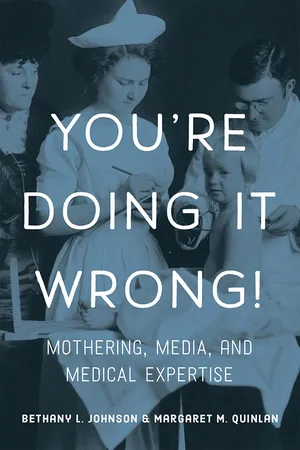
You're Doing it Wrong!
Mothering, Media, and Medical Expertise
- English
- ePUB (mobile friendly)
- Available on iOS & Android
eBook - ePub
You're Doing it Wrong!
Mothering, Media, and Medical Expertise
About this book
Information
Topic
MedicinePART I
CONCEPTION AND (IN)FERTILITY
CHAPTER 1
ON PRECONCEPTION, THE BEGINNING OF THE LIFE CYCLE OF EARLY MOTHERHOOD
Do you care enough about your (potential) future children to perfect your health today? As new mothers, pressure around proper preparation for conception continues to grow (Stephenson et al., 2014), even for “pre-mothers.” Have you taken the proper steps to ensure conception including taking prenatal vitamins? Do you “eat clean” to maintain and protect your fertility? Are you exercising regularly and getting sufficient sleep? Have you even considered sex selection techniques to ensure you create the family of your design? Are you controlling your stress level to create the optimum gestational environment? Have you been screened for potential genetic issues? Are you informed about your fertility health/status? Discussions of preparedness for pregnancy and the emergence of “preconception” as a life stage that is either achieved or failed frames this “stage” as a time imbued with potential crisis, and prescriptive behaviors for preconception now begin during the teen years (Ayala & Freeman, 2016). Problematically, this extends the life cycle of early motherhood drastically, with the preconception stage alone lasting potentially a decade or more (Ayala & Freeman, 2016). Failure to prepare for possible conception denotes numerous negative potentialities, few of which are proven or even demonstrable in available research. For example, failure to “achieve” healthy preconception behaviors could prompt fertility issues, high-risk pregnancies, or a nonoptimal environment for fetal development, with worrisome yet inchoate outcomes (see Ayala & Freeman, 2016). Thus, preconception is a crisis in which either you prepare for the conception of healthy children or your preparation is inadequate and you become a “bad” mother prior to conception.
The notion of preconception as a stage in which women need to prepare their minds and bodies, through products and practices most accessible to educated, middle- and upper-class, white, cis, able-bodied women, reflects long-held notions of the proper work and roles of females as potential mothers in our society as well as the particular assumptions of “good” motherhood bounded by race, class, education level, and gender (Ayala & Freeman, 2016; Breslaw, 2012; Smith-Rosenberg, 1985; Vandenberg-Daves, 2014). This framing extends, in its focus on middle-class whiteness within a heterosexual nuclear family, back to the mid-nineteenth century (and before). Curiously, the “failure” of so many women to meet these emerging preconception standards underscores the blurred lines between technical and lay expertise, as experts of all kinds continue to offer more specialized preconception products and services, angling for market share in the wellness economy. Products and services offered by lay experts online to best prepare the body for conception (e.g., eCourses, preconception nutrition plans, meditation practices, yoga courses, and workouts) are available, albeit different from those available in a traditional doctor’s office (e.g., prenatal vitamins, blood tests for egg “age,” genetic testing). There is also an emerging market for smartphone apps tracking menstruation, ovulation, and optimal fertility (e.g., Kindara, Ovia). The burgeoning number of expert practitioners addressing preconception also increases awareness about this new life stage, and the advent of social media advertising and outreach ensures that potential parents are bombarded with preparation messaging (see Anderson, 2017; BabyCenter, 2017; Mama, 2017; Rhythms, 2016; Weeks, 2013).
BabyCenter (with the website tagline “expert advice”) is a popular parenting website with a similarly popular pregnancy smartphone app. An article on this website offers a list of 17 actions women can take before trying to conceive, including visiting the doctor for a “preconception visit,” monitoring one’s caffeine intake, stocking one’s fridge with healthy foods which include “clean” foods such as kale and spirulina and other “superfoods” like maca, which were previously known mostly in indigenous communities and are now repackaged largely for middle- and upper-class (predominately white) consumers shopping at high-end grocery stores. Other actions include maintaining a workout regimen, and even considering “genetic carrier testing” (BabyCenter, 2017).
This BabyCenter list prompted us to research preconception further, and we were surprised to find the topic of sex selection, sometimes related to genetic carrier issues, occupying a lot of “space” on social media sites when preconception presented in the discourse. Maggie encountered a large number of such discussions during her preconception journey and received contradictory information from the technical and lay experts she consulted before the conception of her first (and second) child. On the topic of sex selection, there are inconsistent findings on how prevalent social-media-based information is or what kind of impact it has on personal decisions for conceptive practices. Similarly, there are no available data on how social media discourse impacts other individual decisions regarding preconception, including dietary or exercise choices. Anecdotally, Instagram and Facebook (FB) offer a wealth of options for supporting preconception health, including food products, exercise classes, mindfulness courses, and sex selection techniques.
In this chapter, within the discussion of sex selection and preconception, we define “lay experts” as those individuals who offer preconception advice, products, or sex selection techniques outside of a traditional doctor’s office (e.g., individuals posting folklore or formal research findings on social media platforms, in chatrooms, etc.). Technical experts include researchers conducting studies and publishing on sex selection as well as practitioners who can assist couples in choosing the sex of their baby through embryo transfer (e.g., reproductive endocrinology and infertility [REI] specialists). Historically, technical experts on sex selection included traditionally trained doctors and lay experts included eclectic medical practitioners (e.g., homeopathic physicians), faith leaders, and observers of atmospheric conditions (e.g., lunar calendars for sex selection in China) (see also Derkatch, 2016). Below we examine the fluidity of technical and lay expertise and the nature of preconception knowledge particularly for sex selection techniques and document how this fluidity confounded Maggie when she sought information during her preconception periods.
Maggie turned to both technical experts and lay experts to address her preconception concerns, such as her baseline health and ability to conceive, including posting questions on social media platforms such as FB. As the BabyCenter post suggested, Maggie (and her partner) also pursued genetic carrier testing, which resulted in a deep dive into the niche dialogue regarding sex selection as a part of preconception. Born into a family with carriers for the gene (CFTR) for cystic fibrosis (CF), Maggie chose testing, having witnessed the struggle and eventual death of some of her classmates with the disease in her all-girls high school. CF is a disease that impacts organ function through the overproduction of mucus (Cystic Fibrosis Foundation, n.d.). Individuals with CF struggle with persistent lung infections, breathing difficulty, and complications in other organs, including severe stress on the pancreas (Cystic Fibrosis Foundation, n.d.). Maggie learned that cis females with CF have a decreased life expectancy and are likely to have “worse outcomes with common CF pathogens” and become “colonized with respiratory pathogens” slightly earlier (Harness-Brumley, Elliot, Rosenbluth, Raghavan, & Jain, 2014, pp. 1012, 1017). She and her partner also worried about their ability to care for a child with CF monetarily; therefore, they decided if they were both carriers, they would either not have children, adopt, or seek fertility treatment with sex selection (see U.S. Department of Health and Human Services, 1995). It was not a decision they had to make. Maggie is a CF carrier; however, her husband James is not. Maggie carried two children to term, and they did not find out the sex before delivery during either pregnancy.
As Maggie and James awaited their CFTR testing results, a colleague provided her with a copy of Weschler’s (2006) Take Charge of Your Fertility, which she read on the beach with a magazine disguising the front cover. Weschler wrote her book after Googling “how to increase your chances of conceiving a boy” and coming across several links and chatrooms dispensing advice on sex-specific conception. Her book details the Shettles Method, which originated in the 1960s and in the 1970s became the book How to Choose the Sex of Your Baby (Shettles & Rorvik, 2006; see also Shettles, 1960, 1961). By following Shettles’s advice and tactics (e.g., to conceive a boy, time intercourse close to ovulation and use a vaginal rear-entry sexual position), a couple could reportedly increase their chances of the desired outcome (from about 75% to 90%). However, during her second preconception stage, Maggie remained curious about the efficacy of sex selection and the preoccupation with it on social media, so she contacted her practitioner directly for more information. In April 2017, she sent a password-protected email to her obstetrician/gynecologist (OBGYN). As part of their conversation, her doctor stated, “Because male sperm is the faster of the two, some suggest having intercourse as close to ovulation as possible. If you have sex several days before ovulation, the male sperm may die off.” Two other doctors in this same OBGYN practice classified these claims as myth; reproductive endocrinology and infertility specialist Dr. Lauren Johnson (2017) recalled these claims in texts but concluded, “Recent data refutes Shettles’ and Billings’ original hypothesis.”1
Questions about Shettles’s (and other scholars’) sex selection research have resurfaced in medical literature for nearly 40 years. In 1978, the New England Journal of Medicine concluded that insemination on different days of the menstrual cycle does lead to variations in the sex ratio (e.g., boys conceived closer to ovulation) (Corson, 1979). It was hypothesized that Y sperm are slightly more likely to fertilize (due to their speed), causing a distorted primary sex ratio. However, later research concluded that natural sex selection methods are not successful (Grant, 2006; Gray et al., 1998). In 1991, Gray published a meta-analysis of sex-selective intercourse practices, including Shettles’s methods, and concluded that “the selection of male offspring by intercourse around the time of ovulation … is contradicted by scientific data” (p. 1984). A 1995 article in the New England Journal of Medicine reported that timed intercourse and ovulation had no impact on the sex of the baby (Wilcox, Weinberg, & Baird, 1995). In 1998, Human Reproduction published an article in which researchers recorded acts of intercourse and signs of ovulation, then assigned the most probable time of conception based on the provided data (Gray et al., 1998). The research team concluded that “manipulation of the timing of insemination during the cycle cannot be used to affect the sex of offspring” (Gray et al., 1998, p. 1397). In a 2006 editorial in the British Medical Journal, Grant dismissed the Shettles Method: “It was not until the development of computer-assisted sperm analysis (CASA) that reliable observations could be made. So far, researchers have found no morphological differences between human X sperm and Y sperm.… Y bull sperm do not swim faster than X sperm” (p. 919; see also Hossain, Barik, & Kulkarni, 2001; Moruzzi, Wyrobek, Mayall, & Gledhill, 1988; Penfold et al., 1998). Yet the expertise Maggie received from various doctors contradicted the last 20-plus years of research. With little consensus, it is difficult to know what to believe (see also Ovia, 2017).
Importantly, Shettles’s study attributed traditional, gender-specific traits to X (female) and Y (male) chromosome sperm, informing readers that Y or “male” sperm are said to be faster and smaller but die faster; X or “female” sperm are slower and better able to withstand the acidic cervical environment (for a summary of Shettles, see FertilityFriend, n.d.; Gary, 1991). Without gendered gametes, sex selection would be more difficult to predict in the Shettles Method. The notion that sperm are inherently “male” and ova are “female” and that these cells act with gendered behavior undergirds all sex-selective recommendations on social media, at family reunions, and, as we’ve seen, in the doctor’s office. The idea that timed intercourse can work for sex selection stems from assumptions about Y (“male”) sperm being more robust and swimming more quickly than X (“female”) sperm. The implication is that male offspring might have these same characteristics, an assumption that circles back into problematic sex preferences. As Emily Martin (1991) noted, the vast majority of medical textbooks depict sperm as masculine and exhibiting strength, virility, and aggressive behavior, while the egg is portrayed as a “damsel in distress” passively awaiting “her” rescue via penetration. The egg “is swept” or “drifts” (pp. 491, 489); women “shed” or lose eggs while men “produce” sperm (Martin, 1991, p. 486). And the impact of these medical teachings doesn’t end with doctors—Barnes’s (2014) work recounted men revealing the pressure they feel to “gush sperm” to prove their virility (p. 5).
Unfortunately, even after extensive studies at leading research institutions showed that egg and sperm both played an active role in conception and other studies found that protein structures placed the egg in the role of aggressor, descriptive language sustained the notion of gametes as operating within the gender binary (Martin, 1991). Citing the new discovery that the sperm is drawn to the ova and then sticks to it, powerless to extract itself from the surface, researchers focused on the harpoon-like head of the sperm (see Schatten & Schatten, 1983). Even when researchers frame the egg and sperm as partners, gendered language remains, parsing the egg into weak, disconnected parts and the sperm into a cohesive, logical whole (Martin, 1991). Again, these same characteristics and constructs are used to define the behavior of X and Y spermatozoa, despite research illustrating no differences exist.
Rooted in these gendered constructions, Shettles’s original hypothesis is popular in obstetrics textbooks in use at many medical schools today (see Cunningham, Leveno, Bloom, Spong, & Dashe, 2014) but also prevalent on social media platforms and in smartphone apps. At the beginning of her search, Maggie could find only arguments in support of Shettles’s work, from both lay and technical experts, or online “experts” whose expertise background was not apparent. We found one chat board that attempted to debunk Shettles’s conclusions. Baby42015 (2014) said, “Male sperm do not swim faster than female sperm”; the poster used scientist Valerie Grant’s (2006) letter to the editor in the British Medical Journal to support her point: “The number of gender based medical falsehoods I keep hearing in and around my pregnancy is just staggering. This one seems to be prevalent too, that male sperm swim faster and female sperm slower.” While technical experts acknowledge the lack of consensus, lay experts also acknowledge varying research conclusions. Positioning herself as a lay expert, Baby42015 (2014) utilized Grant’s arguments (which seem to fall in line with the most up-to-date medical findings) and then chided other lay experts posting on social media for spreading misinformation. However, this supposed misinformation still holds sway with some technical experts. It is clear from Maggie’s experience that some misinformation or outdated information is received at the doctor’s office and then potentially broadcast to personal networks on social media.
Currently, the impact of this gendered framing is apparent among lay experts on social media, in discussion threads trading “techniques” and medical expertise to achieve sex selection during conception. Despite the prevalence of gendered gamete language, individuals are also criticized for engaging in sex selection. For example, a social media uproar (mostly among lay experts) occurred when John Legend and Chrissy Teigen announced the sex of their baby conceived via in vitro fertilization (IVF). Because of IVF, couples can learn the sex of their embryos and can decide which to implant (PeDahl et al., 2006). Teigen’s feed prompted a lot of personal critiques; she defended her preconception choices on Twitter, attempting to educate the public on her views about IVF and sex selection during that process. As Teigen responded to critics: “we didn’t create a little girl. we had multiple embryos. girls and boys. we simply chose to put in a female first (and second),” and “we didn’t ‘throw away’ anything and still would love to have more of both in the future. hard to explain such a complicated process here” (also cited in Lee, 2016).
As with other medical technologies, embryo sex selection is available only to individuals with financial means to undergo IVF with the added cost of testing embryos for sex selection. Infertility is not easy for any couple to face. For parents with class privilege (e.g., access to funds or capital to take loans for treatment) encountering this challenge, to be able to select a gender may be a small “perk” of an emotionally and physically demanding and socially isolating experience. Not all individuals have fertility privilege (the ability to conceive without difficulty) (Johnson, 2016), and very few have the luxury of engaging in preconception preparations that include sex selection. Some medical professionals continue to promote this embryo testing for sex selection, although in 1999 the American Society for Reproductive Medicine (ASRM) stated that using IVF treatment for sex selection should “not be encouraged” and in 2015 urged clinics to develop clear policies for sex selection services (ASRM, 2004, p. S247; see also Storrs, 2016, n.p.). In Canada and the United Kingdom, there are bans on sex selection used for social reasons, such as to promote family balancing (one of each sex) (see Genetics and IVF Institute, 2017). Sex selection is allowed for me...
Table of contents
- Cover
- Title Page
- Copyright
- Dedication
- Epigraph
- Contents
- Introduction
- Part I: Conception and (In)fertility
- Part II: Pregnancy and Birth
- Part III: The Postpartum Period: The “Fourth Trimester”
- Part IV: Infant Loss and Early Childhood
- Conclusion
- Methodological Appendix
- Acknowledgments
- Notes
- Master Reference List
- Selected Bibliography
- Index
- About the Authors
Trusted by 375,005 students
Access to over 1.5 million titles for a fair monthly price.
Study more efficiently using our study tools.
Frequently asked questions
Yes, you can cancel anytime from the Subscription tab in your account settings on the Perlego website. Your subscription will stay active until the end of your current billing period. Learn how to cancel your subscription
No, books cannot be downloaded as external files, such as PDFs, for use outside of Perlego. However, you can download books within the Perlego app for offline reading on mobile or tablet. Learn how to download books offline
Perlego offers two plans: Essential and Complete
- Essential is ideal for learners and professionals who enjoy exploring a wide range of subjects. Access the Essential Library with 800,000+ trusted titles and best-sellers across business, personal growth, and the humanities. Includes unlimited reading time and Standard Read Aloud voice.
- Complete: Perfect for advanced learners and researchers needing full, unrestricted access. Unlock 1.5M+ books across hundreds of subjects, including academic and specialized titles. The Complete Plan also includes advanced features like Premium Read Aloud and Research Assistant.
We are an online textbook subscription service, where you can get access to an entire online library for less than the price of a single book per month. With over 1.5 million books across 990+ topics, we’ve got you covered! Learn about our mission
Look out for the read-aloud symbol on your next book to see if you can listen to it. The read-aloud tool reads text aloud for you, highlighting the text as it is being read. You can pause it, speed it up and slow it down. Learn more about Read Aloud
Yes! You can use the Perlego app on both iOS and Android devices to read anytime, anywhere — even offline. Perfect for commutes or when you’re on the go.
Please note we cannot support devices running on iOS 13 and Android 7 or earlier. Learn more about using the app
Please note we cannot support devices running on iOS 13 and Android 7 or earlier. Learn more about using the app
Yes, you can access You're Doing it Wrong! by Bethany L. Johnson,Margaret M. Quinlan in PDF and/or ePUB format, as well as other popular books in Medicine & Medical Theory, Practice & Reference. We have over 1.5 million books available in our catalogue for you to explore.