When the San Diego Comic-Con was founded in 1970, it provided an exclusive space where fans, dealers, collectors, and industry professionals could come together to celebrate their love of comics and popular culture. In the decades since, Comic-Con has grown in size and scope, attracting hundreds of thousands of fans each summer and increased attention from the media industries, especially Hollywood, which uses the convention's exclusivity to spread promotional hype far and wide. What made the San Diego Comic-Con a Hollywood destination? How does the industry's presence at Comic-Con shape our ideas about what it means to be a fan? And what can this single event tell us about the relationship between media industries and their fans, past and present? Only at Comic-Con answers these questions and more as it examines the connection between exclusivity and the proliferation of media industry promotion at the longest-running comic convention in North America.
- English
- ePUB (mobile friendly)
- Available on iOS & Android
eBook - ePub
About this book
Information
Publisher
Rutgers University PressYear
2019Print ISBN
9780813594705
9780813594712
eBook ISBN
9780813594729
1
Origin Stories
Comic-Con and the Future of All Media
This is the future, not just of comics, but of all media. Movie studios are going to come to this convention every year to see what’s new.—Jack Kirby, 1971
Morgan Spurlock’s 2011 documentary, Comic-Con Episode IV: A Fan’s Hope, begins with a visual primer in Comic-Con history, signaled by the click and whirl of an old slide projector. A mock slide show titled “1970 San Diego” flips through a series of black and white photographs: a handmade, stenciled sign reading, “Comics Convention Registration”; shoppers browsing in the dealers’ room; artist Russ Manning, posing with his sketch of Tarzan; a collector rifling through a box of comics; aficionados enjoying an art display; a table of six panelists addressing a room full of attendees; and comic artist Don Newton and his son posing in matching Superman costumes (figure 1.1). Accompanying the slide show is an audio recording of a Channel 39 news segment with the event’s founder, Shel Dorf.1
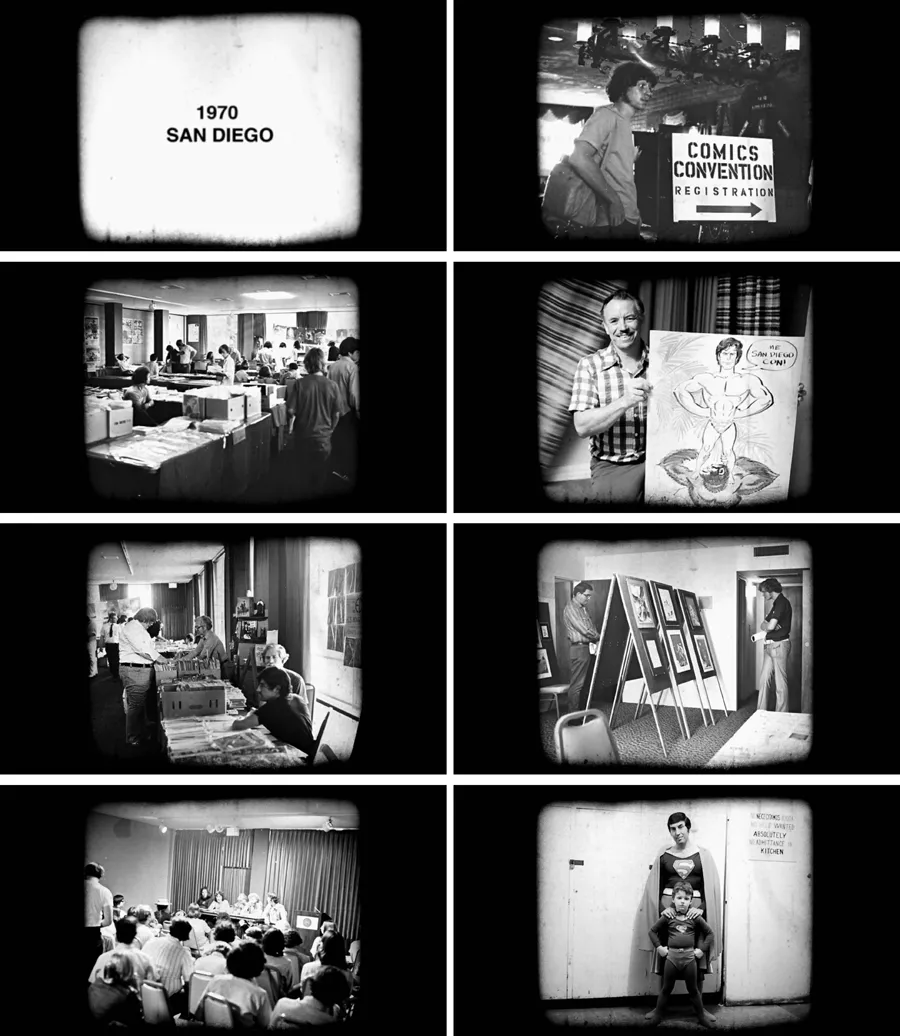
FIGURE 1.1 A series of still photos mimic a slide-show presentation about Comic-Con’s early history in the opening sequence of Comic-Con Episode IV: A Fan’s Hope (Spurlock 2011).
ANNOUNCER: The first annual Golden State Comic-Con gets underway this weekend at the U.S. Grant Hotel. Artist Shel Dorf says that he hopes to make this event an annual thing.NATALIE BEST: Will this be open to the public?DORF: Ah … yes. This is a chance for the amateur fan and amateur writer to really meet with the professionals and find the magic secret of how it’s done.2
When asked about the size of the gathering, Dorf optimistically speculates that attendance at the 1970 convention could hit five hundred.3 At that moment, the film cuts from the antiquated, black and white slide show to colorful moving images filmed at Comic-Con in 2010. As the opening credits roll, we see slow motion and accelerated glimpses of fans—many in costume—pouring into the convention hall, all accompanied by a swelling and downright heroic score (figure 1.2). In the space of one and a half minutes, Spurlock manages to spin a compelling yarn evoking the same epic scope we’ve come to expect from superhero stories, be they on multiplex screens or in the pages of comic books. And, like any good superhero myth, this one provides an origin story of an underdog, imbued with almost otherworldly powers, who is reborn as an unstoppable force. That force, the film suggests, resides in the power, ambition, and resilience of fandom.

FIGURE 1.2 Footage of fans entering Comic-Con 2010, featured in the opening sequence of Comic-Con Episode IV: A Fan’s Hope (Spurlock, 2011).
Clearly, a narrative in which fans—and their tastes and cultural practices—rise from the margins to become a cultural force is a powerful myth. It is one that gets repeated again and again as Hollywood uses venues like Comic-Con to propel its vision for fan culture—and its utility to the industry—into the mainstream. Given that the exclusivity of fans as a powerful demographic of tastemakers is frequently identified as a contemporary phenomenon, deterministically tied to a narrative of digital democracy, it is not surprising that this pre-credits sequence of Comic-Con Episode IV represents the bulk of the eighty-eight-minute film’s overt discussion of history. Add to that the fact that none of the slide show’s seven images were actually taken at the first Comic-Con in 1970 and it becomes clear that in this film, like so many other celebratory discourses about the power and influence of fandom, constructing a compelling narrative of growth and acceptance takes precedence over historical accuracy and precision.4 In such narratives, the fates of pop culture fans and the media industries seem deeply and unproblematically intertwined, propelling each other forward in utopic symbiosis. They also point to the ways in which the exclusivity of Comic-Con was defined and redefined in the process. While Comic-Con’s early years provided an exclusive space for fans and professionals to come together in celebration of comics and the popular arts, the Comic-Con of the twenty-first century redefines exclusivity as the product of insider access to the media industries and their marketing blitzkrieg.
What these narratives frequently omit, however, is the later ambivalence, even downright dissatisfaction, with the event, particularly on the part of comic fans and professionals, who often complain that the object of their fandom has been marginalized as a result of Hollywood’s presence. Some of this frustration makes its way into Spurlock’s largely celebratory film by way of longtime comics dealer Chuck Rozanski.5 In the film, we find him struggling just to break even at Comic-Con. For Rozanski, the crux of Comic-Con’s problem is the steady disappearance of comics, and more importantly, comics buyers, from the event: “Even though they have comic in the name of the event, very little of the convention anymore is actually comics.… we can’t use the loading docks anymore cause frickin’ Lucasfilm owns the loading docks. You know, that kind of pisses you off. It really does. Because it’s our house.” But despite his struggles to turn a profit at a convention that seems to have left him behind, as the film ends, he proclaims that instead of heaven, “I wanna die and go to Comic-Con.”
This ambivalence occasionally crops up in the press too. For example, writing for Variety in 2008, TV critic Brian Lowry described his experiences at Comic-Con in the mid-’70s—“Comic-Con was truly about comic books, and the only stars one was likely to see there were the artists and writers who created them”—and lamented its growth as Hollywood discovered the convention’s promotional possibilities.6 In 2013, the Atlantic published an article titled “How the Nerds Lost Comic-Con,” which echoed Lowry’s sentiments, claiming that as Hollywood promotion at the event propelled it into the mainstream, longtime comic book fans found themselves frozen out—unable to get tickets, or inconvenienced by the massive crowds.7
I have also heard fans express these concerns at Comic-Con’s annual “Talk Back” panel, which provides an open forum for attendees to give feedback on the event. A 2011 exchange between a longtime attendee and Comic-Con’s president at the time, John Rogers, neatly encapsulates the tension between comics and Hollywood at the event.8 The attendee began by saying they had been going to Comic-Con “since back when it was a comic book convention, 1981.” Rogers, who usually remained quite stoic during these sessions, quietly making notes as the flow of complaints and suggestions flew at him, interrupted to argue that comics were still central to the convention. When the attendee suggested that the majority of people were there to see film and television content, Rogers replied, “What we like to say is that we’re celebrating the popular arts which, of course, would include film and television.” The attendee interrupted, “We used to celebrate the unpopular ones.” Rogers went on to suggest that Comic-Con itself had helped to push comics into the mainstream: “one of the things we’ve always done is brought people in who are fans of a movie, like a Batman movie, and gotten them exposed to other comic books on the floor and other comic book items through programming.”9 Not surprisingly, Rogers’s arguments echoed Comic-Con’s mission statement by placing the emphasis on comics and implying that the presence of film and television was a way to further increase awareness of the comic arts: “Comic-Con International: San Diego is a nonprofit educational corporation dedicated to creating awareness of, and appreciation for, comics and related popular art forms, primarily through the presentation of conventions and events that celebrate the historic and ongoing contribution of comics to art and culture.”10 The limits of exclusivity are clearly at play here as the fan’s complaints and Rogers’s response negotiate the push and pull desire to legitimate and promote comics as a popular art form, while still keeping them exclusive to a small group of fans. Even in arguing for the place of comics in mainstream popular culture, Comic-Con organizers deploy the exclusivity of comic books in order to disavow their commodity status.
Nowhere is this ambivalence more pronounced than in Shel Dorf’s reaction to the event’s success. In a 2006 interview he said, “We had no idea it would get this big … to me, it’s just become an ordeal. I don’t know of any way to make it smaller, though, I guess in some ways it’s become too much of a success.”11 Dorf passed away in November 2009, four months after Comic-Con celebrated its fortieth anniversary. Having been hospitalized for quite some time, he was unable to take part in the celebrations, but his friend, Mark Evanier, said Dorf would have been unlikely to attend regardless: “He didn’t like how big the one he started had become, didn’t like how top movie stars were eclipsing top comic creators.”12
Dorf made this sentiment clear in numerous letters to Comic-Con organizers and friends over the years, where he would fluctuate between warm nostalgia and pride for what he had helped to create and contempt for what it had become.13 Having ended his “active participation” in 1984, Dorf remained a voice on the sidelines, attending the convention and sending occasional letters to members of the Comic-Con committee, including clippings from articles and old programs.14 But relations soured as he grew more and more alienated from the committee, evidenced by a letter he wrote to the board of directors in 1994, asking that they remove his founder credit from all future Comic-Con publications. He explained, “the con has changed so much from the friendly little fannish effort I started that I do not feel a kinship to it any longer.”15 Ultimately, Dorf regretted and retracted this request, but tensions lingered, as evidenced by his 1999 letter to Comic-Con’s president, John Rogers, accepting an invitation to join Comic-Con’s thirtieth anniversary celebration. Dorf wrote, “I now know that I will always feel a parental closeness to the con. Those first establishing five years were tougher than anyone could imagine.… As a parent, I have been critical of different directions the thing took. But I did neglect to constantly say, ‘good work.’ My praise far exceeded my criticism. I hope we can reconcile past differences and move on.”16
By all accounts, Dorf’s ongoing ambivalence was the product of the particularities of his personality paired with Comic-Con’s extreme growth and change in the years after he retired.17 His frustrations seemed to increase as the event grew larger and as the Comic-Con committee itself became more self-sustaining and financially solvent.18 But while Dorf was troubled by Comic-Con’s growth in his later years, this was not always the case. As president of Comic-Con for its first fifteen years, he saw attendance increase from 300 attendees in 1970 to almost 5,500 in 1984, fulfilling Dorf’s promise in 1970 that “the years to come will see us grow and San Diego will take it’s [sic] rightful place in the world of fandom.”19 Dorf’s response, once this dream was realized, suggests that Comic-Con, and the relationships it fosters between fandom and industry, are much more complex and fraught than they appear. At the core of these complexities is the desire to experience a reciprocal relationship with the industry—not only to express love but also to ...
Table of contents
- Cover
- Title Page
- Copyright
- Dedication
- Contents
- Introduction: The San Diego Comic-Con and the Limits of Exclusivity
- 1. Origin Stories: Comic-Con and the Future of All Media
- 2. The Liminality of the Line and the Place of Fans at Comic-Con
- 3. Manufacturing “Hall H Hysteria”: Hollywood and Comic-Con
- 4. Ret(ail)con: From Dealers’ Room to Exhibit Hall
- Conclusion: From Franchise Wars to Fry Fans—Comic-Con Anywhere
- Acknowledgments
- Notes
- Bibliography
- Index
- About the Author
Trusted by 375,005 students
Access to over 1.5 million titles for a fair monthly price.
Study more efficiently using our study tools.
Frequently asked questions
Yes, you can cancel anytime from the Subscription tab in your account settings on the Perlego website. Your subscription will stay active until the end of your current billing period. Learn how to cancel your subscription
No, books cannot be downloaded as external files, such as PDFs, for use outside of Perlego. However, you can download books within the Perlego app for offline reading on mobile or tablet. Learn how to download books offline
Perlego offers two plans: Essential and Complete
- Essential is ideal for learners and professionals who enjoy exploring a wide range of subjects. Access the Essential Library with 800,000+ trusted titles and best-sellers across business, personal growth, and the humanities. Includes unlimited reading time and Standard Read Aloud voice.
- Complete: Perfect for advanced learners and researchers needing full, unrestricted access. Unlock 1.5M+ books across hundreds of subjects, including academic and specialized titles. The Complete Plan also includes advanced features like Premium Read Aloud and Research Assistant.
We are an online textbook subscription service, where you can get access to an entire online library for less than the price of a single book per month. With over 1.5 million books across 990+ topics, we’ve got you covered! Learn about our mission
Look out for the read-aloud symbol on your next book to see if you can listen to it. The read-aloud tool reads text aloud for you, highlighting the text as it is being read. You can pause it, speed it up and slow it down. Learn more about Read Aloud
Yes! You can use the Perlego app on both iOS and Android devices to read anytime, anywhere — even offline. Perfect for commutes or when you’re on the go.
Please note we cannot support devices running on iOS 13 and Android 7 or earlier. Learn more about using the app
Please note we cannot support devices running on iOS 13 and Android 7 or earlier. Learn more about using the app
Yes, you can access Only at Comic-Con by Erin Hanna in PDF and/or ePUB format, as well as other popular books in Social Sciences & Media Studies. We have over 1.5 million books available in our catalogue for you to explore.