With contributions by Debora Ayala Walverde | Evgenia Durnovo | Chiori Hashiba | Miho Hayashi | Kirsti Humerinta | Veena Jain | Henriette Lerner | Amélie Mainjot | Saiesha K. Mistry | Katalin Nagy | Hyun Oh | Devorah Schwartz-Arad | Nassem Shah | Meriting Thokoane | Lezize ?ebnem Türkün | Beatriz R. Vilaboa | Debora R. VilaboaA unique collaboration between 17 internationally renowned women dentists has resulted in an inspirational textbook on esthetics in modern dentistry. Illustrated with over 800 figures, the book presents a thorough overview of various aspects of esthetics, including orthodontics and orthognathics, implant therapy, restoration, rehabilitation, materials, trauma, and surgery.Each author also provides fascinating insights into her journey to become a successful female dentist in a male-dominated industry. The stories differ, but the results are the same - excellent patient care and excellent esthetics."My sincere hope is that, over and above its professional contribution to the dental community, this book will encourage both young and experienced women dentists to escalate their knowledge, wisdom, and artistic talent, and to have the impact on the dental community they so rightly deserve."Dr Devorah Schwartz-Arad
- 352 pages
- English
- ePUB (mobile friendly)
- Available on iOS & Android
eBook - ePub
Esthetics in Dentistry
About this book
Information
Chapter 1
Teeth and jaw posture behind the attractive smile: Orthodontic and orthognathic aspects
Kirsti Hurmerinta
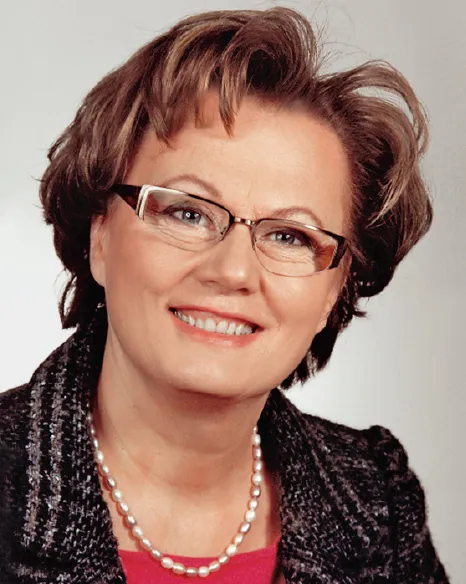
Kirsti Hurmerinta
Adjunct Professor, Clinic Director, Chief Orthodontist, Cleft Palate and Craniofacial Centre, Helsinki University Central Hospital, Finland.
Biography
Kirsti Hurmerinta has been the Clinic Director and Chief Orthodontist at the Cleft Palate and Craniofacial Centre, University Central Hospital, Helsinki, Finland, since 2004. She obtained her undergraduate dental, orthodontic education and PhD from the University of Helsinki. Dr Hurmerinta worked as a Senior Consultant in Orthodontics from 1990 to 1998 at the University of Helsinki and Senior Consultant in Cleft Orthodontics in 1998 at the Karolinska University Hospital, Stockholm, Sweden, and she was appointed as a Professor in 2003 to 2004 at the University of Helsinki. In 2003 she was appointed as Adjunct Professor at the University of Turku, Finland.
Kirsti Hurmerinta was a president of the Orthodontic Division, Finnish Dental Society Apollonia from 2004 to 2009, and a member of the organizing committee of the 85th Congress of the European Orthodontic Society (EOS 2009) in Helsinki. She was in charge of the orthodontic advanced training organized by the Finnish Dental Society Apollonia in 2002 to 2006. Dr Hurmerinta was honoured with the Quality Management Award of the Finnish Dental Association in 2009. She was nominated as The Orthodontist of the Year 2013 in Finland by the Orthodontic Section of the Finnish Dental Society Apollonia. Recently, her scientific interest has been the distraction osteogenesis of facial structures and cleft palate and craniofacial treatment. Dr Hurmerinta has published more than 50 peer-reviewed scientific articles. She has been invited to lecture at many international congresses.
I believe
•Love your work like your family.
•Have a positive and encouraging attitude towards your patients.
•Respect your colleagues.
•Create a network between local and international colleagues.
Introduction
There is evidence that most people agree upon what is an attractive smile, but what actually guides and validates our judgment? The goal of this chapter is to review and illustrate the structural factors in dentition and jaw base relationships behind an attractive smile. The smile is the interaction of a set of factors observed at the same time. In modern orthodontics and orthognathics, smile attractiveness is an important topic and therefore a principal goal. The patient’s decision to undergo a treatment procedure is usually based on esthetic issues. Enhancing the attractiveness of a patient is based on a multidisciplinary clinical process. This chapter describes the current thinking behind combined orthodontic and surgical procedures to achieve a beautiful smile. Restorative and prosthodontic dentistry have extremely effective approaches to improve a smile, but dental characteristics such as smile arc and tooth form, size, and color are not dealt with in this chapter. Esthetics as a treatment goal is increasingly emphasized in combined orthodontic/surgical treatments.
The concept of facial esthetics
In the Renaissance period, Albrecht Durer (1471–1528) and Leonardo da Vinci (1452–1519) traced lines and angles in addition to measuring proportions of the body and face. Ever since that time, the “golden proportion” has been considered as a guideline for facial harmony. It has become a universal standard for facial beauty. In orthodontics and cephalometrics the divine proportions have been used for analyzing the hard and soft tissues of the face.1-7 Peck and Peck8 used historical art collections to establish a scientific link between occlusion and the golden proportion. The role of the smile in esthetic perception is crucial. The Mona Lisa, which was painted around 1506, has an enigmatic smile that has intrigued us for centuries. Her closed-lips smile has been regarded as mysterious. But why did Mona Lisa smile so mysteriously with closed lips? Was the commissure smile due to the artistic mores that prevailed at that time when any show of teeth in paintings might have been considered to be vulgar, or does the Mona Lisa’s smile hide her crowded teeth, as stated by Saadoun.9 Visual analysis suggest that the teeth and jaw posture behind the Mona Lisa’s smile is probably caused by retrognathia and retruded maxillary incisors, which leads to an insufficient dental display during smiling (Fig 1-1). Looking at fashion magazines today, it can be easily seen that the discreet smile has been abandoned for a broad, slightly prominent smile showing aligned white healthy teeth and healthy marginal gingiva.

Figs 1-1a to 1-1e (a) Why did Mona Lisa smile so mysteriously with closed lips? (b and c) This 18-year-old girl’s facial structure greatly resembles the Mona Lisa’s face. She has maxillary retrognathia and retruded maxillary incisors, and insufficient dental display during smiling. (d and e) The same girl after maxillary advancement, showing anterior downward inclination of the palatal plane and labial tipping of the maxillary incisors. Her smile is relaxed and shows the entire incisor crown.
Evaluation of face and smile
Today, three-dimensional (3D) computerized imaging is widely used in craniofacial surgery. However, 3D computerized tomography (CT) analysis is still mainly used for individual examination, and as yet, no accepted norms have been established for 3D CT. Thus the evaluation of face and orthognathic and orthodontic diagnosis is still mostly based on 2D cephalometric measurements. Cephalometric measurements provide objective guidelines to define skeletal and dental structures and describe deviations from the norm. However, cephalometric analysis alone is not sufficient. Although the profile, dentition, and bony structure can be seen in cephalometric analysis, the smile itself cannot. It has also been shown that good facial harmony can exist within a wide range of cephalometric values.10-13 Thus the lateral cephalometric evaluation should be complemented by clinical and dynamic examination from anterior, lateral, and 45-degree angle views during speaking and smiling. The attractiveness of a smile has been shown to be dependent on the extent of incisal and gingival exposure during smiling. A smile depends on the alignment and symmetry of the anterior teeth, the gingi...
Table of contents
- Esthetics in Dentistry
- Title
- Copyright
- Dedication
- Preface
- List of contributors
- Contents
- Section 1: The esthetic smile
- Section 2: Esthetics in adults
- Section 3: Materials for esthetic treatment
- Section 4: Surgery for long-term esthetics
- Index
Trusted by 375,005 students
Access to over 1.5 million titles for a fair monthly price.
Study more efficiently using our study tools.
Frequently asked questions
Yes, you can cancel anytime from the Subscription tab in your account settings on the Perlego website. Your subscription will stay active until the end of your current billing period. Learn how to cancel your subscription
No, books cannot be downloaded as external files, such as PDFs, for use outside of Perlego. However, you can download books within the Perlego app for offline reading on mobile or tablet. Learn how to download books offline
Perlego offers two plans: Essential and Complete
- Essential is ideal for learners and professionals who enjoy exploring a wide range of subjects. Access the Essential Library with 800,000+ trusted titles and best-sellers across business, personal growth, and the humanities. Includes unlimited reading time and Standard Read Aloud voice.
- Complete: Perfect for advanced learners and researchers needing full, unrestricted access. Unlock 1.5M+ books across hundreds of subjects, including academic and specialized titles. The Complete Plan also includes advanced features like Premium Read Aloud and Research Assistant.
We are an online textbook subscription service, where you can get access to an entire online library for less than the price of a single book per month. With over 1.5 million books across 990+ topics, we’ve got you covered! Learn about our mission
Look out for the read-aloud symbol on your next book to see if you can listen to it. The read-aloud tool reads text aloud for you, highlighting the text as it is being read. You can pause it, speed it up and slow it down. Learn more about Read Aloud
Yes! You can use the Perlego app on both iOS and Android devices to read anytime, anywhere — even offline. Perfect for commutes or when you’re on the go.
Please note we cannot support devices running on iOS 13 and Android 7 or earlier. Learn more about using the app
Please note we cannot support devices running on iOS 13 and Android 7 or earlier. Learn more about using the app
Yes, you can access Esthetics in Dentistry by Devorah Schwartz-Arad in PDF and/or ePUB format, as well as other popular books in Medicine & Dentistry. We have over 1.5 million books available in our catalogue for you to explore.