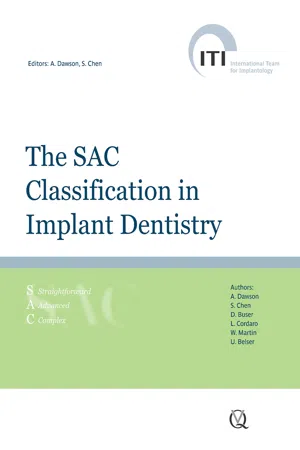
Implant dentistry is now an integral part of everyday dental practice; however, most dentists receive their education in implant dentistry after graduation, with little emphasis on the identification of the complexity and risks of treatment. Since 2003 the International Team for Implantology (ITI) has recommended the SAC Classification to categorize implant treatment procedures into three levels of difficulty-straightforward, advanced, and complex. In 2007 the ITI organized a conference to standardize the application of the SAC classification, the conclusions of which are presented in this volume. This invaluable resource will help clinicians identify treatment complexity and risk before treating a patient, thereby improving the predictability and success of their outcomes.
- 172 pages
- English
- ePUB (mobile friendly)
- Available on iOS & Android
eBook - ePub
The SAC Classification in Implant Dentistry
About this book
Information
1 An Introduction to the SAC Classification
A. Dawson, S. Chen, D. Buser
1.1 Introduction
Over the past 15 years, implant dentistry has progressed to become the standard of care for the rehabilitation of fully and
partially edentulous patients. Clinical and technological advances have led to an expansion of the indications for implant
therapy, providing increased opportunities for dental practitioners to become involved in the delivery of care. Along with
these advances there has been an increase in the complexity of treatment being recommended to patients. This has increased
the need for clinicians in the field of implant dentistry to be able to provide surgical and restorative therapy at an appropriate
level of care.
It has long been recognized that clinical situations present with different levels of difficulty, and with different degrees
of risk for esthetic, restorative and surgical complications. To date, there is no widely accepted classification system in
implant dentistry aimed at defining the level of treatment complexity and the potential for complications. To assist clinicians
in evaluating the degree of difficulty of individual cases, the International Team for Implantology (ITI) organized a Consensus
Conference in Palma de Mallorca, Spain, from March 13th to 15th, 2007. The aim of the conference was to provide guidelines for various types of restorative and surgical cases based on a
system referred to as the Straightforward, Advanced and Complex classification system (SAC).
These guidelines will provide clinicians with a reference for selecting appropriate cases and planning implant therapy. As
well, this book will serve as a useful tool for academics wishing to design implant training programs with incremental levels
of difficulty.
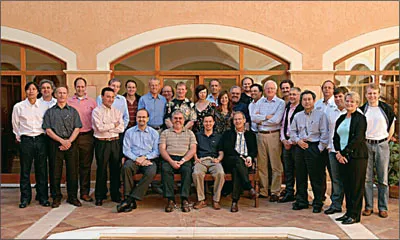
1.2 List of Consensus Conference Participants
This text documents the proceedings of a SAC Consensus Conference held by the International Team for Implantology (ITI) in
Palma de Mallorca, Spain, over the period March 13th to 15th, 2007. The following individuals contributed to the consensus statements of this conference and the content of this publication:
Urs Belser Switzerland
Daniele Botticelli Italy
Daniel Buser Switzerland
Stephen Chen Australia
Luca Cordaro Italy
Anthony Dawson Australia
Anthony Dickinson Australia
Javier G. Fabrega Spain
Andreas Feloutzis Greece
Kerstin Fischer Sweden
Christoph Hämmerle Switzerland
Timothy Head Canada
Frank Higginbottom USA
Haldun Iplikcioglu Turkey
Alessandro Januário Brazil
Simon Jensen Denmark
Hideaki Katsuyama Japan
Christian Krenkel Austria
Richard Leesungbok South Korea
Will Martin USA
Lisa Heitz-Mayfield Australia
Dean Morton USA
Helena Rebelo Portugal
Paul Rousseau France
Bruno Schmid Switzerland
Hendrik Terheyden Germany
Adrian Watkinson UK
Daniel Wismeijer Netherlands
1.3 Introduction to the SAC Classification
The SAC Classification is an assessment of the potential difficulty and risk of a case, and serves as a guide for clinicians
in both case selection and treatment planning. Classifications of Straightforward (low difficulty and low risk), Advanced (moderate difficulty and moderate risk), and Complex (high difficulty and high risk) may be assigned to a case for both restorative and surgical aspects. The knowledge, skill
and experience of individual clinicians, however, introduces subjectivity by influencing their perception of what a specific
case may be classified as. The aim of this book is to bring objectivity to this process with respect to the “standard” presentation
of clinical cases. It should be recognized, however, that the classification of individual cases may be altered as a consequence
of modifying factors. These factors will be outlined in later chapters of this book.
The first SAC Classification was described by Sailer and Pajarola in an atlas of oral surgery (Sailer and Pajarola 1999).
The authors described in detail various clinical situations for procedures in oral surgery, such as the removal of third molars,
and proposed the classification S = Simple, A = Advanced, and C = Complex. The SAC Classification was then adopted in 1999 by the Swiss Society of Oral Implantology (SSOI) during a one-week congress
on quality guidelines in dentistry. The working group of the SSOI developed this SAC Classification from a surgical and prosthetic
point of view for various clinical situations in implant dentistry. This SAC Classification was then adopted by the International
Team for Implantology in 2003 during the ITI Consensus Conference in Gstaad, Switzerland. The surgical SAC Classification
was presented in the proceedings of this conference (Buser et al. 2004). The ITI Education Core Group decided in 2006 to slightly
modify the original classification by changing the term Simple to Straightforward.
The following chapter provides a review of the SAC Classification, its applications and its determinants. Criteria for categorization
of case types were established, and normative classifications (see the following chapter for definitions) for individual case
types were assigned. Subsequent chapters will detail the application of the SAC Classification in the surgical and restorative
fields of implant dentistry. The effects of modifying factors and complications on the normative classification of cases will
also be presented and discussed.
Although it is primarily designed as a guide for identification of the level of difficulty of individual cases, the SAC Classification
may also be used as a tool for risk identification and patient management. Patients may be prepared for treatment by being
given information on expected limitations, complications and outcomes based on the SAC Classification. This in turn would
allow patients to form realistic expectations of the potential outcome of therapy. Consequently, the SAC Classification has
a number of potential audiences and uses. For novice implant clinicians, the SAC Classification provides a case selection
and treatment planning tool which can help them develop their experience in implant dentistry in a responsible and incremental
manner. More experienced clinicians may find somewhat less use in these areas, but might find this a useful framework for
planning implant treatments and for identifying, and thus potentially controlling, risk.
The SAC Classification may also be applied throughout the treatment process. A normative classification, based on the site
and type of clinical presentation, may be altered by patient-specific factors. The assigned classification may be further
modified during the active treatment phases, if required.
2 The Determinants of the SAC Classification
A. Dawson, S.Chen
2.1 Definitions
Process: The implant dentistry “process” is defined as the full range of issues pertaining to assessment, planning, management of treatment, and subsequent maintenance of the implant and prosthetic reconstruction; it does not merely refer to the clinical treatment procedures that are involved.
Normative: In this context, “normative” relates to the classification that conforms to the norm, or standard, for a given clinical situation in implant dentistry. The normative classification relates to the most likely representation of the classification of a case. The normative classification may alter as a result of modifying factors and/or complications.
Timing of implant placement: A number of different classifications have been used to describe the timing of implant placement after tooth extraction. In this book, the classification detailed by Chen and Buser (2008), which is a modification of the classification proposed by Hämmerle et al. (2004), will be used. This classification is summarized in Table 1.
| Classification | Descriptive Terminology | Period after Tooth Extraction | Desired Clinical Situation at Implant Placement |
| Type 1 | Immediate placement | Immediately following extraction | Post-extraction site with no healing of bone or soft tissues |
| Type 2 | Early placement with soft-tissue healing | Typically 4 to 8 weeks | Post-extraction site with healed soft tissue but without significant bone healing |
| Type 3 | Early placement with partial bone healing | Typically 12 to 16 weeks | Post-extraction site with healed soft tissues and with significant bone healing |
| Type 4 | Late placement | Typically 6 months or longer | Fully healed post-extraction site |
Implant loading protocol: In discussions relating to the systems for loading implants after implant placement, the definitions used...
Table of contents
- Deckblatt
- Titelblatt
- Copyright-Seite
- Inhaltsverzeichnis
- Foreword
- Editors and Authors
- Contributors
- 1 An Introduction to the SAC Classification
- 2 The Determinants of the SAC Classification
- 3 Modifying Factors
- 4 Classification of Surgical Cases
- 5 Classification of Restorative Cases
- 6 Practical Application of the SAC Classification
- 7 Conclusion
- References
Trusted by 375,005 students
Access to over 1.5 million titles for a fair monthly price.
Study more efficiently using our study tools.
Frequently asked questions
Yes, you can cancel anytime from the Subscription tab in your account settings on the Perlego website. Your subscription will stay active until the end of your current billing period. Learn how to cancel your subscription
No, books cannot be downloaded as external files, such as PDFs, for use outside of Perlego. However, you can download books within the Perlego app for offline reading on mobile or tablet. Learn how to download books offline
Perlego offers two plans: Essential and Complete
- Essential is ideal for learners and professionals who enjoy exploring a wide range of subjects. Access the Essential Library with 800,000+ trusted titles and best-sellers across business, personal growth, and the humanities. Includes unlimited reading time and Standard Read Aloud voice.
- Complete: Perfect for advanced learners and researchers needing full, unrestricted access. Unlock 1.5M+ books across hundreds of subjects, including academic and specialized titles. The Complete Plan also includes advanced features like Premium Read Aloud and Research Assistant.
We are an online textbook subscription service, where you can get access to an entire online library for less than the price of a single book per month. With over 1.5 million books across 990+ topics, we’ve got you covered! Learn about our mission
Look out for the read-aloud symbol on your next book to see if you can listen to it. The read-aloud tool reads text aloud for you, highlighting the text as it is being read. You can pause it, speed it up and slow it down. Learn more about Read Aloud
Yes! You can use the Perlego app on both iOS and Android devices to read anytime, anywhere — even offline. Perfect for commutes or when you’re on the go.
Please note we cannot support devices running on iOS 13 and Android 7 or earlier. Learn more about using the app
Please note we cannot support devices running on iOS 13 and Android 7 or earlier. Learn more about using the app
Yes, you can access The SAC Classification in Implant Dentistry by Anthony Dawson,Steven Chen in PDF and/or ePUB format, as well as other popular books in Medicine & Dentistry. We have over 1.5 million books available in our catalogue for you to explore.