Implant dentistry has become a standard option for the rehabilitation of fully and partially edentulous patients. With the ever-increasing number of dentists involved in implant dentistry, it is essential to ensure that their treatment methods follow the highest standard. The ITI Treatment Guide series, a compendium of evidence-based implant-therapy techniques in daily practice, is written by renowned clinicians and provides a comprehensive overview of various therapeutic options. Using an illustrated step-by-step approach, the ITI Treatment Guide shows practitioners how to manage different clinical situations, with the emphasis on sound diagnostics, evidence-based treatment concepts, and predictable treatment outcomes.The second volume of the ITI Treatment Guide is devoted to the restoration of partially dentate patients. Central to this volume of the ITI Treatment Guide are loading protocols available to the clinician and the patient and how they relate to various treatment indications, including both single and multiple missing teeth in the posterior and anterior regions of the mouth.Among potential topics for upcoming volumes are implant placement in extraction sockets, loading protocols in edentulous patients, implant therapy in the esthetic zone in extended edentulous spaces, and many more.
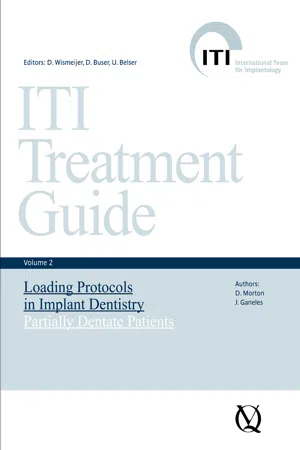
eBook - ePub
Loading Protocols in Implant Dentistry
Partially Dentate Patients
- 184 pages
- English
- ePUB (mobile friendly)
- Available on iOS & Android
eBook - ePub
Loading Protocols in Implant Dentistry
Partially Dentate Patients
About this book
Information
Topic
MedizinSubtopic
Zahnmedizin1 Introduction
D. Morton
Through research, development and education, the ITI has a mission to promote and disseminate knowledge on all aspects of
implant dentistry and related tissue regeneration. Positioned at the forefront of a dynamic and exciting era in implant dentistry,
the ITI has assumed, through its Education Committee and projects, a leading role in the delivery of information to the professional
community and their patients.
Endeavors of particular relevance to this mission include:
-
The ITI Consensus Conferences, which are held periodically to allow for the systematic and critical evaluation of existing knowledge as it relates to recent and perhaps controversial trends in implant dentistry.
-
The ITI Treatment Guides, which provide readers with objective and simplified recommendations for patient treatment that are documented by science, supported by experienced clinicians, and beneficial to patients.
The ITI Treatment Guide Volume 2 is devoted to the restoration of partially dentate patients. Central to this volume of the
ITI Treatment Guide are loading protocols available to the clinician and the patient, and how they relate to various treatment
indications, including both single and multiple missing teeth in the posterior and anterior regions of the mouth.
Through the presentation of the findings from the ITI Consensus Conference held in 2003, historic reference and a range of
patient treatments, it is anticipated that this volume of the ITI Treatment Guide will provide concise and meaningful recommendations
that can improve the prospects of optimal treatment for patients. The authors believe that this volume will provide a valuable
reference and resource that will help clinicians and patients achieve their treatment goals.
2 Proceedings of the Third ITI Consensus Conference: Loading Protocols in Implant Dentistry
With over 4500 Fellows and Members in more than 40 countries, the International Team for Implantology (ITI) is a non-profit academic organization of professionals in implant dentistry and tissue regeneration. The ITI organizes Consensus Conferences at 5-year intervals to discuss relevant topics in implant dentistry.
The first and second ITI Consensus Conferences in 1993 and 1998 (Proceedings of the ITI Consensus Conference, published in 2000) primarily discussed basic surgical and prosthetic issues in implant dentistry. The third ITI Consensus Conference was convened in 2003. For this conference, the ITI Education Committee decided to focus the discussion on four special topics that had received much attention in recent years, “Loading Protocols for Endosseous Dental Implants” being one of them (Proceedings of the Third ITI Consensus Conference, JOMI Special Supplement, 2004).
One group, under the leadership of Professor David Cochran, was asked to focus on, review the relevant literature on, and find consensus relating to loading protocols for endosseous dental implants.
Group participants:
Matteo Chiapasco
Roberto Cornelini
Kerstin Fischer
Jeffrey Ganeles
Siegfried Heckmann
Robert A. Jaffin
Regina Mericske-Stern
Dean Morton
Ates Parlar
Edwin Rosenberg
Paul Rousseau
Yoshikazu Soejima
Pedro Tortamano
Wilfried Wagner
Hans-Peter Weber
Daniel Wismeijer
Roberto Cornelini
Kerstin Fischer
Jeffrey Ganeles
Siegfried Heckmann
Robert A. Jaffin
Regina Mericske-Stern
Dean Morton
Ates Parlar
Edwin Rosenberg
Paul Rousseau
Yoshikazu Soejima
Pedro Tortamano
Wilfried Wagner
Hans-Peter Weber
Daniel Wismeijer
2.1 Consensus Statements and Recommended Clinical Procedures Regarding Loading Protocols for Endosseous Dental Implants
D. Morton
The group was asked to develop evidence-based reviews on topics related to various loading protocols for dental implants. The following literature reviews were prepared and presented to the group for discussion:
- Matteo Chiapasco: “Early and Immediate Restoration and Loading of Implants in Completely Edentulous Patients”
- Jeffrey Ganeles, Daniel Wismeijer: “Early and Immediately Restored and Loaded Dental Implants for Single-Tooth and Partial-Arch Applications”
- Dean Morton, Robert Jaffin, Hans-Peter Weber: “Immediate Restoration and Loading of Dental Implants: Clinical Considerations and Protocols”
The prime objective of the literature reviews was to determine whether a procedure could be recommended as routine based on the available evidence. The second objective was to identify whether patients perceived a benefit associated with these procedures.
At the ITI Consensus Conference, the authors presented their manuscripts to the group for discussion. There was discussion concerning how the authors approached writing the draft, how the literature was searched and reviewed, what the major findings were, and finally, what conclusions could be drawn.
During the discussion, several statements were made regarding immediate or early restoration and/or loading of implants in edentulous and partially dentate patients. These are listed below, along with issues that were identified throughout the discussions.
2.1.1 Definition of Terms
In recent years, confusion has been evident with terminology as it relates to loading protocols in implant dentistry. The group discussed this terminology in detail, in relation to both existing literature and ITI consensus. Most of these terms were defined in a conference on immediate and early loading that was held in Spain in May 2002 (Aparicio and coworkers, 2003). However, the group modified these definitions for use in their report. The modified definitions are presented here:
Conventional loadingThe prosthesis is attached in a second procedure after a healing period of 3 to 6 months.
Early loadingA restoration in contact with the opposing dentition and placed at least 48 hours after implant placement but not later than 3 months afterward.
Immediate restorationA restoration inserted within 48 hours of implant placement but not in occlusion with the opposing dentition.
Immediate loadingA restoration placed in occlusion with the opposing dentition within 48 hours of implant placement.
Delayed loadingThe prosthesis is attached in a second procedure that takes place some time later than the conventional healing period of 3 to 6 months.
2.1.2 Review of Loading Protocols
The choice of loading protocols should be viewed as dependent, among other factors on two distinct processes: primary and secondary bone contact. By understanding these concepts, it is possible to appreciate how various loading protocols are viable and why they are dependent on these processes.
Primary bone contactAs soon as an implant is placed into the jawbone, certain areas of the implant surface are in direct contact with bone.
Secondary bone contactAs healing occurs, the bone around the implant surface is remodeled, and areas of new bone contact with the implant surface appear. This remodeled bone and new bone contact, termed secondary bone contact, predominates at later healing times when the amount of primary contact is decreased.
Shortened loading protocolsImmediate and early loading protocols should focus on (1) the amount of primary bone contact, (2) the quantity and quality of bone at the implant site, and (3) the rapidity of bone formation around the implant.
Immediate loadingWhen existing bone of high quality and quantity is found and when other factors are favorable, immediate loading of the implant may be possible.
Early loadingIf the existing bone is not of high quality and quantity, then bone formation must occur within a relatively short time so that early loading of the implants can take place.
Direct occlusal contactIn the case of direct occlusal contact, the restoration makes contact with the opposing dentition.
Indirect occlusionWith indirect occlusion, the implant is restored without directly contacting the opposing dentition, i.e. it is out of occlusion.
Progressive loadingWith progressive loading, the implant is restored in “light” contact initially and is gradually brought into full contact with the opposing dentition.
2.1.3 Consensus Statements
With the understanding that the literature base is small and the strength of evidence graded as inadequate to fair, the group reached the following conclusions with regard to loading protocols for endosseous dental implants in 2003:
Statements A:
Edentulous Mandible
Edentulous Mandible
Statement A.1In edentulous mandibles, the immediate loading of 4 implants with an overdenture in the interforaminal area with rigid bar fixation and cross-arch stabilization is a predictable and well-documented procedure.
Statement A.2The early loading of implants (splinted or unsplinted) in the edentulous mandible with an overdenture is not well-documented.
Statement A.3Immediate loading of implants supporting fixed restorations in the edentulous mandible is a predictable and well-documented procedure, provided that a relatively large number of implants are placed.
Statement A.4The Consensus Group found only six publications supporting the early loading of implants in the edentulous mandible with a fixed restoration.
Statements B:
Edentulous Maxilla
Edentulous Maxilla
Statement B.1No articles were found supporting immediate or early loading of implants with an overdenture in the edentulous maxilla. Therefore, this procedure would have to be considered experimental at this time.
Statement B.2In the edentulous maxilla, immediate or early loading of implants utilizing a fixed prosthesis is not well-documented.
Statements C:
Partially Dentate Mandible or Maxilla
Partially Dentate Mandible or Maxilla
Statement C.1In the partially dentate maxilla and mandible, the immediate restoration or loading of implants supporting fixed prostheses is not well-documented. It should be noted that in many of these cases the restoration is not in contact with the opposing dentition. This observation highlights the care that must be expended to plan and successfully complete such a restoration.
Statement C.2The early restoration or loading of titanium implants with a roughened surface supporting fixed prostheses after 6 to 8 weeks of healing is well-documented and predictable in the partially dentate maxilla and mandible. Results seem to indicate that the outcome is similar to results obtained with conventional procedures. However, further studies are necessary before these procedures can be proposed as routine due to the limited number of implants placed in comparison to the number of conventionally loaded implants, and the short follow-up period.
Statement C.3Interproximal crestal bone levels and soft tissue changes adjacent to immediately restored or loaded implants were found to be similar to those reported for conventional loading protocols.
Statements D:
Other Issues Discussed
Other Issues Discussed
Statement D.1A conventional loading period of 3 to 6 months is likely to be modified for implants with roughened surfaces. The 3- to 6-month period was originally defined for implants with machined surfaces, and it is well-documented that the machined surface is not as successful as the roughened surface in certain indications.
Statement D.2A question that needs to be addressed is whether the patient benefits from an immediate or early loading protocol. There is an associated risk with immediate and/or early loading, and this risk must be evaluated in terms of patient benefit. Postoperative care mu...
Table of contents
- Deckblatt
- Titelblatt
- Copyright-Seite
- Inhaltsverzeichnis
- Preface
- Acknowledgment
- Editors and Authors
- Contributors
- 1 Introduction
- 2 Proceedings of the Third ITI Consensus Conference: Loading Protocols in Implant Dentistry
- 3 General Principles for the Pre-Treatment Assessment of and Planning for Partially Dentate Patients Receiving Dental Implants
- 4 Clinical Case Presentations Based on Different Loading Protocols
- 5 Conclusions Regarding Loading Decisions for the Partially Dentate Maxilla or Mandible
- Literature/References
Trusted by 375,005 students
Access to over 1.5 million titles for a fair monthly price.
Study more efficiently using our study tools.
Frequently asked questions
Yes, you can cancel anytime from the Subscription tab in your account settings on the Perlego website. Your subscription will stay active until the end of your current billing period. Learn how to cancel your subscription
No, books cannot be downloaded as external files, such as PDFs, for use outside of Perlego. However, you can download books within the Perlego app for offline reading on mobile or tablet. Learn how to download books offline
Perlego offers two plans: Essential and Complete
- Essential is ideal for learners and professionals who enjoy exploring a wide range of subjects. Access the Essential Library with 800,000+ trusted titles and best-sellers across business, personal growth, and the humanities. Includes unlimited reading time and Standard Read Aloud voice.
- Complete: Perfect for advanced learners and researchers needing full, unrestricted access. Unlock 1.5M+ books across hundreds of subjects, including academic and specialized titles. The Complete Plan also includes advanced features like Premium Read Aloud and Research Assistant.
We are an online textbook subscription service, where you can get access to an entire online library for less than the price of a single book per month. With over 1.5 million books across 990+ topics, we’ve got you covered! Learn about our mission
Look out for the read-aloud symbol on your next book to see if you can listen to it. The read-aloud tool reads text aloud for you, highlighting the text as it is being read. You can pause it, speed it up and slow it down. Learn more about Read Aloud
Yes! You can use the Perlego app on both iOS and Android devices to read anytime, anywhere — even offline. Perfect for commutes or when you’re on the go.
Please note we cannot support devices running on iOS 13 and Android 7 or earlier. Learn more about using the app
Please note we cannot support devices running on iOS 13 and Android 7 or earlier. Learn more about using the app
Yes, you can access Loading Protocols in Implant Dentistry by Daniel Wismeijer, Daniel Buser, Urs C. Belser, Daniel Wismeijer,Daniel Buser,Urs C. Belser in PDF and/or ePUB format, as well as other popular books in Medizin & Zahnmedizin. We have over 1.5 million books available in our catalogue for you to explore.