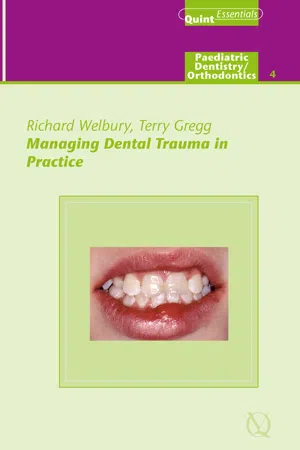
The authors of this book offer expert guidance on diagnosing and treating different forms of dental trauma. Emphasis is placed on the comprehensive care of patients and their damaged teeth following trauma involving the dentition and associated soft tissues. Especially welcome is a chapter on the part dentists may play in identifying cases of child abuse.
- 124 pages
- English
- ePUB (mobile friendly)
- Available on iOS & Android
eBook - ePub
Managing Dental Trauma in Practice
About this book
Information
Chapter 1
History, Examination, Diagnosis and Treatment Planning
Aim
To provide a framework for assessing patients presenting after trauma.
Outcome
After studying this chapter the reader should have a raised awareness of trauma aetiology, and be able to assess patients who have suffered trauma.
Introduction
This book largely focuses on children in whom the majority of dental injuries occur and where management is evidence-based. However, most issues also translate to the management of trauma to permanent teeth in older people.
Trauma to children’s teeth occurs quite frequently. Previous studies in the UK (Todd and Dodd, 1985) suggested that the incidence of trauma to teeth was increasing, but more recent studies have indicated a fall in incidence (O’Brien, 1994). It is suggested that this may be related to a more sedentary lifestyle for children, with less active participation in organised sport and more recreational interest in computer games. It is evident from the world literature however that dental trauma is a global entity. At the age of five years some 31–40% of boys and 16–30% of girls will have suffered dental trauma. By the age of 12 years, the corresponding figures are 12–33% of boys and 4–19% of girls. Traumatic injuries are twice as common in boys in both the permanent and the primary dentitions.
The majority of dental injuries in the primary and permanent dentitions involve the anterior teeth – in particular, the maxillary central incisors. The mandibular central incisors and maxillary lateral incisors are less frequently involved. Concussion, subluxation, and luxation are commonest in the primary dentition, while uncomplicated crown fractures are commonest in the permanent dentition.
Aetiology
The most accident-prone times are between two and four years for the primary dentition and seven and 10 years for the permanent dentition. In the child in the primary dentition, coordination and judgement are incompletely developed and the majority of injuries are due to falls in and around the home – in particular as the child becomes more adventurous and explores its surroundings. In the permanent dentition most injuries result from falls and collisions while playing and running, although bicycles are a common accessory. The place of injury varies in different countries, according to local customs, but accidents in the school playground remain common.
Sports injuries usually occur in teenage years and are commonly associated with contact sports such as soccer, rugby, ice hockey and basketball.
Injuries related to road traffic accidents and assaults are most commonly associated with the late teenage years and adulthood, and are often closely related to alcohol abuse.
One form of injury in childhood that must never be forgotten is child physical abuse or non-accident injury (NAI). This topic will be covered in Chapter 12.
The exact mechanisms of dental injuries are largely unknown and without experimental evidence, but injuries can be the result of either direct or indirect trauma. Direct trauma occurs when the tooth itself is struck. Indirect trauma is seen when the lower dental arch is forcefully closed against the upper, e.g. a blow to chin. Direct trauma implies injuries to the anterior region, while indirect trauma favours crown or crown-root fractures in the premolar and molar regions, as well as the possibility of jaw fractures in the condylar regions and symphysis. The factors which influence the outcome, or type of injury, are a combination of:
- energy of impact
- resilience of impacting object
- shape of impacting object
- angle of direction of the impacting force.
Increased overjet, with protrusion of upper incisors, and insufficient lip closure are significant predisposing factors to traumatic dental injuries. Injuries are almost twice as frequent among children with protruding incisors. The number of teeth affected in a particular incident is also increased by an increased overjet.
The second major group of children predisposed to traumatic injuries are the accident-prone. These children sustain repeated trauma to their teeth. Frequencies have been reported to range from 4–30%.
Another group that has recently been shown to have a higher incidence of dental injuries are those children who are overweight. It is thought that the cause is their lack of athleticism during falling.
Classification
The classification of dento-alveolar injuries based on the World Health Organization (WHO) system is summarised in Table 1-1.
| Injuries to the hard dental tissues and the pulp | |
| Enamel infraction | Incomplete fracture (crack) of enamel without loss of tooth substance |
| Enamel fracture | Loss of tooth substance confined to enamel |
| Enamel-dentine fracture | Loss of tooth substance confined to enamel and dentine not involving the pulp |
| Complicated crown fracture | Fracture of enamel and dentine exposing the pulp |
| Uncomplicated crown-root fracture | Fracture of enamel, dentine, and cementum but not involving the pulp |
| Complicated crown-root fracture | Fracture of enamel, dentine, and cementum and exposing the pulp |
| Root fracture | Fracture involving dentine, cementum and pulp. Can be subclassified into: apical, middle and coronal (gingival) third |
| Injuries to the periodontal tissues | |
| Concussion | No abnormal loosening or displacement but marked reaction to percussion |
| Subluxation (loosening) | Abnormal loosening but no displacement |
| Extrusive luxation (partial avulsion) | Partial displacement of tooth from socket |
| Lateral luxation | Displacement other than axially with comminution or fracture of alveolar socket |
| Intrusive luxation | Displacement into alveolar bone with comminution or fracture of alveolar socket |
| Avulsion | Complete displacement of tooth from socket |
| Injuries to supporting bone | |
| Comminution of mandibular or maxillary alveolar socket wall | Crushing and compression of alveolar socket. Found in intrusive and lateral luxation injuries |
| Fracture of mandibular or maxillary alveolar socket wall | Fracture confined to facial or lingual/palatal socket wall alveolar socket wall |
| Fracture of mandibular or maxillary alveolar socket wall | Fracture of the alveolar process, which may or may not involve the tooth sockets alveolar process |
| Fracture of mandible or maxilla | May or may not involve the alveolar socket |
| Injuries to gingival or oral mucosa | |
| Laceration of gingival or oral mucosa | Wound in the mucosa resulting from a tear |
| Contusion of gingival or oral mucosa | Bruise not accompanied by a break in the mucosa, usually causing submucosal haemorrhage |
| Abrasion of gingival or oral mucosa | Superficial wound produced by rubbing or scraping the mucosal surface |
History and Examination
A history of the injury followed by a thorough examination should be completed in any situation.
Dental History
- When did the injury occur? The time interval between injury and treatment significantly influences the prognosis of avulsions, luxations, crown fractures with or without pulpal exposures, and dento-alveolar fractures.
- Where did the injury occur? May indicate the need for tetanus prophylaxis.
- How did the injury occur? The nature of the accident can yield information on the type of injury expected. Discrepancy between history and clinical findings raises suspicion of child physical abuse.
- Lost...
Table of contents
- Cover
- Title Page
- Copyright Page
- Table of Contents
- Foreword
- Chapter 1: History, Examination, Diagnosis and Treatment Planning
- Chapter 2: Prevention
- Chapter 3: Intraoral Soft Tissue Injuries
- Chapter 4: Primary Dentition Injuries
- Chapter 5: Permanent Dentition: Uncomplicated Crown and Crown-root Fractures: Infractions, Enamel Fractures, Enamel-dentine Fractures, Enamel-dentinecementum Fractures
- Chapter 6: Permanent Dentition: Complicated Crown Fractures: Enamel-dentine-pulp Fractures, Enamel-dentine-pulp-root Fractures
- Chapter 7: Permanent Dentition: Root Fractures and Splinting
- Chapter 8: Permanent Dentition: Concussion, Subluxation, Lateral Luxation, and External Resorption
- Chapter 9: Permanent Dentition: Intrusive and Extrusive Luxations
- Chapter 10: Permanent Dentition: Avulsion and Reimplantation
- Chapter 11: Permanent Dentition: Dento-alveolar Fractures
- Chapter 12: Child Physical Abuse
Trusted by 375,005 students
Access to over 1.5 million titles for a fair monthly price.
Study more efficiently using our study tools.
Frequently asked questions
Yes, you can cancel anytime from the Subscription tab in your account settings on the Perlego website. Your subscription will stay active until the end of your current billing period. Learn how to cancel your subscription
No, books cannot be downloaded as external files, such as PDFs, for use outside of Perlego. However, you can download books within the Perlego app for offline reading on mobile or tablet. Learn how to download books offline
Perlego offers two plans: Essential and Complete
- Essential is ideal for learners and professionals who enjoy exploring a wide range of subjects. Access the Essential Library with 800,000+ trusted titles and best-sellers across business, personal growth, and the humanities. Includes unlimited reading time and Standard Read Aloud voice.
- Complete: Perfect for advanced learners and researchers needing full, unrestricted access. Unlock 1.5M+ books across hundreds of subjects, including academic and specialized titles. The Complete Plan also includes advanced features like Premium Read Aloud and Research Assistant.
We are an online textbook subscription service, where you can get access to an entire online library for less than the price of a single book per month. With over 1.5 million books across 990+ topics, we’ve got you covered! Learn about our mission
Look out for the read-aloud symbol on your next book to see if you can listen to it. The read-aloud tool reads text aloud for you, highlighting the text as it is being read. You can pause it, speed it up and slow it down. Learn more about Read Aloud
Yes! You can use the Perlego app on both iOS and Android devices to read anytime, anywhere — even offline. Perfect for commutes or when you’re on the go.
Please note we cannot support devices running on iOS 13 and Android 7 or earlier. Learn more about using the app
Please note we cannot support devices running on iOS 13 and Android 7 or earlier. Learn more about using the app
Yes, you can access Managing Dental Trauma in Practice by Richard R. Welbury,Terry A. Gregg in PDF and/or ePUB format, as well as other popular books in Medicine & Dentistry. We have over 1.5 million books available in our catalogue for you to explore.