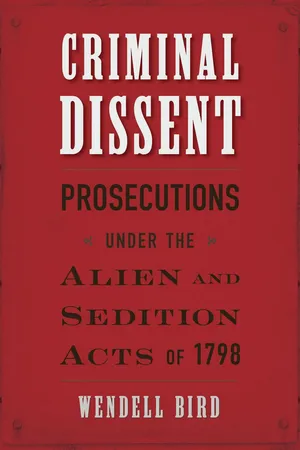
In the first complete account of prosecutions under the Alien and Sedition Acts, dozens of previously unknown cases come to light, revealing the lengths to which the John Adams administration went in order to criminalize dissent.
The campaign to prosecute dissenting Americans under the Alien and Sedition Acts of 1798 ignited the first battle over the Bill of Rights. Fearing destructive criticism and "domestic treachery" by Republicans, the administration of John Adams led a determined effort to safeguard the young republic by suppressing the opposition.
The acts gave the president unlimited discretion to deport noncitizens and made it a crime to criticize the president, Congress, or the federal government. In this definitive account, Wendell Bird goes back to the original federal court records and the papers of Secretary of State Timothy Pickering and finds that the administration's zeal was far greater than historians have recognized. Indeed, there were twice as many prosecutions and planned deportations as previously believed. The government went after local politicians, raisers of liberty poles, and even tavern drunks but most often targeted Republican newspaper editors, including Benjamin Franklin's grandson. Those found guilty were sent to prison or fined and sometimes forced to sell their property to survive. The Federalists' support of laws to prosecute political opponents and opposition newspapers ultimately contributed to the collapse of the party and left a large stain on their record.
The Alien and Sedition Acts launched a foundational debate on press freedom, freedom of speech, and the legitimacy of opposition politics. The result was widespread revulsion over the government's attempt to deprive Americans of their hard-won liberties. Criminal Dissent is a potent reminder of just how fundamental those rights are to a stable democracy.
- 546 pages
- English
- ePUB (mobile friendly)
- Available on iOS & Android
eBook - ePub
About this book
Information
CHAPTER ONE
Federalist and Republican Views of Government
GEORGE WASHINGTON’S administration enjoyed many successes and few failures. The first president would easily have been reelected had he chosen in 1796 to seek a third term. President John Adams’s administration enjoyed one major success—peace abroad—but it split the party and was overshadowed by a number of failures. The second president was not reelected in 1800. A large part of the reason was the foremost of those failures, the Alien and Sedition Acts of 1798, which Adams signed into law and enforced. Those acts provoked the first battles over the Bill of Rights, the decisive battle over the legality of an opposition party, and the beginning of the end of the Federalist Party.
The Federalist era started well with the ratification of the Constitution, the unanimous election of George Washington as the first president, the adoption of the Bill of Rights, and the illusory expectation that political parties were a thing of the past. However, divisions were quick to appear, particularly over Alexander Hamilton’s financial plan during 1790–1791,1 over the French Revolution and its large ripple effects,2 and over the Jay Treaty with Great Britain as it was ratified in 1795 and discussed long after.3 Washington’s neutrality policy helped keep the new American nation out of Europe’s wars, and the Jay Treaty averted war with Britain, but as British attacks on American ships decreased, French attacks increased. Washington remained widely popular but lost his immunity from criticism as he condemned Democratic–Republican Societies, led an overwhelming military response to the Whiskey Rebellion in western Pennsylvania, and signed the Jay Treaty.4 As Washington left office, the deterioration of relations with France reached the point of a war at sea—the Quasi-War.5

FIGURE 1.1. John Adams. Portrait by John Trumbull (1793). Courtesy National Portrait Gallery, Smithsonian Institution.
By the time John Adams took office in March 1797, the Federalists and the Republicans had come to hold opposing views on a number of fundamental issues. The spirit of the times can be seen in the description of those polarized views by Thomas Cooper, a committed Republican and soon a Sedition Act defendant. Cooper’s description of Federalist beliefs is useful, despite his personal bias:
Those who think the power of the Executive ought rather to be encreased than diminished—who are fearful lest liberty should run into licentiousness, and would rather abridge than extend the rights of the people—who doubt about the practical expediency of a Republican Government, and begin to think a limited monarchy more tolerable than was heretofore supposed—who would strengthen the General [Government] at the expence of the State Governments, and stretch the meaning of the Federal Constitution to extend the powers of the President and Congress—who laugh at the efficiency of a militia—who are advocates for a standing army and a permanent navy as absolutely necessary, not only to repel aggressions from abroad, but to quell insurrections at home—who think the Commerce of the Country of sufficient importance to be protected at the expence of a foreign war supported by taxes paid by the Farmer, on whom alone all taxes fall—who make (the executive officers of Government …) synonimous with the constitution, and condemn as enemies of the one, all who may disapprove of the measures of the other—who think it dangerous to investigate the characters and opinions of the public servants unless under the strong controul of sedition laws—who regard aliens, particularly republican aliens, with distrust, and are apprehensive that the best constitution in the world is in perpetual danger from a handful of foreigners who come hither purposely to adopt it—such persons for the most part call themselves FEDERALISTS. Grades of difference they may be, but such are the leading features of the party so called.6
Foreign policy views of most Federalists could be added to this summary: their sympathy for Britain and wish for close ties with it, and their fear of intrigue and of attack by France. That led to their being disparaged as Tories or the British Party by Republicans.7 One version of that sympathy was displayed by Adams, who called the English constitution “the most stupendous fabric of human invention,” while warning of “the foul abominations of the French revolution.”8
Cooper’s description of Republicans showed many of their stark divergences from Federalists:
Others there are, who are cautious of entrusting or extending power unless evidently necessary to the happiness of the people—who are jealous of reposing unlimited confidence in persons of superior station—who think the public character of every public man a fair object of discussion, of praise or of censure—that restraint upon investigation like the late sedition laws, imply a dread of it—… that a sincere friend to the Constitution and the Country, may sometimes disapprove the opinions and measures of the officers of Government—that the Commercial is not of equal importance with the Agricultural interest of America, that temporary depredations upon our vessels of trade by either of the contending powers, is not a sufficient reason for plunging us into the evils of a foreign war, the domestic dangers of a standing army, the temptation to contest which a navy will induce, or the expence of any of them at a period of acknowledged poverty—who regard an alien flying from the Tyranny of Europe as a friend, and rejoice in the accession of wealth and industry, from whatever quarter it may come—who believe the best way to make a man a good citizen, is to give him a stake and interest in the Country—who love the principles of our own Constitutions and rejoice at the downfal[l] of political Superstition in Europe—who glory in the appellation of REPUBLICANS.9
Foreign policy views of most Republicans could be added: their sympathy and support for France and their mistrust of Great Britain. That led to their being pilloried as Jacobins or the French Party by Federalists.
Federalists and Republicans and an Opposition
These descriptions pointed to three differences between Federalists and Republicans that, more than others, led to most Federalists supporting the Alien and Sedition Acts in 1798, and to most Republicans opposing those laws: views of deference, dissent, and freedoms of press and speech.
Most Federalists and Republicans differed in their views of a deferential political system, in contrast to a more democratic political system. In Cooper’s words, the first group “doubt about the practical expediency of a Republican Government,” while the latter group “are jealous of reposing unlimited confidence in persons of superior station.” Thus, High Federalist George Cabot sought rule by “the wisest and best citizens,” and feared “an inundation of democratic evil,” by which government would be “trampled under the feet of barbarous democrats.” Fisher Ames, too, hoped the government would be administered by “the only classes proper to make the selection from,” and he cast a wary eye at “the error into which the multitude is prone to fall,” such as “false notions of liberty” and fanaticism.10 James McHenry, as he left his position as secretary of war, sneered at people of “inferior abilities, and men without the opportunity to be rightly informed or penetration to know when they are so.” Oliver Wolcott, Jr., the secretary of the treasury, smirked with other Federalists at the “ancient usage of the aristocrats to pay respect to the sovereign people, by obsequious attentions whenever their suffrages have been requested,” “soliciting the favour of individuals, with whom they associate on no other occasion,” when “men of the first consideration condescend to collect dissolute and ignorant mobs of hundreds of individuals, to whom they make long speeches.”11 Such Federalists would stand for election but found it improper to campaign or solicit votes. Republican newspapers poked ridicule at Federalist conceits as the “Better Sort” who protected civilization against the “swinish multitude.”12
The American Revolution had weakened many of the foundations of that hierarchical structure, in a number of ways beyond replacing monarchy with republican government.13 The patriots embraced radical Whig ideology along with classical republicanism, and both philosophies were notably unfriendly to unfettered powers, limitations of individual rights, and demands for passive obedience to rulers.14 Also, the Revolution brought a “revolution in rights,” which included discussions in speeches and newspapers, state declarations of rights, development of natural rights theory, and broader rights in practice.15 Moreover, the most influential loyalists were forced to emigrate and, in place of their positions, new state offices were created. A number of newly prosperous contenders for political office and leadership arose, enriched from military supply contracts, confiscated property sales, privateering, or speculation in government obligations.16 Further, the American Revolution included a social transformation from the colonial order to a republican order, as Edward Countryman noted, which continued long afterward, though it failed to convey its benefits to many Americans—enslaved people, women, Native Americans, and others.17 Most Federalists seemed to be less aware than most Republicans of the social changes prompted by the Revolution, at least until the electoral college divulged the results of the presidential election of 1800.
Most Federalists and Republicans also differed in their view of the permissibility of dissent in opposition to the administration.18 A hierarchical view of government led to a Federalist expectation of deference, not criticism, toward the “leading men” in office. Federalists were the administration, filling nearly all political offices in the new federal government, and they readily characterized disparagement of any official as disparagement of the government. In Cooper’s words, Federalists “condemn as enemies of the one [the government], all who may disapprove of the measures of the other [the executive officers],” while Republicans believe “that a sincere friend to the Constitution and the Country, may sometimes disapprove the opinions and measures of the officers of Government.” From a Federalist standpoint, it was easy to view criticism as criminal defamation or sedition, the product of illegitimate factions and parties.
The danger of factions and political parties was a point of agreement when the Constitution was ratified. Factions and parties served private interests, while enlightened officials should serve the national interest; and factions and parties were accompanied by corruption as English parties showed. The key point on which Federalists and Republicans differed was which one of them was a faction or an incipient party. A dozen essays in The Federalist had denounced factions and parties. Washington’s Farewell Address had warned of “the baneful effects of the spirit of party” and faction. Adams’s inaugural speech condemned “the danger to our liberties” from parties determining elections or administrations. Consequently, people referred to their own side as the “Federalist interest” or the “Republican interest” in the early 1790s—not as parties—while they reprehended the other side as a faction or party.19
A related fundamental difference between most Federalists and most Republicans, at least once most Federalists shifted as the Alien and Sedition Acts were passed in mid-1798, was their views of freedom of speech and press, particularly about officials and government. As Cooper put it in 1799, Federalists “think it dangerous to investigate the characters and opinions of the public servants unless under the strong controul of sedition laws,” while Republicans “think the public character of every public man a fair object of discussion, of praise or of censure,” and believe “that restraint upon investigation like the late sedition laws, imply a dread” of investigation. Denying the legitimacy of an opposition, most Federali...
Table of contents
- Cover
- Title Page
- Copyright
- Dedication
- Contents
- Introduction
- 1. Federalist and Republican Views of Government
- 2. Passing Laws against Internal Enemies
- The Sedition Act First Campaign: The “Suppression of the Whig Presses”
- The Sedition Act Second Campaign: The Rebellion the Army Could Not Find
- The Sedition Act Third Campaign: “The Reign of Witches” and the Election of 1800
- The Alien Act: “Worthy of the 8th. or 9th. Century”
- Epilogue
- Appendix: Alien and Sedition Act Prosecutions
- Abbreviations
- Notes
- Acknowledgments
- Index
Trusted by 375,005 students
Access to over 1.5 million titles for a fair monthly price.
Study more efficiently using our study tools.
Frequently asked questions
Yes, you can cancel anytime from the Subscription tab in your account settings on the Perlego website. Your subscription will stay active until the end of your current billing period. Learn how to cancel your subscription
No, books cannot be downloaded as external files, such as PDFs, for use outside of Perlego. However, you can download books within the Perlego app for offline reading on mobile or tablet. Learn how to download books offline
Perlego offers two plans: Essential and Complete
- Essential is ideal for learners and professionals who enjoy exploring a wide range of subjects. Access the Essential Library with 800,000+ trusted titles and best-sellers across business, personal growth, and the humanities. Includes unlimited reading time and Standard Read Aloud voice.
- Complete: Perfect for advanced learners and researchers needing full, unrestricted access. Unlock 1.5M+ books across hundreds of subjects, including academic and specialized titles. The Complete Plan also includes advanced features like Premium Read Aloud and Research Assistant.
We are an online textbook subscription service, where you can get access to an entire online library for less than the price of a single book per month. With over 1.5 million books across 990+ topics, we’ve got you covered! Learn about our mission
Look out for the read-aloud symbol on your next book to see if you can listen to it. The read-aloud tool reads text aloud for you, highlighting the text as it is being read. You can pause it, speed it up and slow it down. Learn more about Read Aloud
Yes! You can use the Perlego app on both iOS and Android devices to read anytime, anywhere — even offline. Perfect for commutes or when you’re on the go.
Please note we cannot support devices running on iOS 13 and Android 7 or earlier. Learn more about using the app
Please note we cannot support devices running on iOS 13 and Android 7 or earlier. Learn more about using the app
Yes, you can access Criminal Dissent by Wendell Bird in PDF and/or ePUB format, as well as other popular books in History & Early American History. We have over 1.5 million books available in our catalogue for you to explore.