During the dictatorship of the Colonels in Greece, there was an attempt at self-transformation into some form of civilian rule in 1973: the so-called 'Markezinis experiment', named after the politician who assumed the task of heading the transition government and lead to elections. It lasted a mere eight weeks, faced heavy opposition from both the opposition elites and the civil society and eventually collapsed by a military hard-liners' coup.
This book argues that the failure of the 'Markezinis experiment' paved the way for the actual transition of 1974 as it happened. Using British and American archival resources, as well as unique private archives and personal interviews, the book concludes by briefly seeking to trace some potential alternative paths for the failed self- transformation attempt, and by accounting for the long-term consequences of the failure of the 'Markezinis experiment'.
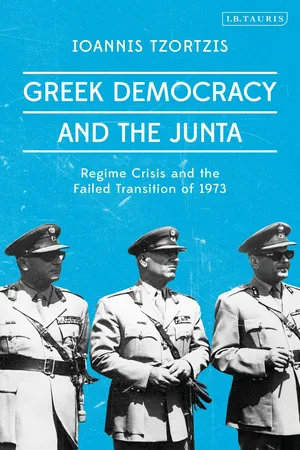
eBook - ePub
Greek Democracy and the Junta
Regime Crisis and the Failed Transition of 1973
- 280 pages
- English
- ePUB (mobile friendly)
- Available on iOS & Android
eBook - ePub
About this book
Information
1
From ‘Difficult Democracy’ to the ‘Wrong Coup’: Greece 1949–67
There will be no elections … because there comes the time of the ‘Unknown Colonel’.
Markezinis, speaking to the press in February 1967
All and no one.
Karamanlis’ reply to the question ‘Who was responsible for the 1967 coup?’
The developments that led to the 1967 coup were indirect consequences of the civil war, therefore the period from 1949 to 1967 calls for a detailed analysis of the political elites, social and institutional change and the military officers’ corps. All prospects of the evolution of the Greek political system towards a proper liberal democratic settlement were blocked by a number of factors: the extreme polarization of Greek political life; the institutionalization of a rigid and partial legal framework against potential challengers of the post-civil war status quo; the emergence of the army as an independent centre of power, enjoying an organizational and institutional autonomy unthinkable for a Western democracy and prone to conspiracy and subversion; and the failed attempt at institutional modernization in the 1960s blocked. This opened the way to the April 1967 coup.
Politics and institutions from 1949 to 1961: The ‘difficult democracy’
Although, for most of the civil war, Greece was ruled by a coalition government of the centre and the right, it was the latter that is considered to have been the winner in the struggle that ravaged the country from 1944 to 1949. Both political poles came out of the war fragmented; however, the right was quicker to unite its pieces in the new party of ES (Greek Rally) under Field Marshal Alexandros Papagos in 1951. The next year Papagos won the elections and stayed in office until his death in October 1955 when, in a controversial move, King Paul appointed Constantine Karamanlis as premier. Karamanlis formed a new party, the ERE (National Radical Union), which was to dominate the right until 1967. Karamanlis himself would stay in office until 1963, a length of service unmatched by any politician up to that point. The party of ERE was largely shaped by the dominant figure of its leader, had a quite vague ideological orientation and lacked both a stable structure and a clear programme, other than that of ‘economic and social rehabilitation and progress’.1
It would take the groups of the centre another decade to achieve the same unity. The political space between ERE and the left comprised a number of parties plagued by the personal enmities and ambitions of their leaders and thus for many years they were incapable of forming a coalition that could effectively challenge ERE. The political vacuum between left and right would, in the 1950s and early 1960s, be occupied by various opportunistic and precarious coalitions that would sometimes include the left itself, ranging up to the fringes of the right and some of its dissidents. Although this particular setting offered ERE some easy victories, in the long run it proved a challenge to the stability of the political status quo. The prolonged incapability of the forces of the centre to find a common political platform worked to the advantage of the left-wing EDA in the elections of 1958, when it emerged for the first time as the major opposition party with 24.43 per cent of the votes. This was a success that proved hard to repeat, but for the moment, this left-wing party, fashioned in the image of the Communist Party of Greece (KKE), had become the major opposition party in the Greek parliament just nine years after the end of the civil war. The implications of this development were twofold: on one hand, it prompted the numerous political groupings which occupied the space between ERE and EDA to overcome their leaders’ personal enmities and ambitions and join forces in one political coalition. This eventually resulted in the creation of the EK (Centre Union) in the summer of 1961, just before the next elections. It was a hastily formed coalition which was plagued by problems of coordination and regular conflict over the personal interests and ambitions of the faction chiefs, some of whom questioned the hegemony of the coalition leader, the 73-year-old George Papandreou. At the same time, the EK alarmed the ‘deep state’ and triggered a violent reaction against the left and its ‘fellow travellers’.
On the left side of the political spectrum, the ideological and organizational domination of the KKE, though illegal since 1947, continued in the face of the EDA (United Democratic Left), a party formed by left-wing personalities and groups which at the same time maintained strong links with the KKE, the expatriated leadership of which had not renounced the possibility of a continuation of an armed struggle should circumstances allow. Moscow’s tight control of the KKE, which faithfully followed the Soviet political and diplomatic agenda in the Cold War years, made consensus a chimerical expectation on the left as well. While the post-civil war institutions of supervised democracy influenced and hardened the stance of the left, its own basic decisions provoked a negative reaction by non-left political groups.2
In September 1946, after a contested referendum, the monarchy was restored in Greece.3 Its return guaranteed to both internal and external allies the continuation of the country’s pro-Western allegiance and anti-communist orientation. After the end of the civil war, backed by the American delegation in Greece and encouraged by the unwillingness of most political groups or leaders to resist its predominance, the monarchy tended to exceed its constitutional authority by seeking to control Greek political life – indeed, to such an extent that, for a number of years, there would be no major political development without the involvement of the Palace.4 However, in the long run this posed a serious threat to the legitimacy of the monarchy: continuous, often overt, interference in politics cost the support of certain political forces, as well as fuelled anti-royal feeling among the population. None the less, the monarchy enjoyed a great deal of popularity during and after the end of the civil war, especially in the countryside, but by the early 1960s this support was beginning to wane.5
It was on an institutional and cultural level that the bitter legacy of the Greek civil war was felt most keenly, preventing the healing of the acute political divisions of the 1940s and perpetuating their consequences well into the 1960s. The post-civil war years saw a sharp contrast between constitutional theory and political practice. The state of emergency, introduced during the civil war, was extended long after the official end of that conflict in 1949 by means of institutional engineering and comprised a complex legal arsenal including a number of special laws and decrees targeting individuals ‘conspiring or revolting or coming into contact with foreigners or participating in armed groups threatening the integrity of the state’, or ‘seeking to apply ideas having as [their] goal the subversion of the state or of the existing social system by violent means’.6 The excuse for this programme was an announcement by the KKE in the autumn of 1949 that the armed struggle was not finished, simply temporarily suspended. The result was the intervention of the state in many facets of everyday life, from the issuing of passports to appointing civil servants, from manipulation of the electoral system to involvement in social and political activities, sometimes using the police and even the army; in extreme cases, the state of emergency practically nullified the constitutional guarantees of democratic institutions.7 The executive was also able to claim some powers which were normally reserved for the legislature. So although Greece remained officially a democratic state, the guarantees of political, civil and individual rights ...
Table of contents
- Cover
- Half-Title Page
- Title Page
- Contents
- Acknowledgements
- Chronology of Events
- Introduction: Why did the Junta not end in 1973?
- 1 From ‘Difficult Democracy’ to the ‘Wrong Coup’: Greece 1949–67
- 2 ‘Greece of Christian Greeks’: The Dictatorship of 21 April 1967
- 3 The Early Liberalization, January–September 1973
- 4 The ‘Unfinished Revolution’ and the ‘Castrated Parliament’: The Elites and the ‘Experiment’
- 5 Fortuna and the ‘Experiment’: Civil Society and the Polytechnic Events
- 6 The Americans Yet Again? The International Factor and the ‘Experiment’
- 7 Concluding Thoughts: The ‘Markezinis Experiment’ between Oblivion and Myth
- Notes
- Bibliography
- Index
- Copyright
Trusted by 375,005 students
Access to over 1.5 million titles for a fair monthly price.
Study more efficiently using our study tools.
Frequently asked questions
Yes, you can cancel anytime from the Subscription tab in your account settings on the Perlego website. Your subscription will stay active until the end of your current billing period. Learn how to cancel your subscription
No, books cannot be downloaded as external files, such as PDFs, for use outside of Perlego. However, you can download books within the Perlego app for offline reading on mobile or tablet. Learn how to download books offline
Perlego offers two plans: Essential and Complete
- Essential is ideal for learners and professionals who enjoy exploring a wide range of subjects. Access the Essential Library with 800,000+ trusted titles and best-sellers across business, personal growth, and the humanities. Includes unlimited reading time and Standard Read Aloud voice.
- Complete: Perfect for advanced learners and researchers needing full, unrestricted access. Unlock 1.5M+ books across hundreds of subjects, including academic and specialized titles. The Complete Plan also includes advanced features like Premium Read Aloud and Research Assistant.
We are an online textbook subscription service, where you can get access to an entire online library for less than the price of a single book per month. With over 1.5 million books across 990+ topics, we’ve got you covered! Learn about our mission
Look out for the read-aloud symbol on your next book to see if you can listen to it. The read-aloud tool reads text aloud for you, highlighting the text as it is being read. You can pause it, speed it up and slow it down. Learn more about Read Aloud
Yes! You can use the Perlego app on both iOS and Android devices to read anytime, anywhere — even offline. Perfect for commutes or when you’re on the go.
Please note we cannot support devices running on iOS 13 and Android 7 or earlier. Learn more about using the app
Please note we cannot support devices running on iOS 13 and Android 7 or earlier. Learn more about using the app
Yes, you can access Greek Democracy and the Junta by Ioannis Tzortzis in PDF and/or ePUB format, as well as other popular books in History & European History. We have over 1.5 million books available in our catalogue for you to explore.