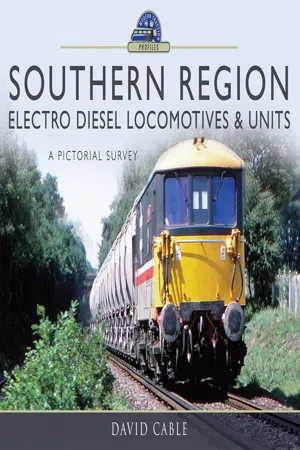
The electro-diesel locomotives and multiple units used by the Southern Region of British Railways, were unique to this region. The locomotives of class 73 were used extensively throughout the region, in particular on Gatwick Express services, as well as on departmental and track recording trains. Their versatility in being able to work off 3rd rail electricity as well as diesel-engined power gave them unrivaled areas of work. The class 74s, which only had a short life, were seen particularly on boat trains and parcels services on the South Western main line. The classes 201-3 were 6-car units of narrow bodied construction, so as to be able to work Hastings line services with its restricted clearances. The other classes 204-207 were 3-car units employed on stopping services throughout the region, but especially in Hampshire and the lines to Uckfield and originally East Grinstead. They were also seen on services in East Sussex and Kent. This volume shows all the classes at work, in a variety of color schemes and locations, and has been compiled by David Cable, well known author of a range of books regarding Modern Traction, published by Pen and Sword Books Ltd.
- 232 pages
- English
- ePUB (mobile friendly)
- Available on iOS & Android
eBook - ePub
About this book
Class 73
The 49 locos in this class were built between 1962 and 1967, the first six at Eastleigh, the remaining 43 at English Electric’s Vulcan Foundry. A Bo-Bo design, they were formed into two sub-groups – 73/0 or JA and 73/1 or JB. The former had an 80mph maximum speed with 1420 electrical HP and a 600 HP English Electric diesel engine. The 73/1s had a 90mph maximum speed and electric power of 1600 HP. The class was originally numbered E6001-49, but after the introduction of TOPS, the JAs became 73001-6 and the JBs 73101-42, one loco having been scrapped after an accident.
Electrical pick-up was by 3rd rail current collectors. The internal wiring system was such that at breaks in the conductor rail (where the voltage could vary due, for example, to voltage drops caused by other traffic) spectacular arcing could occur. This could cause local fires, and when the class was first used on Gatwick Express services leaving Victoria, the fires necessitated using pairs of the class working under diesel power, until fire guards could be fitted around the conductor shoes.
The diesel engine provided the means for the class to be used on non-electrified tracks, or when power was switched off during maintenance work. In 2013/14, seven of the class were re-engined with Cummins and MTU diesels, increasing the power output to 1500/1600 HP respectively. These have been reclassified as 73/9s.
The class has a facility for multiple working, and apart from being compatible with virtually all other Southern Region locos and multiple units, can also work in conjunction with locos of types 2, 3 and 4 from other regions.
Their duties have covered all types of train operation, and in particular have been first choice for trains provided for the Royal Family and other VIPs Twelve of the class were reclassified in 1984 as 73/2s in order to work Gatwick Express services to and from Victoria in push-pull mode. In the late 1980s, when the class 442s were being built using motors from class 432 4REPs, single units replaced a driving coach to for a class 432/9 formed of the 73 and 3 4REP coaches. Others were used in pairs on South Western trains from Waterloo to Bournemouth with 4TC sets.
Much work was undertaken on...
Table of contents
- Cover
- Title
- Copyright
- Contents
- Introduction
- Class 73
- Class 74
- Classes 201, 202 and 203
- Classes 204 and 205
- Class 206
- Class 207
- Summary
Trusted by 375,005 students
Access to over 1.5 million titles for a fair monthly price.
Study more efficiently using our study tools.
Information
Frequently asked questions
Yes, you can cancel anytime from the Subscription tab in your account settings on the Perlego website. Your subscription will stay active until the end of your current billing period. Learn how to cancel your subscription
No, books cannot be downloaded as external files, such as PDFs, for use outside of Perlego. However, you can download books within the Perlego app for offline reading on mobile or tablet. Learn how to download books offline
Perlego offers two plans: Essential and Complete
- Essential is ideal for learners and professionals who enjoy exploring a wide range of subjects. Access the Essential Library with 800,000+ trusted titles and best-sellers across business, personal growth, and the humanities. Includes unlimited reading time and Standard Read Aloud voice.
- Complete: Perfect for advanced learners and researchers needing full, unrestricted access. Unlock 1.5M+ books across hundreds of subjects, including academic and specialized titles. The Complete Plan also includes advanced features like Premium Read Aloud and Research Assistant.
We are an online textbook subscription service, where you can get access to an entire online library for less than the price of a single book per month. With over 1.5 million books across 990+ topics, we’ve got you covered! Learn about our mission
Look out for the read-aloud symbol on your next book to see if you can listen to it. The read-aloud tool reads text aloud for you, highlighting the text as it is being read. You can pause it, speed it up and slow it down. Learn more about Read Aloud
Yes! You can use the Perlego app on both iOS and Android devices to read anytime, anywhere — even offline. Perfect for commutes or when you’re on the go.
Please note we cannot support devices running on iOS 13 and Android 7 or earlier. Learn more about using the app
Please note we cannot support devices running on iOS 13 and Android 7 or earlier. Learn more about using the app
Yes, you can access Southern Region Electro Diesel Locomotives and Units by David Cable in PDF and/or ePUB format, as well as other popular books in Technology & Engineering & British History. We have over 1.5 million books available in our catalogue for you to explore.