"An intriguing, but also shocking insight into the thoughts of those young German women and how they saw their part in Hitler's thousand-year Reich." —
Armorama
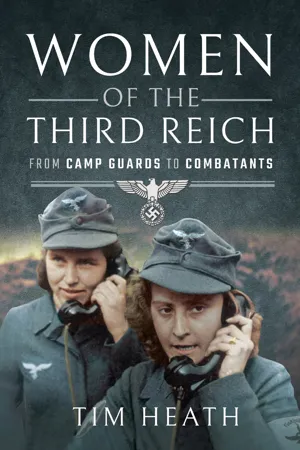
The women of the Third Reich were a vital part in a complex and vilified system. What was their role within its administration, the concentration camps, and the Luftwaffe and militia units and how did it evolve in the way it did?
We hear from women who issued typewritten dictates from above through to those who operated telephones, radar systems, fought fires as the cities burned around them, drove concentration camp inmates to their deaths like cattle, fired Anti-Aircraft guns at Allied aircraft and entered the militias when faced with the impending destruction of what should have been a one thousand-year Reich.
Every testimony is unique, each person a victim of circumstance entwined within the thorns of an ideological obligation. In an interview with Traudl Junge, Hitler's private secretary, she remembers: 'There was so much hatred within it's hard to understand how the state functioned . . . I am convinced all this infighting and competition from the males in Hitler's circle was highly detrimental to its downfall'.
Women of the Third Reich provides an intriguing, humorous, brutal, shocking and unrelenting narrative journey into the half lights of the hell of human consciousness—sometimes at its worst.
"Tim Heath investigated the experiences of women in Nazi Germany before and during World War II . . . What is special is that women speak candidly about their experiences, which were sometimes violent." —
Traces of War
"A fascinating book, chilling at times." —Books Monthly
- 264 pages
- English
- ePUB (mobile friendly)
- Available on iOS & Android
eBook - ePub
About this book
Information
Chapter One
Dismembering Innocence
By 1939, membership of the Hitler Youth for both boys and girls was unavoidable. It was expected that all young Germans should join their respective organisation. Apart from the few sweeteners that the Nazis threw in to make Hitler Youth membership more appealing, it was merely an extension by which young people could be indoctrinated into Nazi ideology, its culture, expectations and principles. Girls and boys who excelled in the political ideology, sports, fitness and all of the basic practical aspects were rewarded handsomely. Certificates and badges were awarded for all manner of proficiencies within the organisation, and any boy or girl showing particular excellence in knowledge and leadership could rise through the ranks to become a troop leader within the Hitler Youth.
Ursula Betmann had joined the Bund Deutscher Madel [League of German Maidens] before it had become compulsory for girls to do so. She recalls:
I was a fifteen year-old totally swept away by the political happenings in Germany just prior to the Second World War. I had girlfriends whose parents were reluctant for their girls to become involved. They had to pay subscriptions, even bribes, to ensure their girls did not have to join. Of course, anyone who did not join was considered ‘unpatriotic’ by others within the community. I had no such problems as my parents were hardline supporters of National Socialism. My parents paid for my uniform and I recall the first time I ever put it on. It was an amazing feeling and my parents looked at me full of pride. The BDM meetings held twice weekly were no holiday camp. The theory work was exhaustive and we could be asked any number of things about Hitler, his parents, and the Nazi Party. If we could not give a clear answer we would be shouted at and berated for not working hard enough. We had to know many political things such as who was in charge of which ministry within the Reich, those who were killed in the Beer Hall Putsch, Hitler’s parents’ names and birthdates. Yes, there was lots we were expected to learn.
We learned much in daily schooling and after school we were given various books to study. Most important of all was Adolf Hitler’s Mein Kampf [‘My Struggle’]. This had to be studied religiously. Now, they could ask you absolutely anything from that book and they would expect you to answer coherently. I read Mein Kamp two, three, four times over. I understood it clearly and, yes, I believed in everything that it presented to the reader; particularly us as young Germans of the new generation. I could answer most questions that I was asked, which impressed our leader tremendously. I was also very good at sports: running, high jump, ball throwing and swimming. I gained many certificates for sporting achievement. In fact, I gained many of the awards in rapid succession. I was part of a gymnastics team that would compete all over the country and we even competed in Japan, winning many classes there. We were superbly fit all of the time as keeping us active and well fed became a national priority. Only when the Second World War broke out did we become second to the soldiers nutritionwise. On the BDM camps held throughout the summertime I would always be up first, asking the leader if there were any tasks she wanted me to do. Normally I would help rouse the other girls from their tents, make sure they were ready to start the day.
I worked very hard in all aspects of our BDM troop and, at the age of sixteen, I was given charge of a small group of our girls. I would be responsible for their discipline, appearance, conduct, safety, etc. on the camp. It was the precursor to bigger things in a way. Was I a bully? No, I don’t think I was, but I was very harsh. I expected much from our girls and wanted them to give as much effort in everything they did, as I had done over the years. You only gained respect as a leader if you were feared; if people did not fear you they generally would not respect you. That is something I learned from my parents from a very young age. It was an ethos I personally believed in and took with me into my BDM leader role. We couldn’t have weak girls in our troop. Our girls had to be the best, especially in the inter-organisational competitions held throughout Germany. We wanted to beat the other BDM troops and the only way we could do that was by persistent hard work coupled with discipline.
I was given a further promotion a few months later and, when I was seventeen, I was given promotion to BDM leader of our troop. Our senior at that point had left to complete service within the Labour Front so I effectively stepped into her role and took over. I enjoyed this role very much as it was, in essence, very militaristic. The girls had to be up early, wash, make breakfast, tidy up, dress into sports attire, complete exercise routines, wash again, change into uniform then march into the woods. When we returned from our march I insisted boots were polished and stowed away properly. Tents were checked to ensure they were tidy. A fire would be made and a meal prepared. Afterwards we would gather round the fire to discuss political theory and current events. There would be questions and answers and I expected my girls to answer me correctly when I asked them a question. Anyone who couldn’t answer me would be punished with extra-hard cleaning duties. One of my punishments would be that a girl would have to polish the boots of all the other girls and clean the undersides of the boots too. I would also make them stand to attention if they displeased me. The discipline instilled in me I was now instilling in them.
I also lectured them on the greatness of our German race and Adolf Hitler. To me he was the most important political leader in our entire history. I made sure all my girls understood that, and followed the principles of National Socialism. Teaching racial theory to the girls on the camps was simple. I told them you should have no compassion at all for the enemies of our race. I also told them Jews had no place in Germany. Even a German Jew is a bad thing for our future. If they have to be eliminated by force then so be it, was what I would say. For my theory to hit home in their minds I had to use fear yet again. The threat of being overtaken by a population who wished nothing but our own destruction was usually enough. Although my style of leadership was harsh, as it was meant to be, I also understood the emotional fragility of young girls. I had to maintain a careful balance, so after the serious stuff we would have lighter moments where we could share jokes and tell each other stories. I felt it important that I should be approachable to my girls in case they had any problems either at home or within the BDM itself.
We were a kind of sisterhood and we had a common bond of being females in the Third Reich where we had clear roles to fulfil. I would discuss children with them and this was always a difficult task. Even I as a BDM leader could not put explicit images in their minds, if you understand me. I had to use excerpts from the biology book supplied to our schools to explain reproduction. The childcare aspects were much easier to explain. As it stood at the time the males knew exactly how to make a girl pregnant and it was their job to deal with that business. The girl was merely the follower, doing as she was told. You were expected to find a man, marry and become a housewife after completing your compulsory labour service. At that point in your life as a girl you would be at optimum fitness and more than ready for reproduction. I myself had mixed feeling about settling down. I loved being a leader and retreating to the role of a submissive haus frau really did not appeal to me at all. The loss of that power would feel somewhat demeaning to me. That’s how I felt at the time, but there was pressure placed even upon me to do my part of producing children for the future Reich.
I continued in my post as a BDM leader for as long as I could, yet other girls were showing great potential and had to have their chance. When I stood down I went and completed my labour service and came back knowing I would have to think about settling down and becoming a housewife. There were many local dances and pageants where we mixed with the young men. One caught my eye and he liked me and so we began talking. Typically, he asked me to tea and things like that. We went on picnics and walked in the countryside; all the normal things a courting couple would do really. I had never been kissed properly before this boy. He was obviously more experienced than I was and had probably had a few girlfriends before me. I didn’t really care; I liked him and felt duty-bound to at least try.
Encouraged by our parents, we married. I was twenty years of age at the time and he was twenty-three. I was not nervous during the small wedding service attended by both families, just the thought of having to have sex with him later on. We drank lots of wine during the evening and then retired to bed late. When we entered our apartment rooms I wanted to sleep separately as that was still something which was traditionally acceptable to some couples. He did not really give me a straight answer as such so I went to one of the two single rooms, undressed and put on a night gown as he drank some more in the other room. Then he came in and argued that, as his wife, I should obey him and sleep beside him. I tried to reason with him, telling him I just felt nervous about having sex and needed a little time to get used to this idea. His whole attitude now was that I was his property and he could do what he wanted with me. He threw down his glass, which smashed on the floor. He grabbed my wrist and pulled me into the bedroom. I was thrown down on the bed and the door was slammed shut behind me. I found myself struggling on the bed with him. He would not stop. As much as I begged him to stop, he would not get off me. I got to the point where I was so exhausted he could do as he pleased with me. That’s how my marriage was consummated. It was painful and not the most pleasant of experiences for a first time. Like most women back then, I got used to it and became more receptive. Yet I felt he was the one who gained the most pleasure from it. We had four children in all. My husband went to fight in the Second World War with the Wehrmacht [German army]. It was a fight he would not return home from. In a way I was happy he was dead. It was not so much love but duty that drove me to marry. I would have my four children and I would bring them up with the values that I had espoused in the BDM when I was a leader. Even after the war I still believed in National Socialism. The events that happened after the Second World War, in my opinion, proved the National Socialist ethos was a rightful one.
Another young girl who joined the ranks of her local BDM troop was Trudi Lehrer. Trudi was born and raised in the German town of Heidelberg. She responded well to her National Socialist teachings but had known little else. She, like many who entered the BDM, dreamed of becoming a leader. She did not have the typical appearance of a BDM girl as portrayed by the propaganda posters of the time. Her hair was jet black and her skin rather tanned when compared to the blonde Aryan models which graced almost every BDM propaganda poster in Germany. She was an attractive looking girl with brown eyes, described by many who knew her as ‘beautifully warm’.
National Socialism was like a fire burning out of control within me. I had been raised by my parents as a Nazi child and I grew up as a Nazi adult. Of course there was the German girls’ league which I wanted to join very much. I loved the look of the uniforms and the fact of what they did. I thought it was great, I really did, and I aspired to do as well as I could once I’d joined up. I was always very good physically so sports of most kinds were something I enjoyed very much. Running was my favourite sport, and the javelin. Gymnastics was another form of physical activity we were very much involved with. Graceful movement, strength, beauty; all these things were what we represented.
To become a leader was an honour as it took a great deal of hard work and dedication to be considered for such a post. The responsibility which it gave an individual was of huge importance. As a leader, you were responsible for teaching Nazism to the girls. When I became a leader I was appointed to a Jungmädelbund troop and not a BDM one. This annoyed me a little at first as it felt like a kind of demotion rather than promotion. They were only very young most of them; ten to fourteen years on average. In my little troop most were aged ten and eleven and the oldest was in fact thirteen. In all they were very well disciplined and attentive. All the skills I had built up with the BDM I could now pass to these girls as their leader.
Political teaching was by far the hardest part of my task. Getting children to absorb politics is no easy thing. They can soon become bored, distracted and some start to fall asleep. This is where the respect part of your identity comes in. You have to be approachable to them but in order to instil the lessons regarding the filth of Jewry and pride in our Germanic racial heritage then they have to listen, absorb and understand you. Sometimes fear is the only method by which to obtain respect. If I had to show anger then I would show it. If I had to punish a girl in front of the others then I would do it. I did what I had to do. Awards, certificates and badges were just a few incentives for the young girls to work hard. Youngsters like to feel that they have accomplished something and receive a physical reward for it. Such diplomas were worthless really, but it gave them a feeling that they had achieved something. They were also something they could take home to their parents who would then be proud of them. Getting the youth of our country to do as we needed was much like training a dog to walk correctly on a leash. Reward them generously and they would get it right pretty quickly.
Cultivating hatred against Jews was not as difficult a process as many would think. We would tell them that Jews were the root of Germany’s misfortunes. Most would accept that view as it was shared by many within our society. Did I personally care about these things and the violence we were perpetrating? No, at that time I did not care. We had our society to care for and that had to come before anything else. For a society to grow strong and become pure it has to relinquish those who are unfit to be a part of it. We were of the opinion that Jews were parasites. That they behaved like parasites in the way they invaded a host then bled that host dry. There was much hatred, and when Jews were sent to the concentration camps there were really no concerns. My parents often spoke of the camps and were of the opinion that we should build as many as possible with a view to destroying all of Germany’s undesirable racial elements. Like a religion, it was accepted as the only way to deal with a particular problem.
For every young girl in the Jungmädelbund or Bund Deutscher Mädel who totally agreed with the political and social system being implemented in the new Germany there was, of course, a good proportion that did not. Thelma Ortge likened the Jungmädelbund and Bund Deutscher Mädel to a group of circus animals that had to be trained. She recalled:
I was fifteen in 1936 with Herr Hitler as the supreme leader of the German people. I noticed how quickly everything changed in our school. It was somewhat confusing, as the swastika flags were always previously a political emblem, yet all of a sudden it was our national emblem; our national flag. My parents were horrified as they were confident the Conservatives within the German government could contain the fascist Hitler. My parents absolutely despised the Nazis and all that they represented. At school they brought in new faces to teach the kids. The whole curriculum of education evolved according to the changes occurring within our society. Many of the old teachers who had been responsible for educating us were told to get out of our school. They were banned from teaching Hitler’s generation and new teachers were brought in. Many of these new teachers were bastards, they were really not nice people. My parents sat me down and tried to discuss with me how I can avoid being indoctrinated. One evening my father sat me down and he said to me: ‘What I am going to try to tell you is going to be the best advice I will ever give to you as your father. I know that you are in school and with the other children. Some of those children have Nazi-sympathising families. They will undoubtedly stand out from those coming from families who are not convinced supporters of this dreadful regime we are now under. My girl it is vital that you play the game, as we all must. But don’t ever believe a word of what they tell you, or let them get inside you and destroy that beautiful mind of yours. Now, do you understand me? Be the actor, play along and do what you have to do and we will do the same. Maybe, if we are clever, we can all survive this.’ That was quite intense coming from my father but I understood what he meant. He did not want them indoctrinating me or taking me away from them, like they would do with thousands of other young German children.
The ‘taking away’ referred to by Thelma was the way that the Hitler Youth organisations provided attractive perks to all those who joined. The young could be easily seduced by the pied piper of National Socialism. Many parents feared for their youngsters once they were in the Hitler Youth – which relished and encouraged violence – yet they knew resistance would bring them to the attention of the authorities, who would then ask questions such as ‘why has your boy not enrolled into the Hitler Youth?’, and ‘why is your daughter not in the German maiden’s league?’ If a child was not encouraged to join either of these Nazi youth organizations, then cries of ‘traitor’ or ‘non-conformist’ were the usual response.
Thelma Ortge continues:
At school they all knew who was in the JM or BDM. Any girl who was not a member was asked why. I know one girl was interrogated one morning during class. That old Nazi teacher, he was a nasty, nasty bastard. He had a certain way of working on you to grind you down and to make you slip up, as they say. He would shout and ask you questions rapidly so that you had to answer him quickly. This one morning he picked on this girl and subjected her to a ten-minute tirade: ‘Why are you not a mädchen [young member of BDM]? Do you not have any pride in being German? Do you not like National Socialism?’ He just kept on and would shout, ‘Well, answer me!’ He broke her in the end, and she began to cry and said, ‘My father told me to say nothing.’ That was enough in his book to inform the local authority of possible non conformism within the community. Of course, the authorities did investigate and usually a threat of serious consequences was enough to bring people into line. I endeavoured to learn their poison and to play their game, but secretly I loathed them. I did join the BDM but never wore the distinctive uniform. My parents could have bought me the uniform but I would just say that we couldn’t afford one. So I entered the BDM and felt just like an actor acting my part as a willing young Nazi girl.
Within the BDM troop there were, of course, the diehard Nazi girls who were infatuated with Hitler. One had a scrap book with pictures of Hitler that she had cut from newspapers. It was her pride and joy and she would say, ‘Oh, how jealous I am of Fraulein Braun, how lucky she is.’ It was all so delusional, a daydream. There were girls who were genuinely interested in the politics too. They were what today might be termed as ‘nerdy types’. They could tell you anything about the National Socialist culture, and if we needed to learn, these girls would help you. There was one named Gabbi. Gabbi was kind of skinny and she sometimes wore glasses. I met her when I was twelve, when she first came to our school after moving from some town in the south of Germany. She would always be with her nose in a book and when you approached her she would look at you over the top of her glasses. She knew you needed help with something, so would say, ‘Oh, what now?’ I liked Gabbi a lot as she ...
Table of contents
- Cover
- Dedication
- Title
- Copyright
- Contents
- About the author
- Introduction
- Chapter One Dismembering Innocence
- Chapter Two Administrating Evil
- Chapter Three From the Beggar’s Paw
- Chapter Four The Little Aryan
- Chapter Five My Infatuation
- Chapter Six Salon Kitty
- Chapter Seven A French Adventure
- Chapter Eight Keeper of Beasts
- Chapter Nine The Devil’s Daughter
- Chapter Ten When Our City Burned
- Chapter Eleven Rotes Kreuz
- Chapter Twelve There be Monsters
- Chapter Thirteen Surviving our Youth
- Chapter Fourteen Shoot Straight
- Chapter Fifteen Maidens of Iron
- Chapter Sixteen Say Hello to God
- Chapter Seventeen Victory, War is Over
- Chapter Eighteen Erich
- Chapter Nineteen In the Absence of Men
- The Future
- Afterword
- Further Reading
- Acknowledgements
- Plate section
Trusted by 375,005 students
Access to over 1.5 million titles for a fair monthly price.
Study more efficiently using our study tools.
Frequently asked questions
Yes, you can cancel anytime from the Subscription tab in your account settings on the Perlego website. Your subscription will stay active until the end of your current billing period. Learn how to cancel your subscription
No, books cannot be downloaded as external files, such as PDFs, for use outside of Perlego. However, you can download books within the Perlego app for offline reading on mobile or tablet. Learn how to download books offline
Perlego offers two plans: Essential and Complete
- Essential is ideal for learners and professionals who enjoy exploring a wide range of subjects. Access the Essential Library with 800,000+ trusted titles and best-sellers across business, personal growth, and the humanities. Includes unlimited reading time and Standard Read Aloud voice.
- Complete: Perfect for advanced learners and researchers needing full, unrestricted access. Unlock 1.5M+ books across hundreds of subjects, including academic and specialized titles. The Complete Plan also includes advanced features like Premium Read Aloud and Research Assistant.
We are an online textbook subscription service, where you can get access to an entire online library for less than the price of a single book per month. With over 1.5 million books across 990+ topics, we’ve got you covered! Learn about our mission
Look out for the read-aloud symbol on your next book to see if you can listen to it. The read-aloud tool reads text aloud for you, highlighting the text as it is being read. You can pause it, speed it up and slow it down. Learn more about Read Aloud
Yes! You can use the Perlego app on both iOS and Android devices to read anytime, anywhere — even offline. Perfect for commutes or when you’re on the go.
Please note we cannot support devices running on iOS 13 and Android 7 or earlier. Learn more about using the app
Please note we cannot support devices running on iOS 13 and Android 7 or earlier. Learn more about using the app
Yes, you can access Women of the Third Reich by Tim Heath in PDF and/or ePUB format, as well as other popular books in History & German History. We have over 1.5 million books available in our catalogue for you to explore.