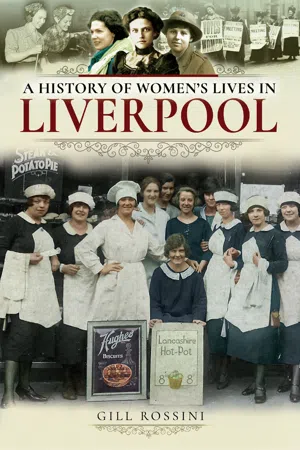
The story of Liverpool's women is one of diversity and contrast. This iconic port has welcomed countless nationalities over the centuries, both as residents and passing migrants; it has experienced both great prosperity, and crushing poverty. Liverpool's women have lived in unhealthy court dwellings, and comfortable suburbs; helped each other, educated each other, and stood together against common adversaries such as poor living conditions, and enemies in wartime; they have lived, loved, worked, fought, laughed, wept, worshiped, and survived in their own unique way. Containing rarely seen illustrations, this book will take you on an adventure through 100 years of Liverpool's history, with a focus on its courageous, hospitable, caring, intelligent and adventurous women. In this honest account, you will meet women from all walks of life, be they politician, home maker, impoverished migrant, the ladies from the 'big house', preacher at a chapel, teacher, prostitute, activist, prisoner, and more. Some of them you may have heard of, such as 'Battling Bessie' Braddock MP, suffragette Jeannie Mole; many are the forgotten women of history you will encounter for the first time. All of them in their own way make up the kaleidoscope of women's history in this great city.
- 208 pages
- English
- ePUB (mobile friendly)
- Available on iOS & Android
eBook - ePub
A History of Women's Lives in Liverpool
About this book
Information
Subtopic
British HistoryIndex
Social SciencesCHAPTER ONE
At Home

Courtship and Marriage
In the nineteenth century, for a woman not to marry was regarded as strange, even freakish, yet early marriage was suggested by the Central Relief Society of Liverpool as a cause of poverty. W. Grisewood, who wrote a milestone series of articles for the Liverpool Mercury in the 1890s, interviewed a teenage couple who had married aged 18 and 17. They came from precarious backgrounds – the husband’s parents were dead, and the wife had to leave home because of an unkind stepmother. Essentially, this young couple only had each other for every kind of support, from emotional to financial. Their furniture comprised a three-legged table, a couple of old chairs, a dirty mattress (but no bedstead or bed clothes) and a few items of crockery. On a weekly basis, the husband was working as a parcel carrier for a few hours, earning up to 10s; his wife was a fish or fruit hawker. Their rent was 7s 6d per week. (Liverpool Mercury, 19 August 1899) Once the first baby came along, followed no doubt by more, their place in the poverty trap would be irretrievable. Working-class people were urged to wait until they were solvent before marrying, but financial security was unattainable for most, and they married anyway, especially if a baby was already on the way.
Decades later, the advantages of later marriage did seem to go hand-in-hand with a better income. The 1934 Social Survey of Merseyside compared two areas with differing socio-economic profiles and studied the age at marriage in them. In Exchange, 40.7 per cent of women aged 20–24 were married, whereas in comfortably off West Derby, only eighteen per cent of women in that age group were married. Even the way in which women met their future husbands was different according to class. Middle class women tended to meet their spouses in private clubs, such as tennis or golf clubs, in a relatively controlled environment where, mixing only with their peers, they were more likely to make a suitable match. Working-class young women in fact had more freedom to mix, and a popular way to circulate in safety, with a large number of young men and women, was ‘The Rack’ – promenading and socialising with one’s friends, and eyeing up the opposite sex. The Rack took place every Sunday morning at Sefton Park, while Queen’s Drive was a somewhat more suburban setting for promenading. On a summer’s morning one could happily sit on the grass with male friends, chat and laugh, while one’s better-off female counterparts would walk past apparently with disdain at the largely innocent but socially infra dig proceedings, perhaps secretly envious at the ease with which these young women could enjoy the company of men. However the match was made, the vast majority of women during this period were married in a place of worship.
‘You’re as black as the cobs of hell!’: Keeping Clean and Tidy, and the ‘Rituals of Respectability’
Before the Liverpudlian housewife did anything for herself, she had a home to clean. Standing outside a terraced house in a street such as those in Anfield or Old Swan (two examples among many), the first thing a visitor would notice would be the well-washed door, and a doorstep buffed to a colour varying from white through to brown using a ‘Donkey Stone’ – a block of compressed stone manufactured for the purpose. ‘Step dashing’ – scrubbing up the doorstep till it was immaculately clean – was also an essential cleaning task, and ground-floor window sills received the same treatment. In the front parlour window would be hanging either summer or winter curtains, and the heavy cotton lace curtain was kept sparkling white with bleach. The front lower-storey bricks were washed to remove the sooty coating from coal fires and pollution, and the pavement was also scrubbed.
Such ‘rituals of respectability’ were not aligned with class or monetary status. They were almost exclusively a marker for, or test of, moral status and hierarchy. The woman with the cleanest step, crispest lace curtains, best scrubbed table, and most spotless laundry in the street, was superior to her neighbours, no matter how poor they were. One woman in her nineties, originally from Birkenhead but who had lived in Liverpool since 1956, told the author: ‘They can take away all your money, you can be as poor as anything, but they can never take away your self-respect’ – this in reference to standards in the home. Even the suffrage movement regularly made references to the ‘respectability’ of their cause, as it was a concept that would be familiar to women from all classes. It was almost exclusively the domain of females to keep this aura of family and home respectability intact, a responsibility that some women would have relished, and others found a suffocating and intolerable burden. Others would have ignored it completely, and struck out to live, work, and love in their own unique way.
The Sunlight Household Hints booklet (see page 4) was issued as a free gift by Lever Brothers, the Wirral company and manufacturers of the Sunlight Soap bars, and offers insights into common household and family care challenges that home makers today could never imagine. Coal fires, especially in a poorly constructed or unswept chimney, deposited a layer of soot over everything, so there are suggestions for cleaning ‘smoke-blackened’ books and whitening discoloured ceilings. If there is a chimney fire, newspaper soaked in water and placed in the grate is the remedy. Cucumber peel can repel cockroach infestations, while cloves deter house flies. A quick way to heat a room is to put several bricks in the oven, leave them till they are hot, and then using a cloth to hold them, place the hot bricks in the parts of the room you want heated – somewhat reminiscent of the later concept of storage heaters. A small piece of soap left in furniture will deter insects. In between wash days, the housewife had to ensure her flat iron did not rust, so she is advised to rub her iron over with warm grease and wrap it in brown paper, while powdered bathbrick rubbed over the flat of the iron would keep it smooth while actually using it on fabrics. Should you be so slovenly as to allow an earthenware teapot to go mouldy inside, use a strong solution of borax to clean it. And so the advice rolls on, through every kind of material, furniture, tableware, metal and leather, and there were no machines or devices to ease the physical drudgery. Clothes were still laundered by hand, furniture vigorously polished, hearths cleaned and belongings mended and cared for. It is little wonder that women expected their eldest daughters to help out at home.

Sunlight Household Hints booklet, published by Wirral company Lever Brothers in c.1900. A promotional give-away, the booklet was crammed with useful tips for all those who had to help keep house and look after a family.
Homemaking work, housework, housewifery – however it is labelled – is unpaid, and always has been. As the Women’s Industrial Council (WIC) wrote in their 1915 report ‘Married Women’s Work’, a case study that included Liverpool women:
woman’s fundamental work – her work as wife and mother, nurse and homemaker – is and always has been, unpaid – in cash. The result is inevitable. In a commercial age work which is unremunerated and a worker who is unpaid are alike of small value and little esteemed … with the consequence that all work done by women and all wage-earning women are paid at a lower rate than would be the case if their work were not cheapened.
(Married Women’s Work, p. 106)
This is the stark reason why no matter how ‘respectable’ a clean home was, as the women themselves would admit, its value was only moral and personal.
Housing
Of the poor housing found across Liverpool, often the worst and least sanitary were court houses. In layout, there would normally be a ‘day room’ on the ground floor, with one bedroom each on the first floor and second floor. The dark, unventilated and flood- prone cellar below the property was used for washing, storage, or rubbish; each of the four spaces may have housed a separate family if the property had been sub-let. Cellar dwellings were some of the very cheapest accommodation and consequently attracted the near-destitute. These courts often lacked adequate daylight, were impossible to keep clean, and lacked privacy, but amazingly, many families lived in them with remarkable stoicism.
In 1878, newly ordained curate Herbert Dale conducted numerous social visits to court dwellings in the North Liverpool parish of St Mathias, and reported on a Mrs MacClelland and her three surviving children, who lived in Court 26, Porter Street (‘first door on the left’). He was moved by her plight:
Her husband and two children died of smallpox. She takes in a little washing, has a small sickly baby. Barbara is in Mr Howells, and the boy in Miss Muller’s school. Clothes are short. But the children seem willing schoolgoers, but depressed and quiet.
A search of the 1871 census reveals the McClelland (note alternative spelling) family in less stressful times. Here, our woman in distress is called Mary, born 1832, and at the time was still married to Patrick, a Scottish mariner. She had five children – Catherine (17), Kenneth (11), Mary (6), Barbara (3), and 8-month-old Roderick. The vast majority of her neighbours are Irish, mostly in family groups, but on Porter Street, there are several lodging houses accommodating Irish dock workers. An overview of the basic family history resources does not reveal a straightforward picture as to what happened to Mary’s family next. Patrick seems to disappear, and there is no death registration for him in England and Wales. Certainly his absence, and the deaths of some of her children, would have worsened Mary’s impoverished circumstances, and although we tend to think Victorians could just brush off child death, it is highly likely that these traumatic events would have added to the low mood witnessed in her surviving children. As we do not know why Patrick departed the family, either through death, work, or desertion, it is impossible to say if the sickly baby is his. Suffice it to say that Mary and her remaining family were struggling to survive with any semblance of good spirits.
Others were quick to condemn the women who ran the homes in question for their state. Hugh Shimmin, a writer of acerbic sketches he claimed were taken from direct observation, was merciless in 1862:
the wife has such a poor perception of her duty that she does not even know how to take care of her home … [she is] given up to filth, and nurses her children in it … the man is driven to drink and he and his wife quarrel – the children are neglected, morally and physically.
Shimmin went on to predict that these neglected children would take the wrong path in life, and end up in court in St George’s Hall, be they male or female, and laid the fault firmly at the feet of their mother, ignoring other social and economic factors.
Although many courts were demolished after the 1846 Sanitary Act, some did continue to be occupied well into the twentieth century, such as those in the area of Scotland Road. As late as 1934, the stigma of living in the courts clung to the remaining residents like the soot and smog they fought against daily; Pat O’Mara wrote, ‘The customary domestic procedure of the courters [people who lived in the courts] was to drink and fight’.
For working-class and poor families, the cramped housing simply was not enough to accommodate them all on an everyday basis, and it makes sense that family life and a neighbourly social life should spill out onto the streets. In 1893, a local newspaper, The Liver, noted that pavements were ‘crowded with the fair sex standing in groups three to a dozen … laughing hilariously as they relate “funny stories”’. This street society also gave women the opportunity to make emotionally deeper connections as they chatted around a doorstep, corner shop, or street barrow, offering friendship and support, and allowed their children to play freely without trashing their meagre homes while under the watchful eye of a streetful of ‘Aunties’.
Despite the mid-century improvements, mortality in Liverpool was one of the highest in England, with a stark difference between inner city and suburb – two-and-a-half times higher in the slums than in the more open spaces further from the centre. Many families still lived in inadequate, cramped and unhealthy accommodation, such as the three-storey back-to-back houses which had been built by speculators on the former gardens of merchant’s houses in Duke Street in the city centre. A true back-to-back shares a rear wall with another house of usually identical or very similar design, and these nine properties were still inhabited as late as the 1970s. Every part of the property was used, including, in the nineteenth century, the dark and damp cellars with their earth flooring, the back cellar room being the most unhealthy of all – as Dr Duncan wrote, it derived ‘its scanty supply of light and air solely from the first apartment [cellar]’.
Liverpool Corporation made great efforts to provide better housing. Attractive terraced houses were built in the Bevington Street area and in Summer Seat (built in c.1911, see page 9) close to Scotland Road. These examples of ‘corpy houses’ were three bedroomed ‘cottages’ with an entrance and small vestibule, a living room, a scullery with sink, washboiler and bath, and a larder. Each house had its own hot-water supply heated by a boiler at the back of an open range in the living room. At the rear was an open yard, with an outside toilet and ashbin. Round the corner was Eldon Place, with its three blocks of corporation tenements constructed the following year. The development had ‘garden city’ touches such as mock Elizabethan details to the exterior, and open spaces with bandstand-like structures to sit in. Prior to this, more tenements had been built in Vauxhall in the 1890s. Victoria Square, as it was known, was regarded as model housing for artisans. The trend continued, and between 1919 and 1931, an impressive seventy per cent of all new property built in Liverpool was built by the corporation.
All in all, by 1900, there were many decent terraced properties in Liverpool, corporation or otherwise, with a front parlour, back kitchen or living room, scullery with tap, and three bedrooms. Simple decorative features such as cornices and ceiling roses added to the feeling of upward mobility, and a bay window in the parlour might house a large potted fern or aspidistra. A home of this size, which might be in a better area such as Everton, would cost 7s 6d per week in rent, and was for skilled workers rather than labourers. Sadly, not everyone appreciated the new housing, or the civic buildings erected in the Victorian era. John Rankin of Liverpool University, complained in 1907 of the ‘miles of dull, monotonous and ugly streets in which not only the poor but the middle classes of the town are condemned to live’ and declared that ‘The building of the period has been … indescribably mean and ugly.’ He also condemned the trend that had developed over the nineteenth century for different social classes to reside more and more in their own districts, which he noted were ‘a physical barrier to the growth of this social spirit’. Presumably, as an academic at the university, and unlike many wives and mothers in Liverpool, he had the luxury of much more superior accommodation to choose from.

Summer Seat, Vauxhall, c.1910. Two well dressed ladies walk down the partially completed street of social housing, designed to offer families safe and hygenic, if still basic, homes in which to enjoy life.
The Suburbs
Life in the pleasant suburbs in the early twentieth century was very different. A typical middle-class house for a professional family in, say, West Derby...
Table of contents
- Cover
- Title
- Copyright
- Dedication
- Contents
- Acknowledgements
- List of Illustrations
- Introduction
- Chapter One At Home
- Chapter Two Health and Welfare
- Chapter Three Toil and Trouble: Women at Work
- Chapter Four ‘Sagging Off with a Sprowser in Me Pocket’: Education
- Chapter Five Mixing With the Woollybacks: Liverpool Women and Leisure
- Chapter Six ‘An Extraordinary Diversity of Races’: Women on the Move
- Chapter Seven ‘We’ll have no wet nellies here!’: Activism and Public Life
- Chapter Eight Postscript: 1945–1950
- Historical Sources
- Bibliography
- Websites
Trusted by 375,005 students
Access to over 1.5 million titles for a fair monthly price.
Study more efficiently using our study tools.
Frequently asked questions
Yes, you can cancel anytime from the Subscription tab in your account settings on the Perlego website. Your subscription will stay active until the end of your current billing period. Learn how to cancel your subscription
No, books cannot be downloaded as external files, such as PDFs, for use outside of Perlego. However, you can download books within the Perlego app for offline reading on mobile or tablet. Learn how to download books offline
Perlego offers two plans: Essential and Complete
- Essential is ideal for learners and professionals who enjoy exploring a wide range of subjects. Access the Essential Library with 800,000+ trusted titles and best-sellers across business, personal growth, and the humanities. Includes unlimited reading time and Standard Read Aloud voice.
- Complete: Perfect for advanced learners and researchers needing full, unrestricted access. Unlock 1.5M+ books across hundreds of subjects, including academic and specialized titles. The Complete Plan also includes advanced features like Premium Read Aloud and Research Assistant.
We are an online textbook subscription service, where you can get access to an entire online library for less than the price of a single book per month. With over 1.5 million books across 990+ topics, we’ve got you covered! Learn about our mission
Look out for the read-aloud symbol on your next book to see if you can listen to it. The read-aloud tool reads text aloud for you, highlighting the text as it is being read. You can pause it, speed it up and slow it down. Learn more about Read Aloud
Yes! You can use the Perlego app on both iOS and Android devices to read anytime, anywhere — even offline. Perfect for commutes or when you’re on the go.
Please note we cannot support devices running on iOS 13 and Android 7 or earlier. Learn more about using the app
Please note we cannot support devices running on iOS 13 and Android 7 or earlier. Learn more about using the app
Yes, you can access A History of Women's Lives in Liverpool by Gill Rossini in PDF and/or ePUB format, as well as other popular books in Social Sciences & British History. We have over 1.5 million books available in our catalogue for you to explore.