Between 58 and 51 BC Julius Caesar conquered Gaul. He campaigned across much of present day France and the Low Countries, crossed the Rhine to Germany, and sailed the Channel to invade Britain. In doing this he achieved immense personal wealth and glory and the loyalty of a battle-hardened army of veterans. Caesar’s eventual return to Rome began with the crossing of the Rubicon which started a bloody civil war from which he emerged victorious and as dictator.
Roman historians have little to say on the consequences of the war on the Iron Age communities of north-west Europe. Their story is told instead by archaeology and numismatics. Huge numbers were involved in the war, at a vast cost in people and wealth. In the aftermath, leaders sympathetic to Rome were installed and sometimes whole peoples were resettled. The diplomatic relations created at this time directly affected the eventual incorporation of these peoples into the Roman Empire.
This book presents the latest archaeological research on the Battle for Gaul and its aftermath. Based on an acclaimed 2017 conference, it is the first Europe-wide overview and much of the research is published here in English for the first time. After an introduction to recent trends in historical studies, thematic studies and regional surveys analyse the archaeological and numismatic evidence from across north-west Europe. Comparative evidence for the Roman conquest of Spain is also examined, along with the fundamental role that the study of the Battle for Gaul played in shaping the development of Iron Age archaeology. Written by leading international experts, this book will be of interest to archaeologists, numismatists, ancient historians and military historians.
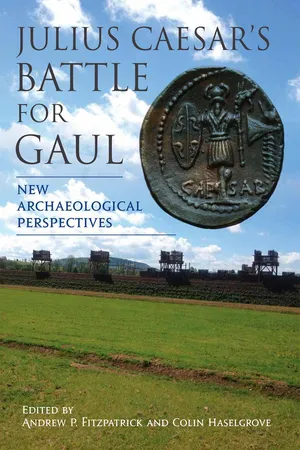
eBook - ePub
Julius Caesar’s Battle for Gaul
New Archaeological Perspectives
- 224 pages
- English
- ePUB (mobile friendly)
- Available on iOS & Android
eBook - ePub
Julius Caesar’s Battle for Gaul
New Archaeological Perspectives
About this book
Information
Topic
HistoriaSubtopic
Historia antigua romanaChapter 1
Scylla, Caesar and Charybdis: (Mis)readings of the Gallic War
‘Vercingetorix’ stands, some 20 feet tall, on top of Mont Auxois near Alise-Sainte-Reine; decked out with a cuirass and a necklace of pearls, and with his hands resting on the pommeled hilt of his hefty sword, he gazes, mournfully perhaps, into the distance. Commissioned by Napoléon III, sculpted by Aimé Millet, and erected in 1865 (Figure 1.1), he commemorates, as the second of two inscriptions specifies, Vercingetorix, Caesar’s main antagonist in the great Gallic uprising of 52 BCE, who lost his final battle defending the oppidum of Alesia on this very hilltop.1 It seems only proper, then, that the Roman leader is present too, inscribed, that is, into the statue’s base; for the upper inscription reads: ‘La Gaule unie, formant une seule nation, animée d’un même esprit, peut défier l’univers.’ It is an adapted excerpt from a speech that Caesar, in his Gallic War, reports of Vercingetorix, who promises ‘to effect one plan for all of Gaul; and not even the whole world can withstand its unanimity’ (unum consilium totius Galliae effecturum, cuius consensui ne orbis quidem terrarum possit obsistere; BG 7.29).
To the keen eye, ‘Vercingetorix’ quickly disintegrates: archaeologists will be quick to point out that his anachronistic accoutrements date from a range of periods other than Vercingetorix’s own, what with his armament from the Bronze Age, and his pantaloons Merovingian; and anyone familiar with Napoléon III will notice the uncanny resemblance (Le Gall 1970, 207–208). ‘Vercingetorix’, it appears, is doubly representative, albeit in starkly uneven measure: he tells today’s observer a great deal about a modern ruler’s infatuation with Caesar and his battle for Gaul, a great deal, too, about ‘the’ Gaul in the artistic imagination of the Second Empire;2 and exceedingly little about his actual referent, Vercingetorix himself. As such, he may well be said to emblematize the mythical transmogrification the Gallic leader has undergone over the last century and a half.3
As the upper inscription neatly intimates, any interest in the Iron Age Gallic man underneath the 19th-century French monument ultimately leads to Caesar’s Gallic War, as, first, it is the only extant contemporary account by an eyewitness (for the most part); second, it is highly uncertain to what – if any – extent later retellings of the campaigns (such as Plutarch’s or Cassius Dio’s) contain anything additional or contradictory to Caesar’s account that is not owed to error, inference, condensation or rhetorical elaboration; and, lastly, even the coins that bear Vercingetorix’s name by themselves tell us next to nothing other than that he seems to have been more important than any other of the five Arvernian leaders Caesar mentions, for whom we lack numismatic evidence.4 ‘Vercingetorix’, in his statued embodiment as well as any other manifestation, owes his existence to Caesar; the ironies multiply.

Figure 1.1 Nineteenth-century statue of Arvernian chieftain Vercingetorix by Aimé Millet, at Mont Auxois, Alise-Sainte-Reine, Côte-d’Or (courtesy Muséoparc Alésia, photo T. Clarté, Balloïde Photo).
What is true of the Gallic leader holds true also – if to a lesser degree – of the battle for Gaul in general; and this is another way in which ‘Vercingetorix’ may serve us as an emblem. For all the clarification and correction that archaeology – the only truly independent (or is it?) alternative source – has brought to our understanding of the Gallic campaigns, it bears recalling what Christian Goudineau stated in the middle of his review of archaeological findings concerning these campaigns some twenty years ago: ‘à supposer que César n’eût pas écrit ses Commentaires et que nul auteur antique ne s’en fut inspiré, la recherche archéologique aurait été incapable d’imaginer qu’il s’était déroulé, entre 58 et 50 av. J.-C, une série d’expéditions militaires sur le territoire gaulois.’5 Let us just think, once more, of the almost two-dozen coins bearing Vercingetorix’s name and how difficult it would be to understand their full significance without Caesar’s narrative. In consequence, for the purposes of this volume (and beyond), a contextual understanding and watchful reading of the Gallic War are imperative.
Caesar’s ‘Notes on events in the Gallic War’, commentarii rerum gestarum belli Gallici, as its original title in all likelihood ran, have traditionally been read – and more often than not from the lectern – with an historical or linguistic interest: time and again, students of history and Latin (were) marched through their pages.6 Caesar’s style seems to encourage both: tendentiously characterized by none other than his political and intellectual rival Cicero as ‘naked … straight and charming, with all embellishment of speech stripped off just like a dress’ (nudi … recti et venusti, omni ornatu orationis tamquam veste detracta, Brutus 262), these ‘Notes’, as highlighted by the deprecatory title, suggest easy access to what happened in Gaul and (the learning of) the Latin language.
But both views require qualification. Cicero, again (Brutus 261), addressing Caesar’s Latin more particularly, comments on how the latter ‘correct[ed] faulty and corrupt usage with his pure and uncorrupted usage (pura et incorrupta consuetudine), aided by theory (rationem adhibens)’; and we now understand much better just how Caesar created his lapidary schoolbook-friendly regular idiom out of the irregular Latin of the time, with a discerning eye on the qualities of the language of the Roman state.7 And just as Caesar shaped his own idiom, so he shaped his narrative, choosing the places, protagonists and occurrences to include as well as the (usually) small amount of detail to provide of them. There are several reasons for the often vague, sometimes misleading presentations of motivations, movements and military engagements. But his contemporaries already felt a certain malaise when reading an account for which one and the same man answered as both protagonist and author; and just so we have come to appreciate rather more fully how the author’s political stake colours his (re) presentation of events and participants in the Gallic War. Caesar writes about ‘Caesar’, ‘Vercingetorix’, and ‘the battle for Gaul’, as it were: Michel Rambaud (1966), who half a century ago looked deeply into Caesar’s art de la déformation historique, overshot, it seemed to most of his critics, when he suggested that the seemingly straightforward war narrative was in fact the product of all-pervasive rhetorical manipulation for political purchase; but it is in no small part Rambaud’s legacy that any responsible reading of the Gallic War today must proceed at equidistance from both a naïve positivism and a radical scepticism.8
Just as political concerns warped the Gallic War, so did literary ones. Mostly forgotten today, to his (near) contemporaries Caesar was known not only as an efficient politician and quick-footed general but also as an eminent man of letters, whose list of accomplishments – in oratory and linguistics, in engineering and geography – was long. When the imperial encyclopaedist Pliny the Elder, a man of formidable learning, pondered Caesar with hindsight, he lamented his battle for Gaul, which ‘I for one should not set down to his glory’; but he praised the man of letters, whose ‘intellectual excellence [was] capable of comprehending everything under the skies’.9 As such Caesar knew that (ancient) histories were treated much the same way we today treat historical fiction: that around a core (often small) of sober historical facts, colourful details, pulled from the rhetorical and literary traditions and the author’s poetic imagination, had to be woven into the text.10 As has become increasingly apparent, the Commentarii, despite their dismissive and disarming title11 and their first impression of simplicity, owe plenty to these traditions. This – more recent – third way of reading, often styled ‘historiographical’, differs from the more traditional historical one in that the former looks for evidence of rhetorical embellishment and borrowings from other Greek and Roman authors (historians amongst them) where the latter (more or less) simply assumes facts. It makes them both more interesting as literary text and more problematic as historical source: is ‘Vercingetorix’ characterized as a ‘young man’ (adulescens, BG 7.4.1), because he was in his 20s when he rose against Caesar; or because other famous enemies of Rome (such as Hannibal) had previously been characterized as young men in Greek and Roman histories (Polybius 3.15.6 ἅτε νέος … ὤν, ‘for he [Hannibal] was young’)? The youthful depictions of ‘Vercingetorix’ on contemporary coins (Figure 1.2) do not, unfortunately, offer any independent corroboration, as they, in turn, adhere to their own conventions (Nieto-Pelletier 2012, 243–245).

Figure 1.2 Gold stater of Vercingetorix from the hoard discovered at Pionsat, Puy-de-Dôme in 1852. Diameter 19mm. Delestrée and Tache (2007) type DT 3601 (© Musée Danicourt, Péronne / Bibracte, photo Antoine Maillier).
Once again, to dismiss all of the detail in the commentarii as ‘commonplace’ would be just as foolish as to accept it all as fact; indeed, it may on occasion be both: when Gergovia, Vercingetorix’s most likely place of birth, is describe...
Table of contents
- Cover
- Title
- Copyright
- Contents
- List of figures and tables
- Ancient sources
- List of contributors
- Introduction
- 1. Scylla, Caesar and Charybdis: (Mis)readings of the Gallic War: Christopher B. Krebs
- 2. The Gallic Wars in Roman history: Greg Woolf
- 3. The Gauls on the eve of the Roman conquest: Ian Ralston
- 4. The Sertorian Wars in the conquest of Hispania: From data to archaeological assessment: Ángel Morillo and Feliciana Sala-Sellés
- 5. 58 BC: The Helvetii, from the Swiss Plateau to Bibracte… and back: Gilbert Kaenel
- 6. Recent archaeological research on Roman military engineering works of the Gallic War: Michel Reddé
- 7. Caesar’s conquest and the archaeology of mass violence in the Germanic frontier zone: Nico Roymans
- 8. Caesar’s landing sites in Britain and Gaul in 55 and 54 BC: Critical places, natural places: Andrew P. Fitzpatrick
- 9. Gauls under siege: Defending against Rome: Sophie Krausz
- 10. Fighting for Caesar: The archaeology and history of Gallic auxiliaries in the 2nd–1st centuries BC: Lionel Pernet
- 11. The Hermeskeil fortress: New light on the Caesarian conquest of eastern Belgic Gaul and its aftermath: Sabine Hornung
- 12. Archaeology of the Roman Civil Wars: The destruction of Puig Ciutat (Catalonia, Spain) and Caesar’s campaign in Ilerda (49 BC): Àngels Pujol, Manuel Fernández-Götz, Roger Sala, Carles Padrós, Eduard Ble, Robert Tamba and Xavier Rubio-Campillo
- 13. The Gallic War in the chronology of Iron Age coinage: Colin Haselgrove
- 14. The island of Jersey: Focus of resistance or field of last resort?: Philip de Jersey
- 15. The second battle of Alesia: The 19th-century investigations at Alise-Sainte-Reine and international recognition of the Gallic period of the late Iron Age: Laurent Olivier
Trusted by 375,005 students
Access to over 1.5 million titles for a fair monthly price.
Study more efficiently using our study tools.
Frequently asked questions
Yes, you can cancel anytime from the Subscription tab in your account settings on the Perlego website. Your subscription will stay active until the end of your current billing period. Learn how to cancel your subscription
No, books cannot be downloaded as external files, such as PDFs, for use outside of Perlego. However, you can download books within the Perlego app for offline reading on mobile or tablet. Learn how to download books offline
Perlego offers two plans: Essential and Complete
- Essential is ideal for learners and professionals who enjoy exploring a wide range of subjects. Access the Essential Library with 800,000+ trusted titles and best-sellers across business, personal growth, and the humanities. Includes unlimited reading time and Standard Read Aloud voice.
- Complete: Perfect for advanced learners and researchers needing full, unrestricted access. Unlock 1.5M+ books across hundreds of subjects, including academic and specialized titles. The Complete Plan also includes advanced features like Premium Read Aloud and Research Assistant.
We are an online textbook subscription service, where you can get access to an entire online library for less than the price of a single book per month. With over 1.5 million books across 990+ topics, we’ve got you covered! Learn about our mission
Look out for the read-aloud symbol on your next book to see if you can listen to it. The read-aloud tool reads text aloud for you, highlighting the text as it is being read. You can pause it, speed it up and slow it down. Learn more about Read Aloud
Yes! You can use the Perlego app on both iOS and Android devices to read anytime, anywhere — even offline. Perfect for commutes or when you’re on the go.
Please note we cannot support devices running on iOS 13 and Android 7 or earlier. Learn more about using the app
Please note we cannot support devices running on iOS 13 and Android 7 or earlier. Learn more about using the app
Yes, you can access Julius Caesar’s Battle for Gaul by Andrew P. Fitzpatrick, Colin Haselgrove, Andrew P. Fitzpatrick,Colin Haselgrove in PDF and/or ePUB format, as well as other popular books in Historia & Historia antigua romana. We have over 1.5 million books available in our catalogue for you to explore.