1
Meet the Man
Clouds of dust rolled across the dirt road, adding to the confusion of a traffic jam. A line of Sherman tanks blocked a military convoy bringing truckloads of American troops to the front in France. The vehicles and equipment looked like they were backed up clear to Texas. This particular crossing was a vital connection that had become a piled-up main road because of the heavy transportation needed to serve the outposts. The bitter wind made for short tempers. The two soldiers watched the traffic jam. Both men shook their heads.
The sergeant turned to me and said, “Corporal Sisson, you know how to make things work. Go out there in the midst of that mess and show them how the Six-Sixty-Seventh Field Artillery Battalion, Third Army, Tenth Armored Division does things.”
“Yes, sir,” I said and trotted out to the center of the snarl just as a tank commander popped up out of the turret to scream at a truck driver.
“Okay, boys!” I yelled like I owned the road. “I’ve been appointed the coordinator of this junction, and I’m telling both of you to move back. We got business with the Germans, and you’re holding up the action. Now, move back now!”
The tank started to rumble backward, and the truck shifted into reverse. Once I got the vehicles rolling, I allowed a truckload of infantry headed for the front line to plow through. The boys waved a friendly salute as the truck turned to the north. Nobody had to tell me that the truck would probably come back empty or with bodies piled in the back.
While I didn’t get there as early as some of the men who landed on Normandy, I knew what we were facing. The generals had nicknamed the breakout from the Normandy beachhead Operation Cobra. Air-support bombing had taken a heavy toll on the Panzer Lehr Division tanks working the area and knocked the Nazis on their butts. The Cobra assault bit the Nazis with a deadly venom.
Hitler’s nefarious battle plan had relied heavily on the Panzer Lehr Division to spearhead shutting down the Allies’ D-Day invasion. A general named Fritz Bayerlein headed the German tank assault and was known for his hard-driving command under General Erwin Rommel. Nobody had to lecture us that we had to stop this son of a bitch from killing our men.
“Come on!” I screamed at a jeep trying to fudge its way ahead of one of our Sherman tanks. “Stop right there!” I rammed my fist at the jeep. “Stay in line.”
The driver halted.
The sergeant joked to me that they might promote me to head traffic cop, but I wasn’t listening. Keeping the company rolling demanded my full attention. I wasn’t trained for any of this troop movement stuff. I had to watch the drivers carefully, or I’d get run over.
The brisk wind blew snow in my face, and the temperature had to be way, way below 32 degrees. I had experienced cold weather back home in Oklahoma, but nothing like this. I thought my nose might fall off. Heavy engines propelled warm steam that helped protect my face, but the putrid smell nearly turned my stomach.
“Okay!” I shouted. “Keep it moving! No slowing down!” Truckloads of soldiers kept rumbling by.
I looked up the road and saw a jeep barreling toward me with flags attached to the fenders. Only one such vehicle was ever dressed out with those kinds of ensigns. This had to be the “big boys.” I threw up my arms to stop all traffic.
As the jeep got closer, I recognized General Dwight D. Eisenhower, the supreme Allied commander of the multinational forces in Europe, coming straight at me. I looked again. With him were General Omar Bradley, and, sure enough, there was General George Patton.
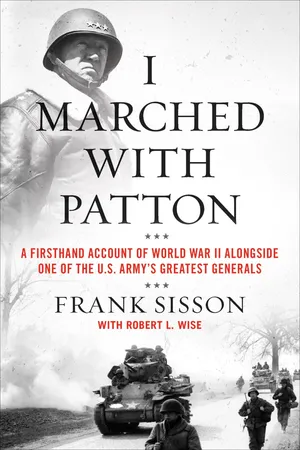
Patton was taller than I expected, six foot two, and both sat and stood with straight posture. As they approached the traffic, the general stood up as if to get a better view of the traffic jam. He had the bearing of an athlete, and wearing that steel helmet over his white hair added to the sense of authority that he bore. Patton’s face carried a stern, no-nonsense look. I could see his eyes surveying the entire scene with an intensity that wouldn’t stand for any monkey business. To say the general was impressive, is to say the least.
With all the propriety they taught me in boot camp, I snapped to attention with the classiest salute I had ever given in my entire life. My backbone stiffened like a cedar board.
The jeep swerved by, with all three generals returning the salute. General Patton looked me straight in the eye, smiling like he appreciated the way I was directing traffic. I stood there in rigid attention until they were long gone down the road. Finally, I relaxed. I couldn’t believe my eyes. I had just ushered along the top brass, and General George Patton had grinned at me. I could see that he approved of what I was doing. His slight smile struck me with an affirmation I’d remember all my life.
By this time, the traffic jam had cleared, and my job directing traffic was virtually over. I started back for the other side of the road when I heard a whistling noise far above my head. My reflexes sent me diving into the bar ditch. An explosion hurled dirt and debris in every direction. Another artillery blast suddenly took out three trees not a hundred feet away. The Nazis must have picked up on General Eisenhower’s trail and started shelling the crossroads with everything they had.
I couldn’t stay in the ditch, or I’d be dead for certain. I looked up and saw our infantry running in every direction. Twenty feet away was a panzer tank that had been knocked out earlier and was sticking halfway out of the ditch on the side of the road. If I could get under that hunk of steel, I might survive. I ran and took a dive.
Another artillery shell exploded in the middle of the field far enough away that I was still safe. I scooted under the panzer. To my surprise, I found another soldier with the same idea lying a few feet away from me.
“You all right?” I asked.
“I think so,” he muttered. “Hell, who can tell?”
I stared. “A-Are you . . . Greg Cain?”
“What?” The soldier rolled over. His jaw dropped. “Frank? Frank Sisson?”
Another explosion shook the ground.
We grabbed each other. I had gone to high school with Greg, in Weleetka, Oklahoma. Now we had been reunited nearly five thousand miles from home. We hugged each other, and tears came to our eyes.
“Out here in this godforsaken French field, we run into each other!” Greg Cain kept shaking his head.
I just couldn’t believe my eyes. What a deal! I had left England on Christmas Day 1944 and crossed the English Channel to land in Saint-Lô, France. Of course, D-Day had already occurred on June 6, when General Omar Bradley’s First Army landed. General Patton had flown into the battle on July 6 in a C-47 transport airplane accompanied by P-47 Thunderbolt fighter planes. He landed on an airstrip close to Omaha Beach. The general wasted no time in moving the Third Army forward and kicking the Germans in the pants. The Nazis still didn’t know he was in front of them and assumed he would show up in the Pas de Calais area of France. By the time I got to Saint-Lô, I was sure the Germans had figured that they’d made a couple of horrendous mistakes, including trying to guess where General Patton was. So, here I was out in the middle of a crossroads, talking to an old buddy from high school while Patton’s Third Army surged forward.
Another thunderous blast rocked the tank, and we hung on for dear life.
“How long you been here, Greg?”
“I came ashore on Omaha Beach on D-Day. Been sluggin’ it out ever since.”
“Got here later than you,” I said. “Just came up from Saint-Lô.”
“Listen,” Greg said. “Sounds like the Germans quit shooting at us.”
We both lay there, listening intently. No sound.
“Yeah,” I said. “Guess they figured they’d done all the damage they could do on this corner. I think we can crawl out.”
We scooted out and looked around. One of the shells had nearly smashed into the crossroads and left a crater that vehicles would have to drive around. The field was probably for milk cows, but the pasture had been fairly well trashed.
“I guess I better get on down the road,” Greg said. “I’ll never forget finding you out here under that tank. God bless you, Frank. God keep you safe.” He started walking back up the road that led to the front. “I’ll never forget you,” he repeated.
“Keep your head down!” I shouted. “Bless you, brother!”
I watched Greg Cain disappear. I never saw him again.
My unit had run for cover when the barrage started. I knew I had to find them before they got too far away. I started walking and thinking. While trying to unravel a traffic jam, I had seen the top command roll by and give me a salute. I had eyeballed General George Patton! And then in the middle of nowhere, I run into an old high school friend. Who would believe it?
I started wondering how I ever got into this war.
2
Ever Hear of Weleetka?
I was fifteen and a half years old and living the good times in Weleetka, Oklahoma. The town always seemed typical of the eastern part of the state, with lots of trees and rolling hills. Of course, Weleetka was a small town of maybe eight hundred to nine hundred people on a good day. The railroad ran through Okfuskee County and kept the town in business. We were just like all those sleepy little towns with a city jail and almost more churches than people.
Like every other kid in town, I lived a carefree life, milking each day for all it was worth. We’d go out to the railroad tracks that wound a hundred or so miles east to Fort Smith, Arkansas, and walk across the thousand-foot-long train trestle, hoping no freights were coming. One day I got halfway across when a big locomotive came steaming toward me from the other end. The best I could do was jump to the side, crawl under, grab a timber, and hang on for dear life until the train went rumbling by. Each day had some sort of adventure—until everything changed one spring afternoon. Stillness had settled over every room. Nothing stirred or moved. Mother stood by the window, looking out and saying nothing. A gnawing hunch that I refused to recognize churned inside me. My father had come down with appendicitis, and they took him to the makeshift hospital over the hill. I knew he was going to be all right, so I hadn’t paid much attention, only going up there to visit him once, because my mother made me.
Mother turned around with tears running down her cheeks. “They waited too long,” she said. “The doctor simply didn’t act fast enough.”
I sank down in a stiff-backed chair. “What do you mean?”
She slowly sat down across from me in the old overstuffed chair that dominated the living room. I could tell she didn’t want to talk about this in front of the other children right then.
My father’s appendix had burst, she explained to me, and peritonitis had set in. The infection spread throughout his body. There was nothing the doctors could do. No one had heard of antibiotics to combat infection at that time. My father had died two hours earlier, she finally said.
I bolted forward in my chair and felt like the room was whirling around me. “God help us.”
I started to cry. For a long time, my mother and I sat there sobbing.
I knew that times were hard. The Great Depression had finally begun to abate somewhat around the country, but not where we lived. No one had any money, and jobs were scarce. Banks were going belly-up every day. My father was a hardworking man out there in the oil field. He was what they called a “pusher”: a foreman of the drilling crew who oversaw various aspects of swinging pipes and cutting below the surface. He went drilling for petroleum every day of the week, but all we could do in this time of depression was survive. Now we were up against the wall. I knew that I was going to have to start making a living if we were to survive.
I suggested my getting a job at McAbee’s Funeral Home, where I...