- English
- ePUB (mobile friendly)
- Available on iOS & Android
eBook - ePub
About this book
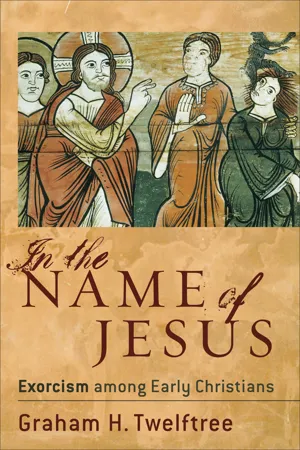
To many in the church in the West, exorcism seems like the stuff of movies. It requires acceptance of the premise that evil spirits exist and can invade, control, and impair the health of an individual and that the individual can, in turn, be cured through someone forcing the evil spirits to leave. "For the vast majority of biblical scholars," asserts Graham H. Twelftree, "this is tantamount to believing in such entities as elves, dragons, or a flat earth." But for Christians throughout the world--especially the developing world--exorcism is an important part of the freedom that can be had through faith. In the Name of Jesus is the only book that explores this common part of ministry in the early church. This reliable and historical discussion provides church leaders, Bible students, pastors, and scholars with an intriguing and unique resource.
Information
1
The Problem of Exorcism
IN RECENT YEARS interest in exorcism in the New Testament has been increasing.[1] However, for most students of the New Testament, there are at least two significant problems in relation to exorcism. The fundamental problem is the premise on which exorcism is based: that malevolent spiritual beings exist and that they can invade, control, and observably impair the health of an individual who, in turn, can be cured through someone purportedly forcing the spiritual beings to leave.[2] For the vast majority of biblical scholars and theologians this is tantamount to belief in such entities as elves, dragons, or a flat earth.[3] Nevertheless, for the historian to deem possession and exorcism in the ancient world a problem of, for example, “crowd psychology” and so place it “off limits”[4] is to miss what was, for most people,[5] including early Christians, a significant aspect of their Weltanschauung.[6] Therefore, despite our difficulty with exorcism, for the sake of historical inquiry, it is important to suspend judgment on the reality of the demonic[7] and approach the subject in terms of the cultural milieu of the text.[8]
1.1 Setting the Scene
Notwithstanding, the issue that has given rise to this study—the second significant problem with exorcism—is the place and practice of exorcism among early Christians. In the modern study of early Christianity the prevailing view has been that exorcism played a significant role in the success of early Christianity. For example, many years ago Adolf von Harnack said, “It was as exorcisers that Christians went out into the great world, and exorcism formed one very powerful method of their mission and propaganda.”[9] More recently, in seeking to explain the extraordinary and unparalleled success of early Christianity, Ramsay MacMullen has maintained not only that miracles were the primary engine for producing conversions in the ancient world, but also that exorcism was “possibly the most highly rated activity of the early Christian church.”[10] Citing Justin, Tertullian, Cyprian, and Eusebius, he concludes that, although the institution of exorcism had taproots in Judaism and was of little account otherwise, “in Christianity it found an extraordinary flowering” and was essential in its growth.[11] Similarly, it has been Bernd Kollmann’s main objective to show that healing miracles, notably exorcism, were critical for early Christians’ success in winning many people to the faith.[12]
Nevertheless, there have been a few voices, such as those of Kenneth Grayston and Ernest Best, suggesting that there was not much interest in exorcism among early Christians.[13] Also, F. Gerald Downing asserted, “Tales of miracles seemed to the evangelists to be worth repeating among the committed; they had little impact outside.”[14] Further, in taking into account the Fourth Gospel, Frederick E. Brenk put it plainly: “The subsequent history of the Church shows a great reluctance to see demons in individuals or to practice exorcism.”[15] Therefore, in light of this range of views, it is reasonable to heed H. K. Nielsen’s call for more light to be shed on this relatively neglected area of research: the role that exorcism played in the early church.[16]
Part of the reason for this difference of opinion on the role of exorcism in the early church could be inherent in the New Testament canon itself. For, in seeking to shed more light on the place and practice of exorcism among early Christians, we are confronted with apparent significant anomalies embedded in the literary legacy of the early church. To begin with, there is a disjunct between the various ways Jesus’ involvement in exorcism is portrayed. On the one hand, even though the Synoptic Gospels are not agreed on the precise place of exorcism in his ministry, they portray Jesus not only as spending a great deal of time performing exorcisms—as well as other healings—but also Matthew and Luke further report that he saw his exorcisms encapsulating his mission as no other aspect of his ministry was able.[17]
On the other hand, when we turn to the letters of Paul, the Christian writings closest in time to Jesus and his first followers, they appear to tell us nothing about Jesus being an exorcist. We are bound, then, to ask both about the accuracy of the Synoptic portrait of Jesus as well as whether Paul’s apparent silence simply has to do with the difference in the two kinds of literature that Paul and the Synoptic Gospel writers were producing, or whether there are some other more fundamental explanations. More puzzling, and the point at which this problem of exorcism is most acute, is this question: Why do we hear nothing whatsoever from the canonical Johannine literature about exorcism or Jesus being an exorcist?
The puzzle of this divergence of perspective on Jesus’ ministry—not to say contradiction—continues to be played out in the different portrayals of what Jesus is said to require of his followers. The Synoptic Gospel writers have Jesus commissioning his followers to be exorcists while the Johannine tradition is completely silent on the matter. Paul, as well, at least on a prima facie reading, also appears to say nothing about exorcism in his own ministry nor among that of his readers. The problem of this diversity is further exacerbated when we take into account that, in telling the story of the first followers of Jesus, the Synoptic Gospel writers, especially Mark, wished to portray the disciples as model exorcists for their readers to follow in ministry.[18] In short, some writers in the New Testament suggest that exorcism is to be part of Christian ministry; others do not. Hence, I have two principal aims in this study. My chief aim is to determine the place as well as to describe the practice of exorcism among early Christians reflected in the New Testament documents. Secondarily, I will attempt to explain the variety of approaches to exorcism in the New Testament canon. Then, acknowledging the narrow basis of this study, I anticipate being able to make some brief comments about the role of the traditions about Jesus in shaping the theology and practice of early Christianity.
1.2 This Study
Solving the problem of the place of exorcism among early Christians is potentially important for a whole cadre of reasons. (1) Being able to describe the place of exorcism among early Christians contributes to our understanding of the nature of early Christianity, including what turns out to be its various understandings of its mission. In turn, (2) a careful study of what was thought and practiced in relation to exorcism among early Christians draws attention to aspects of significant early theological diversity. Further, (3) given the argued place of exorcism in the ministry of Jesus,[19] our project can provide a case study for understanding the various ways early Christians viewed and handled the traditions that had initially developed around Jesus and what part these traditions had in forming early theology and practice. This leads us (4) to inquire in what way, if at all, Jesus functioned—or intended to function—as a model for early Christian ministry, particularly in relation to conducting exorcism. Answering this question will require setting out what models or options were available for those early Christians who were interested in exorcism.
From the work of those who have gone before us, we already have some hypotheses to hand that might explain the interest in and role of exorcism among early Christians. It could be that (1) interest in exorcism, along with miracles in general, diminished over time. In a 1965 essay Maurice Wiles contended that it was not long after the close of the New Testament that the apologetic appeal to outward miracles diminished. This was because, he argued, the early miracles were appropriate to the start of a great spiritual movement, only necessary to give rise to a faith, making further miracles unnecessary.[20] More recently, John Dominic Crossan has said, “Miracles were, at a very early stage, being washed out of the tradition and, when retained, were being very carefully interpreted.”[21] Alternatively, (2) the variation we see in the interest in exorcism in the New Testament may be accounted for in terms of cultural variations across time and place. For example, relying on the work of Eric Sorensen, it may be possible to show that part of an attempt by early Christians to adapt to the cultural sensitivities of a Greco-Roman culture—where exorcism was an unconventional and peripheral occult activity, only “in the eddies of the cultural mainstream”[22]—explains the varying interest in exorcism. Sorensen argues this is particularly noteworthy in the continuation of exorcism in the westward expansion of early Christianity. Or, (3) it could be that the diverse attitudes toward exorcism had theological roots that we might be able to detect and describe through a close examination of the New Testament documents.
Another proposed role for exorcism is (4) its association with baptism, which Elizabeth Ann Leeper argued was a fundamental factor in the development of the church as an institution.[23] In two studies that arose out of her 1991 Duke University PhD dissertation, Leeper examined the role played by exorcism in early Christianity.[24] She says that, for modern historians, exorcism among early Christians is usually taken to be associated “within the context of baptism, where it formed an essential part of the catechumenate and baptismal preparation.”[25] While this link may be obvious later, we need to note how far and in what way this relationship had been established in the first two Christian centuries.
1.3 Scope and Hazards
This is unequivocally a study of New Testament texts, expecting them to yield at least some evidence to help solve the puzzles surrounding exorcism among early Christians. Nevertheless, in order not to torture the texts to say more than the authors intended,[26] we will be looking for assistance beyond the horizons of the canon.
In order to balance the need for the advantage gained from taking into account literature written some distance in time from the material in the canon over against the need to keep manageable the amount of material to be discussed, as well as to remain as close as possible in time and culture to the origins of the New Testament traditions, two limits have been set on the material to be taken into account. First, I have set the terminus ad quem for the scope of this study at 200 CE. This involves leaving aside Tertullian from consideration. Though born well within our period (probably ca. 170 CE), he was not converted until near the end of the century (ca. 195 or 196 CE) and did not begin writing until between then and the turn of the century.[27] Though this is unfortunate, it conveniently confines our study to the period when early Christians remained primarily in a Greek milieu. For Tertullian was the first theologian to write in Latin, the first Western Christian to give us an extended theology, and the writer who “liberated” Christian thought from its Greek origins.[28] Notwithstanding, Tertullian will still be of considerable interest in helping us understand exorcism among the Montanists of the late second century (see §11.8 below).
Secondly, not only in order to keep the amount of material discussed within reasonable bounds, but also because our interest is in what came to be orthodox Christianity, I have taken into account only that which is generally considered orthodox or from mainstream early Christianity. Although our results would be little changed, discussion of second-century gnostic documents will have to wait for a possible future study.
It is anticipated that, looking back as through a lens along the already diverging trajectories of their interpretations, we may be able to detect subtleties in the New Testament texts, as well as discern implications of these writings that would otherwise be imperceptible or appear insignificant to us in viewing the New Testament documents unaided. Or, to change the metaphor, as we survey an increased amount of material over time, we may be able to hear, as through an amplifier, signals that would be too faint for our senses in listening only to signals from the New Testament.[29]
Obviously, in turning to later sources to help interpret New Testament writings, we open ourselves to the potential hazard of using the increased distance in time to give us the illegitimate advantage of historical hindsight.[30] That is, without careful and convincing argument, we might be tempted to fill gaps in our knowledge by using information only known at a later time. In other words, we might read back into the New Testament conclusions drawn from material of a later time regarding practices and theologies relating to exorcism. Rather, resisting these temptations, we can reasonably use reported developments or outcomes, as well as evidence from later times, to help look back with new sensitivity to detect aspects, details, or implications of earlier reports that might otherwise escape our attention.[31]
1.4 Plan of Attack
My p...
Table of contents
- Cover
- Title Page
- Copyright Page
- Dedication
- Contents
- Preface
- Abbreviations
- Part 1: Jesus and the Problem of: Exorcism
- Part 2: The First: Century
- Part 3: The Second: Century
- Part 4: Exorcism among Early: Christians
- Select Bibliography
- Ancient Writings Index
- Name Index
- Subject Index
- Notes
- Back Cover
Trusted by 375,005 students
Access to over 1.5 million titles for a fair monthly price.
Study more efficiently using our study tools.
Frequently asked questions
Yes, you can cancel anytime from the Subscription tab in your account settings on the Perlego website. Your subscription will stay active until the end of your current billing period. Learn how to cancel your subscription
No, books cannot be downloaded as external files, such as PDFs, for use outside of Perlego. However, you can download books within the Perlego app for offline reading on mobile or tablet. Learn how to download books offline
Perlego offers two plans: Essential and Complete
- Essential is ideal for learners and professionals who enjoy exploring a wide range of subjects. Access the Essential Library with 800,000+ trusted titles and best-sellers across business, personal growth, and the humanities. Includes unlimited reading time and Standard Read Aloud voice.
- Complete: Perfect for advanced learners and researchers needing full, unrestricted access. Unlock 1.5M+ books across hundreds of subjects, including academic and specialized titles. The Complete Plan also includes advanced features like Premium Read Aloud and Research Assistant.
We are an online textbook subscription service, where you can get access to an entire online library for less than the price of a single book per month. With over 1.5 million books across 990+ topics, we’ve got you covered! Learn about our mission
Look out for the read-aloud symbol on your next book to see if you can listen to it. The read-aloud tool reads text aloud for you, highlighting the text as it is being read. You can pause it, speed it up and slow it down. Learn more about Read Aloud
Yes! You can use the Perlego app on both iOS and Android devices to read anytime, anywhere — even offline. Perfect for commutes or when you’re on the go.
Please note we cannot support devices running on iOS 13 and Android 7 or earlier. Learn more about using the app
Please note we cannot support devices running on iOS 13 and Android 7 or earlier. Learn more about using the app
Yes, you can access In the Name of Jesus by Graham H. Twelftree in PDF and/or ePUB format, as well as other popular books in Theology & Religion & Biblical Criticism & Interpretation. We have over 1.5 million books available in our catalogue for you to explore.