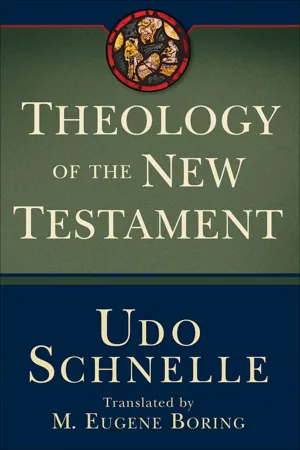
Following his well-received Apostle Paul, prominent European scholar Udo Schnelle now offers a major new theology of the New Testament. The work has been translated into English from the original German, with bibliographic adaptations, by leading American scholar M. Eugene Boring.
This comprehensive critical introduction combines historical and theological analysis. Schnelle begins with the teaching of Jesus and continues with a discussion of the theology of Paul. He then moves on to the Synoptic Gospels; the deutero-Pauline, catholic, and Johannine letters; and Revelation, paying due attention to authorship, chronology, genre, and canonical considerations. This is an essential book for anyone with a scholarly interest in the New Testament.
- 912 pages
- English
- ePUB (mobile friendly)
- Available on iOS & Android
eBook - ePub
Theology of the New Testament
About this book
Information

Approach
Theology of the New Testament as Meaning-Formation
Since a theology of the New Testament must both (1) bring the thought world of the New Testament writings into clear focus and (2) articulate this thought world in the context of a contemporary understanding of reality, it has to work with different temporal planes. Its task is to envision the past in view of the present, to explicate it in such a way that its future relevance can be seen. New Testament theology is thus linked into the question of the lasting significance of past events. So it is always a historical discipline, and as such it must participate in theoretical debates on the nature and extent of historical knowledge. Thus the discipline of New Testament theology is involved from the start in the deliberations of the philosophy of history, how history as past reality is grasped, and which categories play a central role in this process.
People can understand reality only within the human capacity for interpretation, that is, for channeling past events into the worlds of human experience and ascribing significance to them in different ways. These processes are also events of “meaning-formation,” for they always aim at establishing or maintaining a valid orientation to the world and to life. Meaning-formation can entail ascertaining the validity of one’s present orientation, or expanding it, or initiating a new departure. It confers meaning on both past and present. Such constructions provide the sense-making capacity that facilitates the individual’s orientation within the complex framework of life.[1] Meaning is an inherent aspect of human existence as such. It emerges from events, experiences, insights, thought processes, and hermeneutical accomplishments, and it comes together in concepts. These concepts then can provide perspective on the central issues of life, bridging temporal gaps. They can be presented in a narrative mode, and they can generate normative statements and cultural models.[2]
The category meaning[3] is particularly appropriate as a way of connecting the world of the New Testament and that of the present. In every age—including the Greco-Roman era—reality has been perceived through constant processes whereby religious meaning-formation happens in parallel with meaning-formation in other cultural domains: politics, philosophy, art, literature, economics, the natural sciences, and social structures. Human life is always a matter of the realization of meaning, so that the question is not whether human beings undertake meaning-formation but what resources, structure, quality, and argumentative force their efforts exhibit.
For a theology of the New Testament, the concept of meaning is key, for it enables divine and human to unite by encompassing the gift whereby God establishes meaning in Jesus Christ together with the testimony to that gift in the New Testament writings. The New Testament, as the basic documentary archive of Christianity, represents the formation of a meaning-formation or symbolic universe with an extraordinary history of effects. Early Christianity developed in a multicultural milieu with numerous, attractive, and competing religious and philosophical systems.[4] On the foundation of the Jesus-Christ-history, narrated in numerous ways in the New Testament, it succeeded in building, inhabiting, and constantly adding on to a “house of meaning” capable of grounding, establishing, and structuring human life as a whole. This meaning structure, or symbolic universe, obviously had tremendous hermeneutical potential at its disposal, and a theology of the New Testament must aim to ascertain and delineate the basic elements of its hermeneutical potential. The category meaning as the hermeneutical constant thus prevents a narrowing of the focus to issues of historical facts, for what is at stake is how we can appropriate the New Testament traditions historically and make them theologically accessible without violating their religious content and their formative power to generate meaning. The truth claim of these texts is not to be avoided, for “truth” is meaning that makes a binding claim. The goal is not a gutted Christian house, but an appreciation of this house that perceives its architecture, the load-bearing floors and walls, the doors and stairways that create connections between its components, and the windows that make it possible to look outside. At the same time, focusing on the category meaning opens to theology the possibility of entering into critical discourse with other academic disciplines devoted to meaning and truth, and doing so on the basis of its own normative tradition.
1.1 How History Is Made and Written
Jesus of Nazareth is a historical figure, and the New Testament is testimony to his impact on history. When a New Testament theology is written on this basis from a distance of two thousand years, the fundamental problems of historical inquiry and historical knowledge inevitably arise. How was history (Geschichte) made and how does research and writing about history (Historie) take place?[5] What happens when a document from the past that makes a claim on the future is interpreted in the present? How do historical reports and their incorporation into the thought world of the historian/exegete relate to each other?[6]
Interest and Acquisition of Knowledge
From several points of view, the classical ideal of historicism—to present nothing more or less than “what actually happened”[7]—has proven to be an ideological postulate.[8] As the present passes into the past, it irrevocably loses its character as reality. For this reason alone it is not possible to recall the past, in intact form, into the present. The temporal interval signifies a fading away in every regard; it disallows historical knowledge in the sense of a comprehensive restoration of what once happened.[9] All that one can do is to declare in the present one’s own interpretation of the past. The past is available to us exclusively in the mode of the present, and only in interpreted and selected form. What is relevant from the past is not that which is merely past, but that which influences world-formation and world-interpretation in the present.[10] The true temporal plane on which the historian/exegete works is always the present,[11] within which he or she is inextricably intertwined, so that present understanding of past events is always decisively stamped by the historian’s own cultural standards. The historian or exegete’s social setting, traditions, and political and religious values necessarily affect what he or she says in the present about the past.[12] We are all committed to our various intellectual orthodoxies. Even the very preconditions of understanding, especially reason and the particular context in which it operates, are subject to a process of continuing transformation, inasmuch as historical knowledge is conditioned by the aims that direct the quest for knowledge in each period of intellectual history.
The writing of history is thus never an uncontaminated reproduction of “what happened.” Rather, each act of history-writing includes something of its own history—the history, that is, of its writer! Insight into the historicalness of the knowing subject calls for reflection on his or her role in the act of understanding, for the knowing subject does not stand over history but is entirely interwoven within it. It is therefore altogether inappropriate to describe historical understanding in terms of a contrast between “objectivity” and “subjectivity.”[13] The use of such terminology serves rather as a rhetorical strategy of declaring one’s own position as positive and neutral in order to discredit other interpretations as subjective and ideological. The object known cannot be separated from the knowing subject, for the act of knowing also always effects a change in the object that is known. The awareness of reality attained in the act of knowing and the past reality itself do not relate as copy and original.[14] One should thus speak not of the “objectivity” of historical arguments but of their plausibility and fittingness.[15] After all, those reports introduced into historical arguments as “facts” are as a rule themselves already interpretations of past events. Already interpreted as meaningful, they necessarily undergo further meaning-formation in order to continue to be history. The past event itself is not available to us, but only the various understandings of past events mediated to us by various interpreters. Things do not become what they are for us until we ascribe meaning to them. History is not reconstructed, but unavoidably and necessarily constructed. The common perception that things need only be “reported” or “re-constructed” suggests a knowledge of the original events that does not exist in the manner presupposed by this terminology. Nor is history simply identical with the past; rather, it is always only a stance in the present from which one can view the past. Thus within the realm of historical constructions, there are no “facts” in the “objective” sense; interpretations are built on interpretations. Hence the truth of the statement: “Events are not [in themselves] history; they become history.”[16]
Reality as Given
And yet we by no means give up on reference to actual events; rather, we reflect on the conditions under which their reality is perceived. To say that history is constructed does not imply anything arbitrary or self-derived; we proceed according to method and on the basis of data.* We must connect data from the sources in a meaningful framework, necessarily remaining within the academic discourse that makes it possible to receive and discuss the data.[17] Everything we say is always bound up in existing general understandings of time and reality;[18] without these preunderstandings, meaningful construction and communication would not be possible. Every human being is genetically preconstructed and is constantly being coconstructed by sociocultural dynamics. Reflection and construction are always later actions that refer to something already given. Thus self-consciousness is never based on itself but necessarily requires reference to something beyond itself that grounds it and makes it possible. The fact that the question of meaning is even possible, and that history can be seen as meaningful, points to an “unimaginable reality,”[19] preceding all being, that gives it reality. The fundamental principle is that history originates only after the event on which it is based has been discerned as relevant for the present, so that necessarily history cannot have the same claim to reality as the events themselves on which it is based.
*[Schnelle is here opposing Radical Construction, a recent philosophical movement centered at the University of Vienna. The basic tenet of this view, popular among some postmodern authors, is that any kind of knowledge is constructed rather than perceived through senses. Among its leading proponents are Heinz von Foerster and Humberto R. Maturana. Maturana, as the founder of the epistemological theory of autopoiesis, focuses on the central role of the observer in the production of knowledge. For English introductions to the topic cf. Paul Watzlawick, The Invented Reality: How Do We Know What We Believe We Know? Contributions to Constructivism (New York: Norton, 1984), and Lynn Segal, The Dream of Reality: Heinz von Foerster’s Constructivism (2nd ed.; Berlin: Springer, 2001).—MEB]
Language and Reality
In addition to these epistemological insights we now come to reflections on the philosophy of language. History is always mediated to us in linguistic form; history exists only to the extent that it is expressed in language. Historical reports become history only through the semantically organized construction of the historian/exegete. In this process, language not only describes the object of thought accepted as reality but also determines and places its stamp on all perceptions that are organized as history. For human beings, there is no path from language to an independent, extralinguistic reality, for reality is present to us only in and through language. The past event is thus available only as memory, a reality that is mediated and formed by language. Language itself, however, is in turn culturally conditioned and subject to constant social transformation. It is not surprising, then, that historical events are construed and evaluated differently in situations shaped by different cultures and values. Language is much more than a mere reflection of reality, for it regulates and places its own stamp on the appropriation of reality, and thereby also on our pictures of what is real. At the same time, language is not the reality itself, for language too first comes into being in the course of human history, and in the personal history of every human being within the framework of his or her biological and cultural development. This means that in this process it is decisively influenced by the varieties of human cultures and individual lives. This constant process of change to which language is subject can be explained only in relation to the different social contexts by which it is conditioned.[20] This means that the connection between the symbol that signifies and the reality signified must be maintained if one does not want to surrender reality itself.
Facts and Fiction
History is thus always a selective system by means of which interpreters order and interpret not merely the past but especially their own world.[21] The linguistic construction of past events always therefore takes place as a meaning-creating proc...
Table of contents
- Cover
- Title Page
- Copyright Page
- Contents
- Translator’s Preface
- Author’s Preface to the German Edition
- Abbreviations
- 1. Approach: Theology of the New Testament as Meaning-Formation
- 2. Structure: History and Meaning
- 3. Jesus of Nazareth: The Near God
- 4. The First Transformation: The Emergence of Christology
- 5. The Second Transformation: The Early Christian Mission without the Precondition of Circumcision
- 6. Paul: Missionary and Thinker
- 7. The Third Transformation: Composition of Gospels as Innovative Response to Crises
- 8. The Sayings Source, the Synoptic Gospels, and Acts: Meaning through Narration
- 9. The Fourth Transformation: The Gospel in the World
- 10. The Deutero-Pauline Letters: Paul’s Thought Extended
- 11. The Catholic Epistles: Voices in Dangerous Times
- 12. Johannine Theology: Introduction to the Christian Faith
- 13. Revelation: Seeing and Understanding
- Bibliography
- Index of Subjects
- Index of Greek Words and Phrases
- Index of Modern Authors
- Index of Ancient Sources
- Notes
Trusted by 375,005 students
Access to over 1.5 million titles for a fair monthly price.
Study more efficiently using our study tools.
Frequently asked questions
Yes, you can cancel anytime from the Subscription tab in your account settings on the Perlego website. Your subscription will stay active until the end of your current billing period. Learn how to cancel your subscription
No, books cannot be downloaded as external files, such as PDFs, for use outside of Perlego. However, you can download books within the Perlego app for offline reading on mobile or tablet. Learn how to download books offline
Perlego offers two plans: Essential and Complete
- Essential is ideal for learners and professionals who enjoy exploring a wide range of subjects. Access the Essential Library with 800,000+ trusted titles and best-sellers across business, personal growth, and the humanities. Includes unlimited reading time and Standard Read Aloud voice.
- Complete: Perfect for advanced learners and researchers needing full, unrestricted access. Unlock 1.5M+ books across hundreds of subjects, including academic and specialized titles. The Complete Plan also includes advanced features like Premium Read Aloud and Research Assistant.
We are an online textbook subscription service, where you can get access to an entire online library for less than the price of a single book per month. With over 1.5 million books across 990+ topics, we’ve got you covered! Learn about our mission
Look out for the read-aloud symbol on your next book to see if you can listen to it. The read-aloud tool reads text aloud for you, highlighting the text as it is being read. You can pause it, speed it up and slow it down. Learn more about Read Aloud
Yes! You can use the Perlego app on both iOS and Android devices to read anytime, anywhere — even offline. Perfect for commutes or when you’re on the go.
Please note we cannot support devices running on iOS 13 and Android 7 or earlier. Learn more about using the app
Please note we cannot support devices running on iOS 13 and Android 7 or earlier. Learn more about using the app
Yes, you can access Theology of the New Testament by Udo Schnelle, Boring, M. Eugene, M. Eugene Boring in PDF and/or ePUB format, as well as other popular books in Theology & Religion & Biblical Criticism & Interpretation. We have over 1.5 million books available in our catalogue for you to explore.