eBook - ePub
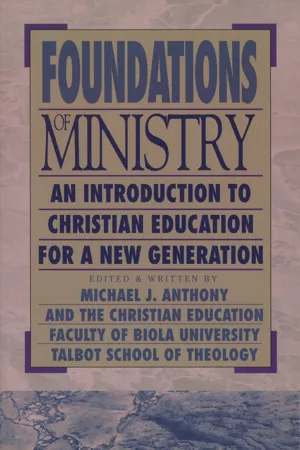
Foundations of Ministry
An Introduction to Christian Education for a New Generation
- 400 pages
- English
- ePUB (mobile friendly)
- Available on iOS & Android
eBook - ePub
Foundations of Ministry
An Introduction to Christian Education for a New Generation
About this book
Develop an excellent Christian education ministry with this introductory guide from the faculty of Biola University's Talbot School of Theology.
Information
Topic
Theology & ReligionSubtopic
ReligionFoundations of Christian Education Ministry
One
Putting Ministry in Perspective
Ministry: How would you define it? It means different things to different people and thus there are as many definitions as there are varied ministries. If you became a Christian at an early age and began attending a small rural church your concept of ministry will be strongly shaped by that experience. But perhaps you came to Christ in your adolescent years as a result of a parachurch organization’s outreach effort. Your first ministry experience probably took place in the context of a home Bible study taught by a parachurch leader. These two examples illustrate some of the many differences that exist in ministry. It isn’t that one is right and the other is wrong. They simply represent different elements of a very broad spectrum of ministry experience that believers share.
Many people come to faith through the efforts of the local church and for this reason have a church perspective on how ministry is conducted. However, even in this there are vast differences in ministry due to the differences that exist in church size, denominational affiliation, church traditions, and pastoral leadership styles. Each of these elements will influence how things are done in the name of ministry. Traditions, old and new, greatly influence ministry perspectives.
There are other believers who came to Christ through the efforts of a missionary sharing Christ on the foreign field. These believers view the way ministry is done in their homeland as an indication of how ministry should be done around the world as well. When these believers travel to others parts of the world and see the differences in ministry perspectives they ask the simple question: What is ministry? The answer, however, is not as simple for there are many common misconceptions about ministry evident in our churches today.
Misconceptions of Ministry
Before attempting to answer the above question we would do well to first identify what ministry is not. Knowing this will help us dispel some of these common misconceptions of ministry and allow us to determine just what it truly is.
1) Ministry is not a social agency. Many churches are involved in activities which contribute to our society’s needy, (such as ministries for the homeless, unwed mothers, and various recovery groups). Their involvement in such programs fulfill the biblical mandate of clothing the needy, feeding the hungry, and visiting prisoners, widows, and orphans (James 1:27; Matt. 25:35-36). The difficulty comes when these programs take on such a significant role that the church ceases to fulfill its primary role of evangelism of the lost and edification of the body. There are a number of distinctive biblical functions, which will be covered in subsequent chapters, which only the church can accomplish. The issue here is balance. When the church ceases to function as a church, then the social programs have blurred its vision to be far more than just a social agency.
2) The church is not an educational institution. This is a common misconception among many new Christian college students. They come to campus and enjoy Bible classes taught by knowledgeable professors; they experience dynamic speakers in their daily chapel hour. The temptation to allow their school experience to double for their church involvement is obvious. However, the church, as Christ intended, is to be far more than a Bible college experience. There are many components of the New Testament church which the Christian college is not able to replicate. We should therefore not see it as a substitute for church ministry.
3) The church is not a program. Many churches have numerous programs designed to minister to the needs of their community (AWANA, VBS, youth groups). Some pastors today measure the effectiveness of their ministry based on how many people they can involve in their church’s programs. If not careful, the pastor will fall prey to the temptation of promoting programs instead of Christ and thus lead the congregation into the false assumption that ministry is simply a matter of implementing a new program every few months. But real ministry is more than a program.
4) Ministry is not a building. It is easy for young believers to equate the church ministry with a building. They say to their friends, “I’ll meet you at the church after school.” Such a statement promotes a common misconception among many Christians that limits their church ministry to a building. The church, as it is described in the New Testament, is not limited to a geographical location or building. The New Testament church is comprised of believers in Christ who choose to associate together. They remain the church whether they meet in a building, a park, or at the side of a lake. A building is not a necessary requirement for a church ministry to fulfill the Great Commission. Buildings can contribute a great deal toward the effectiveness of ministry in a local community. The danger comes when one equates the building with the ministry of the church.
5) The church is not an organization. This last misconception of ministry is also common among believers. This is a popular misconception among Christians who attend large churches. The extent to which many of these large churches are organized is very impressive. Christ has called us to be good stewards of our resources, and there is nothing wrong with sound principles of church administration. The danger comes when believers view church ministry as being the same in scope and content as an organization. They see that both have board members, budgets, staff members, employment policies, job descriptions, organizational charts, goals and objectives, etc. If not careful, the business procedures of the church can so overwhelm believers that they view the church as nothing more than an organization with a Christian emphasis. But the church is not an organization. According to Scripture, the church is an organism. It is the body of Christ incarnate in the world today.
The Early History of Ministry
Theologically speaking, the church began in the mind of God. The Bible teaches that before sin entered the world, God had already planned the course of redemption for mankind (Eph. 3:9-11; 1 Peter 1:20). God had planned that Christ would have to be born a man, incarnate for the purpose of redemption. He was to be the Lamb chosen by God to remove the sin of the world (John 1:29) and make fellowship with an eternal Father possible. God had ordained that Christ would be offered up as an atonement for humankind through His death on the cross (Rom. 3:35; Heb. 2:17).
Historically speaking, the church began at Pentecost. The feast of Pentecost was a Jewish harvest festival which took place fifty days after Passover. The people came to Jerusalem after they had brought in their crops and were in a mood to celebrate their bountiful harvest. It was also a time for them to reflect upon their religious origins and thank God for giving them the Law on Mt. Sinai. It was in this context that the book of Acts records the birth of the church: “And when the day of Pentecost had come, they were all together in one place. And suddenly there came from heaven a noise like a violent, rushing wind, and it filled the whole house where they were sitting. And there appeared to them tongues as of fire distributing themselves, and they rested on each of them. And they were all filled with the Holy Spirit and began to speak with other tongues, as the Spirit was giving them utterance” (Acts 2:1-4).
Merchants, from around the world, who were in Jerusalem for the festival began to stare in amazement as they observed this phenomenon taking place. Peter stood up in the midst of this assembly and began to preach a sermon which resulted in the salvation of approximately 3,000 people. The church was born. Its first membership consisted of more than 3,120 people (cf. Acts 1:15, 2:41).
Characteristics of the Jerusalem Church
Most of these new believers were from Jerusalem and had grown up as devout members of the Jewish faith. They had a strong affinity for the Old Testament, and it was only natural that their new Christian form of worship reflected elements of their Jewish upbringing. The first church, located in Jerusalem, maintained its Jewish cultural and religious heritage. They continued to honor the Sabbath Day as holy (Acts 17:2), went to the temple for regular periods of prayer and worship (Acts 3:1ff.), kept the Jewish dietary laws (Acts 10:14), read from the Jewish sacred Scriptures (Acts 2:42-43), and continued the practice of circumcision (Acts 15:1).
In addition to these practices, which were heavily influenced by their Jewish ancestry, they also began to meet on the first day of the week to commemorate the resurrection of Jesus Christ. They met regularly together in homes to enjoy fellowship meals (Acts 2:42-43) and ended each of these meetings with the celebration of the Lord’s Supper, in remembrance of His death and eventual return (1 Cor. 11:17-34).
Characteristics of the Church in Antioch
Shortly after the birth of the church in Jerusalem the Jewish city leaders began efforts to extinguish this new cult from their city. They prohibited Christians from buying and selling in the city. In addition, they appointed leaders from among themselves to seek out these Jewish defectors and persecute them. This persecution was successful to some degree for the Bible tells us that many believers left Jerusalem for other parts of the world, taking the Gospel with them.
One of these new places was Antioch, a northern city in the middle of a strategic location for commerce and trade. Over several years believers settled in Antioch and established pockets of home fellowships where the Gospel was preached and where the Word of God was taught on a regular basis (Acts 11:19-20). The church in Antioch developed a reputation for rapid growth and became known to the Jerusalem church (Acts 11:21-22). In an effort to guarantee that the Gospel in Antioch was being preached according to the truth, the church leaders in Jerusalem wanted to send some of their members to ascertain the legitimacy of this northern church.
A church leader by the name of Barnabas was selected for this important assignment (Acts 11:22). During the period of time that this northern church was being established, Saul, a member of the ruling council of the Sanhedrin in Jerusalem, had come to faith in Christ. Unsure of his motive for becoming a Christian, the Jerusalem church was wary of accepting him so they sent him to Antioch with Barnabas. It was in this location, for at least a year, that Barnabas discipled Saul into a strong Christian believer (Acts 11:25-26). This man, now with his name changed to Paul, would become one of the leading authors of the New Testament.
The church in Antioch was significantly different from the church in Jerusalem. Their ministry reflected its cultural and geographical context. Made up of Grecian Jews, this church had a cosmopolitan composition. Christians in this church had a diverse background. A few were Greeks who had subsequently become Jews. Having heard the message of the coming of the Jewish Messiah, they converted to Christianity. Many members of this church came to Christ directly from a Greek or Roman background. The cultural and religious heritage of these Greeks and Romans would give this church a significantly different appearance from the church in Jerusalem.
These Antioch believers had a different concept of ministry due to their diverse heritage. They did not see the need to keep the Jewish Sabbath since many of them had never kept it before. They saw no need to maintain the Jewish dietary lifestyle, visit the Temple in Jerusalem, or become circumcised. To them, these were remnants of a Jewish faith which had never been their own. Their ministry reflected their social, geographical, and cultural backgrounds. They were distinct from their Jerusalem brothers and sisters in Christ in many respects. It was in Antioch that believers were first called Christians (Acts 11:26), where a relief effort was first organized to help another church (Acts 11:29-30), and from where the first missionaries were sent out (Acts 13:2-3).
Principles of New Testament Ministry
Scripture provides us with a number of important ministry principles which can be drawn by watching these two churches in action. Observing the differences between them helps us understand the nature of how ministry should be structured in our churches today.
1) There are no prescribed patterns of worship for the church. The early church chose to conduct its worship services in different ways. We are never told that the pattern of worship in the Jerusalem church was duplicated in the church in Antioch, Ephesus, Corinth, or any other group of that day. Each church was allowed the freedom to structure their worship service according to the various social, cultural, and geographical influences in their fellowship.
2) Some program elements in the early church are noticeably absent from church ministry today. The early church did not have Sunday Schools. They did not have youth groups or church choirs. Parachurch ministries were non-existent as well. Each of these program elements, and countless more, have come as a result of differing church contexts. Ministry should not be duplicated in the same way in all churches. Each congregation should take into consideration what their local needs are and not feel compelled to replicate the ministry practices of another church.
3) Ministry should always be based upon the needs of the people. Perhaps one of the most important skills a pastor will ever learn in seminary is the ability to determine the needs of his or her congregation. The churches ...
Table of contents
- Cover
- Title
- Copyright Page
- Dedication
- Contents
- Introduction
- Part One. Foundations of Christian Education Ministry
- Part Two. Christian Education Ministries Across the Lifespan
- Part Three. Organiiation and Administration of Christian Education
- Part Four. Specialized Educational Ministries
- Author Biographies
- Notes
- Back Cover
Trusted by 375,005 students
Access to over 1.5 million titles for a fair monthly price.
Study more efficiently using our study tools.
Frequently asked questions
Yes, you can cancel anytime from the Subscription tab in your account settings on the Perlego website. Your subscription will stay active until the end of your current billing period. Learn how to cancel your subscription
No, books cannot be downloaded as external files, such as PDFs, for use outside of Perlego. However, you can download books within the Perlego app for offline reading on mobile or tablet. Learn how to download books offline
Perlego offers two plans: Essential and Complete
- Essential is ideal for learners and professionals who enjoy exploring a wide range of subjects. Access the Essential Library with 800,000+ trusted titles and best-sellers across business, personal growth, and the humanities. Includes unlimited reading time and Standard Read Aloud voice.
- Complete: Perfect for advanced learners and researchers needing full, unrestricted access. Unlock 1.5M+ books across hundreds of subjects, including academic and specialized titles. The Complete Plan also includes advanced features like Premium Read Aloud and Research Assistant.
We are an online textbook subscription service, where you can get access to an entire online library for less than the price of a single book per month. With over 1.5 million books across 990+ topics, we’ve got you covered! Learn about our mission
Look out for the read-aloud symbol on your next book to see if you can listen to it. The read-aloud tool reads text aloud for you, highlighting the text as it is being read. You can pause it, speed it up and slow it down. Learn more about Read Aloud
Yes! You can use the Perlego app on both iOS and Android devices to read anytime, anywhere — even offline. Perfect for commutes or when you’re on the go.
Please note we cannot support devices running on iOS 13 and Android 7 or earlier. Learn more about using the app
Please note we cannot support devices running on iOS 13 and Android 7 or earlier. Learn more about using the app
Yes, you can access Foundations of Ministry by Anthony, Michael J., Michael J. Anthony in PDF and/or ePUB format, as well as other popular books in Theology & Religion & Religion. We have over 1.5 million books available in our catalogue for you to explore.