Bestselling Authors Tackle Difficult Issues for Believers and Doubters
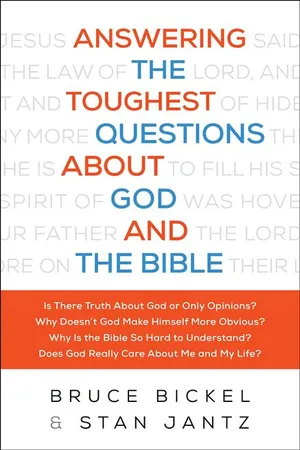
When it comes to the big questions about God--Is he real? Why are Christians so unlike Jesus? Does he really care about me?--Bruce Bickel and Stan Jantz don't pretend to have all the answers. But they do know how to wrestle with doubt. They welcome questions, and in these pages they ask some of the most important ones you have about God and the Bible. With candor, insight, and a disarming touch of humor, they provide some answers to these critical questions, yet they leave enough space--and grace--for you to keep wrestling, asking, and seeking Truth.
There is no shame in asking--after all, even some of the greatest men and women in the Bible had doubts. Don't let your questions go unanswered. What you find might just change your life.
- 208 pages
- English
- ePUB (mobile friendly)
- Available on iOS & Android
eBook - ePub
Answering the Toughest Questions About God and the Bible
About this book
Information
Topic
Theology & ReligionSubtopic
Christian Theology1
Is God Real, and How Can You Know?
Introduction
Every book needs inspiration. It can come from the author’s personal experience, or it can be something external, like an event, an article, or even a headline. For us, it was a headline from a letter that drew us in: “Confessions of an Ex-Evangelical, Pro-SSM Millennial.”
As we read the letter, posted by a popular blogger who left the letter writer anonymous, we were inspired to write our book in a certain way. The letter, written by a twenty-four-year-old who grew up in an evangelical church—and eventually left the faith of his childhood after his views on gay rights changed—did more than inspire us. It helped shape the tone of this book. Here’s the part of this young adult’s letter that got to us:
My leaving was much more about what the gay rights issues revealed about that faith than it was about the actual issue of gays and their right to marry. . . .
We were taught that our church not only had the absolute truth, but that there was no earthly history between the Bible and the doctrines being presented to us. . . . I cannot for the life of me remember once when the name of a theologian was mentioned. There was one interpretation of scripture, and it was absolutely true. . . .
The problem these churches inevitably run into with their young members and same sex marriage is on the issue of doubt. When you have a feelings based salvation in a faith in which doubt is a sign of spiritual failure, the young members of these churches lack the space to wrestle with a tough issue like this.1
The last twelve words of the letter were the most powerful and convicting of all. We realize not all churches fall into the category described by this young adult, but arguably it characterizes many churches. And it’s not just “young members” who are discouraged by the lack of space to wrestle with doubt. We suspect most churchgoers are dismayed by this reality.
We don’t pretend to have all the answers, and we are certainly not a church, but we are prepared to provide a space to wrestle with doubt. We realize there are limitations. We can’t actually talk to you, but we have heard you (or at least people like you), and we have done our best to ask some of the questions you are asking about God and the Bible. And while we have provided some answers to these important questions, we hope we leave enough space for you to wrestle and to keep asking.

Is God real? And how can you know? Nothing like starting with the most important questions anyone can ask, right? And since they are almost impossible to answer with absolute certainty, let’s just call it a day and move on to the next question.
Just kidding.
Let’s camp on these two questions for a while. After all, they are questions you will come back to again . . . and again . . . and again . . . until you are satisfied you have an answer. And though God is not a simple, measurable, physical object that can be contained and tested (he is God, for crying out loud), there are no greater questions to wrestle with.
Certainty, Doubt, and Belief
We’ve become so accustomed to analyzing God, trying to figure him out, and coming to conclusions about him that we’ve pretty much lost perspective on a Being who
- created the universe out of nothing;
- knows everything that’s going on in the universe he made; and
- knows everything about you, including how many hairs you have on your head. (We’re not making that up—it really does say that in the Bible.)
With all that in mind (and that’s just scratching the surface), do we really think we can quantify God, put borders around him, and come up with a “final answer” about his existence? Not really. Of course, you can conclude that he doesn’t exist. But arriving at that conclusion is no picnic, either. Not believing in God is subject to the same kinds of limitations as believing in God.
The Problem With Certainty
The thing is, a lot of people throughout history have tried to button down an answer to the question of whether God does or doesn’t exist. Until a few years ago, those who believed in God didn’t have to back up their belief because nobody challenged the idea that God is real.
It used to be that belief in God was accepted without question. The only people who challenged the reality of God were obnoxious atheists or existential European philosophers. Few people wanted to be associated with either group, so belief in God was the default position for just about everyone.
Then things changed. Interesting and intelligent atheists began to openly challenge the notion that there is a God, which forced thinking Christians to view their faith as more than the summary of their emotions and heritage. In our view, this has been a positive and much-needed development. What good is having a belief if you don’t know why you believe it or, more importantly, why it matters? But that’s what happens when no one challenges what you believe. You get complacent. You get soft. There’s no passion. There’s no meaning.
A New Kind of Atheism
What changed was a new kind of atheism. Instead of obnoxious people saying, “God is dead,” you had intelligent, articulate, normal people saying, “God isn’t real.” And they made a compelling case, usually from the perspective of science, but sometimes for no other reason than they felt betrayed and deceived by the church they grew up in (like the Ex-Evangelical, Pro-SSM Millennial).
These “new atheists,” brimming with confidence as their numbers grew and public opinion started turning their way, began putting people of faith into a “special” category. They started treating Christians like children. Oh, they had their rational arguments against God’s existence, but the most damaging approach had nothing to do with reason and more to do with labeling people of faith as emotional, less intelligent, and naïve.
Now, in defense of people who don’t believe in God, not all of them take such a dim view of people who believe. And there was a time when people of faith put the same kind of label on atheists. But now the tables have turned. People who don’t believe are on the offensive, and those who believe in God have been forced to get defensive.
Apologetics Fires Back
As you might expect, some Christians were not about to take this challenge from the new atheists without a fight. So along came the modern apologetics movement, which is basically about defending your faith. (Just to clarify, people who study and use apologetics aren’t apologizing for what they believe. They are simply giving answers for the common questions about the reality of God.)
Apologetics as a tool can be useful, and the field certainly attracts its share of people who want buttoned-down answers to perplexing questions. The problem is that, for the most part, studying apologetics gives you the ability to answer the questions people are asking about God and the Christian story, rather than teaching you to actually listen to the people who are asking the questions. We can’t speak for all Christian apologists, but you get the impression that this approach is based on trying to prove God exists so that reasonable people will see the light, believe in God, and soon become Christians.
Despite the fine work being done in the field of Christian apologetics, you have to wonder how effective it has been. Based on the evidence of changed lives, there doesn’t appear to be a huge number of new converts flooding churches because suddenly there are a whole bunch of answers to questions about God. In fact, just the opposite is true. Overall, church attendance is declining as more and more people look for answers and meaning outside the church, mainly because most churches have not provided a place for people to wrestle with the toughest questions about God and the Bible.
Somewhere in the Middle
While it may seem as though people who have left the church are skeptics, we haven’t found that to be the case. In our experience, these “leavers” are somewhere in the middle, between unbelief and belief, between outright skepticism and absolute certainty. They haven’t arrived at a place where they believe the Christian story, but neither have they embraced unbelief. They’re in the middle. They have thought enough about this whole God thing to realize two very important principles:
- No amount of evidence can prove beyond a shadow of a doubt that God exists.
- No amount of evidence can prove beyond a shadow of a doubt that God doesn’t exist.
The way we see it, all of us, even those of us who haven’t left the church, are somewhere on a continuum between outright skepticism and absolute certainty. We call this the Doubt Continuum.
Interpreting the Doubt Continuum
We’re not social scientists (like that wasn’t obvious), but we are fascinated by human nature and belief. Plus we have a secret weapon—a young pastor and young adult leader (that would be Chris) who has been researching the questions people are asking. We think our Doubt Continuum accurately reflects the range in which most people find themselves when it comes to doubt and belief.

The shape of the Doubt Continuum illustrates that the vast majority of people are bunched on either side of the dotted line that represents the act of trusting God by faith. Some would call this line conversion. Others would be comfortable labeling it accepting Jesus into your heart. Let’s just say this line is a time—although it doesn’t have to be a precise moment in time (that’s why it’s a dotted line)—when a person makes a decision to surrender to God and accept the path to salvation. Essentially, this means believing by faith that we can have a relationship with God if we accept his rescue plan to save us through Jesus.
Table of contents
- Cover
- Title Page
- Copyright Page
- Contents
- Acknowledgments
- Introduction
- 1. Is God Real, and How Can You Know?
- 2. Why Did God Create Us?
- 3. Why Doesn’t God Make Himself More Obvious?
- 4. Can I Trust What the Bible Says About God?
- 5. If the Bible Is So Important, Why Is It So Hard to Understand?
- 6. Why Does God Seem So Violent While Jesus Is So Loving?
- 7. Is Jesus God?
- 8. Why Do Christians Say Jesus Is the Only Way to God?
- 9. One God, Three Persons? Seriously?
- 10. Does God Really Care About Me and My Life?
- Notes
- About the Authors
- Back Cover
Trusted by 375,005 students
Access to over 1.5 million titles for a fair monthly price.
Study more efficiently using our study tools.
Frequently asked questions
Yes, you can cancel anytime from the Subscription tab in your account settings on the Perlego website. Your subscription will stay active until the end of your current billing period. Learn how to cancel your subscription
No, books cannot be downloaded as external files, such as PDFs, for use outside of Perlego. However, you can download books within the Perlego app for offline reading on mobile or tablet. Learn how to download books offline
Perlego offers two plans: Essential and Complete
- Essential is ideal for learners and professionals who enjoy exploring a wide range of subjects. Access the Essential Library with 800,000+ trusted titles and best-sellers across business, personal growth, and the humanities. Includes unlimited reading time and Standard Read Aloud voice.
- Complete: Perfect for advanced learners and researchers needing full, unrestricted access. Unlock 1.5M+ books across hundreds of subjects, including academic and specialized titles. The Complete Plan also includes advanced features like Premium Read Aloud and Research Assistant.
We are an online textbook subscription service, where you can get access to an entire online library for less than the price of a single book per month. With over 1.5 million books across 990+ topics, we’ve got you covered! Learn about our mission
Look out for the read-aloud symbol on your next book to see if you can listen to it. The read-aloud tool reads text aloud for you, highlighting the text as it is being read. You can pause it, speed it up and slow it down. Learn more about Read Aloud
Yes! You can use the Perlego app on both iOS and Android devices to read anytime, anywhere — even offline. Perfect for commutes or when you’re on the go.
Please note we cannot support devices running on iOS 13 and Android 7 or earlier. Learn more about using the app
Please note we cannot support devices running on iOS 13 and Android 7 or earlier. Learn more about using the app
Yes, you can access Answering the Toughest Questions About God and the Bible by Bruce Bickel,Stan Jantz in PDF and/or ePUB format, as well as other popular books in Theology & Religion & Christian Theology. We have over 1.5 million books available in our catalogue for you to explore.