What Life as a Christian Really Looks Like
New believers need to know what to expect. While many books cover the nuts and bolts of new faith--how to read the Bible, how to pray, how to find a church--in this book, Alex Early focuses on issues of the heart. What are Christians supposed to feel? What happens when they sin? What does God want from them? Designed to challenge and reassure, this book gives a realistic depiction of the Christian life, and includes such topics as how to rest in God's love, what forgiveness looks like when you blow it, what it means to find your identity in Christ, and how to pray with honesty and transparency.
God isn't surprised when we struggle, and although being in a relationship with God is amazing, he never promised that this life would be easy. He can handle "real" people, and he pours out his reckless love regardless of what we do or think on any given day. We all need to be reminded of this, but especially those new to the faith.
This book is ideal for new believers, but seasoned Christians should also have copies on hand to give away. Includes end-of-chapter questions and a "Christianese to English" glossary.
eBook - ePub
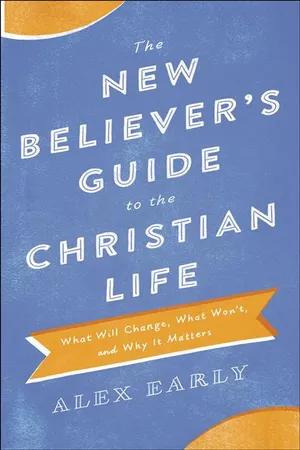
The New Believer's Guide to the Christian Life
What Will Change, What Won't, and Why It Matters
- 176 pages
- English
- ePUB (mobile friendly)
- Available on iOS & Android
eBook - ePub
The New Believer's Guide to the Christian Life
What Will Change, What Won't, and Why It Matters
About this book
Information
Topic
Theology & ReligionSubtopic
Religion1
We Work Not Our Identity
Modern people have things completely back to front: Professing to be unsure of God, they pretend to be sure of themselves. Followers of Christ put things the other way around: Unsure of ourselves, we are sure of God.
—Os Guinness, The Call
The entire message of the Bible is one of grace, hope, forgiveness, and love—all unearned, ill-deserved, and completely without condition! The love of God is reckless, pervasive, and unstoppable. The love of God knows no limits or boundaries! Thus far, though billions have tried, none have been able to stop the work of God.
The love of God is not reserved for only the rich or only the poor. It is not only for straight people, Republicans, or humanitarians. The love of God cannot be confined within the walls of a local church building. The love of God is not rhetoric or wishful thinking. It cannot be shrunk down to a coffee cup or bumper sticker or cliché. The love of God does not fall asleep at the wheel, but is always alive, brilliant, and blazing! God’s love is not just for the world out there, not just for the church down the street, not just for the pastor or missionary, but for you in that chair right there, right now, with all your past mistakes, all your present skepticism, and all the stubborn “so what’s?” and “prove it to me’s” that may be going on in your head right now. Yes, it is for you.
In fact, being a new Christian, you’ve come to terms with or are at least beginning to come to terms with the fact that God hasn’t insisted on your getting better or trying harder in order to get into his family. If you come with empty hands, you come with all you need. God’s love isn’t fickle, moody, or affordable. It is something that must be given to you, and the only thing more offensive to God than your sin is your feeble attempt to earn his loving affection. It is free. God is for us.
Questions Arise
Now, with all of this grace talk, questions start to arise . . . don’t they? For example, you might be thinking, Alex, you’re saying God loves me on my worst day. So . . . is sin okay? Or does sin not bother God anymore once we’re in Christ?
Those are legitimate questions in light of such scandalous grace. Paul asks, “What shall we say then? Are we to continue in sin that grace may abound?” (Romans 6:1). The reasoning goes, “If I sin a lot and I get more grace, then shouldn’t I just keep sinning so that I can get more grace?” That is certainly not at all what the Bible teaches. Paul responds to his own question by saying, “By no means!” (v. 2).
Live at the Foot of the Cross
You see, this way of thinking, and living, is not just sloppy theology and discipleship. It is complete rebellion against God! If you find yourself facing temptation to sin, and you flippantly say, “So what? Grace will cover this” or “I can just charge this sin to Jesus’ account,” you should have no confidence that you have actually experienced the grace of God in the first place. Grace changes our appetites. What we used to love, we no longer crave. The things we used to despise, we now desire. Our diet changes because our appetite changes. As a true Christian, we should actually long for God, his will, his Word, his work in our lives, and not our own.
This is why we must live our lives at the foot of the cross. By this, I mean that we meditate on the meaning of Jesus’ death and we live grateful, joyful, holy lives. It is at the cross of Jesus that we get our clearest instructions on love and discipleship. It’s hard to live at the foot of the cross, knowing who died for you there, bearing all your sin, your guilt, and your shame, and then treat his sacrifice as common or trivial.
Maybe you’ve met some folks who say they know God, but in spite of their claim, they’re rude, grouchy, unkind, and overloaded with worry, stress, and anxiety. Words like contentment, hope, and peace don’t come to mind when you think of them. Based on these people, you might think God couldn’t care less about your joy. And yet that is precisely what he’s after! Jesus said he wants his disciples to remain close to him so that “your joy may be full” (John 15:11). Personally speaking, I grew up in a Christian home and have known Jesus for twenty years, and I’ve never seen a single Christian who seeks to live their life at the foot of the cross of Jesus and treats sin lightly or has an empty joy-tank.
The Prodigal Son: What Do You Think Grace Did to Him?
Consider the famous parable of the prodigal son in Luke 15. The younger of two sons asked for his inheritance and squandered it all away on reckless living. He ended up broke, facedown in the mud, with nowhere to go. But then “he came to his senses” (v.17 NIV) and went back to his father in the hope of being brought on to work as a hired hand. And yet, to his surprise, he was joyously received back by his father, who threw an extravagant party because they had been reunited.
Do you think the son, once he found out how gracious and welcoming his father was, really wanted to go back to the prostitutes and partying? Did he really think to himself, My dad is such a sucker. He lets me get away with anything. I’ll break his heart a hundred times over. Who cares? I’m going to do it my way. Hardly. The following morning, waking up at his father’s home was an overwhelming picture of grace. He must’ve thought to himself, I certainly don’t belong here. And yet I belong here with my father. I don’t want to please my father in order to get grace, but rather because I’ve received grace, I want to please my father.
Dying to Sin
Look closely at what Paul says in Romans 6:2: “How can we who died to sin still live in it?” He does not say, “Sin dies to the believer.” Oh no! Paul tells us that the believer dies to sin. These are radically different. This explains the tension, the struggle between following Jesus and the fact that sin is still tempting to us.
Scholar Robert Mounce says, “Christ’s death for sin becomes our death to sin.”1 Again, you and I are not called to behavior modification, a moral tweak here and there. You and I are called to die to sin and live to Christ. The Puritan preacher John Owen said, “Be killing sin or sin will be killing you.”2 This is a long, ongoing process of becoming more like Jesus . . . it’s called sanctification.
Do you not know that all of us who have been baptized into Christ Jesus were baptized into his death? We were buried therefore with him by baptism into death, in order that, just as Christ was raised from the dead by the glory of the Father, we too might walk in newness of life. For if we have been united with him in a death like his, we shall certainly be united with him in a resurrection like his. We know that our old self was crucified with him in order that the body of sin might be brought to nothing, so that we would no longer be enslaved to sin. For one who has died has been set free from sin. Now if we have died with Christ, we believe that we will also live with him. We know that Christ, being raised from the dead, will never die again; death no longer has dominion over him. For the death he died he died to sin, once for all, but the life he lives he lives to God. So you also must consider yourselves dead to sin and alive to God in Christ Jesus.
Let not sin therefore reign in your mortal body, to make you obey its passions. Do not present your members to sin as instruments for unrighteousness, but present yourselves to God as those who have been brought from death to life, and your members to God as instruments for righteousness. For sin will have no dominion over you, since you are not under law but under grace.
Romans 6:3–14
“Die to Sin”—What? How?
Jesus died for our sins, and through the Holy Spirit we are enabled to walk in joyous obedience to God. This is amazing grace! You may be under the impression that Christianity is a doom and gloom religion, and perhaps that’s why for quite some time you didn’t want to become a Christian. Maybe your understanding was one-sided—“You have to die to sin.” And if that were the message, there’s no way we could call it good news! That’s because it isn’t in our nature to die to sin. To turn down temptation does not feel humanly possible. Yet we are empowered by the Holy Spirit to live our lives following Jesus and dying to sin. The Greek expression translated “newness of life” (Romans 6:4) is better rendered “a new sphere, which is life.”3 You’ve been adopted into a new family, brought into an entirely new world.
Baptism here (v. 3) is not referring to your water baptism, but is shorthand for your conversion experience as a whole. Paul says you are “no longer . . . enslaved to sin” (v. 6). As a Christian, you’ll need to know this and cling to this all the way through to your deathbed. Will you still sin sometimes? Yes. However, if you’re a Christian, you will genuinely repent and move along. When you sin, it no longer feels right. You’re no longer a slave to it. You’re free.
I once heard a vivid description of a Christian having fellowship with sin and death. A sinning Christian can be likened to one digging up a corpse and bringing it to the dinner table, pretending to have a conversation with it. That is gross, revolting, and completely insane! Because the living have no fellowship with the dead.
Your Self-Perception
Here’s how you need to think about yourself, consider yourself, see yourself, meditate on your identity as a child of God: “Dead to sin and alive to God” (Romans 6:11). Paul is telling you how to think. Your flesh is no longer allowed to tell you who you are. But you can’t do this apart from the Holy Spirit. If you try to consider yourself dead to sin apart from the saving work of Christ and the indwelling Holy Spirit, you will be miserable. Because to live as God would have you live requires that God be living through you. Legalism is man’s attempt at sanctification apart from the justifying work of Jesus and the indwelling, empowering, ongoing presence of the Holy Spirit.
Paul tells us, “Do not present your members to sin as instruments of unrighteousness, but present yourselves to God as those who have been brought from death to life, and your members to God as instruments for righteousness” (Romans 6:13). You and I are faced with a presentation of our bodies to one of two places. The question is not “Will I present my body to God or to sin?” The question is “To whom will I present my body?” Many Christians think of their spiritual lives as divorced from their physical bodies—that their Christian life is to be private, and their spirituality is something “out there in the heavens” or “in my heart” or “in my head” or some sort of existential way of thinking. But this kind of thinking comes from Plato, not God.
Plato was a famous Greek philosopher who taught that the body is bad and the spirit is good. This carried over into the way many Christians see themselves. However, the Bible doesn’t present us with this dualistic way of thinking. Rather, you are a soul that has a body wrapped around it. Therefore, what you do physically is a window into who or what your soul values.
Obey! Obey! Obey!
Paul tells us, “By grace you have been saved through faith. And this is not your own doing; it is the gift of God, not a result of works, so that no one may boast. For we are his workmanship, created in Christ Jesus for good works, which God prepared beforehand, that we should walk in them” (Ephesians 2:8–10).
It is critical that we keep constantly before our eyes the reality that we are saved by the grace of God and not by any works of our own. The good works that follow and flow from our salvation are not what justify us before God. We’re justified by Christ and saved by grace. The good works are evidence of the ongoing, inward reality that we are in a relationship with the living God. Thus, Paul admonishes us to “work out your salvation with fear and trembling, for it is God who works in you, both to will and to work for his good pleasure” (Philippians 2:12–13). Catch that! We work out what God works in us. We don’t work at, work for, or work toward our salvation! We are called to work out our salvation. Paul is not saying that we are free of all divine commands!
Jesus commands us to love our neighbor (Luke 10:36–37). Jesus commands us to forsake sin (Matthew 18:6), to walk in holiness (5:27–30). Jesus commands us to go into the world and make disciples (28:18–20). P...
Table of contents
- Cover
- Title Page
- Copyright Page
- Dedication
- Epigraph
- Contents
- Foreword
- Introduction
- 1. We Work From Not For Our Identity
- 2. You Are a Beloved Child of God
- 3. Quit Praying for God to Use You
- 4. Don’t Fake It With God
- 5. Real Obedience
- 6. Baptism
- 7. Church Membership
- 8. Life in the Church Community
- 9. What About My Money?
- Conclusion
- Notes
- Christianese Glossary
- About the Author
- Books by Alex Early
- Back Ad
- Back Cover
Trusted by 375,005 students
Access to over 1.5 million titles for a fair monthly price.
Study more efficiently using our study tools.
Frequently asked questions
Yes, you can cancel anytime from the Subscription tab in your account settings on the Perlego website. Your subscription will stay active until the end of your current billing period. Learn how to cancel your subscription
No, books cannot be downloaded as external files, such as PDFs, for use outside of Perlego. However, you can download books within the Perlego app for offline reading on mobile or tablet. Learn how to download books offline
Perlego offers two plans: Essential and Complete
- Essential is ideal for learners and professionals who enjoy exploring a wide range of subjects. Access the Essential Library with 800,000+ trusted titles and best-sellers across business, personal growth, and the humanities. Includes unlimited reading time and Standard Read Aloud voice.
- Complete: Perfect for advanced learners and researchers needing full, unrestricted access. Unlock 1.5M+ books across hundreds of subjects, including academic and specialized titles. The Complete Plan also includes advanced features like Premium Read Aloud and Research Assistant.
We are an online textbook subscription service, where you can get access to an entire online library for less than the price of a single book per month. With over 1.5 million books across 990+ topics, we’ve got you covered! Learn about our mission
Look out for the read-aloud symbol on your next book to see if you can listen to it. The read-aloud tool reads text aloud for you, highlighting the text as it is being read. You can pause it, speed it up and slow it down. Learn more about Read Aloud
Yes! You can use the Perlego app on both iOS and Android devices to read anytime, anywhere — even offline. Perfect for commutes or when you’re on the go.
Please note we cannot support devices running on iOS 13 and Android 7 or earlier. Learn more about using the app
Please note we cannot support devices running on iOS 13 and Android 7 or earlier. Learn more about using the app
Yes, you can access The New Believer's Guide to the Christian Life by Alex Early in PDF and/or ePUB format, as well as other popular books in Theology & Religion & Religion. We have over 1.5 million books available in our catalogue for you to explore.