Best Book Relating to the New Testament 2011 Biblical Archaeology Society (BAS) Publication Award
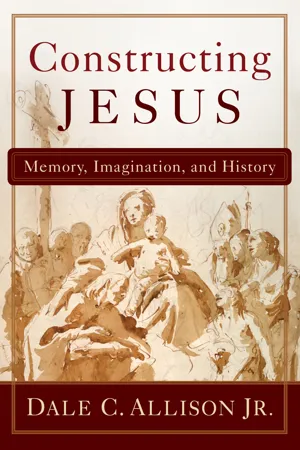
What did Jesus think of himself? How did he face death? What were his expectations of the future? In this volume, now in paperback, internationally renowned Jesus scholar Dale Allison Jr. addresses such perennially fascinating questions about Jesus. The acclaimed hardcover edition received the Biblical Archaeology Society's "Best Book Relating to the New Testament" award in 2011.
Representing the fruit of several decades of research, this major work questions standard approaches to Jesus studies and rethinks our knowledge of the historical Jesus in light of recent progress in the scientific study of memory. Allison's groundbreaking alternative strategy calls for applying what we know about the function of human memory to our reading of the Gospels in order to "construct Jesus" more soundly.
- 624 pages
- English
- ePUB (mobile friendly)
- Available on iOS & Android
eBook - ePub
About this book
Information
1

The General and the Particular
Memories of Jesus
I wept for memory.
—Christina Rossetti
—Christina Rossetti
The frailty of human memory should distress all who quest for the so-called historical Jesus. Even were one to hold, as I do not, that eyewitnesses or companions of eyewitnesses composed the canonical Gospels, our critical work would remain.[1] Personal reminiscence is neither innocent nor objective.[2] Observers habitually misperceive, and they unavoidably misremember. As Thucydides remarked long ago, “Different eyewitnesses give different accounts of the same events, speaking out of partiality for one side or the other or else from imperfect memories” (Hist. 1.22).
Because human memory “leaks and dissociates,”[3] all of us are, to one degree or another, fabulists, even when we try not to be.[4] As modern research abundantly documents, memory often leads us astray.[5] Among its many sins are the following, all of which matter for sober, honest study of Jesus:
1. To recollect is not to play back a tape. Memory, at least long-term memory, is reconstructive as well as reproductive[6] and so involves imagination.[7] This is how it can come to be that, with the passage of time, memories often move from a participant’s viewpoint to an outsider’s viewpoint; that is, we often recall events as though we had been a spectator off to the side.[8]
Remembering is not like reading a book but rather like writing a book.[9] If there are blanks, we fill them in. If the plot is thin, we fill it out.[10] As we constantly revise our memoirs, we may well recollect what we assume was the case rather than what was in fact the case;[11] and as we confuse thought with deed, we may suppose we did something that we only entertained doing. In addition, we regularly mingle related or repeated events,[12] so the memory of a single occurrence is often composite, “a synthesis of experiences,”[13] the upshot of “an abstractive process based on selective attention”[14] or “schematic processing.”[15] When asked, for instance, to recall last year’s Thanksgiving, people typically borrow details from what they otherwise know about the holiday in general. In this way, one event blends in with other events.[16]
2. “Postevent information often becomes incorporated into memory, supplementing and altering a person’s recollection,”[17] so much so that people can “remember” events that they never experienced.[18] Just hearing about a purported incident can lead us to believe that we actually saw it, a phenomenon sometimes dubbed “retroactive interference.”[19] In like manner, even when we have beheld something for ourselves, our own memory, under social pressure, may conform itself to the expectations of others or to their erroneous recall.[20]
3. We are apt to project present circumstances and biases onto our past experiences, assimilating our former selves to our present selves.[21] We may, for example, assume that we once believed what we have believed only of late and distort our recall accordingly.[22] “Surely it must have been like this” readily becomes “It was so.”[23] Similarly, our moral judgments may amend our memories. We may confuse what we think ought to have occurred with what did occur.[24]
4. Although time’s passage may add perspective, memories are not evergreen; they become less and less distinct as the past recedes. Weeks, months, and years dim lucidity, reduce detail, and diminish emotional intensity.[25] Output does not match input.[26]
5. Memories are subject to sequential displacement. We often move remembered events forward and backward in time.[27] “Temporal judgments . . . appear to be highly reconstructive.”[28]
6. Individuals transmute memories into meaningful patterns that advance their agendas.[29] Collectives do likewise.[30] We remember publicly in order to persuade, to justify ourselves, and to explain current circumstances.[31] In other words, memories are a function of self-interest, and we instinctively revise them in order to help maintain “a meaningful sense of self-identity.”[32]
Alfred Adler wrote, “There are no ‘chance memories’: out of the incalculable number of impressions which meet an individual, he chooses to remember only those which he feels, however darkly, to have a bearing on his situation.”[33] Utilizing the past to promote current interests—the classical form critics saw this on every page of the canonical Gospels—leads to alteration, because those interests, a component of which is often entertainment, cannot help affecting both the content and interpretation of what one retrieves from memory.[34] Susan Engel offers an effective example:
Think back to some charged event in your own life. Perhaps the first fight you had with your spouse. Now imagine telling that story to your mate, many years later at the celebration of your twenty-fifth wedding anniversary, telling it to the divorce lawyer, telling it to your children now that they are grown up, writing it in a humorous memoir of your now famous life, or telling it to your therapist. In each case the person you are telling it to, and the reasons you are telling it, will have a formative effect on the memory itself.[35]
Just as we take on different roles for different occasions,[36] so too do we shape our memories according to the varied settings in which we find ourselves.
7. Groups do not rehearse competing memories that fail to shore up what they hold dear. Approved remembrance lives on; unapproved remembrance expires.[37] Communities, like individuals, systematically forget.
8. When, as in the canonical Gospels, memory becomes story, narrative conventions inescapably sculpt the result.[38] Storytellers, needing to bring order out of life’s chaos, are wont to impose upon their materials a neat beginning, a coherent middle, and a resolution that satisfies. They also tend to stereotype and to cast characters as protagonists and antagonists, heroes and villains.[39]
9. Although we are inclined to trust vivid, subjectively compelling memories more than others, such memories can be decidedly inaccurate.[40] No infallible inner voice or sense can consistently adjudicate the accuracy of our recall.[41]
Given what we now know about human recollection, given that “the past is produced in the present and is thus malleable,”[42] one researcher, Elizabeth Loftus, has opined, half seriously, that our lawcourts should administer this oath to witnesses on the stand: “Do you swear to tell the truth, the whole truth, or whatever it is you think you remember?”[43]
The fallibility of memory should profoundly unsettle us would-be historians of Jesus. We have no cause to imagine that those who remembered him were at any moment immune to the usual deficiencies of recall. When we additionally reflect on the common errors of human perception[44] and the human proclivity for tall tales,[45] and then take full cognizance of the strong ideological biases of the partisan sources that we have for Jesus as well as their frequent differences from each other, doubts are bound to implant themselves in our souls, send out roots, and blossom. Even where the Gospels preserve memories,[46] those memories cannot be miraculously pristine; rather, they must often be dim or muddled or just plain wrong.[47]
This is, of course, common opinion, even when uninformed by modern studies of memory.[48] Recognition that the Gospels, just like the writings of Josephus,[49] are not storehouses of auditory and photographic reproductions, and that their recollections must be mixed with much else, explains why scholars have long employed and sought to refine criteria of authenticity, their winnowing forks for separating the ecclesiastical chaff from the pre-Easter wheat. These criteria have, for decades, been much discussed and much deployed.[50] Regrettably, we have good reason to be cynical about them all and about all their refinements, which sometimes presume a crude distinction between Jesus and the churches.[51] This is not the place, however, to rehearse yet again my criticism of how others have proceeded.[52] My present contribution lies elsewhere. I wish, throughout this book, to explicate my conviction that we can learn some important things about the historical Jesus without resorting to the standard criteria and without, for the most part, trying to decide whether he authored this or that saying or whether this or that particular event actually happened as narrated.
The Big Picture
We all know from introspection that our long-term memories, which are “constantly evolving generalizations,”[53] tend to retain “whole events, whole faces, whole conversations, not the sub-plots, the features, the words that make them up.”[54] As our recollections become increasingly tattered and faded, they are disposed to retain, if anything, only the substance or “gist” of an event.[55] We may forget the words and syntax of a sentence yet still remember its general substance or meaning.[56] We construct memories of people and events in the same way we reproduce maps from our heads: we omit most of the details, straighten the lines, and round off the angles, thereby creating a sort of minimalist cartoon.
Who has not more than once thought, “I can’t recall the exact words, but they were something like this”? As one researcher has put it, “Verbatim/perceptual traces fade more quickly than ‘gistified’ traces.”[57] It is the same with the images in our heads. We may recollect visiting the Parthenon, but unless we are that rare, one-in-a-billion individual with a photographic memory, we will not be able to close our eyes and count the number of its columns.[58] Similarly, those who have been robbed will not forget being robbed; yet, as the critical study of criminal lineups has demonstrated, this circumstance does not ensure that witnesses will correctly remember what the robber looked like.[59] This is because, in the words of one authority,
With passing of time, the particulars fade and opportunities multiply for interference—generated by later, similar experiences—to blur our recollections. We thus rely ever more on our memories for the gist of what happened, or what usually happens, and attempt to reconstruct the details by inference and even sheer guesswork. Transience involves a gradual switch from reproductive and specific recollections to reconstructive and more general descriptions.[60]
Maybe it is a bit like Plutarch’s description of the oracle at Delphi (Mor. 397C). The voice, Plutarch tells us, is not that of the god; neither is the diction nor the meter. The deity gives only the inspired vision, which the oracle then translates into her own ideas and speech. Perhaps, in like fashion, memories are our visions, more or less vivid, which we interpret and elaborate.
Scientists, incidentally, now have some credible explanations as to why evolution has sculpted our mnemonic capacities so that they do better with the general than the particular. One proposal, in the words of Daniel Schacter and Donna Addis, is that “remembering the gist of what happened is an economical way of storing the most important aspects of our experiences without cluttering memory with trivial details.”[61] Another plausible suggestion, which could coexist with the first, is that we look to the past in order to navigate the future. Again in the words of Schacter and Addis,
Future events are not exact replicas of past events, and a memory system that simply stored rote records would not be well-suited to simulating future events. A system built according to constructive principles may be a better tool for the job: it can draw on the elements and gist of the past, and extract, recombine and reassemble them into imaginary events that never occurred in that exact form. Such a system will occasionally produce memory errors, but it also provides considerable flexibility.[62]
Whatever the explanation as to why memory fares better with generalizations than specifics, everyone knows that when two cars run into each other, witnesses may well differ on the details. And yet, observers of such an accident will remember that cars collided. They can recall the central fact, upon which they will accordingly agree, even though they may be mistaken about any num...
Table of contents
- Cover
- Title Page
- Copyright Page
- Dedication
- Contents
- Preface
- Abbreviations
- 1. The General and the Particular: Memories of Jesus
- 2. More Than a Sage: The Eschatology of Jesus
- 3. More Than a Prophet: The Christology of Jesus
- 4. More Than an Aphorist: The Discourses of Jesus
- 5. Death and Memory: The Passion of Jesus
- 6. Memory and Invention: How Much History?
- Bibliography
- Ancient Writings Index
- Author Index
- Subject Index
- Notes
- Back Cover
Trusted by 375,005 students
Access to over 1.5 million titles for a fair monthly price.
Study more efficiently using our study tools.
Frequently asked questions
Yes, you can cancel anytime from the Subscription tab in your account settings on the Perlego website. Your subscription will stay active until the end of your current billing period. Learn how to cancel your subscription
No, books cannot be downloaded as external files, such as PDFs, for use outside of Perlego. However, you can download books within the Perlego app for offline reading on mobile or tablet. Learn how to download books offline
Perlego offers two plans: Essential and Complete
- Essential is ideal for learners and professionals who enjoy exploring a wide range of subjects. Access the Essential Library with 800,000+ trusted titles and best-sellers across business, personal growth, and the humanities. Includes unlimited reading time and Standard Read Aloud voice.
- Complete: Perfect for advanced learners and researchers needing full, unrestricted access. Unlock 1.5M+ books across hundreds of subjects, including academic and specialized titles. The Complete Plan also includes advanced features like Premium Read Aloud and Research Assistant.
We are an online textbook subscription service, where you can get access to an entire online library for less than the price of a single book per month. With over 1.5 million books across 990+ topics, we’ve got you covered! Learn about our mission
Look out for the read-aloud symbol on your next book to see if you can listen to it. The read-aloud tool reads text aloud for you, highlighting the text as it is being read. You can pause it, speed it up and slow it down. Learn more about Read Aloud
Yes! You can use the Perlego app on both iOS and Android devices to read anytime, anywhere — even offline. Perfect for commutes or when you’re on the go.
Please note we cannot support devices running on iOS 13 and Android 7 or earlier. Learn more about using the app
Please note we cannot support devices running on iOS 13 and Android 7 or earlier. Learn more about using the app
Yes, you can access Constructing Jesus by Dale C. Allison in PDF and/or ePUB format, as well as other popular books in Theology & Religion & Biblical Criticism & Interpretation. We have over 1.5 million books available in our catalogue for you to explore.