- 160 pages
- English
- ePUB (mobile friendly)
- Available on iOS & Android
eBook - ePub
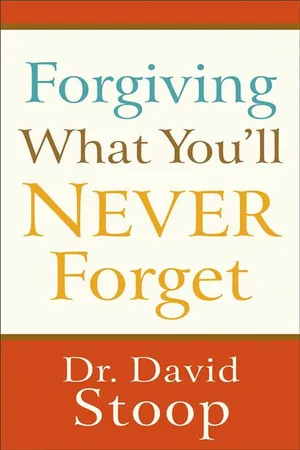
Forgiving What You'll Never Forget
About this book
Forgiveness is an essential part of being a Christian. But what do we do when confronted with the unforgivable--an act that shakes our moral foundations to their roots, often committed by someone trusted and loved? Murder, sexual abuse, adultery--all leave lifelong wounds and all are trespasses that, through the grace of God, still can be forgiven. Dr. David Stoop compassionately guides readers along the course of heartfelt forgiveness, freeing them to apply the biblical teachings that have already changed thousands of lives. Now available in mass market.
Information
Topic
Theology & ReligionSubtopic
Religion1
Apology Not Accepted
The words she spoke of Mrs. Harris, lambs could not forgive . . . nor worms forget.
Charles Dickens
Forgiveness doesn’t come naturally to anyone. Perhaps the main reason is that it is so basically and totally unfair. I’m the one who has been injured, and now I must do the forgiving? No way! And if the offense is horrendous, forgiveness is not only unnatural, it seems impossible. Or what if the other person isn’t sorry, or isn’t even alive anymore? How do I forgive in that situation? It’s impossible. Or is it?
A few years ago, I was confronted with some of the painful things I had experienced with my father as I was growing up. There was a sudden onslaught of memories of things I had tried to forget. Ever since my father had died, 20 years before, I had blocked out all the negatives of our relationship, trying only to remember the good things. But when the veil of my denial was broken by some remarks my sister made, I was flooded with memories of his Irish temper, of the vicious spankings in the basement, of my fear of him and of the ulcer I developed at age 10. Only then did I begin to reference that ulcer to the stress of living with his unpredictable temper. The myth had always been that my diet caused the ulcer—at least that was what I had always been told.
I knew I had to do something about all the feelings with which I was struggling. But he’s dead, I remember thinking. What am I supposed to do with all these horrible feelings? I remembered what I told others in my counseling office, that forgiveness is the only way to resolve issues of the past. But how can I forgive him when he’s not here to be forgiven? I asked myself. Yet a year later I was able to forgive him, and when I did, it was like my life had a new beginning. I understood the words of Pat Conroy, who wrote in one of his novels, “On the day I forgave my father, my life began.”1 What had seemed impossible became a reality.
But what if I had been called upon to forgive a more serious act, like murder? How do you forgive when your own child is murdered? And what if the one who commits the crime is also part of the family? How do you forgive someone you love for killing another loved one?
Wayne and Arlene attended our church. They had two beautiful daughters, both married and growing with their families. There was nothing apparent about the family that would make anyone think such a horrible thing could happen. Yet it happened. Wayne and Arlene’s son-in-law shot and killed his wife, their daughter, during an argument in their kitchen. One can hardly imagine the pain Wayne and Arlene felt.
Then, in the midst of their grief, not only did Wayne and Arlene step in and take over the raising of their grandchildren, but they also stood by their son-in-law during his trial and prison term. When he was released, they invited him to live with them and his kids until he could get his life started again. The reality of the forgiveness given by Wayne and Arlene has been proven over the years by their actions.
But what if complete strangers killed your child? What if your beautiful young daughter was a Fulbright Scholar working halfway around the world, seeking to improve the lives of people trapped in poverty, and you suddenly were confronted with the reality of her brutal death?
Amy was a young woman from our community who was pouring her life into a black squatters’ village in South Africa, helping the residents begin their slow march out of poverty after apartheid was eliminated. After spending over a year there, she felt the community was accepting her and her coworkers. Then the whole world heard the news that four young men from that same community had beaten her to death.
The world watched as her parents walked into the hearing room of the Truth and Reconciliation Commission and then publicly offered these men forgiveness, and stated that they would support the Truth and Reconciliation Commission if it decided to grant them amnesty—which it did. Yet it made the front page of our local paper only when Amy’s parents talked about how they were going to help continue the work started by their daughter and set up a locally run business making “Amy’s bread—the bread of hope and peace.”2
What if the attack was on you personally? What if someone violated you and attempted to take your own life? Madge made news when she was assaulted and stabbed in a rape attempt. For 20 minutes she fought with her attacker in the ladies’ restroom at a local restaurant. When he tried to escape, he was arrested in the parking lot. Madge was taken to the emergency room, covered with blood.
At the trial, months later, the man was sentenced to 17 years in prison. The judge then asked Madge if she wanted to make a statement. She made news again when she expressed to the court that she had forgiven the man and then said as she held up a Living Bible, “Your Honor, this man said that he knew he needed help, and I know that all the help he needs can be found in the Word of God.” Since then she has visited and corresponded with her assailant, who has expressed remorse for his crime and amazement at having been forgiven.
How does someone forgive a betrayal? Judy tried to describe the pain she felt that horrible day five years ago. She said everything inside her was spinning and that she almost literally fell as she got out of her car. And then, as she was trying to steady herself, she heard a horrible moaning sound. Suddenly she realized the sound was coming from her. She said she felt the sound came from the depths of her soul and accurately marked the agony she was feeling. She had just found out that her husband had been into pornography since before their marriage 18 years earlier. She had also discovered that he had been involved in an affair for the past three years. Everything she had always believed about her marriage and family lay shattered at her feet.
Judy recalled how she and her husband had once joked about what would happen if either of them ever had an affair. She had told him, “It better never happen to us because I would be gone in a split second!” But now that it was a reality, her only thoughts were about how to find healing for such a huge wound within her soul, and how to salvage the marriage. Three years later, she had forgiven her husband, and together they had been working hard to create a whole new, healthy relationship as husband and wife.
What if you were the perpetrator? What if you were the one who did something unforgivable? How does forgiveness work when I’m the one needing forgiveness, and I feel like I can’t forgive myself? It had been 15 years, but Irene couldn’t talk about the abortions without breaking into convulsive sobs and then angrily berating herself for being so “wicked and stupid!” It didn’t matter that her husband had been totally unsupportive as she felt so much pain over the years. It didn’t matter that she had been struggling with her young daughter’s potentially fatal illness, again without any support from her husband, when she had the two abortions. Nothing mattered to Irene except the horrible mistakes she had made years ago. It seemed impossible for her to forgive herself. Only when she started working at a local crisis pregnancy center, counseling young women faced with the same choice, was she able to work through her own forgiveness for the seemingly unforgivable actions she had taken in desperation years before.
What Is Unforgivable
Each of these stories is true, though some of the names have been changed, and each represents something unforgivable in some way. So when I was leading a workshop on forgiveness and the subject of unforgivable acts came up, I was ready.
“So what’s unforgivable?” I asked the group as I moved toward the whiteboard. The first suggestions came quickly, and our list began to take shape:
- Child molestation
- Adultery
- Murder
“And especially if it’s your child,” someone added.
- Abortion
- Rape
- Divorce
- Abandonment by a parent
- Physical abuse by a parent or a spouse
- Any kind of betrayal by a loved one
Then suggestions started coming more slowly. People began suggesting things that were simply spin-offs, or specific examples, from what we had already listed. Or they were raising actions that were rather common but seemed more serious because of their circumstances.
Finally we agreed that the things on our list were the “heavies.” They represented the major offenses that almost everyone was willing to place in the “unforgivable” category.
Then the discussion started to expand into larger events. Someone suggested the Holocaust as an unforgivable event in millions of people’s lives. We talked about the horrible things done in South Africa in the name of apartheid. The atrocities done by both sides in Bosnia and Kosovo were recent enough for all to remember. That led someone to name the Arab-Israeli conflict, which is heating up even while I write this. And violence has been increasing again in Northern Ireland and other not-so-familiar places in the world. How do those who are touched directly by these events forgive? Are these acts unforgivable?
We next began to discuss the relative seriousness of the offenses we have experienced in our own lives. What may seem like a forgivable event to me may seem unforgivable to you. Some in the group said there were things in their lives that they didn’t offer to put on the list because they were too personal and other people might not understand why these offenses felt unforgivable.
You may be thinking the same thing as you are reading this. What about my issue? What about that thing in my life that I consider to be unforgivable? As you read over the list above, you may think it is too general; it doesn’t include some very specific offense that has taken place in your life. So we finally added to the bottom of the list the phrase, “Other personal things too numerous to list specifically.”
Why Is Something Unforgivable?
What makes something feel like it is unforgivable? Is there a common element in those events? When people deal with personal issues, they typically see an unforgivable act as something done to us or to someone else that is (1) so out of the ordinary that it shakes our moral foundations to their roots—it goes against some very strongly held core belief—and, usually, (2) done by someone trusted and loved.
In each offense listed at the workshop, something was done that should not have been done, or something was not done that should have been done. In each instance a moral issue is raised. Even if the offender has died, he or she is on the list because of something done or not done. Murder, sexual abuse, adultery, abortion, rape, divorce, physical abuse, abandonment—each one is clearly a moral violation.
Forgiveness always involves the moral side of life. It involves our sense of right and wrong, of fairness, and of justice. It also involves our sense of love, compassion, and mercy. When someone violates us with a seemingly unforgivable act, at least some of these values have been violated.
We then experience an internal conflict over how to resolve the conflict. For example, when someone we love betrays us, our values of right and wrong—or fairness—and of justice cry out for satisfaction. But we are torn, for there is another part of us that holds on to feelings of love for that person, compassion for their predicament, and a desire to show mercy. We are angry because of the tension between these two sets of values, which are competing for our attention. If we are to forgive, it feels like we must deny our own sense of justice and fairness. But not to forgive is to deny our sense of love and compassion. There is no easy way out of the predicament.
Even from a young age, we all have a sense of right and wrong and a concern for what is fair. Listen to a group of young children argue on a playground. Chances are, they will be arguing about something not being “fair.” Or they may be arguing over their different interpretations of the rules.
We all have this early sense of what is bad and what is good behavior. Relationships are built on the foundation of our innate sense of morality. Without it we would experience chaos in our relationships and would probably avoid other people altogether.
When someone violates one of us in some hurtful way, not only is a moral principle being violated, but we also feel that something very important to us has been destroyed—our sense of innocence, for one thing. “How could this happen to me?” is the question that tears at the very core of our being. We had felt safe and protected, but now we feel exposed and vulnerable to the chaotic forces of evil. Our child has been taken from us. Our trust in the goodness of life has been shattered. The world is evil after all. In fact, there is no place that feels safe anymore—and no one who can be trusted. All of these thoughts and more now race through our minds and the thought of forgiveness becomes an unwelcome intrusion.
The Alternative to Forgiveness—Revenge!
Our natural desire for justice after unforgivable offenses often leads to thoughts of revenge, and those thoughts all too often feel good. Revenge has been called a wild but dangerous form of justice. But does it help? Revenge can often leave us with a haunting emptiness.
I was struck by the closing scenes of the movie Dead Man Walking. The parents of one of the murder victims were convinced that the murderer’s execution would somehow release them from their pain and suffering. But the murderer’s pain and suffering was in no way similar to their own, and retribution, no matter how just, did not provide any sense of satisfaction.
Revenge, no matter how just, can never bring satisfaction, for it can never replace what has been destroyed. It also brings us down to the level of the offender. There is an old saying that goes, “Doing an injury puts you below your enemy; revenging an injury makes you but even; forgiving it sets you above.”3 We usually do not even the score when we seek revenge; we merely set in motion a pattern of revenge. The lifelong feud between the Hatfields and the McCoys—and the Arab-Israeli conflict of today—shows us that revenge only leads to more injury. To get even only makes the other side feel he or she is now one down and so must retaliate in order to stay even. The offender becomes the offended, and on and on the cycle goes until all are destroyed.
When horrible things happen t...
Table of contents
- Cover
- Title Page
- Copyright Page
- Praise for Forgiving What You’ll Never Forget
- Contents
- 1. Apology Not Accepted
- 2. Myths and Truths about Forgiveness
- 3. Forgiveness and Reconciliation
- 4. A Radical Forgiveness
- 5. Choosing to Forgive
- 6. The Path of Forgiveness
- 7. Forgiving Ourselves
- 8. A Step Beyond Forgiveness
- 9. The Benefits of Forgiveness
- 10. Questions Often Asked Concerning Forgiveness
- Notes
- Back Cover
Trusted by 375,005 students
Access to over 1.5 million titles for a fair monthly price.
Study more efficiently using our study tools.
Frequently asked questions
Yes, you can cancel anytime from the Subscription tab in your account settings on the Perlego website. Your subscription will stay active until the end of your current billing period. Learn how to cancel your subscription
No, books cannot be downloaded as external files, such as PDFs, for use outside of Perlego. However, you can download books within the Perlego app for offline reading on mobile or tablet. Learn how to download books offline
Perlego offers two plans: Essential and Complete
- Essential is ideal for learners and professionals who enjoy exploring a wide range of subjects. Access the Essential Library with 800,000+ trusted titles and best-sellers across business, personal growth, and the humanities. Includes unlimited reading time and Standard Read Aloud voice.
- Complete: Perfect for advanced learners and researchers needing full, unrestricted access. Unlock 1.5M+ books across hundreds of subjects, including academic and specialized titles. The Complete Plan also includes advanced features like Premium Read Aloud and Research Assistant.
We are an online textbook subscription service, where you can get access to an entire online library for less than the price of a single book per month. With over 1.5 million books across 990+ topics, we’ve got you covered! Learn about our mission
Look out for the read-aloud symbol on your next book to see if you can listen to it. The read-aloud tool reads text aloud for you, highlighting the text as it is being read. You can pause it, speed it up and slow it down. Learn more about Read Aloud
Yes! You can use the Perlego app on both iOS and Android devices to read anytime, anywhere — even offline. Perfect for commutes or when you’re on the go.
Please note we cannot support devices running on iOS 13 and Android 7 or earlier. Learn more about using the app
Please note we cannot support devices running on iOS 13 and Android 7 or earlier. Learn more about using the app
Yes, you can access Forgiving What You'll Never Forget by Dr. David Stoop in PDF and/or ePUB format, as well as other popular books in Theology & Religion & Religion. We have over 1.5 million books available in our catalogue for you to explore.