The key to spiritual and emotional health is to grasp the truth of God's transforming love for us and then let that reality influence our own hearts and relationships. It seems simple, but we are experts at complicating simple things. Instead of living lives characterized by love we find ourselves trapped in cycles of shame, violence, and addiction that steal our joy and keep us from loving others--so much so that, by all indications, Christians are living no differently than anyone else when it comes to abuse rates, use of pornography, alcohol and drug addiction, and more.
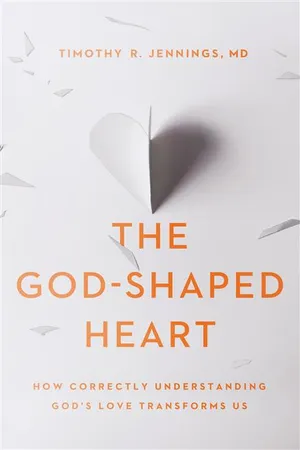
Christian psychiatrist Dr. Timothy Jennings wants to release us from this prison. With powerful illustrations from case studies and from Scripture, Jennings shows believers who are stuck in addiction, violence, fear, and broken relationships how to experience true freedom through God's transforming love to experience greater health, fulfillment, and well-being.
eBook - ePub
The God-Shaped Heart
How Correctly Understanding God's Love Transforms Us
- 304 pages
- English
- ePUB (mobile friendly)
- Available on iOS & Android
eBook - ePub
About this book
Information
Topic
Teología y religiónSubtopic
Religión1
Heart Disease in Christianity
There Is Something Wrong
People look at the outward appearance, but the LORD looks at the heart.
1 Samuel 16:7
She was terrified. Dust caked her mouth, and the tears that made trails through the dirt on her face couldn’t flow fast enough to keep the painful grit out of her eyes. Her knees bled from being dragged through the rough streets as she desperately clung to the torn sheet barely covering her body. She frantically looked for escape, but in every direction there was only the impenetrable wall of hate. She could feel their malice building, their hunger for her blood, the dam holding back their pent-up savagery about to break upon her.
She knew she deserved to die. She was taught from childhood that what she had just been caught doing was punishable by death, and she loathed who she had become. She remembered how her uncle had taken her innocence when she was only a child and then had told her how wicked and filthy she was. He called her vile names, and those insults replayed in her mind in a nonstop cacophony of self-loathing. Some part of her longed for escape; perhaps death would finally free her from the years of guilt, shame, insecurity, fear of rejection, and chronic loneliness—yes, loneliness. Though she had been with more men than anyone she knew, she always felt alone, unloved, worthless. Life was hard; perhaps it was better this way. Perhaps this was God’s will for someone like her, someone who wasn’t pure. Perhaps death was all she deserved. Let it come. Why fight it? She sank down in the dirt waiting for the stones to find her.
But the stones never came. One moment the vulgar taunts of the murderous mob were all she could hear, and the next—silence. Daring to open her eyes, she saw a pair of sandaled feet. Fearfully looking up, she thought she must be dreaming as she saw the kindest face she had ever seen, and he smiled at her.
How could he smile? But he was smiling, and in his smile she saw peace, compassion, and real concern for her. And then she noticed his eyes. They were intense, and she knew instantly that he saw her—not the nearly naked body the mob looked upon nor the frightened girl groveling in guilt and shame. No! He saw her! He saw the little girl, the bruised, battered, betrayed, exploited, misunderstood, and vilified little girl hiding behind years of bad choices, broken promises, and self-hatred. He saw the little girl inside longing to be loved, desperate to be whole—he saw her!
She held her breath as he asked her where her accusers were. With a voice barely above a whisper, not wanting to shatter this fragile moment, she told him they had gone. And then, the unbelievable happened and her world shook, her distorted self-image shattered, her understanding of reality changed. His voice was so compassionate, so tender, like the gentlest music, and she heard him say, “Neither do I condemn you.” How? How could he not? He knew what she was, and what she had done. She knew what the law said, what the teachers said, and what the priests said. Everyone agreed she deserved to be condemned. But not this man! He said no, I don’t condemn you! I love you and want you to be whole—go now and live a better life, live in harmony with God’s design for life and relationships!
The years of pent-up shame burst, and tears began to spill down her cheeks—not the terrified tears of guilt and fear she had shed just moments before, but tears of joy and relief, tears of love and thanksgiving. She was loved despite any previous actions, loved not for what she had done but loved for who she was—a child of God!
There is power in love—power to change people, power to heal broken hearts, power to transform lives. God is love, and it is his plan to pour his love into our hearts to heal, transform, and rebuild each of us back into his original design for humankind (Rom. 5:5). But sadly, something obstructs that love. Something has prevented far too many good Christian people from experiencing that transforming power.
There Is Something Wrong
Have you ever been the first to recognize a problem? Have you ever known something was wrong before others around you saw it? Have you ever had the difficulty of identifying a danger when a superior, or some other expert, already determined no threat exists?
When I was in my second year of residency, I examined a patient who put me in just such a bind. A young man was admitted to my team on the psychiatry service with odd and peculiar behavior. I took a detailed history, but his presentation just didn’t seem right. Sure, he had a strange look in his eyes; his thoughts were disconnected and confused, and his wife reported he had extreme mood swings with anger and aggressive outbursts. But he would also wake up in the living room after having gone to sleep in his bed with no recollection of actually moving from the bedroom. He had subtle, but nonspecific, physical findings suggestive of a neurological brain problem. So I ordered an MRI of the brain.
The problem was he had already been evaluated by the chief of neurology, had an EEG and CT scan of the brain, and was cleared by the senior neurologist in the hospital as not having a neurological problem. In those days, MRIs were new and very expensive and required the approval of the chief of neurology. My request for the MRI for my patient was denied because the neurologist who had already examined him believed the MRI was not warranted. Further, because I was a second-year resident, my assessment was not deemed to be as diagnostically accurate and reliable as that of the chief of neurology.
What was I to do? This young man was in my care, and I was convinced he had a neurological problem, not a psychiatric one, but I was not taken seriously. My faculty supervisor supported the need for diagnostic clarity and spoke to the chief of neurology about getting an MRI, but he wouldn’t budge. This put everyone in a bind. But I wouldn’t relent and kept pressing to get the MRI. My faculty supervisor struggled with what to do. Should she believe the neurologist or me? Should she order me to let the matter go or support me and potentially offend the neurologist by going over his head to the hospital commander?
My conviction was so strong, and my concern for the welfare of my patient so great, that I kept pressing my request until I convinced my supervisor there really was something neurologically wrong with my patient. Finally, she went to the hospital commander, who ordered the MRI. The MRI revealed a massive tumor invading both sides of my patient’s brain. Reexamination of the CT scan, with the MRI findings in mind, revealed the tumor was there but was so large it was missed by both the radiologist and neurologist. My patient was immediately transferred from psychiatry to oncology and neurosurgery services.
Have you ever been in a situation like this, convinced you saw a problem, but those in authority didn’t see it; or worse, having gone on record with a different view, those in leadership refused to even consider new evidence? I believe this happens all too frequently within Christianity. I think there is something wrong in Christianity, yet many in leadership defend the status quo.
Multiple studies document that domestic violence against women is no different in Christian homes than in non-Christian homes. While men suffer abuse from their wives about three times less frequently than wives from their husbands, the risk of being abused by one’s wife is actually greater if a man marries a Christian woman than a non-Christian woman.1
There is something wrong in Christianity. America, the nation in which 70–82 percent2 of people identify themselves as Christian, has the highest rate of teen pregnancy and abortion of any westernized country in the world. Thirty-four percent of American teenage girls will get pregnant before the age of twenty. Teen pregnancy in the United States is ten times that of Japan (where less than 3 percent of the population is Christian), four times that of France and Germany, and nearly twice that of Great Britain.3
There is something wrong in Christianity. Epidemiological surveys of the US population place the prevalence of alcohol-use disorders in the general population at 8.5 percent,4 but according to the Barna group 28 percent of young Christians describe themselves as struggling with alcohol-use problems.5 Other research shows no difference in rates of worry and anxiety among Christians as compared to the population as a whole.6
When comparing trends in Christian character, studies show that with each generation since World War II, character became more corrupt. When comparing the Greatest Generation (WWII generation), the Silent Generation, Baby Boomers, Generation X, and Millennials, a disturbing trend is revealed. From the Greatest Generation to Millennials, sexual misconduct increased from 3 percent to 21 percent, lying or cheating went from 3 percent to 22 percent, and not fulfilling one’s responsibilities at work increased from 30 percent to 56 percent.7 With a large portion of the population self-identifying as Christian, there is definitely something wrong in Christianity.
According to a national survey conducted by Proven Men Ministry and the Barna group, pornography use is no different among Christians and non-Christians. Sixty-four percent of US men view pornography monthly, and the rate among Christian men is the same. The ages of those who view porn at least monthly break down as follows: 79 percent of men age 18–30, 67 percent of men age 31–49, and 50 percent of men age 50–68. Fifty-five percent of married men view porn monthly compared to 70 percent of single men.8
There is something wrong in Christianity. We have all heard the distressing news reports of children who have been molested by a pastor or priest and of the subsequent cover-up by their religious institutions. Christianity appears to have no impact on reducing child abuse. Various studies have documented that 25–35 percent of women and 15–20 percent of men are molested before the age of twenty, and the rate of molestation in Christian homes is no different from that of the general population.9
There is something wrong in Christianity. Even though Jesus prayed for his followers to be united as one in love, mission, purpose, and message, and even though the apostle Paul predicted that the followers of Christ would be unified under one head—Jesus himself (John 17:20–23; Eph. 1:10)—according to the World Christian Encyclopedia, Christianity is fragmented into over thirty-three thousand divergent groups all too frequently arguing among themselves.10
And while many of these different groups argue over doctrine, ritual, and textual interpretation, perhaps the most distressing problem in Christianity is distorted ideas about God.
Distorted Ideas
Mara, depressed and anxious, came to see me. Laundry was undone. The kitchen was a mess. Her home hadn’t been vacuumed in weeks, and even showering was a chore. She was not doing well. Her daughter had been diagnosed with cancer at age three and underwent chemotherapy, which had put the cancer into remission. But seizures developed from the chemo, and now, at age nine, a new cancer had occurred.
Mara looked at me with pain in her eyes and pleaded, “What did I do that God is punishing me? Why has God given my daughter cancer?” Mara’s view of events is not unique.
Nate, referred to me by a friend, was overwhelmed with grief from the death of his son in a car accident. Nate couldn’t understand “why God would take my son from me.”
Sharon wanted to know why God would allow her husband to have an affair. “I prayed, but God didn’t do anything. Why would God want this for me?”
When Christians come to believe that God, the One about whom Jesus said, “Anyone who has seen me has seen the Father” (John 14:9), would inflict cancer, kill children in car accidents, or cause husbands to cheat, we know, without a doubt, there is something terribly wrong in Christianity.
God in his foreknowledge warned that something would be wrong in Christianity near the end of time:
But mark this: There will be terrible times in the last days. People will be lovers of themselves, lovers of money, boastful, proud, abusive, disobedient to their parents, ungrateful, unholy, without love, unforgiving, slanderous, without self-control, brutal, not lovers of the good, treacherous, rash, conceited, lovers of pleasure rather than lovers of God—having a form of godliness but denying its power. (2 Tim. 3:1–5)
These poor people, struggling with all the problems of the world, have a form of godliness but no freedom, no power to overcome. Paul is not speaking of atheists but of those who profess a belief in God, yet who have no power to live victoriously.
Shouldn’t people who claim Jesus as their Savior, who strive to live like Christ, and who claim the indwelling of the Holy Spirit be people who abuse their wives, molest their children, attack their husbands, worry, be addicted, and view pornography less often than people who have not accepted Jesus Christ? In fact, should people who are like Jesus abuse their families at all? Shouldn’t they treat their families like Christ treats the church, sacrificing self for them (Eph. 5:25)?
Shouldn’t people who claim their bodies are the temples of the Holy Spirit have less premarital sex than those who do not?
Shouldn’t people who claim to have the peace that passes understanding actually suffer less anxiety than those who don’t participate in God’s peace?
Shouldn’t those who have died to the world, who have crucified the flesh, who have the mind of Christ, and who have the new covenant promise of God’s law written on their hearts visit porn sites less often than those who have not died to self?
Is it wrong to expect those who have been reborn by the Holy Spirit to be conformed to the image...
Table of contents
- Cover
- Title Page
- Copyright Page
- Endorsements
- Dedication
- Contents
- Acknowledgments
- 1. Heart Disease in Christianity
- 2. The Infection
- 3. Growing Past the Rules
- 4. Spiritual Failure to Thrive
- 5. Law, Love, and Healing
- 6. The Evidence
- 7. Love and Worship
- 8. Love and the Institution
- 9. Rituals, Metaphors, and Symbols
- 10. The Little Theater
- 11. The Power of Love and Truth
- 12. Law or Love in the Real World
- 13. God’s Action in the Old Testament
- 14. Love and Eternal Judgment
- Appendix A: Summary of God’s Design Laws
- Appendix B: Another Resource—The Remedy
- Notes
- About the Author
- Back Ads
- Back Cover
Trusted by 375,005 students
Access to over 1.5 million titles for a fair monthly price.
Study more efficiently using our study tools.
Frequently asked questions
Yes, you can cancel anytime from the Subscription tab in your account settings on the Perlego website. Your subscription will stay active until the end of your current billing period. Learn how to cancel your subscription
No, books cannot be downloaded as external files, such as PDFs, for use outside of Perlego. However, you can download books within the Perlego app for offline reading on mobile or tablet. Learn how to download books offline
Perlego offers two plans: Essential and Complete
- Essential is ideal for learners and professionals who enjoy exploring a wide range of subjects. Access the Essential Library with 800,000+ trusted titles and best-sellers across business, personal growth, and the humanities. Includes unlimited reading time and Standard Read Aloud voice.
- Complete: Perfect for advanced learners and researchers needing full, unrestricted access. Unlock 1.5M+ books across hundreds of subjects, including academic and specialized titles. The Complete Plan also includes advanced features like Premium Read Aloud and Research Assistant.
We are an online textbook subscription service, where you can get access to an entire online library for less than the price of a single book per month. With over 1.5 million books across 990+ topics, we’ve got you covered! Learn about our mission
Look out for the read-aloud symbol on your next book to see if you can listen to it. The read-aloud tool reads text aloud for you, highlighting the text as it is being read. You can pause it, speed it up and slow it down. Learn more about Read Aloud
Yes! You can use the Perlego app on both iOS and Android devices to read anytime, anywhere — even offline. Perfect for commutes or when you’re on the go.
Please note we cannot support devices running on iOS 13 and Android 7 or earlier. Learn more about using the app
Please note we cannot support devices running on iOS 13 and Android 7 or earlier. Learn more about using the app
Yes, you can access The God-Shaped Heart by Timothy R. Jennings in PDF and/or ePUB format, as well as other popular books in Teología y religión & Religión. We have over 1.5 million books available in our catalogue for you to explore.