Dynamic New Teaching from Bestselling Author Ed Silvoso
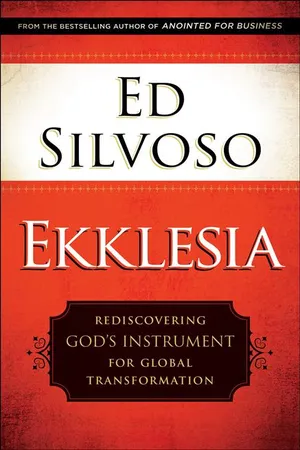
The word church has many connotations; we think of it as a specific building, as a group of people, even as a long service to sit through. We hardly ever think of it as world-changing--and neither does society. Yet this is exactly what the first-century ekklesia was.
In these vital, eye-opening pages, bestselling author Ed Silvoso takes you back to the first days of the church. Digging into Scripture, he shows how the New Testament church--devoid of buildings, professional clergy, and religious freedom--was able to transform the hostile, pagan places into which it was born and set in motion a process that changed the world forever.
Even more, Silvoso offers a roadmap back to becoming the ekklesia Jesus called his church to be. In the midst of the social, economic, political, and moral chaos in our world today, we possess the hope that people and nations so desperately need--and we can become the revolutionary, transformational, life-giving voice Jesus called us to be.
A new, in-depth curriculum kit--which features a DVD with 12 brand-new teaching sessions, a group guide for both leaders and participants, and a copy of the book--is also available. Expounding on the book's dynamic teachings, each kit contains everything you need to equip your group to transform the world around them.
- 272 pages
- English
- ePUB (mobile friendly)
- Available on iOS & Android
eBook - ePub
About this book
Information
Topic
Theology & ReligionSubtopic
Christian Denominations
1
Church: A Radical Proposition
From “Something Wrong” to “Something More”
Jesus did not state, “I will build My Temple” or “I will build My synagogue,” the two most prominent Jewish religious institutions at the time. Instead, He chose a secular entity first developed by the Greeks when He said, “I will build My Ekklesia.” Why? The answer is fascinating, challenging and empowering.
Nowadays, when we hear the word church, we usually picture a solemn building with a cross on top, a pulpit, clergy, a choir, a worship leader and members.
I do not put such notions down, because they reflect cherished expressions of how and where most Christians teach or practice their faith today. During the days when Jesus walked this earth, however, Ekklesia—the Greek word translated into English as “church”—was not religious in nature or connotation at all. In fact, by the time He first uttered the word in the gospel of Matthew, it had been in use for centuries in both the Greek and Roman empires to refer to a secular institution operating in the marketplace in a governmental capacity.
When Jesus chose the word Ekklesia to introduce His redemptive agency, no one among His disciples would have conceived it as redeemable—as we will see later—since the existing ekklesia embodied a foreign stronghold. (Note that when I use the term ekklesia with a lowercase e, it refers to the secular institution. When I capitalize the term, I am referring to Jesus’ Ekklesia of Matthew 16:18.) Granted, the term Ekklesia is present in the Septuagint (Greek) translation of the Old Testament to describe religious assemblies, but Jesus’ usage was related to the secular Greek version. So, how did this secular institution that Jesus was referencing evolve into the religious one we are so familiar with today? And more important yet, once the Ekklesia became Jesus’ redemptive agency, how did it mutate from the pivotal, pace-setting role in society that we read about in the Scriptures into its seemingly less relevant and more ethereal role of today?
A Different Kind of Church
The New Testament examples of church are vastly different from the contemporary notion that it is a place where members go, usually once a week. Back then, church always referred to people, never to buildings, and it was made up of individuals who operated 24/7 “from house to house” all over town as a transforming organism, not as a static institution (Acts 2:46; 5:42). Its objective was the transformation of people and of society, rather than acting as a transfer station for saved souls bound for heaven.
In fact, the New Testament Church was so vibrant and expansive that it overcame the powerful political and religious establishments bent on stamping it out since its very inception. Its vitality is attested to by the fact that in a matter of weeks it filled Jerusalem—the city that crucified its founder—with its doctrine (see Acts 5:28), leading many thousands in just a few days to join its ranks by publicly confessing that Jesus was indeed the Son of God.
Its capacity for growth was so dynamic that two years after Paul planted the Ekklesia in Ephesus, “all who lived in [the Roman province of] Asia heard the word of the Lord” (Acts 19:10), no small accomplishment since the population of that region exceeded a million people. And not long afterward, Paul was able to state with certitude that “from Jerusalem and round about as far as Illyricum I have fully preached the gospel” (Romans 15:19). That was a surface area of around 300,000 square miles—leading Paul to set his evangelistic eyes on Spain, a place that stood some 3,600 miles by land from Jerusalem, the birthplace of Christianity (see verses 18–24).
What makes this stunningly remarkable is that Jesus’ Ekklesia accomplished all of this without military or governmental support. It was instead a massive people movement that swept region after region victoriously as the counterculture to the existing status quo.
The magnitude of the Church’s expansion in such a relatively short time is hard to imagine, much less conceive as the norm in our contemporary environs, since it was accomplished without seminaries, campuses, full-time staff or professional ministers. Furthermore, with the exception of some epistles that circulated regionally, it did not have the New Testament epistles and had only occasional access to Old Testament writings. Yet it was so healthy and powerful that rather than being an item on someone else’s agenda, the Ekklesia was the agenda setter!
A Much-Needed Reality Check
These observations beg additional questions: Where is the influence of the Church today in the midst of the social, economic, political and moral upheaval that is wreaking havoc in the world? And how is it doing relative to the victorious climax that Revelation 21:24–27 describes, where, led by their rulers, a procession of saved nations—not just saved people—will bring their honor and glory as a wedding present to Jesus? In light of all this, I believe it is both fair and necessary to admit that there is something missing that we have not tapped into yet. If so, what is it?
I don’t despise, nor is it my intention to put down, the Church as we know it today. Ministers are among the most giving and sacrificial people on earth, folks whose lives are dedicated to helping others week after week. I am unconditionally committed to the Church as it is, both as a faithful member and a leader. This is why no one can join our ministry team unless they are full-fledged members of a local church. I will never demean or disqualify the Church, but I would rather constructively point out that to fulfill the mission that Jesus assigned it, it must recover what worked so well back then and reinject what is missing into its mainstream.
This is why, instead of the word Church, with its rich religious and traditional connotations, I have chosen the one used in the original manuscripts—Ekklesia—for this quest to rediscover the meaning and function of the entity that Jesus stated will both prevail against the Gates of Hades and cause not just individuals but also nations and their rulers to be saved. Furthermore, instead of spelling it ecclesia, I have deliberately used Ekklesia because most readers are bound to associate the former spelling with ecclesiastical, which is used to describe traditional religious activities.
Jesus’ Intriguing Silence about the Church
One would assume that during His years of public ministry, Jesus must have spent considerable time teaching about the Church, specifically about its nature and also how to plant and grow one. Get ready to be surprised, because as far as the four gospels are concerned, Jesus used the word translated “church” in our Bibles only three times (see Matthew 16:18; 18:17). That is the extent of His recorded teaching on the subject in the gospels.
Most Christian leaders, myself included, acknowledge the key role church planting has in fulfilling the Great Commission. It is perplexing that in the Scriptures, however, there is neither a command nor instructions on how to plant a church. This does not signify that churches were not planted, because in New Testament times they were established all over the interconnected world. Nor could it mean that the Church is not essential, because Paul described it as “the household of God . . . the pillar and support of the truth” (1 Timothy 3:15). Furthermore, after planting quite a few churches, he taught extensively on how to govern them. Nevertheless, the questions remain, why did Jesus speak so little about the Church, and why did neither He nor His apostles give specific instructions on how to plant a church?
The manner in which church elders were chosen and appointed in biblical times challenges us even further. Today, we consider epistles like those written to the Philippians and Thessalonians prime timber with which to build the theological furniture of the Church. But Paul, who planted those churches, spent less than a week in Philippi and not quite three weeks in Thessalonica. Yet by the time he left town, he had established dynamic churches in both cities, with capable local leadership in place.
Nowadays, we are so meticulous about planting a church, and even more so about appointing elders, that it usually takes years. I have no objection to being thorough about this, since in a passage dealing with the government of the Church Paul admonished us, “Do not lay hands upon anyone too hastily” (1 Timothy 5:22). But the fact remains that not only was the premier New Testament church planter able to do it, complete with competent leadership, in a much shorter time than it takes us today, but also that the congregations under these local leaders’ oversight became models for us to emulate.
This thought-provoking contrast between what Paul did so well and what we try to emulate with much less success triggers another challenging question: What kind of churches did Paul plant? For this I found the answer in the Church’s secular roots, which opened the door to see, in an unanticipated way, what Jesus had in mind when He introduced the Ekklesia. In fact, I was surprised to discover that His intention all along was to co-opt an existing secular concept and impregnate it with His Kingdom DNA.
Understanding the roots and function of the secular ekklesia—which predated Jesus’ use of the term—is crucial for us to rediscover the Church as it was really meant to be.
The Genesis of the Ekklesia
At the time of Jesus’ birth and all through His life on earth, there were three main institutions in Israel: the Temple, the synagogue and the ekklesia. It is usually assumed that all three were religious bodies, but only the Temple and the synagogue fit that description. The ekklesia was not religious at all, since it was first developed as a ruling assembly of citizens in the Grecian democracy to govern its city-states. It consisted of men eighteen years or older who had done two years of military service; in essence, people substantially committed to their city-state.
In a broader sense, ekklesia also came to mean an assembly of citizens duly convened. When the more hierarchical Romans replaced the Greeks in the imperial scene, the Romans assimilated the concept.1 Consequently, the general public in Jesus’ day understood ekklesia to mean both the secular institution and the governmental system it represented.
We find an example of the Hellenistic ekklesia in the book of Acts, when Paul’s associates Gaius and Aristarchus were dragged to the theater in Ephesus (a Roman colony) in response to a complaint brought by the local union of silversmiths. The word that is translated assembly in this instance is the same one rendered church elsewhere in the New Testament (see Acts 19:32, 39). Here ekklesia refers to the crowd twice, and a third time to the court itself, showing that the term was employed to describe a body of people assembled to conduct governmental business. In fact, when the town clerk “dismissed the assembly [ekklesia]” amidst warnings of illegality (Acts 19:41), the same noun translated assembly in that verse is translated church 112 times elsewhere in the New Testament. This assembly model is precisely the one that Jesus chose to emulate conceptually, as we will see in greater detail later.2
It is most revealing that Jesus did not say, “I will build My Temple” or “I will build My synagogue”—the two premier Jewish religious institutions. If He were thinking along those lines, He could have said, “I will restore and even surpass the former glory of the Temple so that heads of state will journey to Jerusalem, as the Queen of Sheba did, until every world ruler has bent his or her knee before the God worshiped here.” He could have also said, “I will build My own worldwide network of synagogues to make the Gospel available to people in every nation.” The synagogue was the religious place where Jews met on the Sabbath to read the Scriptures and to pray. Like the Temple, a building was essential to the synagogue’s function.
When the moment came to introduce His transformational agency, Jesus selected neither one. Instead, He announced that He would build His Ekklesia—choosing a term that, in the Roman Empire in general and also in subjugated Israel, described a governmental institution.
The Lord did not discard everything that went on in the Temple or the synagogue, but assimilated significant components from both institutions into His Ekklesia. From the Temple He kept the indwelling presence of God, and from the synagogue the central role of the Scriptures and the fellowship of its members.
Where the Temple and the synagogue differ with Jesus’ Ekklesia, however, is in the areas of constitution, location and mobility. The Temple and the synagogue were static institutions that functioned in buildings that members had to go to on specified occasions, whereas the Ekklesia was a building-less mobile people movement designed to operate 24/7 in the marketplace for the purpose of having an impact on everybody and everything.
The Conventus: A Fascinating Caveat
The Greek and Roman versions of the ekklesia appeared in different forms and sizes, all of which are relevant to the subject at hand. But one format is especially notable: the Conventus Civium Romanorum, or conventus for short. According to Sir William Ramsay, when a group of Roman citizens as small as two or three gathered anywhere in the world, it constituted the conventus as a local expression of Rome. Even though geography separated them from the capital of the empire and the emperor, their coming together as fellow citizens automatically brought the power and presence of Rome into their midst. This was indeed the Roman ekklesia in a microcosm.3
We see an expression of this in Acts 16, when the Roman magistrates panicked at the realization that they had beaten and thrown in prison a fellow citizen (Paul) without the due process accorded to Romans. Later on, another centurion and his commander exhibited similar concerns after finding out that Paul, who they were about to punish, was also a Roman citizen (see Acts 22:24–29). Evidently, when two or more Roman citizens connected, the laws (and protection) of the emperor were in their midst.
This is relevant to our discussion because in Matthew 18, after describing the authority entrusted to His deputies as the Ekklesia to bind and release for the will of G...
Table of contents
- Cover
- Title Page
- Copyright Page
- Endorsements
- Dedication
- Contents
- Gratitude
- Introduction
- 1. Church: A Radical Proposition
- 2. Transformation Is a Journey
- 3. A Fuller Understanding of the Gates of Hades
- 4. A Fuller Understanding of the Gospel
- 5. A Fuller Understanding of Proclamation
- 6. A Fuller Understanding of the Cross
- 7. A Fuller Understanding of the Great Commission
- 8. A Fuller Understanding of Cooperation with God
- 9. A Fuller Understanding of New Testament Baptisms
- 10. A New Understanding of Baptizing Nations
- 11. A Fuller Understanding of How to Baptize a Nation
- 12. A Fuller Understanding of the Ekklesia’s Social Agenda
- 13. A Fuller Understanding of the Incarnation
- 14. A Fuller Understanding of What God Loves the Most
- 15. A Fuller Understanding of Spiritual Authority
- 16. A Fuller Understanding of the Ekklesia’s Operational Methodology
- 17. The Way Forward
- Notes
- About the Author
- Books by Ed Silvoso
- Back Ads
- Back Cover
Trusted by 375,005 students
Access to over 1.5 million titles for a fair monthly price.
Study more efficiently using our study tools.
Frequently asked questions
Yes, you can cancel anytime from the Subscription tab in your account settings on the Perlego website. Your subscription will stay active until the end of your current billing period. Learn how to cancel your subscription
No, books cannot be downloaded as external files, such as PDFs, for use outside of Perlego. However, you can download books within the Perlego app for offline reading on mobile or tablet. Learn how to download books offline
Perlego offers two plans: Essential and Complete
- Essential is ideal for learners and professionals who enjoy exploring a wide range of subjects. Access the Essential Library with 800,000+ trusted titles and best-sellers across business, personal growth, and the humanities. Includes unlimited reading time and Standard Read Aloud voice.
- Complete: Perfect for advanced learners and researchers needing full, unrestricted access. Unlock 1.5M+ books across hundreds of subjects, including academic and specialized titles. The Complete Plan also includes advanced features like Premium Read Aloud and Research Assistant.
We are an online textbook subscription service, where you can get access to an entire online library for less than the price of a single book per month. With over 1.5 million books across 990+ topics, we’ve got you covered! Learn about our mission
Look out for the read-aloud symbol on your next book to see if you can listen to it. The read-aloud tool reads text aloud for you, highlighting the text as it is being read. You can pause it, speed it up and slow it down. Learn more about Read Aloud
Yes! You can use the Perlego app on both iOS and Android devices to read anytime, anywhere — even offline. Perfect for commutes or when you’re on the go.
Please note we cannot support devices running on iOS 13 and Android 7 or earlier. Learn more about using the app
Please note we cannot support devices running on iOS 13 and Android 7 or earlier. Learn more about using the app
Yes, you can access Ekklesia by Ed Silvoso in PDF and/or ePUB format, as well as other popular books in Theology & Religion & Christian Denominations. We have over 1.5 million books available in our catalogue for you to explore.