eBook - ePub
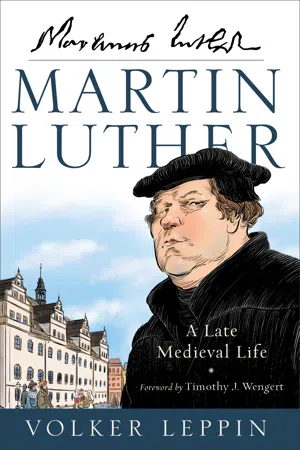
Martin Luther
A Late Medieval Life
- 160 pages
- English
- ePUB (mobile friendly)
- Available on iOS & Android
eBook - ePub
About this book
This brief, insightful biography of Martin Luther strips away the myths surrounding the Reformer to offer a more nuanced account of his life and ministry. Coinciding with the 500th anniversary of the Reformation, this accessible yet robustly historical and theological work highlights the medieval background of Luther's life in contrast to contemporary legends. Internationally respected church historian Volker Leppin explores the Catholic roots of Lutheran thought and locates Luther's life in the unfolding history of 16th-century Europe. Foreword by Timothy J. Wengert.
Information
Topic
Theology & ReligionSubtopic
Religious Biographies1
The Son
Destined for Higher Things
I confess I’m the son of a peasant from Möhra, near Eisenach, but in spite of this I’m a doctor of the Holy Scriptures and an opponent of the pope.”1 In this one sentence from his Table Talk, Martin Luther encapsulates a major theme in his family’s history: the narrative of upward social mobility, which both shaped his parents’ home and culminated in his own story as an academic and reformer. His grandfather Heine Luder was a successful and influential farmer in Möhra, just a few miles south of Eisenach.2 His father, Hans, was a miner, which in those days meant geographic and social mobility. This mobility gave Hans the opportunity to meet and woo Margarete Lindemann, who hailed from one of the most prestigious families in Eisenach. Martin’s ambitious father had his sights set on moving up in the world, while his mother knew the pleasure of a privileged upbringing. This dynamic mixture of social and economic realities shaped the son who would go on to reform Western Christianity.
Martin Luder was born in Eisleben on November 10, 1483, apparently some time after the death of an older brother (though the details are unclear). He was given the name Martin after the saint of the day on which he was baptized, November 11, as was common practice. Not long after, his family moved to Mansfeld so Hans could work in a flourishing copper mine. Despite some challenges, Hans became a successful small-scale entrepreneur and was able to lease a mining workshop. Although we have only sparse references to Martin’s childhood in this hard-working and frugal home, he remembers experiencing conflict with his parents. Later in life he recalled, “My father once whipped me so severely that I ran away from him, and he was worried that he might not win me back again.”3 His father regretted punishing his son so strictly, though we know little more about this incident.
Reports concerning Martin’s religious upbringing are similarly sparse. We know that when he was a young boy his mother would often sing a song to him about human failings and ensuing guilt, which reveals something of the gloomy nature of her faith. Martin later recollects how his parents gave him a basic catechetical education and inadvertently fostered in him an anticlerical spirit. Moreover, within the polarizing views of God in late medieval piety—with the tender and loving God of the mystics on the one hand and the distant and terrifying image of God in traditional religion on the other—the Luder family clearly leaned toward the latter. From his earliest days, Martin feared what he understood to be the ever-present power of the devil, whom he saw as his opponent for the remainder of his life. Even his view of Christ was colored with overtones of fearful expectation. He found it difficult to shake early childhood impressions, for he had been taught to expect a terrifying encounter with Christ at the last judgment. This expectation tormented him until he found some measure of release from these fears with the help of his spiritual director in the monastery.
More important for Martin in the development of his reforming ways was the excellent education that his father made possible, no doubt in the hope of further social advance. Martin began attending school in his hometown of Mansfeld on March 12, 1491. The lessons were conducted in Latin, and the main content was the so-called trivium, consisting of logic, grammar, and rhetoric. The school also offered basic religious instruction in the Lord’s Prayer and the Apostles’ Creed, but limited educational possibilities in small-town Mansfeld were apparently disappointing for his ambitious parents, so they sought suggestions from family friends for the next stage of his education. Consequently, in 1497 Martin started at the cathedral school in Magdeburg. Here he lived in community with the Brethren of the Common Life, known as the Null-Brothers, where he experienced a meditative and holistic monastic way of life. This group belonged to a late medieval movement known as the devotio moderna. In more ways than one, life in Magdeburg opened up a new world for Martin as this young country boy experienced city life for the first time. A year later, however, he changed schools once again, this time to one in Eisenach. The reasons for this latest change are not as clear, but it can be assumed that closeness to extended family may have been a factor.
Life in Eisenach presented Martin with opportunities for new friendships and experiences. Through his landlord, Heinrich Schalbe, he not only was offered a bursary for study but also came into contact with the local Franciscans, toward whom he then and for many years afterward felt such warmth. Nicknamed “The College of Schalbe,” they were primarily interested in matters of the individual’s soul and spirit. Moreover, while attending St. George’s School in Eisenach, Martin was significantly influenced by Johannes Braun, vicar of St. Mary’s Abbey, whose humanist ideals were powerfully formative for him.
After fulfilling the demanding requirements of his secondary education, Martin began further study in Erfurt in the summer of 1501. University education in this era typically began with studies in philosophy in the arts faculty, which in Erfurt followed the scholastic logic of Aristotle. Only when these foundational studies had been completed could a student be admitted to one of the higher faculties of law, medicine, or theology. Martin’s teachers, Jodokus Trutvetter and Bartholomäus Arnoldi of Usingen, lectured according to the via moderna syllabus, which held that any system of universals exists only conceptually, or nominally, and so was sometimes known as nominalism or terminism. This theory differed from the teaching of Thomas Aquinas, which defended the existence of universals and was sometimes known as realism or the via antiqua. In Erfurt the modern philosophical way was taught, according to the principles of William of Ockham. Luther later declared that he belonged to the terminists and that Ockham had been his teacher.
Martin’s education in Erfurt wasn’t just about his classes. Living in the St. George’s student hostel helped deepen his knowledge of humanism—a term referring both to a modern pedagogy and to a syllabus oriented toward a philological approach to the study of humanities. This “new” humanist approach to knowledge provided a popular alternative to the dominant and dry Scholasticism of the day, and Martin clearly enjoyed pursuing an agenda that opposed the university syllabus. Perhaps it is not surprising that, before entering the monastery in Erfurt, he returned all of his university texts to the bookseller except for his copies of Plautus and Virgil, the latter of which was highly regarded in humanist circles as the definitive guide to antiquity after Dante.
During this time, Martin also demonstrated his skill as a musician, revealing what a well-rounded individual he had become. The circumstances surrounding his decision to take up music followed an almost fatal accident. While traveling on one occasion to see his parents, Martin inadvertently stabbed himself in the leg with his own dagger and very nearly bled to death—his first near-death experience. He took up the lute during his period of convalescence.
In 1505 he graduated with a master of arts, and by this time he considered himself to have broken free from the university’s scholastic agenda through his liberating studies of humanism. His degree was the ticket he needed to enroll in one of the higher faculties, and according to his father’s wishes, he chose to study law.
1. Martin Luther, Luther’s Works, ed. Jaroslav Pelikan, Hilton C. Oswald, and Helmut T. Lehmann (hereafter LW), vol. 54, Table Talk, ed. Theodore G. Tappert (Philadelphia: Fortress, 1967), 282.
2. Martin was descended from the Luder family but in 1517 changed the spelling of his name to the well-known form “Luther.” In order to avoid historical anachronism, we shall refer to him as Martin Luder when referring to the man prior to this change and as Martin Luther when referring to the man following this time.
3. Luther, Table Talk, 157.
2
The Monk
By the end of June 1505, Martin’s parents had apparently learned of their son’s recent intention to give up studying law, so they summoned him home to Mansfeld. According to Martin’s later reflections, a significant dispute broke out between father and son regarding his plans to become a monk. In seeking to prevent this move, Hans arranged a wealthy marriage partner for him, but nothing came of it. Soon afterward, though, another event overshadowed everything that had been discussed and decided. While journeying back to Erfurt on July 2, Martin was nearly hit by a lightning bolt as he approached the village of Stotternheim. The report he gave of this event has been narrated many times, particularly his anguished cry, “Help me, St. Anna, and I’ll become a monk!” Anna is known as the mother of Mary and patron saint of miners, although this association was probably not very important to the Luder family since veneration of her was not widespread in the region around Mansfeld.
In addition to the relative unimportance of St. Anna in the region, there is another reason to regard Luther’s report skeptically. He did not explicitly mention Anna in reference to his Stotternheim vow until 1539, and even then he did so by appealing to her name’s etymology—“Anna” in Hebrew means mercy. By making reference to Anna in connection with his cry for help, he could point to the grace of God as the central theme in his life from the very beginning. Such a significant theological connection, on top of the marginal role that St. Anna would have played in Martin’s upbringing, suggests that his calling out to her is more likely to have been a deliberate reconstruction of the past rather than an actual memory of the event. We should perhaps understand the incident at Stotternheim without the invocation of St. Anna.
Yet something significant did happen on July 2, for we are not dependent on Luther’s reports of the event alone. In a letter written on October 16, 1519, that refers back to Martin’s decision to leave the student hostel and to enter the monastery, fellow student Crotus Rubianus mentions a lightning strike and some form of divine purpose. There can scarcely be reason to doubt that Martin actually did encounter a storm on his journey back to Erfurt and linked this event with his decision to enter monastic life. Abject fear of sudden death was widespread in the Middle Ages because it meant being unprepared to meet the Lord. Not surprisingly, Martin shared this fear, compelling him to make his vow. But he can’t have failed to realize that a vow made under duress or in distress was not binding. Martin could rightly have thanked God for his survival on July 2, 1505, without having to act upon any promise made under pressure.
That Martin didn’t take this path but rather fulfilled his promise and entered the monastery is the true meaning of Stotternheim. Only in this light can we understand the complex pattern of these events, which are worth summarizing. A young man decided to travel home to his parents with a particular purpose in mind. He needed to deal with some family disagreements concerning the whole direction of his life, including study and marriage plans. On his way back from the visit, he fell into danger and offered his life to God or to the saints, which in either case was diametrically opposed to the wishes of his father. He could have reneged on his vow, but he chose not to, which provides the key to the meaning of the event.
It seems that the vow provided an ideal way out of a difficult family situation. Martin was not merely disobeying his father but instead was offering a higher obedience to his heavenly Father. Hans himself therefore had to come to terms with God and with Martin’s commitment to God. Indeed, a spiritual battlefield was now the context for their dispute, suggesting to Hans the possibility that Martin had been deceived or blinded by the devil. In the end, however, there seemed to be no real chance of defeating the power that had led his son into the field of battle in the first place. Furious, Hans changed from using the respectful form of address “Ir,” which he had used when speaking to Martin since his graduation, and reverted to the less respectful “Du.” Nonetheless, the son still became a monk, and in the end Hans begrudgingly accepted his decision.
Martin chose to enter a monastery of the Augustinian hermits in Erfurt (near the St. George’s student hostel), which was an observant branch of the Augustinians, known for their strict adherence to the monastic rule. Since 1461 the movement had been led by Andreas Proles, who held the position of vicar-general over this network of monasteries, but in 1503, just before Martin was admitted to the monastery, Proles was succeeded by Johannes von Staupitz, who, as father confessor and spiritual mentor to Martin, was to play an extraordinarily significant role in his personal and theological development. Martin was drawn to the Erfurt Augustinian hermits not only because of their strict lifestyle but also because of the quality of their theology. Until shortly before Martin’s admission, Johannes von Paltz had also belonged to the community, who according to historian Berndt Hamm, was one of the most important representatives of a movement emphasizing personal piety, in which the main focus was spiritual appreciation of God’s involvement in everyday life. Paltz described life in the monastery as a via securior (sure path) to salvation precisely because monastic discipline helped weak and sinful people to walk a path toward grace.
Martin thus made his new home in a community that was both theologically demanding and spiritually vibrant. The turnaround time between making the decision and moving in was swift. On July 16 Martin invited some friends to his send-off, and on the very next day, the feast of St. Alexius, he knocked on the monastery gate. According to the regulations of the order, he was required to spend several months as a guest of the monastery before his intention to become a monk could be accepted. His period as novice was overseen by Johann Grevenstein, who introduced Martin to the practices of monastic life. Looking back on this phase from the vantage point of 1532, Luther mused that Grevenstein was a true Christian, despite that “damned cowl.”1 This was one of the few occasions when Luther was able to see his cloistered life in a positive light.
At the end of his probation, Martin made his profession as a monk. In light of how often he described his path as reformer in terms of his search for a merciful God, the wording of the vows that he had to make are surprising. The young novic...
Table of contents
- Cover
- Title Page
- Copyright Page
- Contents
- Foreword
- Translators’ Introduction
- Acknowledgments
- 1. The Son
- 2. The Monk
- 3. The Young Professor
- 4. The Publicist
- 5. The Prophet
- 6. The Preacher-Bishop from Wittenberg
- 7. The Year of Climax, 1525
- 8. The Educator
- 9. The Outsider
- 10. The Old Professor
- 11. The End of Life
- Back Cover
Trusted by 375,005 students
Access to over 1.5 million titles for a fair monthly price.
Study more efficiently using our study tools.
Frequently asked questions
Yes, you can cancel anytime from the Subscription tab in your account settings on the Perlego website. Your subscription will stay active until the end of your current billing period. Learn how to cancel your subscription
No, books cannot be downloaded as external files, such as PDFs, for use outside of Perlego. However, you can download books within the Perlego app for offline reading on mobile or tablet. Learn how to download books offline
We are an online textbook subscription service, where you can get access to an entire online library for less than the price of a single book per month. With over 1.5 million books across 990+ topics, we’ve got you covered! Learn about our mission
Look out for the read-aloud symbol on your next book to see if you can listen to it. The read-aloud tool reads text aloud for you, highlighting the text as it is being read. You can pause it, speed it up and slow it down. Learn more about Read Aloud
Yes! You can use the Perlego app on both iOS and Android devices to read anytime, anywhere — even offline. Perfect for commutes or when you’re on the go.
Please note we cannot support devices running on iOS 13 and Android 7 or earlier. Learn more about using the app
Please note we cannot support devices running on iOS 13 and Android 7 or earlier. Learn more about using the app
Yes, you can access Martin Luther by Volker Leppin, Bezzant, Rhys, Roe, Karen, Rhys Bezzant,Karen Roe in PDF and/or ePUB format, as well as other popular books in Theology & Religion & Religious Biographies. We have over 1.5 million books available in our catalogue for you to explore.