There are now more single adults than married adults in the United States, yet the evangelical church continues to focus primarily on serving couples and families with ministries geared toward their particular needs. This can lead, however unintentionally, to the marginalization of adults who are single by choice, divorce, or death, or who are simply not yet married. Families are a good thing, but so are all of God's people, and singles long to be lovingly integrated into the Body of Christ.
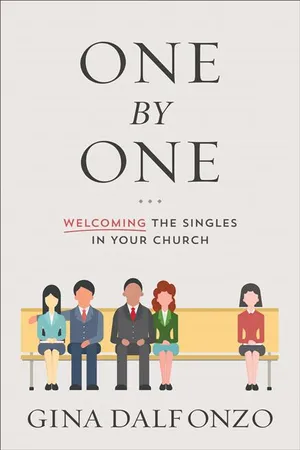
In One by One, Gina Dalfonzo explores common misconceptions and stereotypes about singles, including the idea that they must be single because something is wrong with them, and the subtle (and not-so-subtle) ways they are devalued, like when sermons focus overmuch on navigating marital relationships or raising children. She shows how the church of Paul, who commended those who remained single, became the church where singles are too often treated like second class Christians. Then she explores what the church is doing right, what unique services singles can offer the church, and, most importantly, what the church can do to love and support the singles in their midst.
- 240 pages
- English
- ePUB (mobile friendly)
- Available on iOS & Android
eBook - ePub
About this book
Information
Topic
Theology & ReligionSubtopic
Christian MinistrySection 1
Stigmas,
Stereotypes,
and Shame

What did I do wrong?
I look around me at family members, neighbors, colleagues. So many couples, so many families. So many people preoccupied with home and children and all the cares and concerns and mess and busyness and affection that go with them. So many people who have what I’ve been longing for . . . what I may never have.
Did I Do Something Wrong?
Having bought a subscription to Ancestry.com, I work on my family tree, tracing various branches further and further back, fascinated by the names and lives of people I’ve never known whose blood runs in my veins. Natalina married Giuseppe; their daughter Antonia married Luigi and then they Americanized their names to Antoinette and Louis (They really did! Maybe whoever was working at Ellis Island that day was a student of French history?); their son Albert married Martha; their daughter Joyce married Joe (son of Mary and Tony, grandson of Marco and Nicolina), and they became my parents.
And then there’s me—still sitting there alone on my branch, feeling like I’m getting the ghostly side-eye from all those old Italians who married young and had lots of children and couldn’t imagine how there could be any difficulty about the matter.
They tell me the Chinese have a name for people in my situation: “broken branches.” “They are the biological dead ends of their family,” explains journalist Mei Fong.1 Am I a broken branch, a dead end? Will I be the end of that long line that was flourishing until I came along?
Why am I different? What did I do wrong?
These questions haunt many of us. In a sea of couples, we feel—pardon the pun—singled out, different, penalized for something we had so little control over. What did we do wrong? How could we have done things differently? How could we have made them go right?
“You Have Not Sinned”
Before we go any further, I need to make something clear. The feelings I’ve been describing are just that: feelings. I don’t want to downplay the role or the value of feelings—they’re real, and they matter—but sometimes, if we’re not careful, they can get out of control and give us a distorted picture of the truth. And these feelings in particular are not grounded in reality. The truth is the Word of God doesn’t say that being single is wrong, sinful, or bad.
On the contrary, we know that Paul was all in favor of it:
Now concerning virgins: I have no commandment from the Lord; yet I give judgment as one whom the Lord in His mercy has made trustworthy. I suppose therefore that this is good because of the present distress—that it is good for a man to remain as he is: Are you bound to a wife? Do not seek to be loosed. Are you loosed from a wife? Do not seek a wife. But even if you do marry, you have not sinned; and if a virgin marries, she has not sinned. Nevertheless such will have trouble in the flesh, but I would spare you. . . .
But I want you to be without care. He who is unmarried cares for the things of the Lord—how he may please the Lord. But he who is married cares about the things of the world—how he may please his wife. There is a difference between a wife and a virgin. The unmarried woman cares about the things of the Lord, that she may be holy both in body and in spirit. But she who is married cares about the things of the world—how she may please her husband. And this I say for your own profit, not that I may put a leash on you, but for what is proper, and that you may serve the Lord without distraction. (1 Cor. 7:25–28, 32–35)
We’ve all read those verses. They remind us, or should remind us, that singleness is not a moral failing or a cause for shame. On the contrary, the single person has equal worth and dignity with the married person before God.
This should be reason enough for the church to offer the single person genuine acceptance and support. But ask single people if this has been happening in recent years, and you’re likely to hear otherwise. Here’s what a few of them told me:
I sometimes feel isolated, scrutinized, and ignored because the church is by nature a family-oriented community.—Jim
We kind of get shuffled to the background, particularly as adults, because the church doesn’t know where to put us within their small group system.—Charity
I wish there was greater understanding that we are not “strange,” and [more] intermingling by families with the singles.—Bea
The evangelical church in general seems to have developed a tendency to rush past those particular verses that elevate singleness, or gloss over them, or explain them away. I’ve even heard some say that if singles are going to cite Paul’s example and advice on singleness, they’d better be prepared to go suffer and give their lives for Christ, as Paul did. For example, here’s former Mars Hill Church pastor Mark Driscoll in a sermon on singleness:
Let’s say for example there is a closed Muslim country that desperately needs Jesus. Should I go, with my wife and five kids, or should I have a single guy go and lean over the plate and take one for the team? I should send the single guy, right, because if he’s there, and they capture and kill him—which is what they do if you preach the gospel in a Muslim country—at least he doesn’t leave behind a widow and orphans.2
Thanks, I think.
As I wrote earlier, and as some of my interviewees have said, marriage and families have been elevated to such a high status in the church that single people don’t always seem to fit anymore or, at worst, seem to have less value than married people—even when we’re not being portrayed as cannon fodder! And then when the tough questions I mentioned come up in our minds, the ones that can keep us awake late into the night—Where did I go wrong? What should I have done differently? Has God forgotten me?—it’s sometimes hard to feel as if we can turn to the church for answers and for help.
I don’t say any of this to complain or whine. I want to make the church aware of the experiences of a significant number of its people in the interest of helping the body of Christ learn to recognize and cherish all of its members, not just those who happen to fit the ideal of parents/kids/pets. The first step toward changing the church’s view of single Christians is to understand what, exactly, that view is and the thinking behind it. This is something I touched on in the introduction to this book. This section will explore it in more detail.
One
Singles as Problems

“I’m going to speak of the sin I think besets this generation. It is the sin of delaying marriage as a lifestyle option among those who intend someday to get married, but they just haven’t yet. This is a problem shared by men and women, but it’s a problem primarily of men.”1
With those words, spoken at a conference for Christian singles in 2004—and later broadcast on the radio by Dennis Rainey and Bob Lepine of FamilyLife Today—Dr. Al Mohler, then president of the Southern Baptist Theological Seminary, sparked an outcry. Many single Christians wrote to him in protest. Christianity Today writer Camerin Courtney, herself a single woman, challenged Mohler’s views in a column titled “Is Singleness a Sin?”
“If the reasons for delaying marriage truly are selfishness, childishness, and a purposeful denying of God’s will, as Mohler, Rainey, and Lepine assert,” Courtney wrote, “then those things are the sins—not the resulting singleness. And throwing around the s-word like that, especially toward a group of individuals who already sometimes feel devalued by the church, our families, and sometimes even ourselves, seems not only unscriptural but also irresponsible.”2
Dr. Mohler eventually clarified:
I stand unmoved, even more convinced that the argument I made at the New Attitude Conference is precisely correct. Singleness is not a sin, but deliberate singleness on the part of those who know they have not been given the gift of celibacy is, at best, a neglect of a Christian responsibility. The problem may be simple sloth, personal immaturity, a fear of commitment, or an unbalanced priority given to work and profession. On the part of men, it may also take the shape of a refusal to grow up and take the lead in courtship. There are countless Christian women who are prayerfully waiting for Christian men to grow up and take the lead. What are these guys waiting for?3
In section 2 of this book, we’ll take a closer look at some of the ideas about men and women implicit in this passage and how they relate to the current state of affairs among single Christians. But Mohler’s statement, as Camerin Courtney suggested, was a sign of a much broader phenomenon within the church. It’s the viewing of single people as a problem that needs to be solved.
Note that when Courtney unpacked Mohler’s statement, she made a list of qualities that seem to be bound up with singleness, according to his way of looking at the issue: “selfishness, childishness, and a purposeful denying of God’s will.” She wasn’t just extrapolating too much from his words. These are qualities that the church—consciously or unconsciously—often does attribute to single people. We’re often seen as solitary, self-contained, self-sufficient units, blissfully living our own lives without a thought for others.
Naturally, therefore, the increase of singleness within the church is seen as cause for alarm. Look at something else that Mohler said in his original speech: “What is the ultimate priority God has called us to? In heaven, is the crucible of our saint-making going to have been through our jobs? I don’t think so. The Scripture makes clear that it will be done largely through our marriages.” He also spoke of marriage as “the central crucible for adult-making.”4
It’s not just Mohler, either. Consider for a moment all the messages you’ve heard through the years from Christian churches and ministries about the importance and value of family. Most likely, they went something like this:
“Motherhood is the most important job in the world.”
“Your only real and lasting legacy is your family.”
“No one ever said on his deathbed, ‘I wish I’d spent more time at work.’”
“If you don’t have children, no one will take care of you when you’re old/remember you when you’re gone.”
We’re taught, too, that experiencing a faithful marriage and a healthy family life is the best way for Christians to reclaim the culture for God. Here’s Candice Watters in her book Get Married:
I was sitting in class [in a graduate program in public policy] learning about all the ways our country was slipping from its constitutional foundation. And in a moment of exasperation, I raised my hand and called out, “So what’s the solution?” I really wanted to know, though I’m not sure I believed there was one. . . .
Dr. Hubert Morken didn’t disappoint. He looked at me with a twinkle in his eye and let his grenade fly: “Get married, have babies, and do government! That’s how we win.”5
If family life is the highest form of life on earth that Christians can aspire to, and if the family is the exclusive breeding ground of faith and virtue—if, in fact, it’s the family that will arrest the decline of Western civilization—then, of course, increasing singleness is going to be a problem. If all this is true, we have around us an increasing number of stunted adults and half-formed saints, unable to reach full maturity or holiness because they’re not married.
This view is given even greater credibility by those worrisome statistics I referred to earlier: the ones about cohabitation and extramarital pregnancy rates and other indicators of immorality spiraling out of control. As this one particular aspect of the wider culture—higher rates of singleness—spills into the church, the thinking goes, it must be bringing all those other unsavory trends with it. So it’s our duty to urge the singles to marry as soon as possible . . . and if the singles don’t or won’t or can’t get married, that makes them an even bigger problem than they already were.
Eric Reed of Leadership Journal frames the issue this way:
Today’s young adults are marrying later, if at all, are technologically savvy, and hold worldviews alien to their upbringing. Barna Research president David Kinnaman, after a five-year study, declared that church leaders are unequipped to deal with this “new normal.”
. . . Many ignore the situation, hoping young adults’ views will be righted when they are older and have their own children. These leaders miss the significance of the shifts of the past 25 years, Kinnaman contends, and the needs for ministry young people have in their present phase—if it is a phase.6
Debbie Maken is one author who believes that any attempt to encourage singles to make peace with their state in life is to encourage something unholy. She put it this way in her book Getting Serious about Getting Married:
Being a single person for too long has more capacity to produce negative characteristics in terms of sanctification than it does to produce healthy members of the body of Christ. And yet we persist in our churches to praise the single status, placing it on an equal level with marriage. We delude ourselves and the singles in our congregations into believing that participation in a few service activities will somehow redeem or offset all of the negative practical—and sometimes spiritual—consequences of remaining single despite God’s clear call to marriage.7
Probably very few Christians in the pews have thought through the issue to this extent, but these teachings—teachings that tell us singleness is a negative condition that needs to be redeemed or offset—do tend to spread throughout the church, often in subtle ways, and they do have an effect. I think they’re often behind the ways that people react to our presence in the church—like the woman I met in the ladies’ ro...
Table of contents
- Cover
- Title Page
- Copyright Page
- Endorsements
- Contents
- A Note about the Interviews in This Book
- Acknowledgments
- Introduction
- Section 1: Stigmas, Stereotypes, and Shame
- Section 2: How We Got Here
- Section 3: Where Do We Go from Here?
- Epilogue
- Notes
- About the Author
- Back Ads
- Back Cover
Trusted by 375,005 students
Access to over 1.5 million titles for a fair monthly price.
Study more efficiently using our study tools.
Frequently asked questions
Yes, you can cancel anytime from the Subscription tab in your account settings on the Perlego website. Your subscription will stay active until the end of your current billing period. Learn how to cancel your subscription
No, books cannot be downloaded as external files, such as PDFs, for use outside of Perlego. However, you can download books within the Perlego app for offline reading on mobile or tablet. Learn how to download books offline
Perlego offers two plans: Essential and Complete
- Essential is ideal for learners and professionals who enjoy exploring a wide range of subjects. Access the Essential Library with 800,000+ trusted titles and best-sellers across business, personal growth, and the humanities. Includes unlimited reading time and Standard Read Aloud voice.
- Complete: Perfect for advanced learners and researchers needing full, unrestricted access. Unlock 1.5M+ books across hundreds of subjects, including academic and specialized titles. The Complete Plan also includes advanced features like Premium Read Aloud and Research Assistant.
We are an online textbook subscription service, where you can get access to an entire online library for less than the price of a single book per month. With over 1.5 million books across 990+ topics, we’ve got you covered! Learn about our mission
Look out for the read-aloud symbol on your next book to see if you can listen to it. The read-aloud tool reads text aloud for you, highlighting the text as it is being read. You can pause it, speed it up and slow it down. Learn more about Read Aloud
Yes! You can use the Perlego app on both iOS and Android devices to read anytime, anywhere — even offline. Perfect for commutes or when you’re on the go.
Please note we cannot support devices running on iOS 13 and Android 7 or earlier. Learn more about using the app
Please note we cannot support devices running on iOS 13 and Android 7 or earlier. Learn more about using the app
Yes, you can access One by One by Gina Dalfonzo in PDF and/or ePUB format, as well as other popular books in Theology & Religion & Christian Ministry. We have over 1.5 million books available in our catalogue for you to explore.