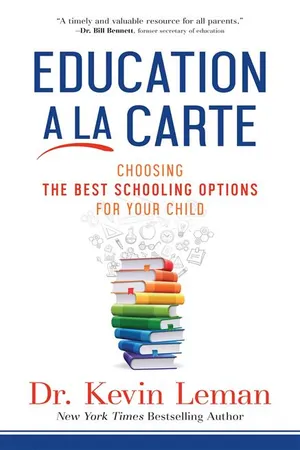
Every parent wants the best possible education for their child--one that fits their child's unique needs, challenges them to grow, and equips them to succeed. But there are so many options--public, private, and charter schools, plus homeschooling and online schooling--that it's easy for parents to feel overwhelmed and, well, undereducated about the choices. What's more, while one schooling option may be right for one child, it may be challenging for another. And sometimes the same child will thrive in one environment in elementary school but falter in that same environment in middle school.
What's a parent to do?
Parenting expert and longtime educator Dr. Kevin Leman can help. In this practical book, he clearly explains the pros and cons of various schooling options so that parents can make an informed choice about the kind of education that will help their child thrive. He shows parents how to stay involved and engaged with their child's education every step of the way, knowing that the choices they make about school now will reverberate long into that child's future.
- 288 pages
- English
- ePUB (mobile friendly)
- Available on iOS & Android
eBook - ePub
About this book
Information
Print ISBN
9780800728434
Subtopic
Sexuality & Gender in Religion1
The Top Concerns of Parents
What’s most important to parents, and how they can best help their child succeed.
I don’t have to be in a room long with other parents before they start sharing their concerns with me. Ninety-five percent of the time, those concerns are focused around their children and their long-term welfare. I understand thoroughly, because I’m a parent of five kids who are spaced far enough apart that I was in the active trenches of parenting for a long time. Now I have the joy of being an involved grandparent of four.
Every parent wants the best for their child and will do everything in their utmost power to secure their child’s long-term success and happiness. So much of a child’s path in life will be determined by the education she receives.
What are your top concerns as a parent? And in an increasingly complicated, fast-paced world, how can you best help your child succeed? Those are million-dollar questions this book will assist you in answering.
Concern #1: Safety at School
These days, parents always list the safety of their children at school as a paramount concern. We live in a violent world, with racial tensions, fear, anger, bullying, and cyberbullying on the rise.
Sadly, shootings in school aren’t a new phenomenon, but the scope of the deaths and coverage of them has increased greatly. Why are they so prevalent? A study found that mass killings and school shootings tend to spread “contagiously.” In other words, excessive national media coverage of one killing or shooting greatly increases the chance that others—copycats of the crime—will occur within a couple of weeks.1
All children crave attention and belonging. Students who haven’t had those needs fulfilled in positive ways can easily move toward revenge and begin to identify with the shooters as “celebrities” who have their day in the limelight. The media not only highlights the perpetrator’s name, background, and motivation for the crime but also details specifics about weapons used and the number of victims. Effectively, such coverage gives the potential next school shooter a road map for his crime and the hope that he may have his own day in the spotlight.
However, the media coverage of such tragedies also serves to bring the problem to the forefront of our nation’s attention. That allows schools the opportunity to become more prepared for these events. But with the continued occurrence of such tragedies, no school can be completely prepared.
What could possibly make the difference in lessening the number of school shootings? The website Security Today says, “The media needs to eliminate the shooter as the focal point for stories and instead focus on the victims, their families, and highlight what could have been done to prevent this in the first place.”2 In other words, the media should focus not on the shooter—making him into a monster celebrity to be emulated—but on solutions. What can schools do to increase safety and lower the chances of such a shooting happening? What warning signs should students, counselors, and teachers look for? Unfortunately, such coverage isn’t likely to happen with the nature of today’s media, where the principle of “the more shocking, the more newsworthy the event” reigns.
Many schools have installed extra security precautions—badges for visitors, metal detectors, front security doors, lockdown procedures, regular drills with law enforcement, designated safety areas, and bulletproof classroom doors. They’ve also trained counselors to spot warning signs and at-risk behavior in students. However, there is no 100 percent guarantee in life, and that includes safety for our children at school. Yes, we can do all in our power to choose the school and its location wisely, but we can’t always protect against every aspect of human nature gone awry. Children can be injured or killed while at school, but they also can become victims of drive-by shootings anywhere.
What can be done to limit classroom violence? As Security Today reports, it doesn’t matter whether a student is in kindergarten or in college; she will always be at risk because of insufficient security in schools.3 The best way to limit the risk is to ramp up the resources spent to help troubled students. With bullying so common at school—and cyberbullying carrying the damage even wider so that the student isn’t really safe anywhere, even in his own home where his cell phone accompanies him—school violence and shootings will continue to escalate.
A parent’s concerns about the social environment of a school are very valid in terms of safety. Sure, a school may have a strong academic reputation, but what is the atmosphere like? Are the students safe walking the hallways? In the locker rooms? In the restrooms?
When we build Leman Academy of Excellence schools, I make sure every wing has single-unit bathrooms to guarantee privacy. So many problems in school generate from the restrooms. It’s a congregating place where not a lot of good happens . . . except for the elimination process. Even if bullying isn’t officially allowed, what would the students of the school say confidentially if you asked them? Would they whisper the truth that a certain segment of kids have a “Get out of jail free” card on anything they do, because their parents are heavy hitters with the school administration in some way?
What’s the school’s internet and social media policy? Is cyberbullying passed over as “just something kids do” and nothing really to be concerned about? Or is it taken seriously and acted upon, involving students, parents, teachers, and administration?
Simply stated, today’s school landscape is scary. No school is immune from the fracas, though some schools are more prone to trouble than others. But you as a parent always have a choice of what to do about it.
Concern #2: The Ability to Compete in a Global World
I recently overheard two moms conversing at a doctor’s office.
Mom 1: “I tell him all the time how important school is.”
Mom 2 (nodding): “We also stress that she has to get really good grades.”
Mom 1: “Agreed. Without them, he won’t be able to get into my alma mater. The stipulations for entrance are pretty stiff.”
Mom 2: “So what do you think of the Academy on 4th Street, near downtown?”
Mom 1: “I’ve heard it’s an excellent high school. The grads are successful in a lot of different fields. I think Ryan might be good in science.”
Mom 2: “Oh? How did you figure that out?”
And the conversation continued.
I couldn’t help but shake my head. I looked over at the two little kids sitting on the floor, playing with toys. They weren’t even 2 years old yet, and the boy was clearly still in pull-ups.
Yes, we parents need to be proactive. But we also shouldn’t go over the top in mapping our child’s entire life out when it has barely started.
Let’s be honest, shall we? Each one of us wants our child not only to compete but also to be top dog in an increasingly complicated, global world. None of us wants our child on the bottom of the heap if there’s anything we can do about it. That means our kids have to be both adequate and skilled in tackling all aspects of technology, which changes at a rapid pace. And they have to do well in subjects we may have done poorly in, such as math and science. Children who aren’t, we fear, will be left in everyone else’s dust.
That’s why we parents, more than at any other time in our history, are pushing our kids. The instant they come into this world, many of us start planning their education and directing their dreams. We talk to them about the importance of school and studying to get good grades before they’re even in school or can comprehend what that means.
When friends of ours adopted a baby, they were shocked when other parents told them, “Your baby is already 6 months old and you haven’t signed up for kindergarten yet? You’re not going to be able to get into one of the best ones. There’s a long waiting list.”
If you don’t have your child in preschool, you’ve probably faced pressure from other parents who give you “the look.” You know, the one that says, “Wow, you really dropped the ball. You’re endangering your kid’s future.”
Why are we so worried that our child becomes a good student? A big motivation is that if they don’t get good grades, it means they can’t get into a certain college. This pressure transfers to the child psychologically as, “If you don’t get into that college I want you to get into, then you are a nothing.” But is that the truth?
WHAT WE DID
I have an amazing, delightful daughter, Suzanne. A high-honor student, she has always worked hard on her studies and been self-motivated. Even more important, she willingly gives back to her family and has a compassionate heart toward others. However, when she was a high school senior, she still wasn’t certain of her career path. She had interests in engineering, being a pharmacist, or even being an entrepreneur who might start her own company.
After a lot of research together, we decided not to spend the $25,000 per year at the university she’d initially applied to and been accepted at. Instead, Suzanne would take two years of basic classes from the community college nearby. She could save further expenses by living at home for that time. This also would allow her to take a broad variety of classes to fine-tune her direction.
When she was a sophomore, she found her love—genetic engineering. Knowing she could help children who struggled with illnesses completely fit her compassionate heart too. The two years of basic courses from community college transferred directly to the four-year university, so that saved us some more bucks. She’s now a senior at the university and loves her internship in genetics. The company, in fact, likes her so much they’ve offered her a job when she graduates in two months.
Although our plan raised a few eyebrows—including those of my own parents, who couldn’t believe we weren’t sending our smart daughter straight to university—it was a wise one. It gave Suzanne a running start so she’ll be able to exit college with as little debt as possible and with the skills for a solidified career direction that she loves.
The reality is that you have to go to some sort of college these days in order to make a decent buck. However, not all students are highly motivated or have the natural skills and intelligence to be accepted by the best colleges in the nation. Pushing them in that direction will only frustrate you and your child. Frankly, most students exit high school with a very fuzzy view of what to do next. If that’s the case, then why spend upwards of $100,000 to put your kid through four years of college or a university, earning him a degree he won’t know what to do with and doesn’t have the passion to really pursue? And incurring debt he or you will be paying off for years to come? The best option might be for him to go to community college for a couple years to get the basic classes covered, and then once he’s identified his direction, transfer the credits to a four-year college or university.
Today, college kids have become boomerang kids in huge numbers. When they couldn’t find work after graduation, they moved back home. Now they’re struggling to find work—any work—that they’re passionate about. One 23-year-old I know, Jared, is a sociology major who graduated two years ago from a prestigious four-year university. Problem is, he hasn’t been able to identify a single job in the sociology field that sounds interesting to him. He is now majoring in living in his parents’ basement and working part-time at a garage to pay the monthly minimum on his college debts. Sadly, this is the same kid who, when he was 16, showed a great deal of interest in auto mechanics. He was always in the garage, tinkering with the clunker car he’d bought for a thousand bucks with money earned from odd jobs. But his parents insisted that he pursue a degree in one of the “helping people” fields—just like his father and grandfather had. Though he often fixed the family car, they didn’t see those practical skills as a career direction. Too bad, because auto mechanics seems like a perfect fit for Jared. My guess is that he’ll eventually end up in that field, but it’ll take him years to pay off his university debts.
Which of you wants to see your child in debt? Or be in debt yourself for years to come? As you think about your child’s future college decision, keep your options broad. Is your child more talented with practical skills, such as fixing computers or being a craftsman of some sort? Is she academically focused, someone who would make a good teacher or scientist? In vocational counseling with kids, we always talk about people, data, and things. Does your child show signs that she is specifically interested in one of those three? The answer to those questions—rather than your desire to see your child succeed in a particular way—should become the basis of your brainstorming for your child’s future direction. After all, it’s not your future. It’s hers.
That’s why it’s important to let your child’s natural talents unfold, instead of feeling the push to make her compete in a global world. If your child is in her niche, she will be able to compete. No, she may not be top dog, but that isn’t all there is to life.
Parents who fear their kids are going to be left behind are the parents who do their kid’s homework and science project. Their reasoning? He has to have good grades. He has to look good to others or he won’t make it in life.
But think about that for a minute. Do you really have such little confidence that your child can make it on his own? If so, is that because you have little confidence in yourself and you’re living with lots of unfulfilled desires? If you as a parent aren’t confident, don’t expect your child to be. You have to be the one who believes your child can develop what it takes to compete, and compete well, in life and his area of expertise.
Take a look around, parent. Who do you see as successful in life? How did they get there? People who are successful aren’t usually those whose path has been snowplowed in life. They’re people who have failed, gotten back up, and worked hard toward their dreams because they were internally motivated to make a difference on the planet.
Has your child failed already? What has he learned from you about dusting himself off and getting back up? About working hard? No matter what other teachers your child has, the best teacher of all is you.
Concern #3: The Influence of Peers
Not every child has been raised the way yours has been. Not every child has a parent who cares about her enough to read this book. Parents are wise to consider the influence of peers on their child. As children grow older...
Table of contents
- Cover
- Opening Reflection
- Title Page
- Copyright Page
- Dedication
- Contents
- Acknowledgments
- Introduction
- 1. The Top Concerns of Parents
- 2. Factoring In Your Child’s Uniqueness
- 3. Schooling a la Carte
- 4. Finding Just the Right Menu for Your Palate
- 5. Your Parental Role in Schooling
- 6. Preschool and Kindergarten
- 7. Homework and Grades
- 8. Top Traits of the Absolute Best Schools
- 9. Your Personal Menu to Educational Success
- Ask Dr. Leman
- An Encouraging Word
- Top 10 List
- Notes
- About Dr. Kevin Leman
- Resources by Dr. Kevin Leman
- Back Ads
- Back Cover
Trusted by 375,005 students
Access to over 1.5 million titles for a fair monthly price.
Study more efficiently using our study tools.
Frequently asked questions
Yes, you can cancel anytime from the Subscription tab in your account settings on the Perlego website. Your subscription will stay active until the end of your current billing period. Learn how to cancel your subscription
No, books cannot be downloaded as external files, such as PDFs, for use outside of Perlego. However, you can download books within the Perlego app for offline reading on mobile or tablet. Learn how to download books offline
Perlego offers two plans: Essential and Complete
- Essential is ideal for learners and professionals who enjoy exploring a wide range of subjects. Access the Essential Library with 800,000+ trusted titles and best-sellers across business, personal growth, and the humanities. Includes unlimited reading time and Standard Read Aloud voice.
- Complete: Perfect for advanced learners and researchers needing full, unrestricted access. Unlock 1.5M+ books across hundreds of subjects, including academic and specialized titles. The Complete Plan also includes advanced features like Premium Read Aloud and Research Assistant.
We are an online textbook subscription service, where you can get access to an entire online library for less than the price of a single book per month. With over 1.5 million books across 990+ topics, we’ve got you covered! Learn about our mission
Look out for the read-aloud symbol on your next book to see if you can listen to it. The read-aloud tool reads text aloud for you, highlighting the text as it is being read. You can pause it, speed it up and slow it down. Learn more about Read Aloud
Yes! You can use the Perlego app on both iOS and Android devices to read anytime, anywhere — even offline. Perfect for commutes or when you’re on the go.
Please note we cannot support devices running on iOS 13 and Android 7 or earlier. Learn more about using the app
Please note we cannot support devices running on iOS 13 and Android 7 or earlier. Learn more about using the app
Yes, you can access Education a la Carte by Dr. Kevin Leman in PDF and/or ePUB format. We have over 1.5 million books available in our catalogue for you to explore.