The church in the West is rediscovering the fact that God cares deeply for the poor. More and more, churches and individual Christians are looking for ways to practice economic discipleship, but it's hard to make progress when we are blind to our own entanglement in our culture's idolatrous economic beliefs and practices.
Practicing the King's Economy cuts through much confusion and invites Christians to take their place within the biblical story of the "King Jesus Economy." Through eye-opening true stories of economic discipleship in action, and with a solid exploration of six key biblical themes, the authors offer practical ways for God's people to earn, invest, spend, compensate, save, share, and give in ways that embody God's love and provision for the world.
Foreword by Christopher J. H. Wright.
eBook - ePub
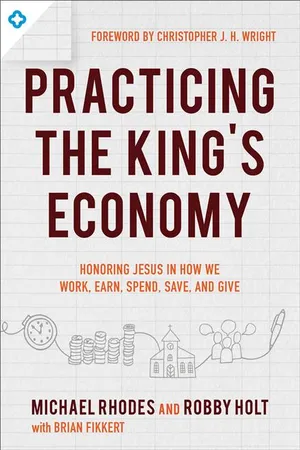
Practicing the King's Economy
Honoring Jesus in How We Work, Earn, Spend, Save, and Give
- 320 pages
- English
- ePUB (mobile friendly)
- Available on iOS & Android
eBook - ePub
Practicing the King's Economy
Honoring Jesus in How We Work, Earn, Spend, Save, and Give
About this book
Information
Topic
Theology & ReligionSubtopic
Christian Ministry1
“God, Not Mammon”
The Worship Key in Scripture
All things come from God, are sustained through him, and will eventually flow back to him as the ultimate Owner of everything. . . . Only by affirming that Yahweh is the God of creation, with everything flowing from him, through him, and to him, can we rightly relate to God.
Kelly Kapic
I do not believe one can settle how much we ought to give. I am afraid the only safe rule is to give more than we can spare. In other words, if our expenditure on comforts, luxuries, amusements, etc., is up to the standard common among those with the same income as our own, we are probably giving away too little. If our charities do not at all pinch or hamper us, I should say they are too small. There ought to be things we should like to do and cannot do because our charitable expenditure excludes them.
C. S. Lewis
I see us free, therefore, to return to some of the most sure and certain principles of religion and traditional virtue—that avarice is a vice . . . and the love of money is detestable. . . . But beware! The time for all this is not yet. For at least another hundred years we must pretend to ourselves and to everyone that fair is foul and foul is fair; for foul is useful and fair is not. Avarice and usury and precaution must be our gods for a little longer still. For only they can lead us out of the tunnel of economic necessity into daylight.
John Maynard Keynes, prominent twentieth-century economist
For where your treasure is, there your heart will be also.
Matthew 6:21
The tomatoes caught me off guard. Sitting in a small Anglican church in Kenya, I was prepared for the invitation to give an offering to God as an act of worship. I was not prepared for tomatoes.
But that’s what the members of that farming village brought. Tomatoes, mangoes, perhaps some chickens, all brought up and placed on the altar. They brought the literal firstfruits of their small fields, the work of their hands given back to God in gratitude for his blessing on farm and farmer alike.
Few aspects of Christian worship are more controversial than the passing of the dreaded collection plate. Yet in that pile of tomatoes stacked up on the table that held the Lord’s Supper, I caught a glimpse of the Father whose gift of his Son reshapes our work and our world. His gift invites us into the King’s economy, where all our economic lives are nothing more than one long grateful response to the God who so loved he gave.1
Choose This Day: Worship, Idolatry, and Economics
Worship is an economic issue. As discussed in the introduction, from Genesis to Revelation, we see that one of our Creator King’s primary qualities is his lavish generosity. We are made in the image of this generous King, wired to reflect his generosity to the rest of creation. Indeed, giving back to God and to his people is part of our DNA, a sign of our family resemblance to our generous Creator. “Giving is what we do best”; “the air into which we were born.”2 Giving signals and solidifies our allegiance to and dependence on God and his kingdom.
Idolatry is an economic issue. When we read about the Israelites worshiping the god Baal in 1 Kings 18, we tend to think of them developing a preference for wooden idol images. But the primary attraction to Baal wasn’t a pretty statue; it was an economic promise. For the nations around Israel, Baal was the “rider of the clouds,” who brought the rains and blessed the earth.3 When Baal showed up, the heavens rained oil, the rivers ran with honey, mothers gave birth to healthy children, and even the dead could be raised.4 Little wonder, then, that when King Ahab chose to marry a woman from Baal territory, the farmers in Israel built a house for this new god and welcomed him to the neighborhood (see 1 Kings 16:31).
Of course, most Israelites probably didn’t totally reject Yahweh, the God of Israel. They likely continued going to church, paying their tithes, and saying a prayer or two now and again—especially on holidays. They just added Baal worship to their insurance policy. After all, if you’re a farmer, it’s only practical to invest in getting the rider of the clouds to like you.
Yahweh would have none of it. He sent his prophet Elijah to tell Israel to stop “limping between two different opinions” (1 Kings 18:21 ESV). Through Elijah, God declared that Baal couldn’t deliver the goods and his people couldn’t have it both ways.
To win his people back, God demonstrated his power and mocked Baal along the way. Baal promised the rains, so God sent a drought at the word of his prophet (see 1 Kings 17:1). While Baal worshipers went hungry during the drought, God fed Elijah meat and bread delivered to him daily by carrier ravens (see v. 6).
Even on Baal’s home turf, people starved while waiting for Baal to bring his promised abundance. Meanwhile, in the midst of Baal country, God made oil and flour overflow for Elijah and his newfound friends (vv. 14–16). When Baal’s people died, it was Elijah who raised them to life (v. 22). Yahweh took care of his own while the king who had turned to Baal because of his claim to bring home the economic bacon wandered the countryside hoping to find a bit of grass for the few horses and mules who hadn’t died yet (see 1 Kings 18:4–5). Baal’s 450 prophets worked themselves into a frenzy, cutting themselves, dancing, and chanting to their god. “But there was no voice. No one answered; no one paid attention” (v. 29 ESV).
But God listened to his prophet. He sent fire from heaven. He sent the rain in torrents. He turned the hearts of his people back to himself. He solicited their allegiance, work, and worship—for himself and his kingdom. The battle for their hearts took place in part on the battlefield of their bank accounts. Worship, after all, is an economic issue.
From Pretty Statues to Silver and Gold: Jesus or Mammon?
Jesus knew all about gods such as Baal. He also recognized, though, that people in his day faced a new, subtler, and perhaps even stronger temptation: to treat money as an idol like Baal, an idol to worship as a god to get what they wanted. But humans cannot serve two kings. Jesus reminds us that when we try, we risk devoting ourselves to money and hating him (see Luke 16:13).
In fact, the New Testament teaches that money and greed are often the loudest and most appealing idols seeking to steal our attention. Paul declares that greed is idolatry, that to be greedy is to worship other gods (see Col. 3:5; Eph. 5:3). Once we remember that the Jews saw idolatry as the ultimate sin that put one outside the community of faith, we can hear the full force of Paul’s words. Idols had always threatened to steal the love, trust, and service God deserves and demands.5 By equating greed with idolatry, Paul provocatively told the church they didn’t have to go into a rival temple to worship another god. Their greedy hearts created other gods out of every coin in their coffers.
That’s why Jesus warned his followers to watch out for all kinds of greed (see Luke 12:15). His parables tell of farmers destroyed in the midst of their prosperity because they hoarded wealth and failed to be rich toward God (see vv. 16–21), of rich men sent to hell for their failure to let go of their wealth for the sake of their neighbor (see Luke 16:19–31), and of eternal judgment declared on the basis of one’s willingness to share with those in need (Matt. 25:31–46). All these parables point in the same direction: money wants our worship. But every bit of ourselves we give to our stuff we snatch away from our true King.
Mauled by Money: The Cost of Economic Idolatry
The Bible also teaches us that the wages of our economic idolatry is death. “[People] who want to get rich,” Paul declares, “fall into
temptation
and a trap
and into many foolish and harmful desires
that plunge people into ruin
and destruction.” (1 Tim. 6:9)
Stop for a moment. Do you believe that? That wanting to get rich inevitably causes such destruction? Paul goes even further. He writes that “the love of money is a root of all kinds of evil” that has led some to wander from the faith and pierce themselves with “many griefs” (v. 10). In Paul’s opinion, love of money wounds the worshiper, woos them away from the faith, and wells up in all sorts of other evils. “You desire and do not have, so you murder,” James writes, spelling out a few of these other evils. “You covet and cannot obtain, so you fight and quarrel. You do not have, because you do not ask. You ask and do not receive, because you ask wrongly, to spend it on your passions” (James 4:2–3 ESV, emphasis added).
Because our material possessions so often seduce us into worshiping them like gods, they pose possibly the preeminent threat to worshiping Jesus. When we worship money, it mauls us. Money becomes a spiritual power that too often uses us rather than the other way around.6
In a truly horrific passage, Jeremiah writes that our worship of idols consumes not only our “flocks and herds” but also our “sons and daughters” (Jer. 3:24). Our idols never stop consuming and destroying that which we hold most dear. In the end, “Those who make [idols] will end up like them, as will everyone who trusts in them” (Ps. 115:8 NET). We said earlier that when we give, we reflect the image of our giving God. But when we worship the idol of money, when our lives are oriented primarily toward earning, getting, and keeping, we become deformed, reflecting not the image of Yahweh, Lord of heaven and earth, but money, the god of me and mine. We become increasingly committed to a lifestyle of an abundance of possessions. Such living falls far short of the life Jesus invites us to experience.
The Idol of Our Age
In 1860, a ship traveling from Panama to the United States sank. Four hundred people lost their lives. One of those passengers was a very successful businessman who had two hundred pounds of gold on the ship. Reluctant to lose all this wealth, he strapped as much as he could to himself before jumping into the sea. The gold, of course, dragged him to the bottom. “Now as he was sinking,” one author asks rhetorically, “had he got the gold? Or had the gold got him?”7
So many of us find ourselves drowning in our worship of stuff. The signs are all around us. Slogans like “It’s the economy, stupid!” reflect the belief that gross domestic product is the primary measure of our national success. The General Motors marketing team could have spoken for much of the advertising industry when they declared themselves to be in the business of the “organized creation of dissatisfaction.”8 Everywhere we look we encounter “icons of the ideal” that “subtly impress upon us what’s wrong and where we fail.”9 “But don’t worry,” we’re told. “Shopping can solve your problem.” This deodorant will summon an army of bikini-clad supermodels to your side. That smartphone will keep you connected to what really matters. This financial adviser will make sure you can retire to a yacht at age fifty-five.
Contemporary economists describe people as homo economicus.10 This view defines people as being, at their core, solitary individuals whose lives are devoted to increasing pleasure through consuming more material goods and increasing leisure. The formula for achieving homo economicus happiness is pretty simple: get more services, consume more stuff, and work less.11 Of course, in many ways, this is a laughably lopsided view of humans, who are so much messier than the model. Even more obviously, nobody who reads Genesis 2 could ever embrace the idea that people were designed simply to walk around finding ways to work less and consume more! The homo economicus story falls far short of the big story of God’s purposes for his people that we explored in the introduction.
But what if our idolatry is reshaping us in the image of this homo economicus idol? What if, by investing our love, trust, and identity in materialism, we have lost the ability to see, value, or pursue much else? What if living life in a world dominated by homo economicus has given us training routines that have gotten us into good shape for the homo economicus game but left us horribly unprepared for life in the King’s economy? John Maynard Keynes, one of the twentieth century’s most prominent economists, declared that the gods of avarice and usury could lead us out of the tunnel of economic necessity and into the daylight (see the quote at the start of this chapter). What if our worship of these gods is shattering our souls and leaving us empty and in despair?
Evidence shows that this is precisely what’s happening. From 1968 to 2001, US per capita incomes doubled. During that same time, the average church member’s giving fell from 3.10 percent to 2.66 percent of their total income. In other words, “For most of the past thirty-plus years, the percentage [Christians gave] kept falling even though our income kept climbing.”12
Nor has our wealth made us any happier. As we discussed in the introduction, mental illness and suicide have increased alongside rising incomes over the last fifty years in the United States. Brian Fikkert writes about one effort ...
Table of contents
- Cover
- Title Page
- Copyright Page
- Endorsements
- Dedication
- Contents
- Foreword
- Acknowledgments
- Preface
- Introduction
- 1. “God, Not Mammon”
- 2. The Worship Key Today
- 3. “One Table, One Baptism, No Distinction”
- 4. The Community Key Today
- 5. “Work and Wages, Gleaning and Giving”
- 6. The Work Key Today
- 7. “No Poor Among You”
- 8. The Equity Key Today
- 9. “The Heavens Declare the Glory”
- 10. The Creation Care Key Today
- 11. “The Lord Has Given You the Sabbath”
- 12. The Rest Key Today
- Conclusion
- Resources for Further Study
- Notes
- Index
- About the Authors
- Back Ads
- Back Cover
Trusted by 375,005 students
Access to over 1.5 million titles for a fair monthly price.
Study more efficiently using our study tools.
Frequently asked questions
Yes, you can cancel anytime from the Subscription tab in your account settings on the Perlego website. Your subscription will stay active until the end of your current billing period. Learn how to cancel your subscription
No, books cannot be downloaded as external files, such as PDFs, for use outside of Perlego. However, you can download books within the Perlego app for offline reading on mobile or tablet. Learn how to download books offline
Perlego offers two plans: Essential and Complete
- Essential is ideal for learners and professionals who enjoy exploring a wide range of subjects. Access the Essential Library with 800,000+ trusted titles and best-sellers across business, personal growth, and the humanities. Includes unlimited reading time and Standard Read Aloud voice.
- Complete: Perfect for advanced learners and researchers needing full, unrestricted access. Unlock 1.5M+ books across hundreds of subjects, including academic and specialized titles. The Complete Plan also includes advanced features like Premium Read Aloud and Research Assistant.
We are an online textbook subscription service, where you can get access to an entire online library for less than the price of a single book per month. With over 1.5 million books across 990+ topics, we’ve got you covered! Learn about our mission
Look out for the read-aloud symbol on your next book to see if you can listen to it. The read-aloud tool reads text aloud for you, highlighting the text as it is being read. You can pause it, speed it up and slow it down. Learn more about Read Aloud
Yes! You can use the Perlego app on both iOS and Android devices to read anytime, anywhere — even offline. Perfect for commutes or when you’re on the go.
Please note we cannot support devices running on iOS 13 and Android 7 or earlier. Learn more about using the app
Please note we cannot support devices running on iOS 13 and Android 7 or earlier. Learn more about using the app
Yes, you can access Practicing the King's Economy by Michael J. Rhodes,Robby Holt,Brian Fikkert in PDF and/or ePUB format, as well as other popular books in Theology & Religion & Christian Ministry. We have over 1.5 million books available in our catalogue for you to explore.