Trust makes everything better. It's the glue that binds people together. From our families and friendships to our companies and communities, we know that trust is the fuel that drives long-term success and impact. But we also know what betrayal feels like. We know that trust is a fragile, vulnerable gift that can be abused, broken, and exploited with devastating consequences.
In The Trust Protocol, Mac Richard challenges conventional wisdom with biblical insights, humor, and passion as he explains how to
· process the pain of betrayal
· prioritize relationships and work
· discern who to trust
· decide when and how to move on
· deploy trust in even the harshest environments
· develop active integrity
The Trust Protocol provides a clear path not just to manage these tensions but to embrace them in order to experience the genuine connectedness and effectiveness we're created for.
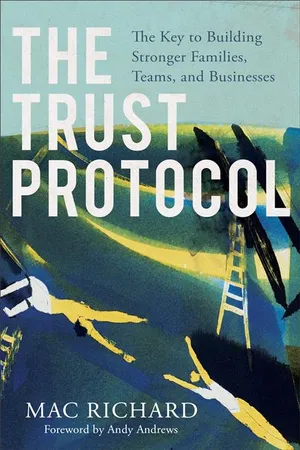
eBook - ePub
The Trust Protocol
The Key to Building Stronger Families, Teams, and Businesses
- 176 pages
- English
- ePUB (mobile friendly)
- Available on iOS & Android
eBook - ePub
About this book
Information
Print ISBN
9780801019647
Subtopic
Christian Ministry1
“I Love You, and I Will Fire You”
Introducing the Trust Protocol
Straight out of college, I got the kind of opportunity that most graduates only dream of. I was the third person hired by a start-up that erupted in exponential growth. The job found me before I graduated because of a friendship with the guy who would become the leader of this start-up. We were all overworked and underpaid, and we wouldn’t have traded it for anything else in the world. I loved what I was doing, the adventure of doing something new and unknown, and the people. In the words of one early associate, it was a “rocket ship.”
One day Ed called me into his office. I came in, and he asked me to close the door behind me. I sat down for what I thought would be one of our usual conversations: how things were going in my department, what was up with my girlfriend, or some new initiative/event/strategy that he had cooked up. At the time, Ed was only twenty-nine years old, but even then he had a natural leadership presence, the ability to cut through clutter, a monster work ethic, and a passion that was infectious. The conversation went like this:
Ed: Mac, sit down. I want to talk to you. You know I love that you’re here.
Mac: Thanks, I appreciate it. I love being here, and I’m having a ball.
Ed: Man, I’m glad. I really believe in you and think you’ve got amazing potential. And you know I think you’re a great guy. [Did I mention he was very perceptive? I was so green I never saw the big hairy “but” that was obviously lurking in this opening statement.] But you need to understand something: I love you, and I will fire you.
Mac: [internally] Well, then could you maybe love me just a little less?
Ed: I can’t keep paying you just because you’re a good guy. You’ve got too much talent, and we’ve got too much to do for me to let you get by without producing something and being a contributor around here. You’ve got great potential, but from now on, potential is profanity for you. All it means is that you haven’t done anything yet.
I won’t bore you with the rest of the conversation, except to say that he did not fire me, though he would’ve been more than justified on more than a few occasions. And almost twenty years later, we remain very close. Our friendship has not only survived, it has also thrived, not in spite of that conversation and others like it but largely because of them.
Would it surprise you to know that the start-up was actually a church? Or that Ed was the pastor of that church? I mean, what pastor says, “I love you, and I will fire you”? The pastor was—and is—Ed Young, and the church is Fellowship Church, which began in Dallas–Ft. Worth and now has locations across the country and is one of the most innovative, influential churches of this generation.
I would love to tell you that in that moment I realized God was using Ed to shape me and mold me, so I joyfully submitted. The reality, though, is that I did exactly what most of us do when we feel threatened or vulnerable: I read the situation through the lens of self—specifically, self-protection and self-preservation. I feared for my job, worried about where I would go should I actually get fired, and was unsure how I would explain losing my first job right out of college.
But in God’s truly amazing grace, another lesson revealed itself through that same lens of self. I realized that staying in that situation, working for Ed, and submitting to his leadership, in addition to being the right thing to do was actually in my best interest. Where else would someone have more of my best interest at heart? Where else would I never have conflict or disagreement? Where else could I find someone with whom I always agreed? I realized that I would get better, I would be better, if I let him hold me accountable and push me.
What I couldn’t know at the time was that that defining moment early in my ministry was carving in stone for me the absolute, undeniable power of the Trust Protocol.
The Trust Protocol
In Hebrews 10:24, the Bible challenges Christ followers: “And let us consider how we may spur one another on toward love and good deeds.” In that simple, one-sentence exhortation, God asserts and reinforces the Trust Protocol, which is essential and fundamental to all he has called us to be and do in relationship with him. Not only is it woven into every page and principle of Scripture, it is also absolutely essential to everything that really matters to us—our families and relationships, our vocation and work, our purpose and fulfillment. The power of this Protocol can actually help us point people toward a relationship with Christ before they ever discover that the Bible is reliable.
There are a few things you need to know before we dive into the Trust Protocol:
- The Trust Protocol works. Every single time. We’ll talk about why this is true in detail in the last chapter. But for now, just know that whenever we choose to put it into effect, regardless of the context or circumstances, it produces results so powerful, so beautiful that nothing else compares to it. No exceptions.
- The Trust Protocol is hard work. There’s just no way around it. This is not a game for the faint of heart or the timid. For this to work, we have to roll up our sleeves and put our spiritual, emotional, and relational—and sometimes, even our physical—weight into it.
- The Trust Protocol will get messy. By virtue of the fact that it calls for fallen and fallible people to truly engage with one another, just know that it will get messy at some points along the way.
And perhaps most important,
4. The work, the mess, the pain and uncertainty along the way—all of it—is absolutely worth it. If you’re currently participating in the Trust Protocol (though you may never have used that terminology), you’re going to be affirmed and encouraged throughout this book. If you’ve not used it intentionally or consistently, you’re going to discover the supernatural blessing that God pours out on every relationship, enterprise, and exercise that practices the Protocol.
I want to set your expectations before we actually begin so that, should you choose to participate in the Protocol, you do so with your eyes wide open and are as prepared as you can be for what follows.
What exactly is the Trust Protocol? It is simply this: forging credibility through integrity and action. It is deliberately demonstrating our dependability to the people with whom we live, work, love, and serve—when we excel and, especially, when we struggle. It is backing up our talk with our walk. It is being consistently the same person we were created to be no matter where we are or whom we are with.
The Trust Protocol calls us to a higher plane of relational responsibility. Instead of assigning blame and fault to others for disasters and disappointments, practitioners of the Protocol assume accurate and appropriate ownership for their role in those failures and learn from their mistakes. Instead of blithely getting through another day of the status quo, the Trust Protocol propels us through intentional interactions that invigorate community, connectedness, and collaboration. This relational responsibility feeds the fire of trust and smokes out those unwilling to pay the price to stoke that fire.
Everything in life that really matters radiates out of relationships. From the lunchroom to the locker room, from the bedroom to the boardroom, regardless of the arena or the endeavor, relationship is the coin of the realm. And trust, or credibility, is the tie that binds every relationship, from the most casual acquaintance, to the marketplace, to the most intimate and personal connections of marriage and family.
The Universal Value of Trust
By any objective standard, my wife, Julie, and I live in the greatest city in the world. Austin, Texas, is home to the weird, the wonderful, and the wacky of every imaginable stripe. Every year, Austin welcomes tens of thousands of new residents from around the world chasing the dream of launching technology start-ups. Many of these new arrivals can describe in vivid detail what their businesses will do and who their target market might be, and their businesses are as varied and diverse as the imaginations that dream them up. But whenever I ask about their challenges, what might be their obstacles to growth or corporate survival, without exception they point to interpersonal issues as the primary impediment to organizational success.
Interestingly, but not surprisingly, those are the same challenges and issues that churches struggle with. The preaching, connecting and assimilating, discipling, mission strategizing—these are easy in comparison with the people issues that we encounter on a regular basis. I’ve noticed a common thread that runs through every single industry, enterprise, and vocation: people. No matter what we do or where we do it, we’re all in the people business, and how we navigate the relational waters of our everyday lives is the single greatest propellant or deterrent to how successful, how fulfilled, how peaceful, and how effective we will be.
Relationships come in all shapes and sizes, with wildly varying needs, expectations, and requirements. But deliberately and intentionally forging credibility that anchors the Trust Protocol boils down to a single, simple element: integrity. Every relationship, no matter how superficial and temporary, or long-term and intimate, can be rock solid if it is built on a foundation of integrity.
Relationships are unavoidable. Relationships of integrity are invincible. Integrity, which we’ll cover later in more detail, means so much more than mere honesty or ethical behavior. Those things do matter, and they’re mandatory for our relational and professional success over time. But if we limit the meaning to merely telling the truth and honoring our contracts—legal or relational—then we’ve set the bar far too low for what God declares our integrity standard to be.
Foundations of the Trust Protocol
When I was in the sixth grade, Dr. Edwin Young (Ed’s dad) had become the pastor of my home church, Second Baptist Church, in Houston. Almost immediately, Dr. Young cranked up our church’s engine, excitement, and impact. At the time, Ed was a senior in high school who was about to depart for Florida State University where he would play basketball on scholarship.
Over the next few years, Ed would be the counselor we would fight to have on Beach Retreat, our annual summer camp. He would sneak us out in the middle of the night to go get breakfast at Mr. Z’s, South Padre Island’s finest all-night diner. We fished in the resort’s pond. From our condo’s balcony! Since it was the early ’80s, Ed lathered up in sunscreen, tied a black headband around his head, and brandishing an M-16 water gun stormed the beach for freedom, justice, and the American way, a la Rambo.
The summer before my senior season of high school basketball, Ed stopped me and told me he was going to start training me in the church’s weight room. Every day, we’d meet in that shed, and he’d put me through reps and sets he’d learned at Florida State. On the opening night of the season, my Lee Generals squared off against Ed’s alma mater Memorial High School, and there was Ed in the stands, watching and cheering me on.
We reconnected when Ed returned to finish college in Houston after marrying Lisa and joined the staff at Second Baptist. I’d regularly stop by his converted office above the sanctuary, attend retreats that he planned as our college minister, and would house-sit for him and Lisa when they went on vacation.
By the time Ed looked across his desk and said, “I love you, and I will fire you,” we had accumulated more than ten years of shared history, relationship, and life. I knew that he did in fact love me. And I sensed a very real sincerity that he would in fact fire me. In short, I trusted him.
The Trust Protocol is an absolute nonnegotiable in every enterprise and exercise that matters. Partnerships that practice the Protocol persist. They survive economic downturns and pricing wars, damaging words, thoughtlessness, out-of-the-ordinary unkindnesses, and frequently even out-and-out betrayals. The beautiful power of the Trust Protocol lies in the fact that it is available to anyone and everyone who wants to make a difference in this world:
- The fourth-grade teacher who has influenced and inspired generations of students to enjoy learning and seek out new subjects to study
- The husband and wife who not only stay together for a lifetime but who actually enjoy each other as much in their seventies as they did on their honeymoon
- The entrepreneurial business owner whose employees know that their boss takes home less money personally so they can participate in the company’s profit-sharing program
- The church that evolves across decades and remains a lighthouse and beacon of hope as their neighborhood shifts demographically
These and so many others are practitioners of the Protocol.
A protocol is simply a predetermined procedure or set of rules. It establishes a process or system, whether in diplomatic circles or scientific and medical experiments. Protocols also play a role in spycraft. Think Jack Bauer and Chloe O’Brian in 24 or Carrie Mathis and Saul Berenson in Homeland. When Saul walks past an operative in a crowded European town square, the red carnation in his lapel indicates that their mission is a “go.” Protocols provide next steps in if-then sequences: if this happens, then that should follow.
The Trust Protocol is an if-then sequence: if love, then good deeds. Everywhere the Trust Protocol is practiced, love and good deeds are always at work. Here’s why: love without action is bankrupt, and action without love is hollow. But together, love and good deeds conspire to cultivate trust and unity that change everything they touch for the better.
This was the exact tension Ed was living in and living out that day he called me into his office. There was genuine love and concern for me as a person, friend, and leader-in-training. But his investment in me as a person didn’t eclipse his larger responsibility to the church as a whole.
It was his responsibility for both me personally and the church at large that compelled him to hold my feet to the fire—to hold me accountable for my actions (or lack thereof). He made the time to spur me to good deeds precisely because he loved me and cared about growth and development and productivity—both mine and the church’s. It wasn’t that he would fire me despite his love for me. Rather, he was willing to go through the relational discomfort because he loved me. He wouldn’t allow me to settle for some warm and fuzzy, saccharine substitute for love. He forced me to realize that if my love for people in the church and outside the church was real, then I would back it up with real action, with productivity and effectiveness. In short, with good deeds.
I’m now more than twenty years removed from that conversation, but I’m even more amazed at the extravagant goodness of God, who allows us, even calls us, to participate with him in the divinely ordained Trust Protocol. In those twenty intervening years, I have seen the Protocol repeatedly reap staggering results ...
Table of contents
- Cover
- Title Page
- Copyright Page
- Endorsements
- Dedication
- Contents
- Foreword
- Acknowledgments
- Introduction
- 1. “I Love You, and I Will Fire You”
- 2. The Battle of the Why
- 3. The Revolution Will Not Be Sanitized
- 4. The Gift of Betrayal
- 5. It’s the Relationship, Stupid
- 6. You Have to Try!
- 7. The Best Teacher You Ever Had
- 8. The Chicken or the Egg? Yes
- 9. “How Many Can You Do When You’re Tired?”
- 10. “Stay on the Bar!”
- 11. But I Live in the Real World
- 12. Staying Power
- 13. No Exceptions
- Notes
- About the Author
- Back Ads
- Back Cover
Trusted by 375,005 students
Access to over 1.5 million titles for a fair monthly price.
Study more efficiently using our study tools.
Frequently asked questions
Yes, you can cancel anytime from the Subscription tab in your account settings on the Perlego website. Your subscription will stay active until the end of your current billing period. Learn how to cancel your subscription
No, books cannot be downloaded as external files, such as PDFs, for use outside of Perlego. However, you can download books within the Perlego app for offline reading on mobile or tablet. Learn how to download books offline
We are an online textbook subscription service, where you can get access to an entire online library for less than the price of a single book per month. With over 1.5 million books across 990+ topics, we’ve got you covered! Learn about our mission
Look out for the read-aloud symbol on your next book to see if you can listen to it. The read-aloud tool reads text aloud for you, highlighting the text as it is being read. You can pause it, speed it up and slow it down. Learn more about Read Aloud
Yes! You can use the Perlego app on both iOS and Android devices to read anytime, anywhere — even offline. Perfect for commutes or when you’re on the go.
Please note we cannot support devices running on iOS 13 and Android 7 or earlier. Learn more about using the app
Please note we cannot support devices running on iOS 13 and Android 7 or earlier. Learn more about using the app
Yes, you can access The Trust Protocol by Mac Richard in PDF and/or ePUB format. We have over 1.5 million books available in our catalogue for you to explore.