The 2016 election of Donald J. Trump exposed a deep divide in American politics and culture, one that pollsters and pundits didn't seem to realize was there. But Trump did, and he used it to his advantage in ways that surprised nearly everyone, even those who voted for him. Perhaps the biggest question on many people's minds is how, exactly, did a crass, unrepentant reality TV star and cutthroat business tycoon secure the majority of the religious conservative vote?
Now the New York Times bestselling author of The Faith of George W. Bush and The Faith of Barack Obama turns his pen toward the Trump phenomenon. Through meticulous research and personal interviews, Stephen Mansfield uncovers who Trump's spiritual influences have been and explains why Christian conservatives were attracted to this unlikely candidate. The book ends with a reflection on the vital role of prophetic distance, both historically and now.
eBook - ePub
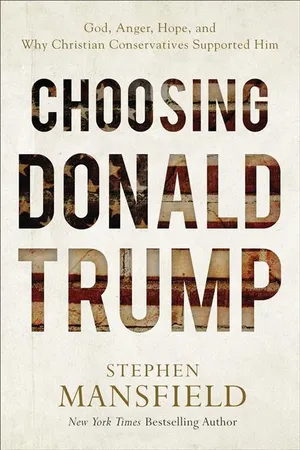
Choosing Donald Trump
God, Anger, Hope, and Why Christian Conservatives Supported Him
- 208 pages
- English
- ePUB (mobile friendly)
- Available on iOS & Android
eBook - ePub
Choosing Donald Trump
God, Anger, Hope, and Why Christian Conservatives Supported Him
About this book
Information
Topic
Theology & ReligionSubtopic
American Government
Part 1
An Unlikely Champion
In the 2016 election, Donald Trump ran for president against a Baptist minister, two sons of pastors, and a slate of Republican candidates, most of whom considered themselves evangelicals. He then ran against one of the most vocally religious Democrats in the country. He was among the least religious and least religiously articulate men ever to run for the presidency. And he won. He did it with the surprising help of a vast majority of the nation’s religious conservatives. They have taken responsibility for him now, and this may, in time, exact a very dear price.
1
Convergence
I think people are shocked when they find out that I am a Christian, that I am a religious person. They see me with all the surroundings of wealth so they sometimes don’t associate that with being religious. That’s not accurate. I go to church. I love God, and I love having a relationship with Him.
Donald Trump1
It was September 24, 2012, and Donald Trump was scheduled to speak at a convocation of Liberty University in Lynchburg, Virginia. This was the largest Protestant university in the world. Trump knew it and wanted to impress. He had considered a presidential run earlier in the year but thought it ill-timed, yet knew there would come a day when he would declare himself a candidate. It was important that he make himself known to the more than ten thousand students present and the tens of thousands more watching online. As important were the millions of evangelicals around the country who would eventually take note of his thirty-minute speech.
Trump was introduced by President Jerry Falwell Jr., son of the university’s founder, as “one of the greatest visionaries of our time.” The rest of the lengthy introduction could have been given at a real estate convention. Trump’s luxurious properties, his philanthropy, and his rising media empire were all extolled. President Falwell drew cheers from the students when he announced that the school planned to replace some of its dormitories and that perhaps a Trump Tower might adorn the campus one day. Falwell was, as most university presidents are, nothing if not a salesman.
The speech was classic Donald Trump. He honored the memory of Jerry Falwell Sr., founder of the school, and thrilled students by acknowledging that learning about God is more important than having all the business knowledge in the world. He then criticized America’s leaders, warned of America’s future, and couldn’t stay away from the theme of the nation’s “idiot politicians.”
In typical style, Trump pushed the boundaries of propriety. While giving a list of steps for success—some as innocuous as “Work hard” and “Love what you do”—he also told the students to “Get even” with those who wronged them, to never “Let people take advantage of you,” and to “Get a prenuptial.” Then he added, “But these are the things I can’t say at Liberty.” The comment drew howling laughter. The speech was a success. The students gave Trump a prolonged and adoring standing ovation.
What few of those in attendance could have known was the intense effort Trump had devoted to one part of his speech in particular. He wanted to show his Christian credentials. He wanted to assure that he belonged among these evangelical students, that he, too, was a man of faith. So he asked the university to prepare a slide to be shown during his talk. It was a photograph of a young Donald Trump on the day of his baptism, along with a baptismal certificate confirming that the all-important deed had been done.
It was a simple request and the university happily agreed. That should have been the end of it. Like any university, Liberty was experienced with Keynote and PowerPoint presentations. In their convocation, even the song lyrics for worship are projected on huge screens. Millions of such images have been shown during classroom lectures and student presentations in the school’s history. A single slide would be no problem.
The matter just wouldn’t go away. Donald Trump was obsessed. There were repeated calls to university officials—and not by executive assistants or public relations staff. The calls came from Trump himself. And often. He worried that the school had the right photo and that they would highlight it just as he wished. He wanted to know if his face could be emphasized so that the audience would know which child in the photo he was. Could the certificate be read? Was it all clear enough? Would it appear at the right time in his talk?2
The memory of these calls prompted laughter from university officials long after Trump’s 2012 talk. There was more in this, though, than a nervous speaker concerned about the state of his visual aids. Trump was eager for religious conservatives to know that he was not what they had been told. He was not merely the unforgiving mogul with the morally questionable past. He was also the freckle-faced boy who had been confirmed in his faith at First Presbyterian Church, Jamaica, Queens. He was a man who had sat in church by the hour to hear the revered Norman Vincent Peale preach, and he had made the eminent preacher/statesman’s methods his own. He had come to love many of the nation’s leading religious broadcasters. He watched them late into the night, sometimes on obscure cable channels, and was not beyond calling them when moved by something they said.
Yet he was clumsy in matters of religion, largely because he had worn the garment of his Christianity loosely throughout his life, and usually only when fashionable. It was why he did not know that the evangelical students and faculty at Liberty University would not be won by a Presbyterian baptismal certificate from sixty years ago. They wanted a conversion story, heartfelt and tearful and reminiscent of revivals past. They wanted “fruit,” evidence of a life changed by conversion and modeled on the message of Jesus Christ. They would know that getting even with enemies in business was the opposite of what Jesus had taught. They believed that prenuptial agreements and multiple marriages and sexual conquests tallied like wild game bagged on safari were part of the scourge of their generation. Trump did not know these things or, if he did, was unwilling to distance himself from the offense.
Still, there was something remarkable and sincere about Trump’s eagerness to be accepted by religious conservatives. It is true that he had political aspirations. He never hid this. He wanted their support and knew that to get it he would have to show sympathy for their concerns. He lived in a transactional world. A man got only as good as he gave. He expected to pay up for privileges given, for access and power provided. This was the world of Donald Trump, and he expected it to be no different in matters of religion and politics.
Yet he had a tender place in his heart for men and women who taught religious truth. He admired them. He was in awe of their power and moved by their gifts for helping people become more than they had been. His own life had been profoundly shaped by Norman Vincent Peale, the pastor of Marble Collegiate Church in New York and the founder of a religious empire built on the principles captured in his epic bestseller, The Power of Positive Thinking. For many an hour Trump had listened to Peale as he spoke of the example of Jesus, of the grace God gave to live a better life, and of the battles to be fought against godless communism and the secularism of the age.
“He would instill a very positive feeling about God that also made me feel positive about myself,” Trump would say later. “I would literally leave that church feeling like I could listen to another three sermons.”3
It is hard to exaggerate the impact of Peale upon Donald Trump’s life. From the time his family made the move from First Presbyterian Church to Peale’s Marble Collegiate Church in 1975, Peale and his teachings were interwoven with Trump’s life and business. Peale officiated at his first wedding, conducted the funeral services for both of his parents, and was the honored clergyman at birthdays, wedding anniversaries, births, and even building dedications.
Perhaps more, Peale was the spiritual father who filled gaps left by the demanding, hard-driving biological father with whom Donald Trump had to contend. It was Peale who told Trump he was the famous preacher’s “greatest student of all time.”4 It was Peale who wrote to congratulate him on the opening of Trump Tower and said he had always believed “you were going to be America’s greatest builder.” In fact, he said, “You have already arrived at that status and believe me, as your friend, I am very proud of you.”5
These were sentiments sure to capture the heart of a son whose natural father “freely dispensed criticism, but rarely praise.”6 Peale became the loving mentor and father figure that Fred Trump, Donald’s father, could never be. This meant that Donald Trump was drawn ever more deeply into the “thought process” of Peale’s theology. It has done much to shape the Donald Trump of today, as we shall see. Peale believed, for example, that “attitudes are more important than facts.” His book titles alone express the pillars of his teaching: You Can Win, Guide to Confident Living, You Can If You Think You Can, Enthusiasm Makes the Difference, and, of course, The Power of Positive Thinking.
Trump drank in Peale’s system, and it left him both with a love for dynamic clergy and with a theology to match his ambitions. As one biographer has written of Donald Trump and his father:
As nearly perfect practitioners of the power of positive thinking, they both wanted to achieve the kind of wealth and status that would elevate them above other men. In Peale they found a pastor who taught them that God wanted the same thing for them and that the “infinite forces of the universe” were available to them if only they used positive thinking and trained their minds “to think victory.”7
This meant, then, that when Trump spoke at Liberty University in 2012, and certainly four years later when he ran for the Oval Office, he was a man churched if not yet converted, intrigued if not yet convinced, eager if not yet captured by a transforming faith in God. The minister who knew his spiritual life at the time better than anyone outside of his family said that Trump was spiritually “hungry.”8
If this is true, then it means that Trump’s association with the nation’s leading ministers during his 2016 presidential campaign might have led to profound change for him and, ultimately, to a nobler president for the country. They might have called him to a more orthodox and full-bodied belief system than he had received under Norman Vincent Peale. They might have challenged him about some of his extreme behavior. When he swore, they might have reminded him of his younger listeners. When he called for violence against protestors or went on racist rants or spoke of women in disparaging terms, they might have reminded him of the example of Jesus and helped him recover his moral balance. They might also have whispered in his ear from time to time, “Always remember the poor.”
In short, had they maintained prophetic distance, had they been more interested in urging the candidate toward God and his ways and less interested in allying themselves to power at any moral cost, great good might have been done.
It was largely not to be.
National religious leaders often seemed more interested in anointing Donald Trump than in challenging him or calling him to his best. A prime example of this occurred when Trump spoke at Liberty University a second time, in January 2016. By this time, he had achieved what he set out to accomplish in 2012. He had made himself familiar to religious conservatives. He had proven himself a man at least friendly to the Christian faith. After eight years of Barack Obama and facing a possible eight more under Hillary Clinton, many Americans heard Trump’s promise to defend religious liberty with grateful ears. National religious leaders welcomed him with open arms.
Some went even further.
President Jerry Falwell Jr.’s introduction at that second Liberty University speech came close to portraying Trump as the ideal Christian. The university president quoted Matthew 7:16—“You shall know them by their fruit”—and said that Trump’s life displayed the fruit described in this passage. He recounted as evidence that Trump had generously rescued a Harlem basketball program and saved Newton, Iowa, from the devastation of its main business moving to Mexico. He told the tale of Trump paying the mortgage of a family that had helped when his limousine broke down by the side of a road. He also offered the fact that Trump’s staff loved him.
Falwell said he had attended the Republican debate in Charleston the previous week and that Trump was the only candidate who shook hands and posed for pictures afterward. This, he suggested, was a sign of Trump’s kindness to strangers. “In my opinion,” Falwell said, “Trump lives a life of loving and helping others as Jesus taught in the Great Commandment.”9 The candidate was not unlike Reagan, who was condemned by religious leaders as a Hollywood actor and a divorced man. Those leaders preferred the Baptist Sunday school teacher Jimmy Carter. “He may have been a great Sunday school teacher,” Falwell said, “but look what happened to our nation while he was president.”
The young university president declared that Trump was much like his own father, Jerry Falwell Sr. The elder Falwell was a generous man. He was a courageous man. He loved his enemies and was kind to his political opponents. He was also fierce in defense of the truth. He had once put a sign in front of the school that read, “Politically Incorrect Since 1971.” All of this described Donald Trump as well, a man whom Falwell said he had introduced in 2012...
Table of contents
- Cover
- Title Page
- Copyright Page
- Endorsements
- Dedication
- Epigraph
- Contents
- Introduction
- Part 1: An Unlikely Champion
- Part 2: The Backstory
- Part 3: The Appeal
- Part 4: Of Prophets and Presidents
- Epilogue
- Acknowledgments
- Appendix: Donald Trump in His Own Words
- Notes
- Bibliography
- About the Author
- Also by Stephen Mansfield
- Back Ads
- Back Cover
Trusted by 375,005 students
Access to over 1.5 million titles for a fair monthly price.
Study more efficiently using our study tools.
Frequently asked questions
Yes, you can cancel anytime from the Subscription tab in your account settings on the Perlego website. Your subscription will stay active until the end of your current billing period. Learn how to cancel your subscription
No, books cannot be downloaded as external files, such as PDFs, for use outside of Perlego. However, you can download books within the Perlego app for offline reading on mobile or tablet. Learn how to download books offline
Perlego offers two plans: Essential and Complete
- Essential is ideal for learners and professionals who enjoy exploring a wide range of subjects. Access the Essential Library with 800,000+ trusted titles and best-sellers across business, personal growth, and the humanities. Includes unlimited reading time and Standard Read Aloud voice.
- Complete: Perfect for advanced learners and researchers needing full, unrestricted access. Unlock 1.5M+ books across hundreds of subjects, including academic and specialized titles. The Complete Plan also includes advanced features like Premium Read Aloud and Research Assistant.
We are an online textbook subscription service, where you can get access to an entire online library for less than the price of a single book per month. With over 1.5 million books across 990+ topics, we’ve got you covered! Learn about our mission
Look out for the read-aloud symbol on your next book to see if you can listen to it. The read-aloud tool reads text aloud for you, highlighting the text as it is being read. You can pause it, speed it up and slow it down. Learn more about Read Aloud
Yes! You can use the Perlego app on both iOS and Android devices to read anytime, anywhere — even offline. Perfect for commutes or when you’re on the go.
Please note we cannot support devices running on iOS 13 and Android 7 or earlier. Learn more about using the app
Please note we cannot support devices running on iOS 13 and Android 7 or earlier. Learn more about using the app
Yes, you can access Choosing Donald Trump by Stephen Mansfield in PDF and/or ePUB format, as well as other popular books in Theology & Religion & American Government. We have over 1.5 million books available in our catalogue for you to explore.